Complex thinking about war, religion, oil and sanctions

The marker says, “The homeland will not forget its heroes.” But this photo always makes me think, “To remember is to end all war.” It shows one of three Soviet War Memorials in Berlin built to commemorate the 80,000 Soviet soldiers who died in the Battle of Berlin in April and May 1945. (Photo: Jim Hodgson, 1977)

Jim Hodgson

Just before heading out for a bike ride on a warm spring day, the last thing that I heard from the TV was a CNN talking head ranting about a certain “genocidal maniac.” You know about whom he was speaking. 

I had just read a reflection by the Portuguese sociologist, Boaventura de Sousa Santos, on the need for “complex thinking” in these times of pandemic and war. He is a respected writer on social movements; I met him at the World Social Forum in Porto Alegre in 2005.

We are living in a moment like that which followed the terrorist attacks of September 11, 2001, he wrote, when it became impossible to introduce complexity into conversations. There was no space for asking why the attacks had occurred, and voices that questioned the utility of the subsequent invasion of Afghanistan were excluded from public debate.  

As I rode about the city streets, I tried to meditate on the need for complex thinking, but that CNN assessment of Russian President Vladimir Putin kept intruding. To imagine about a good way forward and an end to this war, you need to assume a certain rationality about those with whom you disagree. 

And yes: the Russian invasion of Ukraine is wrong, a human tragedy and a disaster for global community. It must end. As the war began, the ACT Alliance of churches and aid organizations called on all parties “to respect humanitarian operations and their humanitarian obligations, to protect all human lives and communities threatened by this violence, and to keep borders open, create safe pathways and provide refuge for those expected to flee the conflict.”

I feel solidarity with the people of Ukraine in their struggle to end the invasion and protect the sovereignty that is theirs in international law – just as I do with the people of other invaded territories (Palestine, Western Sahara, Yemen, all the Indigenous territories whose people still struggle to recover). I hope those who are able will continue to support humanitarian relief efforts for Ukrainians.

My solidarity too with all those in Russia who protest Putin’s war. “No pasarán,” said the journalists as they were forced to close an independent TV station, Dozhd, reviving a line from the anti-fascist resistance in Spain in the 1930s. 

Sanctions – warfare by other means, some have said – have been applied. This time, I am not exactly against them. Short-term, targeted measures seem reasonable; longer-term, their impact on civilians will need to be measured and their effectiveness evaluated. Russia is now the world’s most-sanctioned country. Space for diplomacy, public health and science, however, should remain open, including the Arctic Council and the International Space Station.

The NATO leaders are justified in their caution about further escalation (enforcement of a “no-fly” zone): the greatest danger is nuclear war.
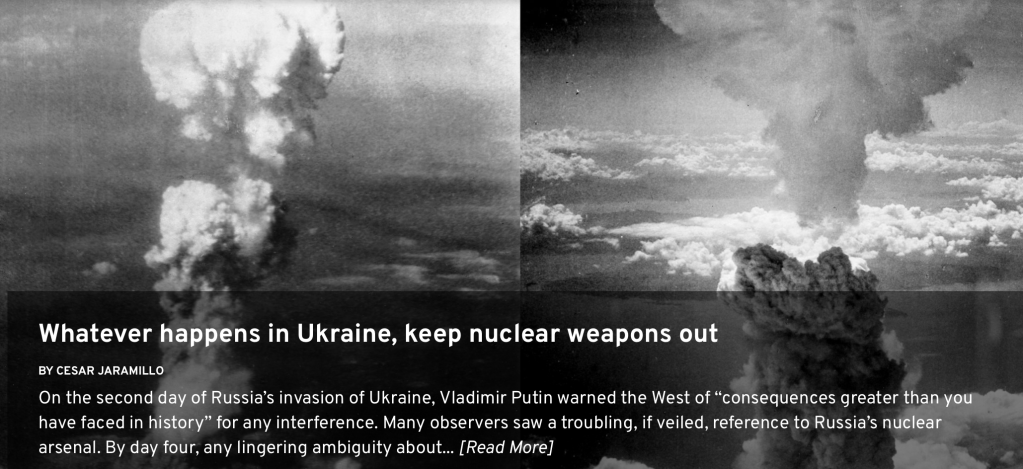
Cesar Jaramillo, director of Project Ploughshares, wrote March 3: “Not since John F. Kennedy and Nikita Khrushchev stared each other down during the 1962 Cuban Missile Crisis has the possibility of nuclear weapons use involving the world’s two major nuclear powers been more present.” The image shows the atomic bombings of Hiroshima and Nagasaki in 1945.

But what do we do now? 

We should do what we who believe in peace do in every other armed conflict: call for peace, withdrawal, dialogue, diplomacy. And engage in complex thinking.

Otherwise, the war drags on: a Ukrainian government in Lviv or in exile, with a NATO-sponsored insurgency. Think of the U.S.-backed forces that over a decade drove the Soviet Union from Afghanistan in the 1980s. No one wants that for the people of Ukraine. Worse still: the possibility of an incident that sparks use of nuclear weapons.
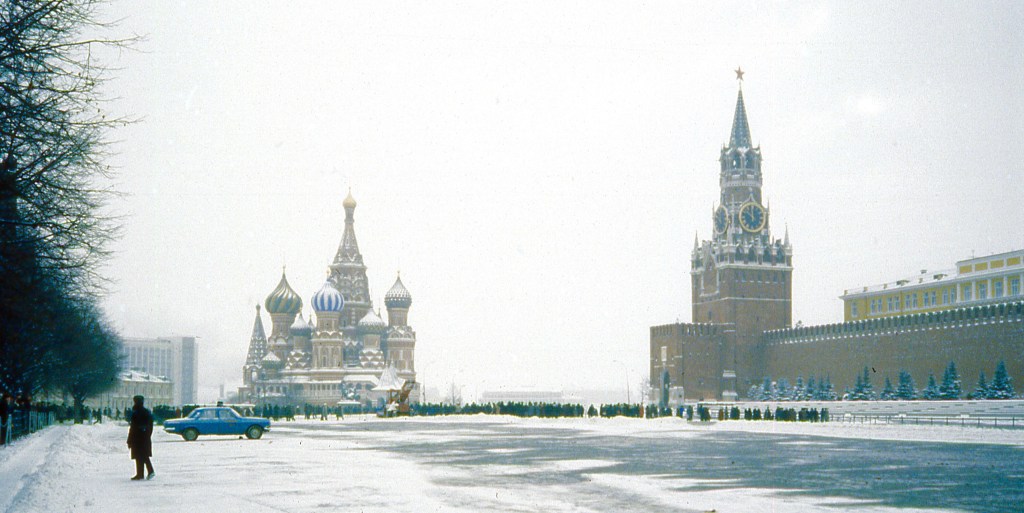
As in many capitals, church and state in Moscow face each other across a large plaza, Red Square. The church has operated as a museum since 1928, but religious services began again in 1997. (Photo: Jim Hodgson, 1983)

About religion:

“The only reasonable and constructive way to settle differences is through dialogue, as Pope Francis never tires of repeating,” said Cardinal Pietro Parolin, Vatican secretary of state. The pope, however, has been criticized for not condemning the Russian invasion. Such criticism, however, seems not to value that Pope Francis has potential as a mediator and that his relationship with Russian Orthodox Patriarch Kirill may give him some influence. The pope has sent two cardinals to Ukraine to help mobilize humanitarian efforts: Polish Cardinal Konrad Krajewski, papal almoner (responsible for aid to those in need), and Canadian Cardinal Michael Czerny, interim president of the Dicastery for Promoting Integral Human Development. 

That Patriarch Kirill has fanned the fires of Russian nationalism and failed to respect the 21st-century reality of Ukrainian statehood does not mean he cannot be part of a solution. The World Council of Churches has called on him to speak directly with President Putin and to encourage him to end the bloodshed in Ukraine; the Patriarch responded March 10. Some of his priests (a tiny minority, to be sure) insist that “no call for peace should be rejected” and “Blessed are the peace-makers.”

About oil, gas, weapons and defence spending:

Arms manufacturers and their political and media shills have seized on the present crisis to demand that Canada and other nations increase military spending in the face of Russian and Chinese threats. 

I would suggest that we revive conversations on common security and mutual understanding and increase official development assistance to 0.7 per cent of gross national income: these are better investments in security and sustainability for all.

Similarly, the oil and gas oligarchs pressed to restore planned pipelines and gas terminals that had been cancelled because of pressure from climate justice activists. 

And in times of war, last year’s bad guys become this year’s good guys. The U.S. (now as in 1973 and 2003 addicted to oil) sent a delegation Saturday, March 5, to Venezuela to talk with President Nicolás Maduro. White House spokeswoman Jen Psaki confirmed that the meeting covered issues of “energy security.” Maduro spoke about the meeting two days later, saying his government would return to negotiations in Mexico with opposition parties and that it would sell oil to the United States “for world stability.” Some sanctions may be lifted and assets restored to the state oil company PDVSA.

Can peace with Iran be far behind? Ah, but wait. Corporate media have that one covered too, saying that Russia will now try to block any revived accord.

About history and the future 

Several readings of history are in conflict here. One is the thousand-year view expressed by President Putin and Patriarch Kirill – nostalgia perhaps for the Kievan Rus, the ancient state that converted to Christianity in 988 – but rejected by Ukrainians as the excuse for domination by one cultural and linguistic group over another.

Another would be a three-decades view, the one that predominates in the West but in two versions. One holds that NATO should have been abolished (as I argued a few days ago) when the Soviet Union and Warsaw Pact dissolved, with a much more comprehensive common security plan to replace the old alliances. After 1991, Russia received assurances from officials of the first Bush administration that NATO would not move “one centimeter to the east.” The other version, effected by U.S. President Bill Clinton and his successors, persisted in seeing Russia as reason to sustain a bloated military-industrial complex and to project U.S. power across Europe, the Middle East and North Africa. Now, NATO has moved at least 1,000 kilometres to the east (perceived by Russia as a threat), and the alliance has intervened beyond its original mandate in former Yugoslav republics, Afghanistan and Libya.

Shorter timelines begin with the events of 2014, when the Euromaidan protests resulted in the removal of pro-Russian President Viktor Yanukovych in February. In March, after a much-criticized referendum in Crimea, Russia annexed the region. In April, demonstrations by pro-Russian groups in the Donbas region of eastern Ukraine escalated into a war between the Ukrainian military and Russian-backed separatists of the self-declared Donetsk and Luhansk republics. A series of negotiations resulted in the Minsk Accords, but those were never fully respected and fighting in the east continued sporadically.

What should happen now? Russia must withdraw. Everybody needs to sit down and talk. Some agreement needs to be reached that recognizes Ukraine as an independent and neutral country (like Finland and Austria), acknowledges the rights of Russian-speakers in Ukraine, and deals with the status of the contested regions of Donetsk, Luhansk and Crimea. 

Moreover, a lot of work has to be done in Russia and Ukraine about managing religious, linguistic, political and other social differences in civil society – including, of course, sexual orientation and gender identity and expression. Churches that have been problematic in the past on these issues need to lead the way in showing they can live with diversity.
War and Peace, Sanctions and Social Movements

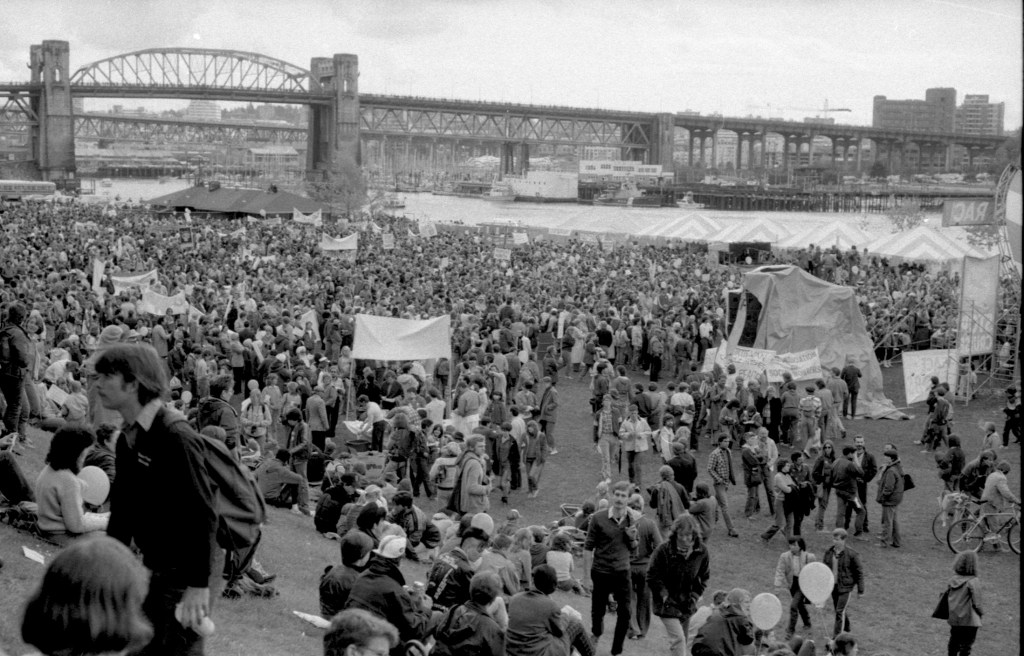
In the 1980s, hundreds of thousands of people around the world joined marches for peace and disarmament. Here, people gather at Sunset Beach Park in Vancouver in May 1985 after a march that drew 65,000 people. That good energy did not result in dismantling NATO and other instruments of war in the 1990s, even after the Warsaw Pact and Soviet Union were dissolved.

Story and photos by Jim Hodgson

Russia’s February 24 invasion of Ukraine is a massive failure of diplomacy and the oft-abused “rules-based international order.” Yes, President Vladimir Putin has done wrong. Sadly, most western countries failed to support recent diplomatic efforts by France and Germany or the earlier Minsk Accords

Decades earlier, we who were part of the massive peace movement of the 1980s failed to press hard enough for dissolution of NATO and for a fulsome welcome of Russia into the European Union and other multilateral spaces: Russia, in the eyes of the west, remained a foe, even after the end of the Warsaw Pact and the Soviet Union. In the 1990s, we fell for the “end of history” nonsense promoted by the neo-liberal capitalists: it would be a unipolar world, with the United States defining how the rules would be applied.

That said, we just can’t have countries invading each other. 

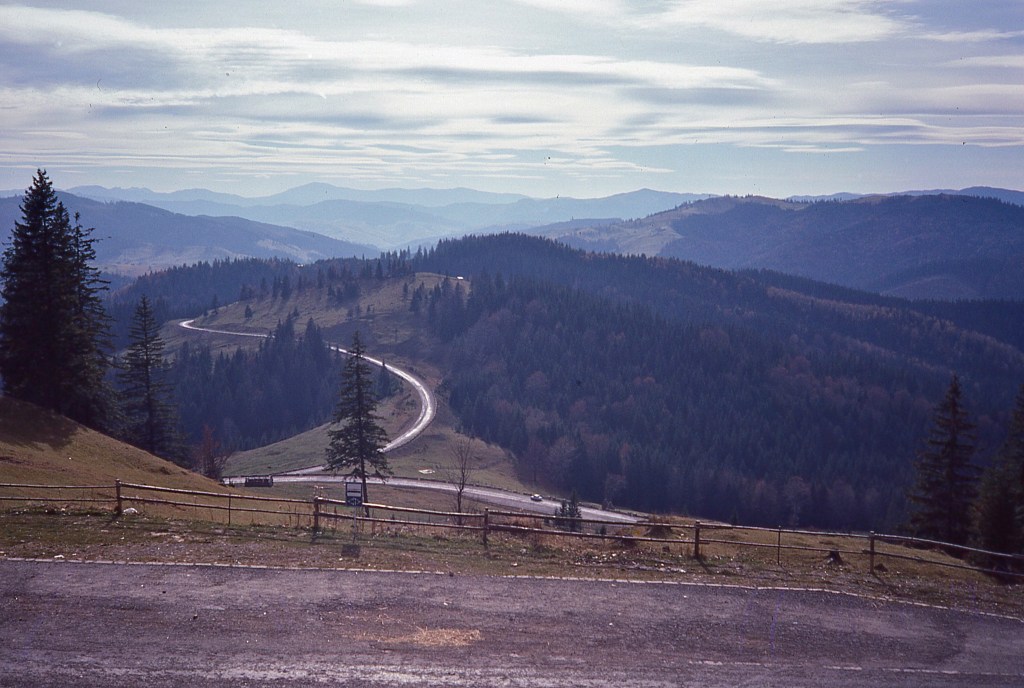
I regret that I have not (yet) visited Ukraine, though I have been in many of its neighbours. The closest I came to Ukraine was on an October day in 1977: the eastern slopes of the Carpathian Mountains, the Romanian city of Rădăuți, Suceava district, about 20 km from the border of what was then the Soviet Union, now independent Ukraine. Today, the Suceava district is receiving Ukrainian refugees.

The UN Charter affirms self-determination in Chapter 1, Article 1 (2), and sovereignty in Chapter 1, Article 2 (1). Article 2(4) adds: “All Members shall refrain in their international relations from the threat or use of force against the territorial integrity or political independence of any State.” Those principles are at the heart of the rules-based international order.

Unfortunately, the five permanent members of the United Nations Security Council are pretty much immune from measures that could be applied to other states: they use their veto power to protect themselves or their client states in the wake of invasions and other interventions. 

This time, in the case of Russia, the western powers are increasing levels of sanctions, with new announcements rolling out every day. The first round seemed weak, excluding such obvious measures as suspending Russia’s participation in the global SWIFT system for financial transfers or banning the purchase of Russian oil and gas. Five days later, some of those measures have been taken, together with suspending Russian access to airspace over many countries. The measures will bite. But whether their impact is greater on the rich and powerful or on ordinary people – or effectively aid Ukrainians in their struggle – remains to be seen. 

I have done some work in recent years on negative humanitarian impacts of sanctions in so-called “less developed” countries (North Korea, Venezuela, Iran, Cuba, Zimbabwe, among others). I did not look carefully at sanctions applied among the United States, Russia and China against each other, or Canada’s sanctions against Russia and China (though I kept extensive notes). I have significant doubts about both the legality and effectiveness of most economic sanctions – “weaponized finance,” some have called them – whether applied by single states, groups of states, or the even UN Security Council.

The new sanctions against Russia represent a mix of what might be legal or not in public international law. Countries acting alone can restrict with whom they engage in trade and act to control their airspace. The UN General Assembly, the UN Human Rights Council and various UN independent experts regularly denounce the illegality of “unilateral coercive measures” – sanctions – applied by one or more states against another outside the authority of the UN Security Council or other membership group like the African Union. General Assembly votes largely pit the United States, European Union, Canada, Japan and their allies against the majority world, the so-called developing nations. The December 2019 General Assembly vote on such measures was 135 in favour, 55 opposed, with no abstentions and three absent.

But, in this time of war, legal issues will only be dealt with later: for the moment, those with power make the rules. Where does that leave the rest of us?

At times like these, it’s useful to hear voices from outside the dominant North America/Western Europe political and media chatter.

Some people have correctly denounced the racism and hypocrisy reflected in much media coverage of present conflict. White Ukrainians are brave resisters, even shown on TV making Molotov cocktails, while any brown person doing that in southern Lebanon, Yemen, Gaza, Somalia or Afghanistan would be denounced as a terrorist or soon draw a drone attack. 

One of the writers to whom I pay much attention is Raúl Zibechi, an Uruguayan writer on Latin America’s social movements – the Indigenous, peasant and urban movements that represent “los de abajo” – the under-classes, or those who are locked out of the formal economy and political power.

In an article published at the end of January, he cautioned such movements and their allies against choosing sides in “wars among the great powers.” Some people, he wrote, “think that it is better that the winners be those who oppose U.S. imperialism, which leads them to support Russia or China, or occasionally, Iran or any other nation that opposes the western powers.”

Social movements, he added, “should oppose war so as to deepen their own agendas” and “exercise autonomy and self-government, building other worlds that are new and different from the capitalist, patriarchal and colonial world.”

In several parts of Latin America, small farmers and Indigenous communities have had to learn to defend themselves against attacks from state authorities, drug-traffickers and large land-owners. Their self-defence, adds Zibechi, is not the same as “participating in a war that they did not choose.” Communities learn from the experiences of the Zapatistas in Chiapas, the Mapuche people in Chile, and the “ronderos campesinos” in Peru. “If we respond with violence (which ethically would be irreproachable), they [those with power] would take the initiative that they most want: the genocide of entire peoples, as has happened in the recent past.”

“The task of the peoples, in this time of wars among capital, is not to take power, but to preserve life and care for Mother Earth, elude genocides and not turn ourselves into the same as them, which would be another form of being defeated,” Zibechi concluded.

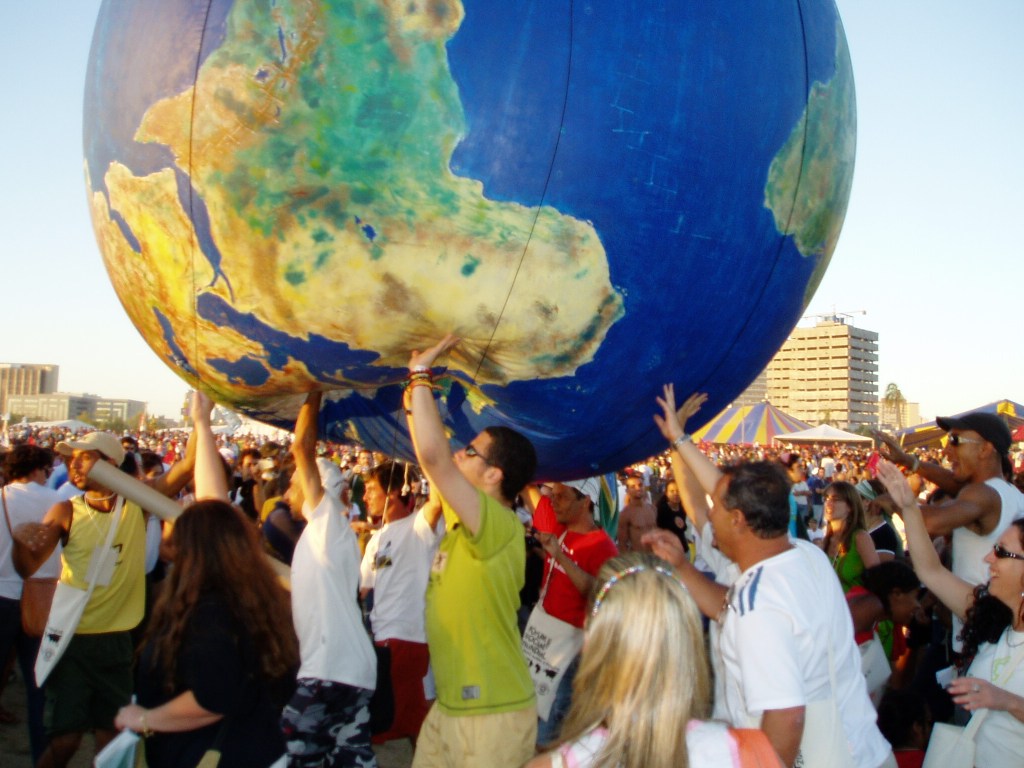
Another World is Possible – World Social Forum, Porto Alegre, Brasil – January 2005

Fanning the fires of hope in Chiapas, still

There was one time when I was glad to see the riot place arrive: Sunday afternoon, February 19, 1995 in San Cristóbal de Las Casas, Chiapas. 

For more than a week, Maya Indigenous people of the Chiapas highlands had protected their cathedral, the seat of Bishop Samuel Ruiz. On that Sunday afternoon, the feared attack had become real as a larger group of about 400 “auténticos coletos” (denoting descendants of the European settlers in the city) hurled stones: the settlers saw the Indigenous people as interlopers, the ones who had no business in the heart of their city.

The defenders stood three deep in scraggly lines surrounding the cathedral. They held flowers. Men, women and children, old and young, Indigenous and Mestizo, Mexican and foreign, held marigolds, lilies and carnations and wore white ribbons across their chests as they faced the attack. They endured the attack, holding blankets over their heads and trying to duck the stones. The woman next to me whispered prayers and repeatedly blessed the rock-throwers: “God, forgive them.”

The mob tried for more than an hour to storm into the cathedral and the diocesan office next to it. Finally, the riot squad arrived and traced a line between the two groups. The people on the steps cheered; the mob dispersed. In the meantime, at least five people, including two reporters, had been injured. 

For 10 days, ever since Mexican President Ernesto Zedillo pledged to capture the leaders of the rebel Zapatista army (EZLN), the people of this diocese had maintained a vigil around the cathedral and diocesan office. That building also housed the National Mediation Commission (CONAI), chaired by Bishop Ruiz and in session at the time of the attack.

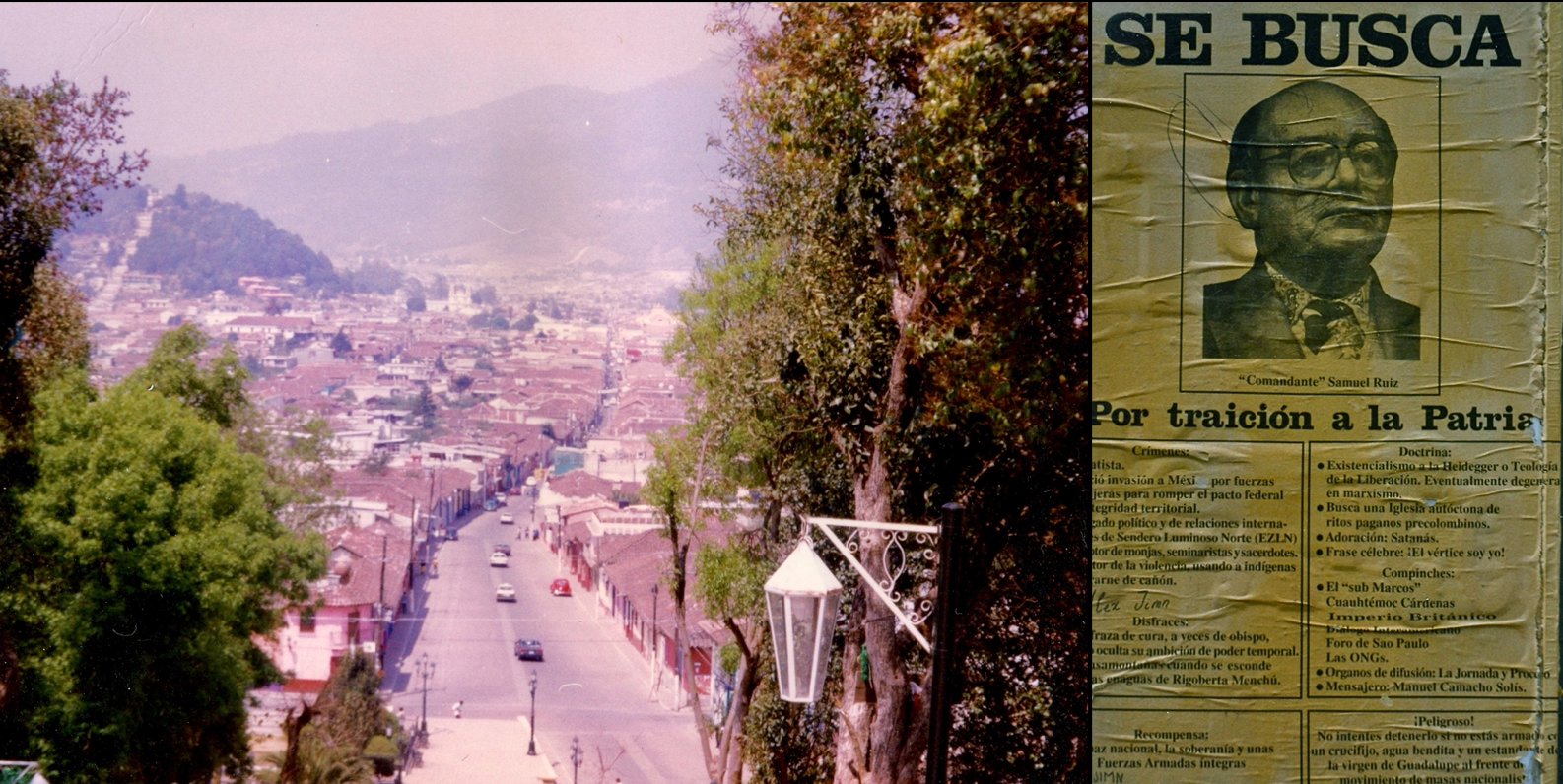
Left: a view of San Cristóbal de Las Casas. Right: a “wanted” poster that describes Bishop Ruiz variously as a traitor, existentialist, liberation theologian and Marxist – typical of the charges laid against him by his opponents over many years.

For more than a year, Ruiz had been at the centre of ecclesial and political controversies over his decades-long advocacy for and with Indigenous and impoverished people in Chiapas and his role as a mediator between the government and the Zapatistas. The EZLN uprising had begun on January 1, 1994, the day that the North America Free Trade Agreement (NAFTA) came into effect.

Zedillo failed to capture Zapatista leaders, but instead arrested people who worked for community development organizations (notably Jorge Santiago of DESMI, Economic and Social Development of Mexican Indigenous Peoples). His army also achieved what it considered to be better strategic positions near the Zapatista communities. 

Over the subsequent year, CONAI’s mediation work continued and bore fruit: on February 16, 1996, the government and EZLN representatives signed an Agreement on Indigenous Culture and Rights in San Andrés Sakamch’en. It was not a comprehensive peace deal, but rather the first step in a planned process to address Indigenous rights in Chiapas and beyond. “It was the first time in Mexican history that the state had sat down with Indigenous people to hear their demands,” wrote La Jornada columnist Magdalena Gómez recently. Later that year, the National Indigenous Congress (CNI) was created and continues its work today.

But from the government side, nothing happened! The first agreement has not been implemented; worse, the government negotiators essentially sabotaged a second round that was to address issues of democracy and justice, leading the EZLN to suspend the dialogue on September 4, 1996. It has not been renewed. The EZLN continues to press its cause in multiple public fora in Mexico and far beyond, and the communities persist in building a fairly successful example of Indigenous autonomy. 

Sadly, even the somewhat more progressive government of Andrés Manuel López Obrador, in power now for more than three years, has failed to move beyond what Gómez called “recycled, low-intensity, neo-Indigenous” policies of individual support and mega-projects without reference to the San Andrés Accords. 

A year ago, the Fray Bartolomé de Las Casas Human Rights Centre in San Cristóbal said the San Andrés Accords persist as a framework and reference for the people of Chiapas. “The people who struggle will continue to fan the fire of hope, and history will give an account of this, because despite the war of extermination, the construction of autonomy gives light and fire to women and men throughout the world.”

Parts of this post are adapted from two of my articles published in Catholic New Times, March 5 and 19, 1995.

“I give you a flower,” says a t-shirt from Yajalón, Chiapas.