Colombia’s Gustavo Petro seeks to contain the growth of “hyper-fascism” in Latin America

by Jim Hodgson

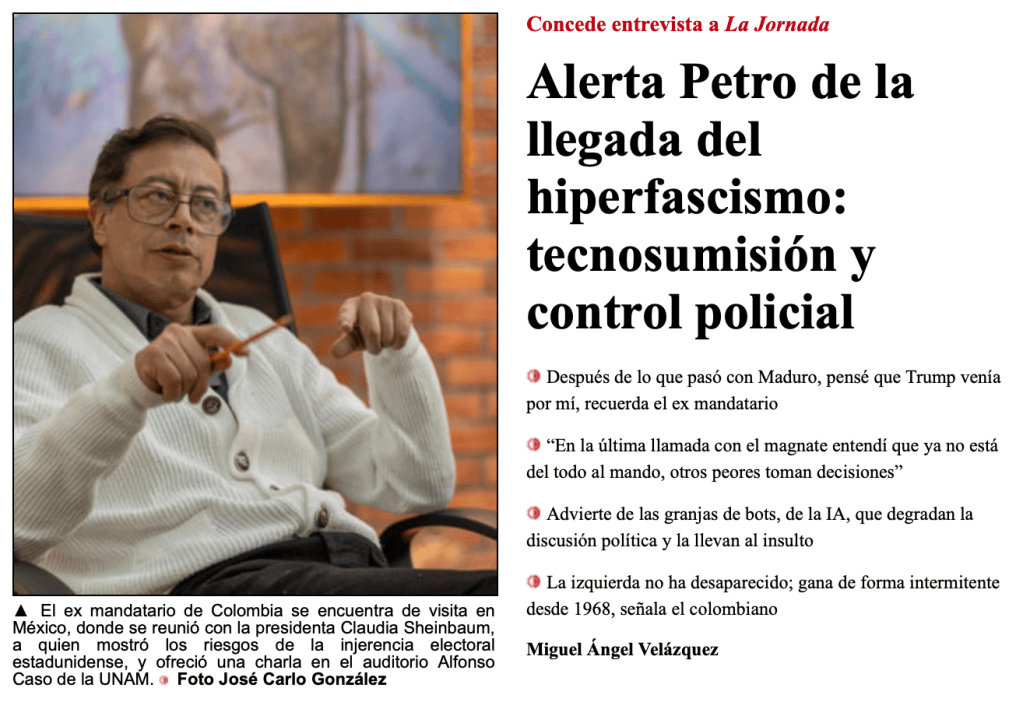
During a visit last week to Mexico City, Colombia’s former president Gustavo Petro declared he would work with others to prevent “hyper-fascism” and “techno-fascism” from taking control of all Latin America.

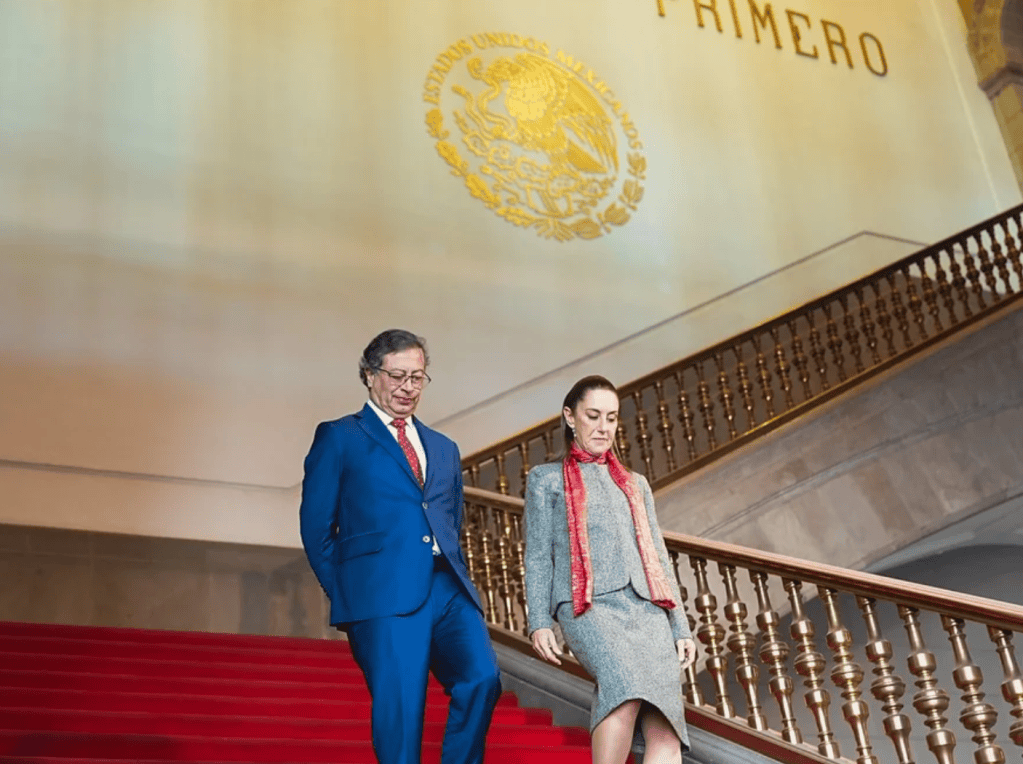
He met with President Claudia Sheinbaum in the National Palace (above); spoke with students at Mexico’s National Autonomous University on economic policy in the climate crisis; met with Colombians living in Mexico; and sat down for an interview with Miguel Ángel Velázquez of La Jornada daily newspaper.

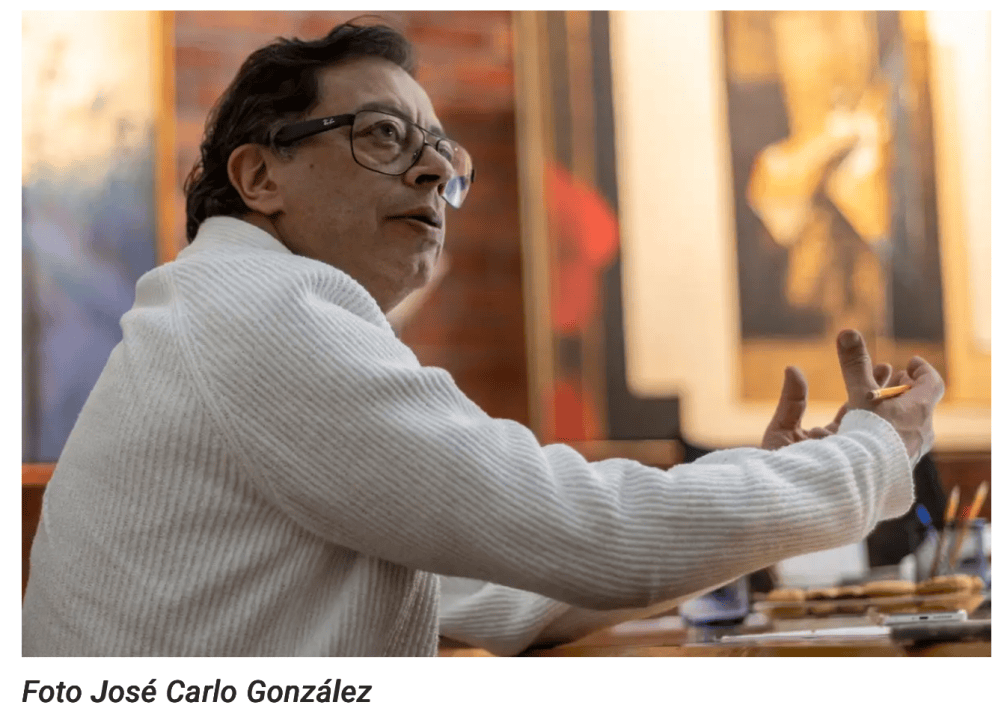
In that interview, Petro spoke of his complicated relationship with the administration of Donald Trump. The two have differed sharply over Israel’s treatment of Palestine, climate justice, relations with Venezuela and Cuba, and the U.S. “war” on drugs.

Petro’s four-year presidential term ended on Aug. 7 when his hard-right successor, Abelardo de la Espriella was sworn in. Petro had been Colombia’s first president from a party of the left. He had tried (unsuccessfully) to bring about “total peace” in a country torn for decades by civil war and violence tied to drug-trafficking. It was Jan. 3, when the United States kidnapped Petro’s Venezuelan counterpart, Nicolás Maduro, that fear set in.

“After the crucial day, when they bombed Caracas, Trump said: ‘Watch your back, because now I’m coming for Petro.’ That day I thought: ‘A missile is coming for me.’”

After talks among diplomats and with Republicans in the U.S. congress, Petro and Trump met in the White House on Feb. 3. Trump called the conversation “terrific.” Petro said it was “constructive.” (In the La Jornada interview, Petro added that others behind Trump “worse than him” are driving the key decisions.)

Their rapprochement did not last. In Colombia’s presidential election, Trump and his officials backed de la Espriella, calling the other candidate, human rights defender Iván Cepeda, a “radical left Marxist.” This was one more instance of U.S. interference in Latin American elections (after a presidential vote in Honduras and mid-term contests in Argentina). 

Now, countries from Argentina and Chile to El Salvador and Trinidad and Tobago have governments of the hard-right that are solidly attached to Trump’s agenda. The next election to watch is in Brazil next month, where progressive President Luiz Inácio (Lula) da Silva faces Flávio Bolsonaro, son of disgraced former president Jair Bolsonaro.

Across the region, right-wing parties are backed by a large-scale disinformation network, La Derecha Diario (“The Right Wing Daily”). A failed murder-for-hire plot in Bolivia has drawn wider attention to the network’s activities. 

In his interview with La Jornada, Petro spoke of his vision of the political moment: 

“We live in a planetary shell; it’s the matrix of lies. We act like in The Matrix, like in the movie. Suddenly you find a bot farm. It’s not made up of human beings, but rather profiles that automatically react to any Latin American leader because they want to degrade political discourse and reduce it to insults. That’s why I call it the matrix of lies. In this shell of falsehood, some parts escape because they are strong, like states, but the intention of this matrix is ​​to enslave human beings, and it’s not just a physical chain, but a mental one, to enslave human beings to allow the exploitation of non-renewable natural resources, for example.”

Petro explained the counterattack: “Mathematics is required, because it’s a mathematical, algorithmic attack, both in the bots used to manipulate human beings and in the elections themselves and their final results.”

In a subsequent editorial, La Jornada wrote:

“Petro’s contribution to the political debate serves as a wake-up call to increase vigilance regarding foreign agents who exploit communication tools such as social media to promote neo-fascist rhetoric, spread misinformation, incite hatred, and manipulate electorates to benefit their external and internal sponsors – namely, the White House and a sector of big business resistant to democracy. 

“Alongside the bleak picture he paints, there is a message of hope. In his country in 2022, the people elected the first progressive government in history, and this experience cannot be seen as a failure. Societies are not defenseless against technofascism, he says, because they can protect themselves with strong minds and with the same resources used by oppressors: mathematics. Education is fundamental to the resistance that he joins and invites others to join.”

Yes. And, to me, hope is in revival of the networks of social movements that gave rise to the “pink wave” of progressive governments a quarter-century ago.

A postscript: In a Labour Day essay, Canadian politician and activist Charlie Angus offered a similarly sharp warning about the power of the big-tech corporations in the Trump White House. He recalled that in his farewell address, Joe Biden warned that the Silicon Valley elite were capable of destroying democracy and damaging the future.

The Shield of the Americas: a summit of nations on their knees

by Jim Hodgson

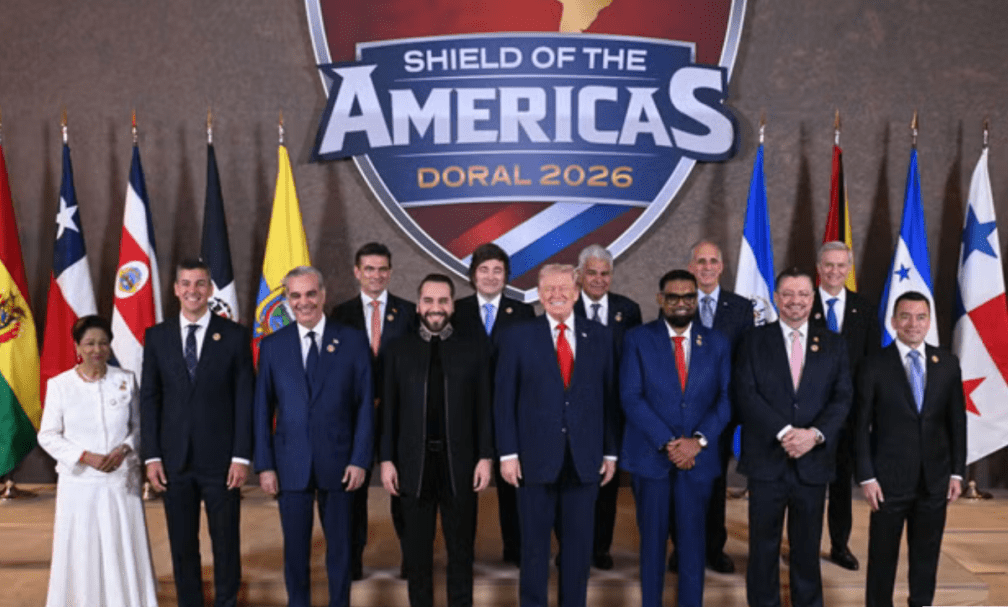
Leaders of a dozen Latin American and Caribbean nations spent a few hours last week with President Donald Trump at one of his golf courses near Miami. This was the launch of the “Shield of the Americas,” a bloc of right-wing governments that have pledged to join Trump’s war against so-called “narco-terrorism.”

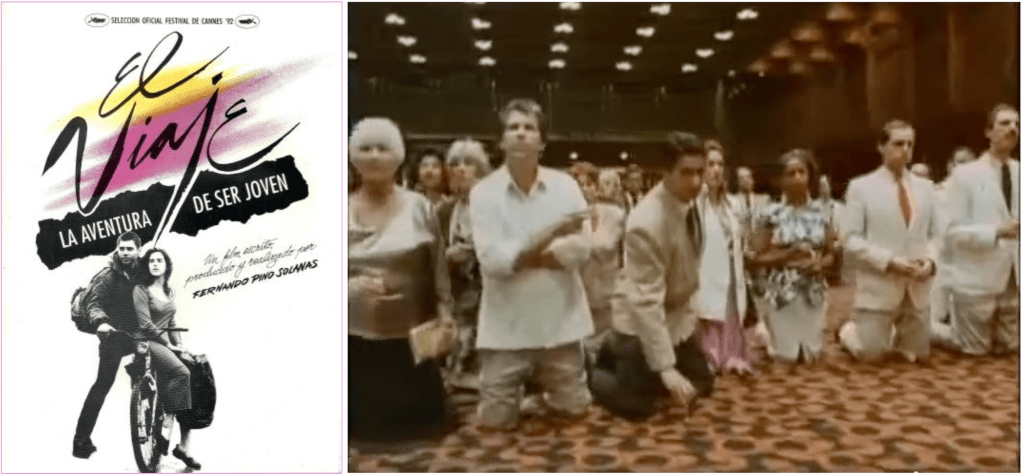
The spectacle recalled for me a 1992 film, El Viaje (The Journey), by Argentinian director Fernando “Pino” Solanas. It won prizes at film festivals in Cannes and Havana, and I saw it in Toronto.

El Viaje satirizes the way Latin American governments in the 1980s and 90s knelt before the rich countries for the sake of debt forgiveness, implementing austerity programs that harmed their own people. One scene (above right) shows a meeting of the Organización de Países Arrodillados (the Organization of Countries on their Knees). You can see a clip on Facebook.

In Miami, the leaders plainly knew that their face time with Trump was squeezed out from his preoccupation with his ill-conceived and unpopular war on Iran. They even applauded his insults: “I’m not learning your damn language,” said Trump. “I don’t have time.”

Beyond the farce, however, there is harsh reality to be faced. 

Trump called for an “anti-cartel coalition” that would use military might to “eradicate” drug cartels. A day earlier, his “war secretary,” Pete Hegseth, warned representatives from 16 countries in the region that if they didn’t adopt more aggressive strategies against drug cartels, the Trump regime would do it for them. Hegseth urged the countries to remain “Christian nations, under God, proud of our shared heritage with strong borders,” and not to be led astray by “radical narco-communism, anarcho-tyranny… and uncontrolled mass migration.”

Since his return to power 14 months ago:

Trump’s threat at the summit to “take care of” Cuba drew an immediate response from Havana. President Miguel Díaz-Canel wrote on X:

“The little reactionary and neocolonial summit in Florida, convened by the United States and attended by right-wing governments from the region, commit themselves to accept lethal use of U.S. military force to resolve internal problems of order and tranquility in their countries.”

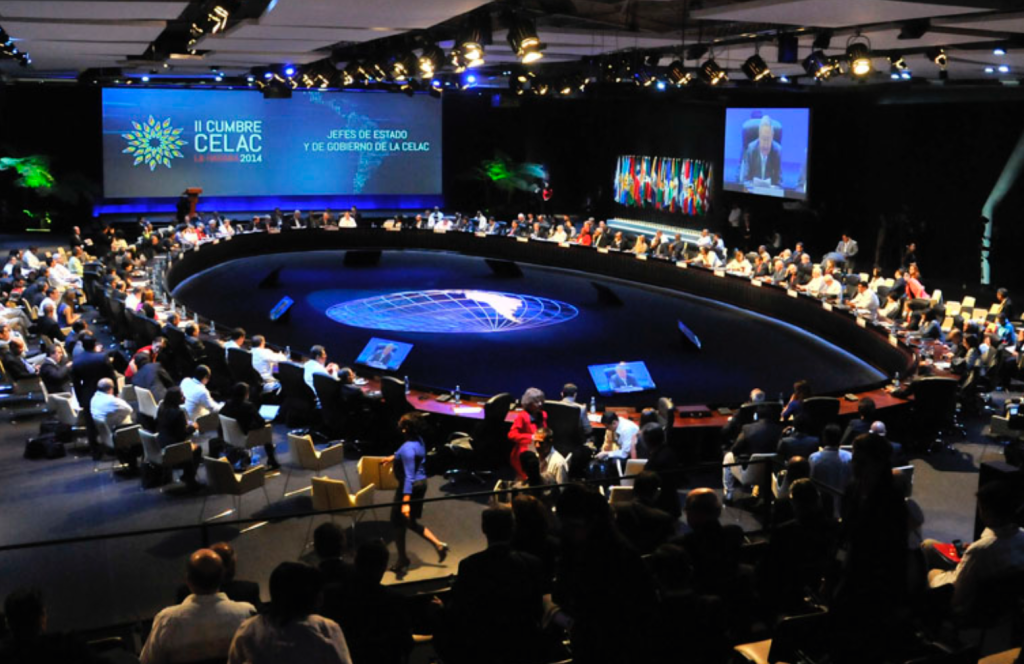
Díaz-Canel said the summit was an attack on the 2014 proclamation of Latin America and the Caribbean as a Zone of Peace, a declaration signed in Havana (photo above by René Pérez Massola.) The summit, he added, also attacked “aspirations for regional integration” and was “a sign of their willingness to subordinate themselves to the interests of the powerful nation to the north.”

Cuba’s foreign minister, Bruno Rodríguez, said the Miami summit was “a clear and dangerous setback in the long and difficult process of independence for the peoples of Latin America and the Caribbean.”

In his speech, Trump said that Mexico was the “epicentre” of drug-trafficking. The cartels, he said, “are getting worse and taking over the country. The cartels are running Mexico. We can’t have that. Too close to us, too close to you.”

Hours later, President Claudia Sheinbaum, pleaded for “cabeza fría” (cool heads) as Mexico determines its next moves – all (like Canada) under the pressure of new free trade talks with the United States.

A few days before the summit, Costa Rica’s president-elect, Laura Fernández, called Mexico “a reference point for where we do not want to go” regarding violence, organized crime and drug-trafficking. She was the minister of national planning and economic policy under the out-going president, Rodrigo Chaves. Chaves attended the Sheild summit, not Fernández, but her comment got attention in Mexico.

In an editorial, the daily newspaper La Jornada said that if Fernández wants to avoid the suffering experienced in Mexico over the past two decades, she should bear in mind that the crisis of insecurity was launched by a politician of the same ultra-right current that she represents. After his election in 2006, President Felipe Calderón began Mexico’s war on drugs by:

“opening the country to U.S. spy agencies, subordinating national interests to those of Washington, ignoring the social and economic roots of the crime phenomenon, and declaring a war against his own citizens. The violence of the state became a criterion for measuring success. The lessons of the Calderón years are important to for the other governments (and the governed) that still see or pretend to see the White House ‘war on drugs’ as an offensive against criminal structures and not the mechanism of imperial domination that it is.”

Trump says U.S. is ‘starting to talk with Cuba’ even as he tries to block oil imports

by Jim Hodgson

In the face of U.S. President Donald Trump’s threats to impose new tariffs on any nation that exports oil to Cuba, we all need to stand firm. Here are two ways to send messages to Canadian leaders.

First, the Take Action proposed by Canadian churches, trade unions and NGOs. Yes: it pre-dates the current crisis, but its message is vital. Canada cannot be silent.

Second, the Canadian Network on Cuba has an on-line petition to Canadian parliamentarians. It too pre-dates the immediate crisis, but is still an important means to communicate.

Of course you can write your own letters to leaders in whichever country you live.

Take heart from increasingly strong messages from Mexican President Claudia Sheinbaum.

Today, she denied Trump’s claim a night earlier that they had talked about Cuba, much less that he had asked her to stop sending Mexican oil to Cuba and that she would comply.

La Jornada

The only such conversation, she said while travelling in Sonora state, had been between her foreign affairs secretary, Juan Ramón de la Fuente, and U.S. Secretary of State Marco RubioSheinbaum has said several times this week that her country will continue to send humanitarian aid including oil to Cuba. Various sources report that Cuba has only enough oil to satisfy needs for another 15 to 20 days.

For his part, de la Fuente told Mexican legislators today that Mexico considers it “unacceptable that there not be humanitarian aid where it is needed, when some country in the world requires it.”

Saturday night, while travelling from Washington DC to his home in Florida, Trump said the United States was beginning to talk with Cuban leaders. (There is no confirmation as of Sunday evening from Cuba that such talks have begun.)

In comments to reports on Air Force One, he added: “It doesn’t have to be a humanitarian crisis. I think they probably would come to us and want to make a deal,” Trump said Saturday. “So Cuba would be free again.”

He predicted they would make some sort of deal with Cuba and said, “I think, you know, we’ll be kind.” (U.S. interventions since 1812 have not been known for their kindness.)

The comments follow more than six decades of U.S. sanctions aimed at inducing regime change in revolutionary Cuba, the kidnapping four weeks ago of Venezuelan President Nicolás Maduro, and Trump’s threat to impose tariffs on any country that continued to sell oil to Cuba. 

On Wednesday night, Jan. 29, he declared a “national emergency” to protect “U.S. national security and foreign policy from the Cuban regime’s malign actions and policies.”

Granma photo: Ricardo López Hevia

Cuban leaders have condemned and denounced this new escalation of the “U.S. economic blockade.”

“Surrender will never be an option, and hard times like these must be faced with courage and bravery,” said President Miguel Díaz-Canel Saturday.

The Trump regime’s tactic of confiscating Venezuelan oil tankers has worsened a fuel and electricity crisis in Cuba. The Cuban people face rolling blackouts and struggle to cope without reliable fuel and electricity supplies.