Gabriel Boric: Hope defeated fear in Chile 

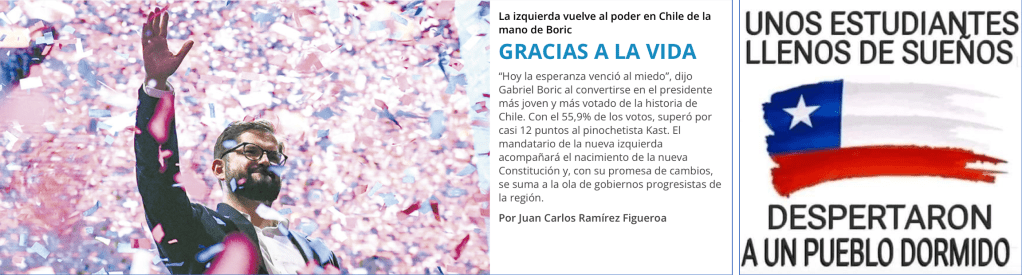
“Thanks to life,” the headline on Página 12 (Argentina) news site today. “Hope defeated fear,” said Gabriel Boric. On the right: “Students full of dreams awakened a sleeping people.”

Jim Hodgson

Good news today is that Gabriel Boric has won the presidential election in Chile. In his campaign, he promised to bury the neoliberal economic system imposed by Augusto Pinochet’s 1973-90 dictatorship, raise taxes on the super-rich, fight inequality, expand social services, and strengthen ecological protection.

Boric won 56 per cent of the votes, compared to 44 per cent for his opponent, José Antonio Kast, a supporter of the dictator. Boric will be 36 years of age when he is sworn in on March 11.

But like his neighbour to the north, Peruvian President Pedro Castillo (elected in June), Boric will face both a fragmented congress and a deeply-entrenched system that will oppose his agenda.

Since the election of Salvador Allende in Chile in 1970 and despite the coup three years later, the left in Latin America has participated in elections and governed according to the rules of liberal democracy. They do so without sufficient regard for the roles of money, foreign interference and private media companies.
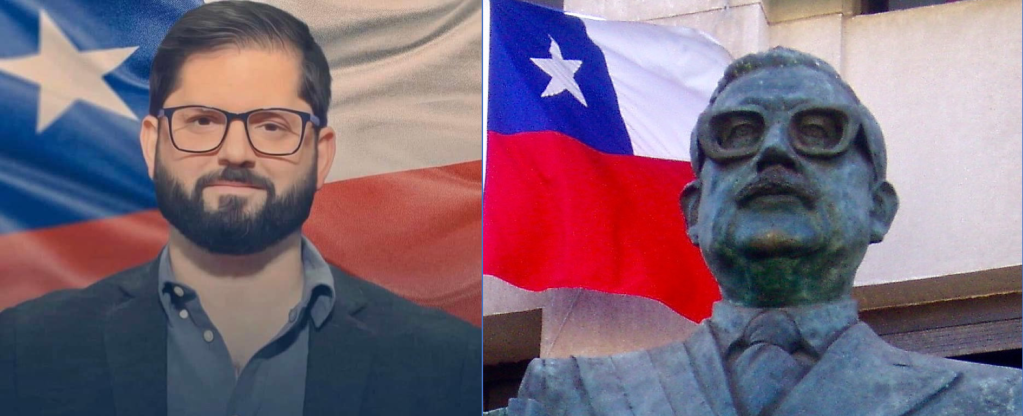
Check out the glasses! Gabriel Boric (left) and the statue of Salvador Allende at the Moneda palace in Santiago.

Chile has had several other relatively progressive presidents since the demise of Pinochet (Patricio Aylwin, Ricardo Lagos and Michelle Bachelet), but none could undo his political and economic system. They were referred to not as “socialists” but as “socios listos” – willing business partners. After widespread protests at the end of 2019, Chileans set in motion a process to create a new constitution, and the election of Boric may help to re-energize that lagging process.

But action by private bus companies in Sunday’s election, when they reduced service in poor neighbourhoods to try to suppress votes for the left, may be a sign of things to come. I was a young teen in a small town in western Canada in the early 70s, but I remember the transportation shutdowns – strikes by capital – together with other actions that damaged Allende’s government well before the coup. 

That progressive politicians are chosen in multi-party elections has never prevented the United States and its allies (including Canada) from supporting coups – and this is only a partial list, not counting the invasions – in Guatemala (1954), Dominican Republic (1963), Brazil (1964), Chile (1973), Argentina (1976), Venezuela (2002), Honduras (2009), Bolivia (1964, 2019), or the parliamentary coups like those in Paraguay (2012) and Brazil (2016). By the way, you should read Vincent Bevins (2020), The Jakarta Method: Washington’s Anticommunist Crusade & the Mass Murder Program that Shaped Our World – and follow him on Twitter @Vinncent.
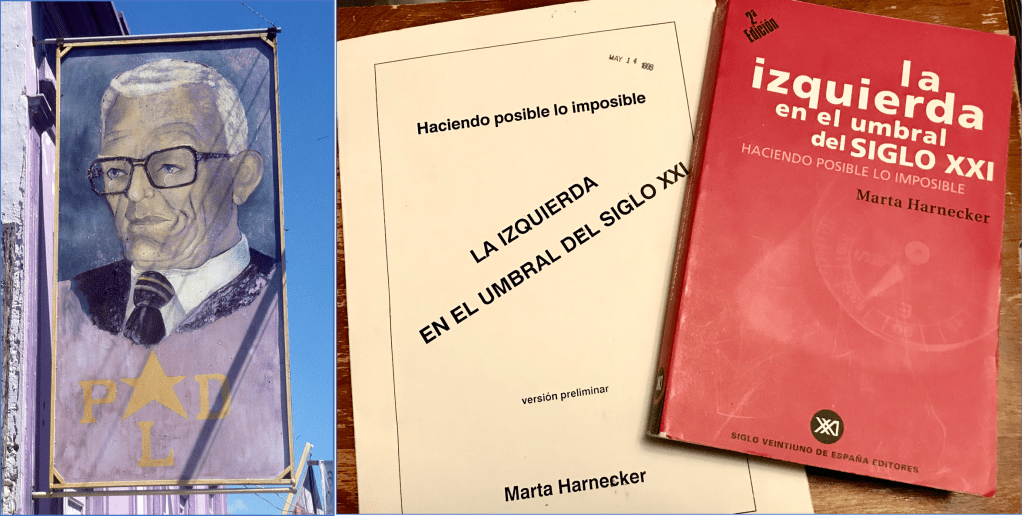
Former president Juan Bosch (1901-2001) in a campaign poster; two versions of Marta Harnecker’s hopeful look at 21st century politics.

I met Juan Bosch, one of the overthrown presidents, in 1987. He had been elected to serve as president of the Dominican Republic after the Trujillo dictatorship, but was ousted in September 1963 with the complicity of a White House run by that paragon of U.S. liberal democracy, John F. Kennedy. Bosch said that the United States was interested only in “formal democracy” – that elections appeared to be held; external funding allowed only if it came from the United States.

In a 1986 interview, Bosch said: “Only North American leaders think that democracy could or should function in any Latin American country the way it does in the United States.”

“It’s the right, not the left, that has historically blocked those paths,” insisted Marta Harnecker, chronicler of the Latin American left until her death in 2019.

“The possibility that the left has now to compete in many spaces openly and legally should not make us forget that the right respects the rules of the game only to the extent that they are convenient for them. To date, we do not see any experience in the world where the dominant groups are willing to renounce their privileges,” she wrote in 1999 (Haciendo posible lo imposible: la izquierda en el umbral del siglo XXI, p.351.) “What they will always try to block – and in this, no illusions – is any attempt to build an alternative society.”

Saint Oscar Romero, the slain archbishop of San Salvador, said something similar in 1979: “It’s natural that when the right feels that their economic privileges are being threatened, they will move heaven and earth in order to maintain their idol of wealth.

A memorial to Allende inside the foreign affairs ministry in Caracas, Venezuela. Photo: Jim Hodgson

What is to be done? Tolstoy, Lenin, John the Baptist and recent elections

Xiomara Castro, president-elect in Honduras. Right: “Long live the People in Resistance” – post coup graffiti.

Soon after my return to Canada from my first visit to the Dominican Republic in 1983, I saw Peter Weir’s brilliant film, In a Year of Living Dangerously. As a socialist option in Indonesia collapses through local intrigue and U.S. intervention, Linda Hunt’s character, Billy Kwan, asks obsessively: “What is to be done?”

In the wake of my encounters with Haitian cane-cutters and Dominican and Haitian activists, it became my question too.

Billy Kwan’s question alludes to Lenin’s 1902 manifesto that called for a new vanguard organization that would be dedicated to taking power. Lenin took his title from two earlier works by Russian authors. In 1863, Nicholas Chernyshevsky issued a manifesto that imagined a new social order. Twenty years later, Leo Tolstoy took the same title to offer a vision of the renewal of individual moral responsibility.

But the question actually comes from the Bible. In Luke 3:10—part of the lectionary readings in many churches this Sunday, Dec. 5, the second Sunday of Advent—the people ask John the Baptist: “What are we to do?” And John answered, “If you have two coats, give one to the person who has none; and if you have food, do the same.” 

Later, in Luke 12:16-21, the question appears in Jesus’ story about the rich fool: “There was a rich man and his land had produced a good harvest. He thought: ‘What shall I do? For I am short of room to store my harvest.’So this is what he planned: ‘I will pull down my barns and build bigger ones to store all this grain, which is my wealth. Then I may say to myself: My friend, you have a lot of good things put by for many years. Rest, eat, drink and enjoy yourself.’ But God said to him: ‘You fool! This very night your life will be taken from you; tell me who shall get all you have put aside?’ This is the lot of the one who stores up riches instead of amassing for God.”

Life is too short for the poor to wait for wealth to trickle across the greatest breach between rich and poor that this planet has ever known. While some of us in the North think we have the luxury of sitting back to see how things go—except that climate change seems to have finally got our attention—the impoverished must always take risks and try something new.

Since the election of Salvador Allende in Chile in 1970 and despite the coup led by Gen. Augusto Pinochet three years later, the left in power in Latin America has tried to govern according to the rules of liberal democracy, arguably without sufficient regard for the roles of money, foreign interference and private media companies.

Confronted by poverty, after “lost decades” of development, social movements in Latin America began to develop alternative policy approaches in the 1990s. Smart politicians paid attention and in one country after another—imperfectly, with lots of mistakes—the “formal democracies” of old began to be transformed.

That “pink wave” did not last. A military coups in Honduras and Bolivia, parliamentary coups (or “lawfare”) in Paraguay and Brazil, devastating impacts of U.S.-led (backed by Canada) sanctions in Venezuela, the power of money in Ecuador and petty corruption all weakened the drive for lasting change.

Left and centre: Chile’s election pits Gabriel Boric against José Antonio Kast. Right: the party of Nicolás Maduro won most regional elections in Venezuela. (Images from Página 12, Argentina)

A second progressive wave?

In October 2020, voters in Bolivia restored the “Movement for Socialism” (MAS) party to power just a year after the coup. In June, voters in Peru elected a rural teacher, Pedro Castillo, to be their president. In November, Venezuela’s ruling PSUV party won almost all state-governor races. Later in November, voters in Honduras chose Xiomara Castro, whose husband Mel Zelaya had been overthrown in a coup backed by the United States and Canada in 2009, to be their new president. 

The next test comes in Chile on Dec. 19, when a Pinochet-loyalist, José Antonio Kast, faces a centre-left candidate, Gabriel Boric, in a second-round run-off vote.

No country is the same as another, and specific issues pertain to each of the elections noted above. But the big loser in most of these votes is the United States, together with ever more deferential Canada. Latin Americans are again choosing leaders who do not have the interests of the United States at heart. 

Mexico and the world: “For the good of all, the poor come first”

JIM HODGSON

As Mexico’s president, Andrés Manuel López Obrador (AMLO), gets ready to meet Thursday, Nov. 18, with U.S. President Joe Biden and Canadian Prime Minister Justin Trudeau on Nov. 18, I prepared a few notes to keep in mind.

In the lead-up to the summit, much attention is paid to U.S. “Buy America” initiatives that threaten the (messy and often-unfair) market created after 1994 by the North America Free Trade Agreement (NAFTA). On that issue, Trudeau and AMLO will each back the other, especially with regard to the automobile industry.

But there are other issues.

Most media fail to understand the Mexican president, or worse: they misrepresent his intent to put impoverished people at the centre of policy-making. I’ll touch on two issues here—energy and Mexican proposals on international development—but their treatment has an impact on climate, deforestation, corruption and migration.

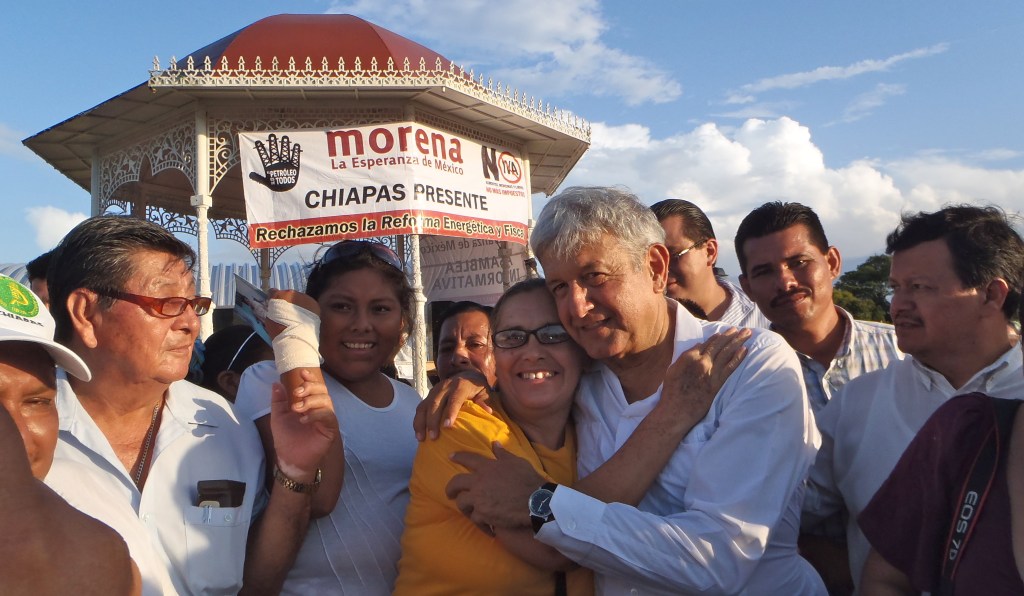
AMLO in Juárez, Chiapas, July 2014–campaigning four years ahead of the 2018 election. Behind him, the lower part of his party’s banner says in part: “We reject the energy reform.” Photo: Jim Hodgson

Energy—and learning about coal and colonialism

One of the points of tension in the Glasgow climate negotiations was the enormous advantage the rich countries of the global “North” have over countries in the global “South,” most of which still struggle to overcome colonial and neo-colonial exploitation. 

And one of the countries that gets criticized for not doing more is Mexico, where energy policy has been a hot topic for most of the past century. (In 1925, when Mexico declared all petroleum products to be of “public use,” and then in 1938 when Mexico expropriated assets of foreign oil companies, the United States (which always sees its corporations’ interests as national interests) objected. Mexico excluded energy from NAFTA, but governments from 2000 to 2018 began allowed limited foreign investment in the sector. AMLO is now trying to reform those reforms.)

While the Mexican representative in Glasgow criticized the last-minute move by India and China to change the language on coal from “phase-out” to “phase-down,” Mexico currently has no phase-out policy in place

In Glasgow, Prime Minister Trudeau repeated his campaign pledge to stop the export of “thermal coal” (the kind used for power production) by 2030. It’s an easy promise to keep: just five per cent of Canadian coal exports are of thermal coal. Most of the Canadian production that is exported is “metallurgical coal” (the kind used for making steel—also harmful to the atmosphere, but harder to do without). 

But Canada does not track shipments of thermal coal that originate in the United States. During the Glasgow summit, a coalition of Canadian groups demanded that Canada end thermal coal exports by 2023

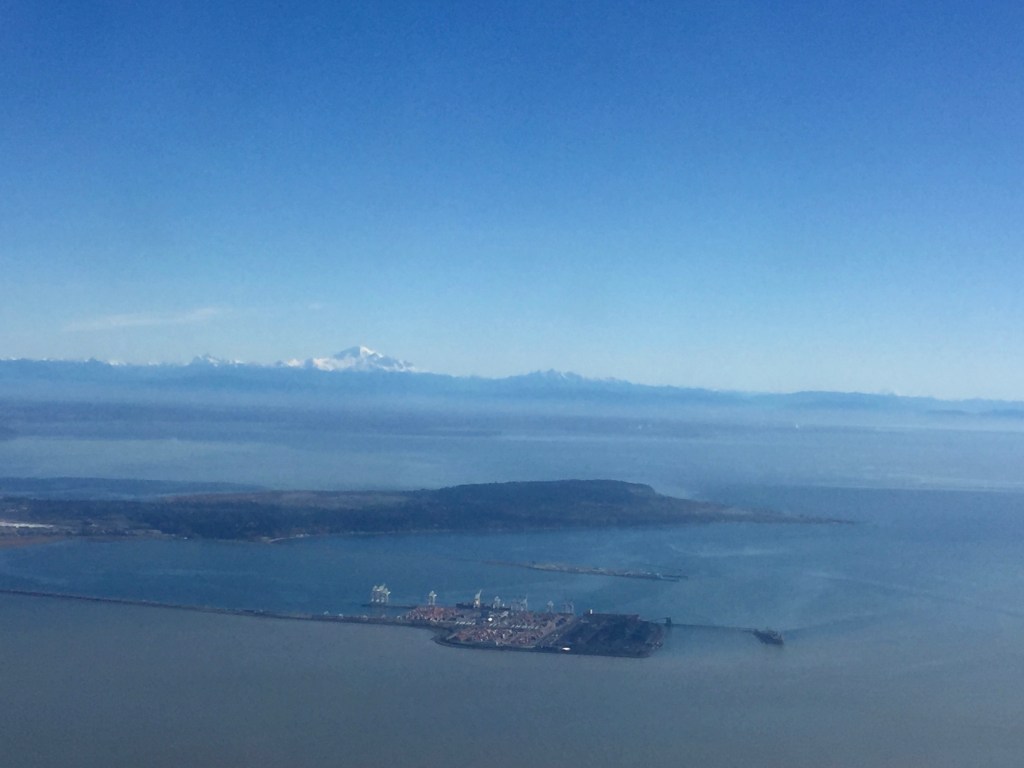
In front, you see the Roberts Bank Superport, and just beyond it, the Tsawwassen B.C. ferry terminal. The superport is owned by Westshore Terminals Ltd., and is the largest single export coal terminal in all of North America. Further back, you see Point Roberts and Mount Baker in Washington state. Photo: Jim Hodgson

Indeed, comparisons of Canadian and Mexican CO2 outputs typify the hypocrisy of global North promises from the perspective of people in the global South. Here’s a comparison of per capital CO2 output based on information from Our World in Data:

Canada (1980 18.14t)  2000 18.52t     2020 14.20t (a 23% drop)
Mexico (1980 3.95t)    2000 4.00t       2020 2.77t (a 31% drop)

And yes: Canada has a colder climate, and our population is spread thinly. But the CO2 output of Mexicans is far lower than that of Canadians, and it’s dropping more quickly.

Development, or something like it, in the face of climate change and migration

Every time someone utters the world ”development” these days, I shudder. Much of what rich countries have done in the name of development over the past 80 years has worsened inequalities and perpetuated colonial patterns of exploitation. But let us rescue what we can….

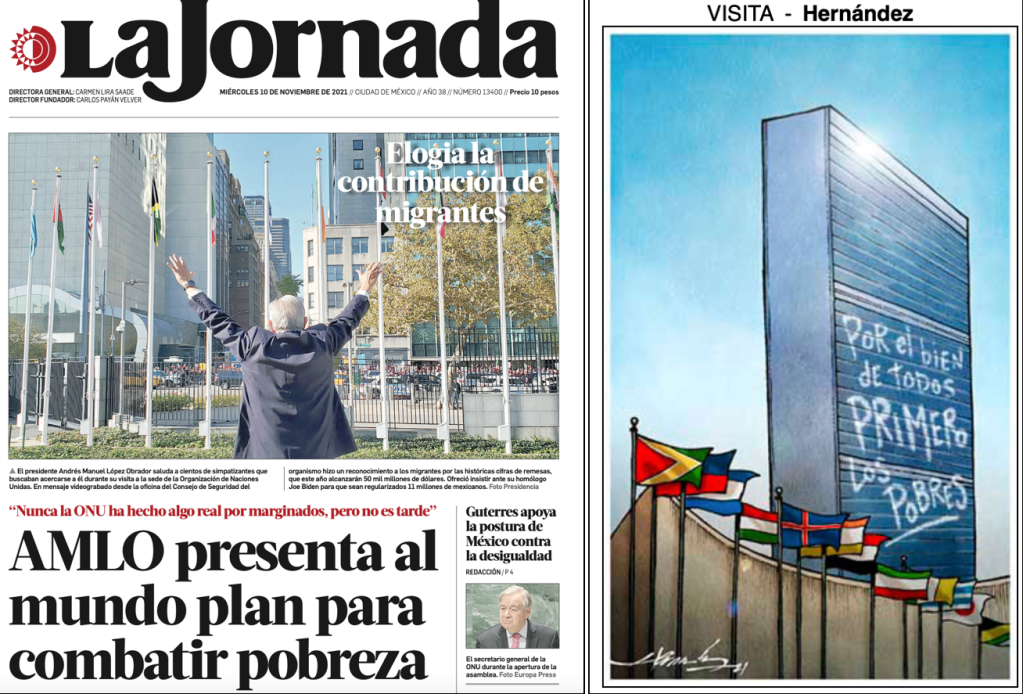
Front page of La Jornada Nov. 10: AMLO at the UN; cartoon by José Hernández, Nov. 10

In a speech to the UN Security Council on Nov. 9, AMLO proposed a plan that would lift about 750 million people living on less than US$2 per day out of extreme poverty. The plan, which would raise about U.S.$1 billion each year, has three sources:

  • An annual voluntary contribution of four per cent of the fortunes of the 1,000 richest people on the planet
  • A similar contribution from the largest 1,000 private corporations on the planet
  • A contribution of 0.2 per cent from each of the members of the G20.

“Never in the history of this organisation has something substantial been really done for the benefit of the poor, but it is never too late to do justice,” he said. “Today is the time to act against marginalisation, addressing the causes and not only the consequences.”

AMLO said that the main problems of the planet are political, economic, legal and financial forms of corruption, and that these lead to inequality, poverty, frustration, violence, migration and grave social conflicts. Using the pandemic as an example, he noted that pharmaceutical companies have sold 94 per cent of their vaccines, but only six per cent has been distributed to the COVAX facility for use in the developing world—a painful and “complete failure of inclusion.”

It was the second international development plan proposed by AMLO this year. At the end of April, he proposed extending a Mexican government agricultural support program to Guatemala, Honduras and El Salvador—with U.S. financial support—as a way to address root causes of migration.

The program, Sembrando Vida (Sowing Life), has been running in Mexico for over two years and is intended to generate jobs in the small-farming sector, reactivate the economy in areas affected by out-migration, and overcome deforestation. “The plan seeks to overcome social exclusion and the poverty that afflicts 61 per cent of the rural population.” It includes focus on community-controlled farms overlooked or attacked by successive neoliberal governments in power in Mexico between 1988 and 2018.

Critics warn, however, that Sembrando Vida is not sufficient. “It won’t but the brakes on deforestation or other degradation, because it’s not having a direct impact on the causes of these problems,” said Danae Azuara of the Mexican Climate Initiative. Additional programs are needed to end deforestation.

Canada, Mexico and the United States are heavily dependent on fossil fuels for their development and, official pronouncements aside, their governments are likely happier in a phase-down world than in an phase-out one. 

But none is exempt from extreme weather events—heat domes and drought, hurricanes and floods—related to climate change.

Climate change—unpredictable cycles of rainy and dry seasons—is a driver of migration from Central America and Mexico to the north. In talks with Biden, Mexico wants the United States to regularize the status of 11 million Mexicans living in the United States, and to negotiate a temporary foreign worker program not unlike the one that Canada already has with Mexico.