¿Qué hubo? What’s going on in Colombia?

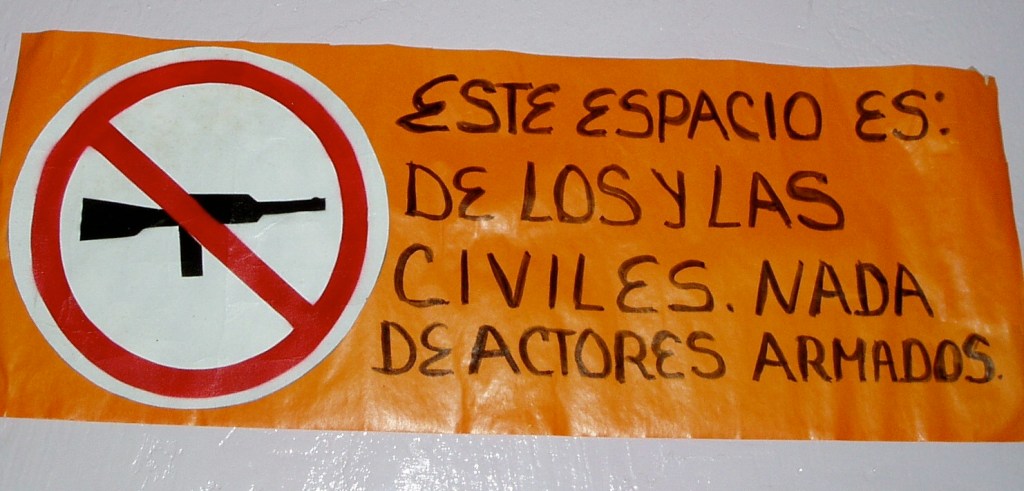
“This space is for civilian women and men. No armed actors.”

Against all odds, the Colombian people have succeeded these recent weeks in mounting the biggest challenge to the country’s ruling class in living memory. 

Since April 28, Colombia has been rocked by mass protests—and excessive police and military repression. The government’s human rights office acknowledges the deaths of at least 42 protesters and one policeman, but independent groups put the toll much higher. 

Protests began because of an ill-conceived plan to raises taxes on working and middle-class people while the COVID pandemic continues to take a huge toll on human lives and the economy. The government backed down and the finance minister quit, but the protests continue because taxes are not the only problem.

“Together we build peace; with the accords, we all win.”

The government of Iván Duque, the president who depends on former president Álvaro Uribe for political support, has done little to implement the peace agreement reached in 2016 by his predecessor, Juan Manuel Santos, and the FARC guerrillas. Nor has it pursued talks with the other guerrilla army, the ELN. Some of the once-demobilized FARC fighters have taken up arms again. Killings of social movement leaders, human rights defenders and ex-combatants continue, reaching “shocking levels” in 2020 according to Amnesty International.

Little is done to assist Colombia’s nearly 8 million internally-displaced people to recover land taken from them by paramilitary death squads acting on behalf of large land-owners—the class that Uribe defends most ardently. Ancestors of that group seized control of Colombia in the wake of the independence struggle two centuries ago, and it continues to take land from Indigenous, Afro-Colombian and other small land-holder farmers. 

With the pandemic, poverty has worsened—and the government does not address the problem. The UN’s Economic Commission on Latin America and the Caribbean (ECLAC) estimated that 37.5 per cent of Colombia’s population lived below the poverty line by the end of 2020, making it the country with the highest poverty rate in Latin America. The World Bank’s numbers give cause to even greater pessimism: it estimates a poverty rate of 45 per cent.

Trade unions, women’s groups, students, Indigenous, Afro-Colombian and LGBTI groups have all been part of the protests. Churches were slow to speak—and some merely echoed the government’s call for order. But Colombia’s Methodist Church and the Presbyterian Church have affirmed the rights of the multitudes to protest. The Evangelical Lutheran Church called on the government to “peacefully listen.”

The Women’s Popular Organization (OFP), a partner of KAIROS Canada, called for political will to implement the peace accords, demilitarization of areas where protests are taking place, and for a “universal basic income for women and families living in poverty.” 

Through Common Frontiers, several Canadian allies of Colombian groups issued a joint statement of solidarity with the protests, and called on Canada to press Colombia to dismantle its riot squad (called the ESMAD and held responsible for most of the violence), halt human rights violations, to negotiate with the National Strike Committee, and “engage in a serious dialogue with social and institutional actors to address the deep inequalities which are at the root of this conflict.”

For a few days, the protests garnered worldwide attention. Canada’s foreign affairs minister, Marc Garneau, condemned “the violence, including the disproportionate use of force by security forces.” He went on to express concern about “the acts of vandalism and attacks directed against public officials responsible for the protection of all Colombian citizens. Canada calls upon those responsible for road blockades to allow the free passage of goods and services essential to fight the COVID-19 pandemic.”

Left: “The land is for those who work it.” Right: Displacement.

When thinking about Colombia today, however, it’s important to bear in mind the falsos positivos, the false positives—6,402 murders carried out during the Uribe presidency. Colombia’s armed forces kidnapped young men from urban barrios, murdered them, dressed them as guerrillas, and then tried to pass them off “successes” in its war on “terrorism.” They’re quite capable of dressing themselves up, acting as vandals, and then blaming the protesters.

While proclaiming support for peace, Canada’s Prime Minister Stephen Harper signed a free trade agreement with Uribe in 2008; opponents (among whom I was one) stalled its implementation until 2011 because it rewards the same thieving class that has ruled Colombia since 1810. 

Canada also allows weapons sales to Colombia. The Colombian human rights group CREDHOS, a partner of Peace Brigades International, is calling on Canada to stop technical assistance, logistical or financial support to the Colombian armed forces and police. 

“The world is seeing the repression that is happening in Colombia. We call on Canada and other countries to please talk about the violence in Colombia. If there is any sort of military support or technical assistance, please abstain from providing that military aid because they are attacking the civilian population.”

“With due respect to the Canadian government we are asking that through your different actions and mechanisms, diplomatic channels that you have with the Colombian state, that you can speak to the national government and express your concern about systematic human rights violations in the context of the social protests.”

“Hopefully from the actions of the Canadian government and other countries we will be able to de-escalate the violence we are facing today in our country.”

Canada also has a “bilateral police initiative” with Colombia, announced in 2017 by Prime Minister Justin Trudeau

Antidotes to neocolonial “development” in Central America

Santa Marta’s school, church and a greenhouse

Following on my post yesterday about the Biden Plan: what would it take for a development plan to work for Central Americans? We need to unwrap that word “development.”

Over many years, it has been my joy to work with organizations created by people in the region who talk about their aspirations in ways that are different from the White House or the World Bank.

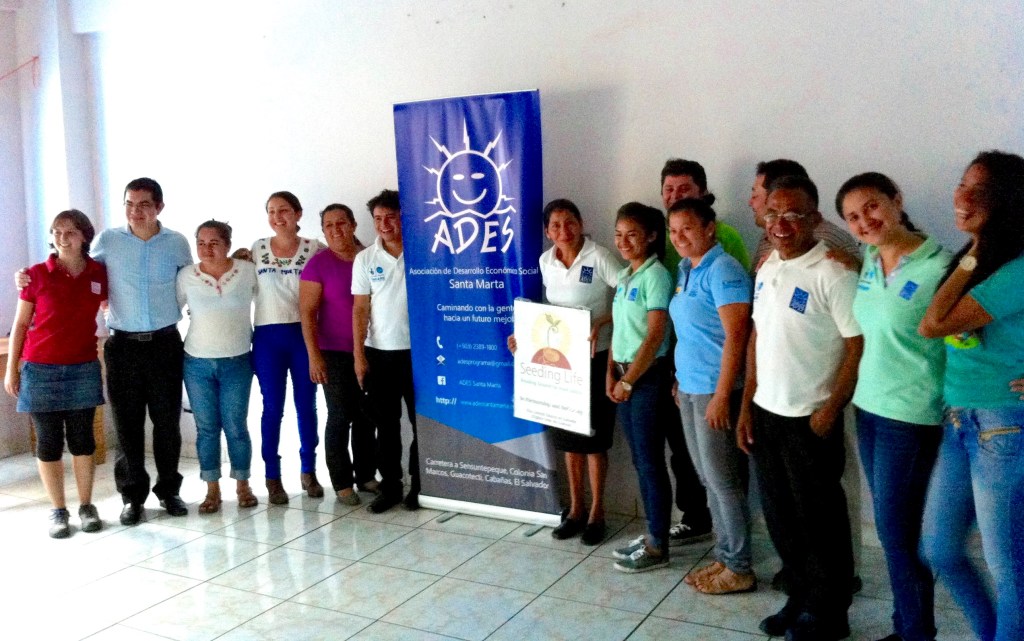
In May 2018, I found myself in conversation with one of the founders of the Association for Economic and Social Development (ADES) in the northern part of Cabañas department in El Salvador. ADES sometimes describes itself as a “social movement that is organized as a non-governmental organization” (NGO).

I asked one of the founders, Alonso, about the word “development” in the organization’s name. In response, he gave me what he called the “A-B-C-D of all of this.” The roots of community organization in the area were in the growth of base Christian communities (CEBs) in the 1960s and 70s, he said. Because of persecution during the civil war in the 1980s, the people of Santa Marta fled to Honduras. As the war came to an end in the late 80s and early 90s, and as the people of Santa Marta returned in October 1987, ways had to be found for the people “to defend themselves” against local and national governments. Alonso said: 

“We had to create conditions for life. We wanted development in rural areas. We sought water, land, health. Later, this was organized in a more intentional way [with the creation of ADES in 1992]. The first thing we did was to build a community centre for events, parties, weddings, and meetings.” 

Over time, people—especially women—began to see different possibilities for changing their conditions. Women began a small store that they owned cooperatively. Other projects began and spun off: micro-credit, community radio, the regional AIDS committee CoCoSI, among others. The United Church of Canada and the Anglican Primate’s World Relief and Development Fund were supporters from the outset. Alonso added: 

“For us development means to improve a the conditions of the people a little bit: having water in the communities, sharing land, getting access to health care and education, and transportation.”

Today, formal education is one of Santa Marta’s great successes. More than 100 people graduate from high school each year. ADES continues to lead in agricultural development and training in northern Cabañas. Even so, about half of the young grads choose to leave each year to continue their educations or to work in other cities, but they leave with a huge educational advantage.

Leaders of ADES in 2016

Throughout Central America, churches and NGOs support a wide variety of initiatives that benefit small farmers, emphasizing good ecological practice including reforestation. They also work to strengthen the voices of women in community and in their churches.

The challenges are growing. Climate change has meant both prolonged drought and more severe storms, including two hurricanes this past November. Part of the problem, especially in El Salvador, Honduras and Guatemala, is high levels of violence that is partly related to the illegal drug trade and to the growth of street gangs. Those are factors leading to migration away from the region. 

In the face of violence in El Salvador, churches work to build a “culture of peace.” For example, Emmanuel Baptist Church (IBE) in San Salvador backs a program for youth led by youth. In a meeting in June 2019, 17-year old Laura said: “The way to achieve peace at the national level is to start from what is small. Begin with childhood. If someone beats a child, tell them not to, that’s not good. You have to treat them the way you want to be treated.” Peace, then, is the way of non-violence, providing people with the skills they need so they need so as not to be subject to the logic of the gangs. 

“Perhaps we are just a few people,” said Laura’s friend Michelle, also 17. “But if we come together, not just as church, not just as school, not just activists, but everyone, and if the government would support us, peace can be achieved.”

Yes. And:

In a conversation around the same time with another friend, Jorge, a leader in Guatemala’s LGBTI community, I said that it seemed to me that the violence in some Central American countries had to do with the failure of the peace accords that ended the civil wars, and the failure to provide some sort of authentic development across the region. 

But Jorge replied: “No, in fact, it has all worked out exactly the way that the elites and the big business-owners wanted: people are fighting with each other, too afraid to raise their voices, and they are afraid of their neighbours.” 

In that sense, the work of ADES and IBE represents signs of a future still to be attained. Part of the logic of ADES was for the people to live as if they had won the war: land was re-distributed, people were empowered for change.

But on the larger scale, our efforts for peace and a more inclusive vision of human development were largely defeated by a U.S.-backed military strategy and then by the imposition of a toxic development model, the one that has resulted in incredibly high rates of violence and unconstrained migration toward Mexico and the United States.

Neo-colonial inertia and development plans for Central America

The shopping mall model of development (Honduras, 2009)

In October 2008, in a classroom in Ciudad Juárez—one of the most violent cities on the planet but on the border with the richest country—an international ecumenical group considered the latest official development plan for Mexico and Central America.* 

After hearing from Raúl Moreno, an economist from El Salvador long active in the Hemispheric Social Alliance of groups that questioned free trade and other top-down, capital-intensive development schemes, I wrote in a report:

“When you look at the extreme violence occurring in Juárez, the de-population of rural Mexico, the official development plans in Central America (and consequent dislocation of rural populations), and the extreme violence carried out in Colombia to drive rural populations from their land, you come away with the impression of a development model that has been continuously applied since the days of the “wild, wild west” in the United States. The model is now extended all the way to Colombia and beyond: drive Indigenous peoples on to ever more marginal lands; destroy small farmers; insert mines and hydro-electric projects where convenient to the interests of large capital; and reward allies by granting them the lands of the displaced.”

I suppose it’s progress of a sort that the masters now see the need to incorporate ecological goals into their development plans.

But these plans have at their core a neoliberal notion of development: cut protection for workers, reinforce free trade agreements, and protect private-sector investment. 

The latest plan, promoted by President Joe Biden, Vice-President Kamala Harris and the leaders of Guatemala, Honduras and El Salvador, does not correspond to the real needs and aspirations of the people: land redistribution, legal reform, ecological justice, human rights, and for Indigenous peoples: full implementation of free, prior and informed consent.

On Monday, April 26, the same day that Harris held a video conference with Guatemalan President Alejandro Giammattei, the progressive Mexican daily newspaper La Jornada questioned the U.S. approach. During the U.S.-led Earth Day summit that was held a few days earlier, Mexican President Andrés Manuel López Obrador proposed extending a Mexican government agricultural support program to Guatemala, Honduras and El Salvador—with U.S. financial support. 

The program, Sembrando Vida (Sowing Life), has been running in Mexico for two years and is intended to generate jobs in the small-farming sector, reactivate the economy in areas affected by out-migration, and overcome deforestation. “The plan seeks to overcome social exclusion and the poverty that afflicts 61 per cent of the rural population.” It includes focus on ejidos and other community-controlled farms overlooked or attacked by successive neoliberal governments in power between 1988 and 2018 in Mexico.

In her meeting with Giammattei, the Vice-president Harris announced $310 million in U.S. government support for humanitarian relief and to address food insecurity in Guatemala, Honduras and El Salvador. This is in addition to $4 billion announced by President Biden on the day of his inauguration that is intended to “address the root causes of migration” from Central America.

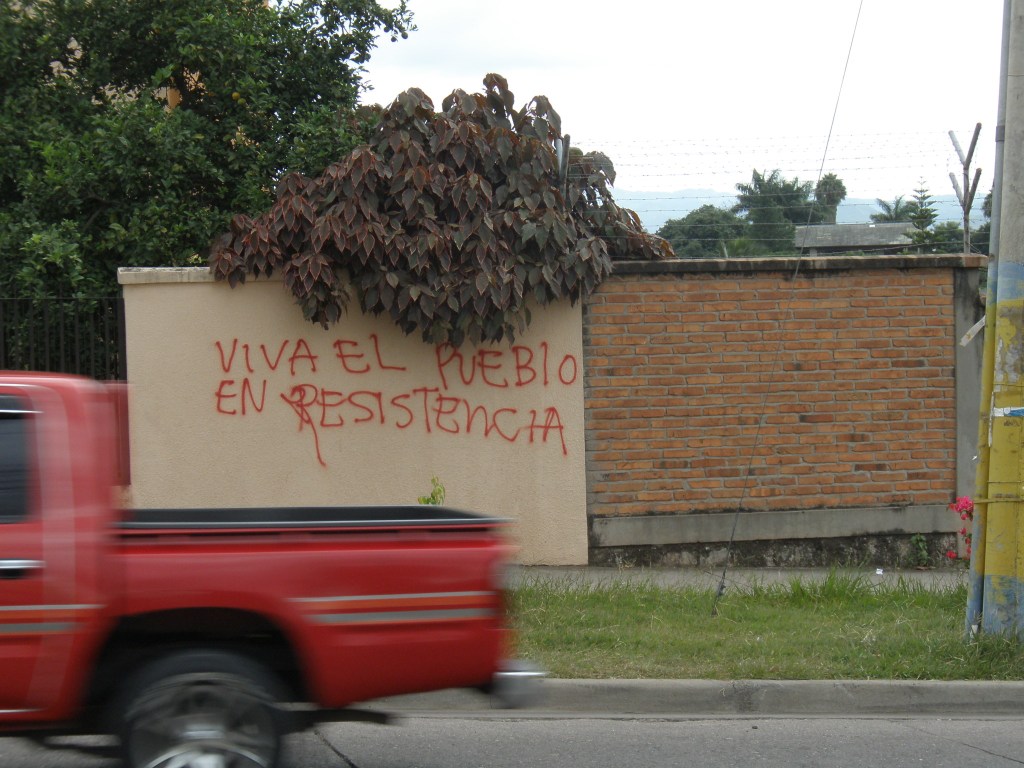
Graffiti in Honduras, 2009: “Long live the people in resistance.”

“Without strong collective action, this will mean MORE money for militarization and neoliberal economic policies that will continue to displace people from their lands and communities,” said a statement from the Committee in Solidarity with the People of El Salvador (CISPES). CISPES, joined by other solidarity and religious groups, demanded an end to U.S. police and military assistance in El Salvador, Honduras and Guatemala, and an end to development policies that “promote climate change, privatize natural resources and public services, violate workers’ rights and destroy Indigenous and communal lands.”

One of the last people I met before the pandemic lockdown began in mid-March 2020 was Giovanni Batz (G’io B’atz), a U.S.-Guatemalan researcher. He was in Toronto for a two-day conference about Central American migrants and refugees at York University. In this essay, he denounces the latest U.S. plan and explains why it will fail. By supporting further militarization and neoliberal development in Central America, the United States contributes to displacement. “When discussing climate change, hunger, and poverty as causes of migration,” he writes, “land redistribution, reform, and rights must be discussed as solutions.” 

La Jornada’s editorial noted that Biden-Harris roll-out is through a series of bilateral meetings. “The White House has not accepted multilateral treatment of human displacement and the environmental crisis, the newspaper said. 

It reflects the historic preference of the White House to negotiate individually with each country, a terrain in which the superpower can more easily impose its terms and conditions. As it confronts the migration issue, we hope that the Democratic administration will go beyond the colonial inertia that shapes every foreign policy action from a position of advantage over and against the other, and that it will recognize that behind the migration flows there are economic and social components apart from climate change which must, nevertheless, be confronted with the same urgency as global warming.

* Plan Puebla Panamá had just given way that year to the Proyecto Mesoamérica (the Project for the Integration and Development of Mesoamerica), which would later become the Comprehensive Development Plan and then the Comprehensive Regional Protection and Solutions Framework (MIRPS).