The shopping mall model of development (Honduras, 2009)
In October 2008, in a classroom in Ciudad Juárez—one of the most violent cities on the planet but on the border with the richest country—an international ecumenical group considered the latest official development plan for Mexico and Central America.*
After hearing from Raúl Moreno, an economist from El Salvador long active in the Hemispheric Social Alliance of groups that questioned free trade and other top-down, capital-intensive development schemes, I wrote in a report:
“When you look at the extreme violence occurring in Juárez, the de-population of rural Mexico, the official development plans in Central America (and consequent dislocation of rural populations), and the extreme violence carried out in Colombia to drive rural populations from their land, you come away with the impression of a development model that has been continuously applied since the days of the “wild, wild west” in the United States. The model is now extended all the way to Colombia and beyond: drive Indigenous peoples on to ever more marginal lands; destroy small farmers; insert mines and hydro-electric projects where convenient to the interests of large capital; and reward allies by granting them the lands of the displaced.”
I suppose it’s progress of a sort that the masters now see the need to incorporate ecological goals into their development plans.
But these plans have at their core a neoliberal notion of development: cut protection for workers, reinforce free trade agreements, and protect private-sector investment.
The latest plan, promoted by President Joe Biden, Vice-President Kamala Harris and the leaders of Guatemala, Honduras and El Salvador, does not correspond to the real needs and aspirations of the people: land redistribution, legal reform, ecological justice, human rights, and for Indigenous peoples: full implementation of free, prior and informed consent.
On Monday, April 26, the same day that Harris held a video conference with Guatemalan President Alejandro Giammattei, the progressive Mexican daily newspaper La Jornada questioned the U.S. approach. During the U.S.-led Earth Day summit that was held a few days earlier, Mexican President Andrés Manuel López Obrador proposed extending a Mexican government agricultural support program to Guatemala, Honduras and El Salvador—with U.S. financial support.
The program, Sembrando Vida(Sowing Life), has been running in Mexico for two years and is intended to generate jobs in the small-farming sector, reactivate the economy in areas affected by out-migration, and overcome deforestation. “The plan seeks to overcome social exclusion and the poverty that afflicts 61 per cent of the rural population.” It includes focus on ejidos and other community-controlled farms overlooked or attacked by successive neoliberal governments in power between 1988 and 2018 in Mexico.
In her meeting with Giammattei, the Vice-president Harris announced $310 million in U.S. government support for humanitarian relief and to address food insecurity in Guatemala, Honduras and El Salvador. This is in addition to $4 billion announced by President Biden on the day of his inauguration that is intended to “address the root causes of migration” from Central America.
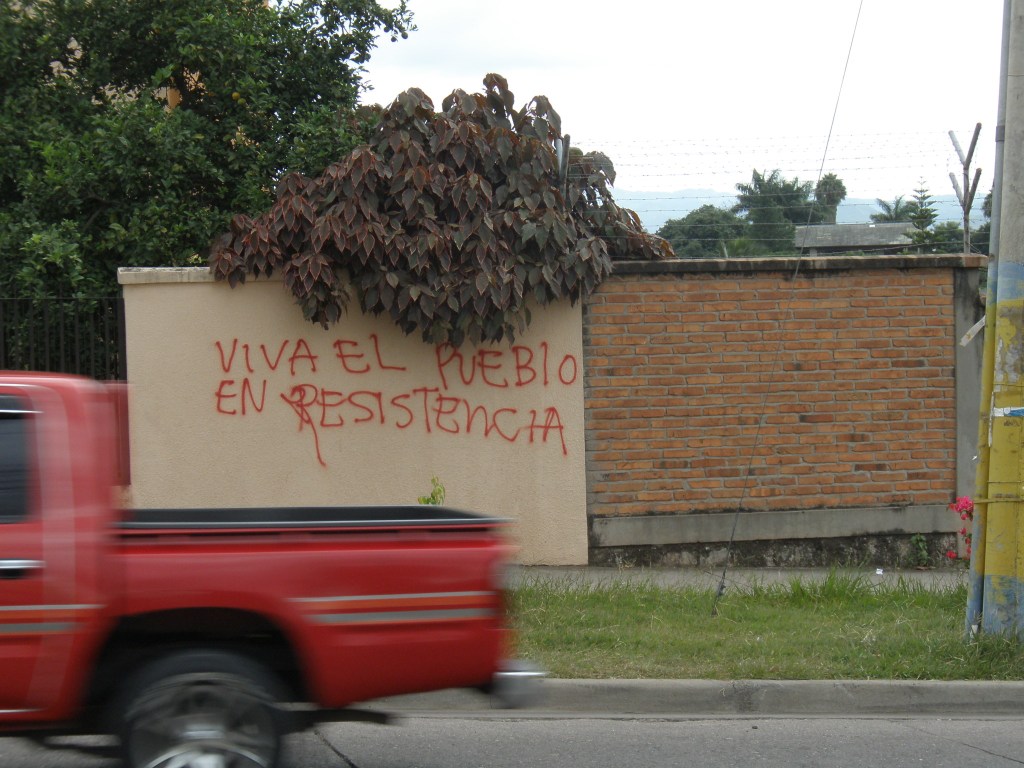
Graffiti in Honduras, 2009: “Long live the people in resistance.”
“Without strong collective action, this will mean MORE money for militarization and neoliberal economic policies that will continue to displace people from their lands and communities,” said a statement from the Committee in Solidarity with the People of El Salvador (CISPES). CISPES, joined by other solidarity and religious groups, demanded an end to U.S. police and military assistance in El Salvador, Honduras and Guatemala, and an end to development policies that “promote climate change, privatize natural resources and public services, violate workers’ rights and destroy Indigenous and communal lands.”
One of the last people I met before the pandemic lockdown began in mid-March 2020 was Giovanni Batz (G’io B’atz), a U.S.-Guatemalan researcher. He was in Toronto for a two-day conference about Central American migrants and refugees at York University. In this essay, he denounces the latest U.S. plan and explains why it will fail. By supporting further militarization and neoliberal development in Central America, the United States contributes to displacement. “When discussing climate change, hunger, and poverty as causes of migration,” he writes, “land redistribution, reform, and rights must be discussed as solutions.”
La Jornada’s editorial noted that Biden-Harris roll-out is through a series of bilateral meetings. “The White House has not accepted multilateral treatment of human displacement and the environmental crisis, the newspaper said.
It reflects the historic preference of the White House to negotiate individually with each country, a terrain in which the superpower can more easily impose its terms and conditions. As it confronts the migration issue, we hope that the Democratic administration will go beyond the colonial inertia that shapes every foreign policy action from a position of advantage over and against the other, and that it will recognize that behind the migration flows there are economic and social components apart from climate change which must, nevertheless, be confronted with the same urgency as global warming.
* Plan Puebla Panamá had just given way that year to the Proyecto Mesoamérica (the Project for the Integration and Development of Mesoamerica), which would later become the Comprehensive Development Plan and then the Comprehensive Regional Protection and Solutions Framework (MIRPS).
Back in the mid-1980s, as Dominican farmers and trade unionists were teaching me and the rest of the world about debt conditionality, structural adjustment and the International Monetary Fund, their critics said they merely mimicked the government’s excuses for inept policies. The fact that we’re having the same conversations again almost 40 years later says to me that the farmers and workers were right.
Take a moment to recall what people in many global South countries were enduring in the 1980s. A glut of oil money in U.S. and European banks in the 1970s had led to a loans frenzy: developing countries got cheap credit. But the recession in the 1980s saw interest rates skyrocket.
Protesters in the Dominican Republic in 1984 took their protests into the street. Many civil society organizations try to carry voices of those locked out of decision-making spaces inside meetings like the UN gathering on debt relief.
The resulting “third-world debt crisis” (as it was called at the time) became a shock-doctrine opportunity to strengthen a harsher form of capitalism, one that came to be called “neo-liberal economic globalization” (or simply neoliberalism or globalization). Dominicans and countless others around the world protested, but by the turn of the millennium, this new world order was firmly entrenched.
A new crisis—the effects of the Covid-19 pandemic—has revealed the old, unhealed fractures as countries struggle to sustain already-weak health systems, provide testing and vaccines, and keep economies at least partly functioning.
To their credit, the United Nations secretary general, Antonio Guterres, and Prime Ministers Justin Trudeau of Canada and Andrew Holness of Jamaica, convened a conversation March 29 among world leaders and heads of various international financial institutions.
Top row: Prime Minister Andrew Holness, Jamaica; Lidy Nacpil, Asian Peoples’ Movement on Debt and Development; Ngozi Okonjo-Iweala, World Trade Organization. Bottom row: Prime Minister Justin Trudeau, Canada; President Alberto Fernández, Argentina; and President Nicolás Maduro, Venezuela.
Holness and Argentinian President Alberto Fernández called for fundamental reform of “debt architecture” and the need for a “multilateral framework for debt restructuring.” Such steps would break from current practice, which allows wealthier countries (G7, G20) or groups dominated by them (the World Bank and International Monetary Fund), along with private creditors, to make decisions binding on all the other countries. Fernández added that there can’t be a global recovery when there are countries excluded from the solutions.
Venezuela’s president, Nicolás Maduro, said nations should ensure that “measures are not a weapon to control our countries.” He urged “comprehensive restructuring” and an end to use of “unilateral, coercive and criminal” sanctions against his country and others.
The civil society organizations (CSOs) that have laboured for decades to build a system to manage and resolve debt issues said later that the leaders “continue to kick the can down the road” on meaningful reform. The groups welcome measures like the G20 agreement to further delay debt payments by the most impoverished countries (a mechanism called the Debt Service Suspension Initiative, or DSSI) to June 2021, and action to use global reserve funds (“special drawing rights,” or SDRs) to support recovery efforts in developing countries. [On April 1, the IMF approved a third tranche of grants for debt service relief for 28 countries through Oct. 15.]
But more needs to be done, said the CSOs. “Rich countries are continuing to prioritise their own power over global solidarity, leaving many people behind.” Moreover, the measures do not do enough to assist middle-income countries (like Argentina and Jamaica) with their challenges, or address the problem of the private-debt “cartel.”
“Throughout decades of exploitation, rich countries accumulated a social and ecological debt owed to the people in developing countries which is higher than our financial debt. Today these same rich nations fail to deliver the system changing solutions that we need, including immediate debt cancellation by all lenders for all countries in need”.
Lidy Nacpil, Coordinator of the Asian Peoples’ Movement on Debt and Development (APMDD)
“A multilateral framework under the UN is the only way to resolve the crippling debt crises affecting the world’s poorest. This is the only way to ensure debt cancellation in a fair and orderly fashion, where developing countries have a seat at the table. This would ensure a future of responsible lending and borrowing together with regulation based on human rights and gender justice.”
Patricia Miranda, Advocacy Coordinator at the Latin American Network for Economic and Social Justice (Latindadd)
World Social Forum, Porto Alegre, January 2005
One potential forum for further work would be a global conference next year on Financing for Development—”Monterrey+20”—with the issue of global economic architecture firmly on the table.
“Pursuit of a permanent solution to the debt problem both for poor countries and middle-income countries starting with an immediate cancellation of the external debt of poor countries and setting up, under UN auspices, an independent and fair debt arbitration mechanism for current and future loans which will promote ethical lending and borrowing policies.”
As Ngozi Okonjo-Iweala, the newly appointed Director-General of the World Trade Organization, stated during the meeting: “lost decades are a policy choice.”
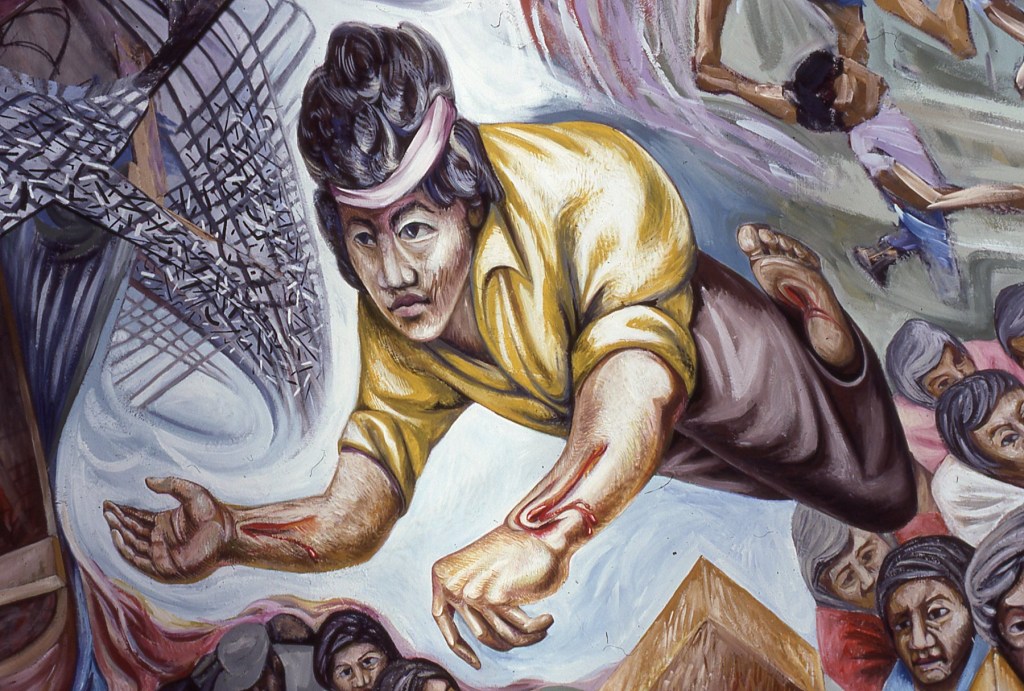
The Risen Christ: Detail from the central mural of the Iglesia Santa Maria de los Angeles en el Barrio Riguero, Managua (Jim Hodgson, 1984)
Things that have been different in the past can be different again in the future.
If, like me, you are distressed by actions of religious extremists and their allies among Canada’s bishops against global partners of the Canadian Catholic Organization for Development and Peace (D&P), then it is useful to remember how some forward-looking people were inspired by the Second Vatican Council and by social and political change in the global South to create the organization back in the 1960s.
Today I share with you the text of an interview I did in February 1989 with Bill Smith, a Scarboro Missions priest who had just finished 15 years of service as D&P’s Central America project officer. Bill died less than three months later, just after arriving in Brazil.
I share Bill’s words to me that day in Montreal 32 years ago as a sign of what has been possible, and of what can be possible yet again.
The interview was published in Scarboro Missions magazine, September 1989, pp. 4-7.
Bill: I was 50 years old last November, so I begin by saying this is quite a remarkable phenomenon to have lived so long in a world where the majority of people do not even attain early adolescence. It is not at all remarkable in the North American continent but it is very remarkable if set in the framework of what we traditionally refer to as the Third World.
To place in context where I am and the journey that I have made, we would have to go back almost 30 years to Vatican II. A revolutionary process was underway in Christianity by the early 1960s. Women and men in the Church had become identified and involved in life and death struggles of primarily peasant farm peoples with whom they had been working, and with the struggles of oppressed people. Out of this context emerges later on in history what they refer to as the theology of liberation. This theology denounces injustice and announces that the gospel is involved in bringing about change and justice. Vatican II was a moment in this century when the Catholic church which over a period of hundreds of years had distanced itself from the radical message of the gospel, got in touch with its roots again, and that has made a profound change throughout Christianity and throughout secular society as well. It certainly made a profound change in myself.
The articulation of that “new vision” of society and the now famous encyclical of Paul VI, The Progress of Peoples, state that the Church does not have economic answers, nor does the church have any particular model of society, but only suggests that men and women working together must build a society based on the logic of the poor majority. There was also the serious question of the absolute right to private property on which our North American society is based.
We witness this radical change in the thinking and the living of the gospel message because the Catholic Church is no long a white, middle-class Western and European church but is a peripheral church made up of men and women who are not attached to the status-quo of the present economic system that we see primarily in the West called Capitalism, but who are looking for and demanding, in the name of their faith, a radical change in the structures of society.
So today, I no long think that mission is primarily the proclamation of a message that is assented to in faith, but today it is an evangelization based on a faith that does justice. So mission is no longer considered as only the work of missionaries, who leave their country to proclaim the gospel in distant lands.
When I first went to Brazil, I thought that mission would be working in the Amazon. But what I had originally thought, in my simplicity, that there were frontiers and barriers between countries, was again part of a mythology. I discovered that there was a social, economic and ecological vision of men and women that was being imposed by the powerful over the weak. I have also witnessed a church that has done a self-critique and had realized that it does not own the gospel, and does not own the historical Jesus. I have seen the Magnificat lived in the sense of the ‘great’ being questioned and pushed to the wall by the ‘small’ who have been lifted up. I think that is amply illustrated in the case of Nicaragua and El Salvador. Despite literally millions of dollars per day being put into machines of death, the men and women of Nicaragua and El Salvador are building a society precisely that comes out of this new awareness of social justice. These are poor people, suffering people, who are the victims of an unjust and aggressive war.
A different era of North-South cooperation: Bishop Bernard Hubert, Longueuil; Fr. Bill Smith, SFM; Bishop Remi de Roo, Victoria; Cardinal Paulo Evaristo Arns, São Paulo.
I would say that the major changes that I discovered in working in Central America over the last few years has been primarily a tremendous awareness of people, of men and women and peasant farmers who are capable of seeing very clearly what is going on. Where is the creativity taking place in the world today? Men and women in the Third World see clearly and understand that there is a structure that has been put in place. And that poor housing and lack of schools and lack of health facilities and lack of education is no indication of any kind of inferiority. But it is a provoked phenomenon. It is something that is determined. What I get very excited about is this tremendous creativity where poor people are looking a life and asking, Why can’t everybody have a decent life? Why can’t we build an economy in which people don’t have to be destroyed through pesticides? Why can we not build a society where justice applies to all, and where women are not chattels and objects but full human beings with all the rights that men have? And why cannot religion, instead of being something that suffocates and destroys creativity, be the source of new energy, integration and wholesomeness?
Growth takes place when people begin to come to grips with the real issues in society, when we get beyond the guilt of feeling responsible for what has happened in the Third World, to where we feel we are co-responsible for transforming our Third World here in Canada and all the other Third Worlds. People are coming together and trying to understand, moving beyond mythology to an understanding of society. That is what I see having happened in this period for the past 30 years.
I think that Development and Peace has fundamentally held on to this meaning of the encyclical The Progress of Peoples and realized quite prophetically that social change is fundamentally all about empowering people and not about technology or funds or even personnel, that transformation takes place when people begin to come together and share. Solidarity, so beautifully stated in Nicaragua, is the tenderness of peoples. So that if you are going to have social change then you have to have the empowerment of people who are going to bring about change.
Q: Who are the major actors to bring about change in society in Central America?
It is the majority of people who are the peasant farmers. Women and men involved in alternate forms of education for the ordinary people, since to be ‘educated’ has been primarily reserved to the elite. What Development and Peace does, and I think does well and with a great deal of respect is to accompany groups, communities and other popular organizations in Central America who are involved in the very democratic process of resolving their own problems through new forms of popular education. So we don’t tell them what to do. They present projects to Development and Peace for financial help. So that is one leg. Development and Peace walks on two legs. Its other leg is here in Canada because it has to be involved in what is happening here. If you are not, what kind of credibility can you have by being in another country? Thus, Development and Peace has to conscientize or educate us Canadians here in Canada. This happens by bringing peoples, spokespersons, men and women to be with us. It is those two legs or accompaniments that make for an exciting development journey.
We must note, however, that the people in the Third World are no longer talking about development. They are talking about liberation and they are talking about liberation in a broader context—social, economic, political and religious liberation. And so the evangelist goes out and ends up being evangelized. The teacher becomes the student. The Third World peoples do need us as we need them to walk together, to listen to each other, to be strengthened, to be empowered mutually, to bring about precisely this vast change that we need in our own Canadian society. St. Augustine says Hope had two beautiful daughters: one of them called Anger because of the way things are and the other called Courage to work to change things, to bring about change.
That is what I have learned, what the Third World has taught me, and I would hope that at the end of all of this, if indeed there are any titles left to be handed out, I and others would be entitled to the name Companion. I think that is what Development and Peace is, I think that is what Scarboro is and it is something that I aspire to as well.
Q: What did you do in Central America?
I was a bridge, a contact between farmers’ groups, unions, women’s groups, health groups, popular education groups, human rights groups and Canadians. Solidarity has to be personalized. I mean people have to sit down and break bread together. That is what Companion means, and that is when Jesus was recognized on the road to Emmaus. He walked with them, he talked with them but it was when they broke bread they knew Him.
What is important is the quality of life here and in the Third World and the exchanges and dialogue that takes place. I carry in my heart so many wonderful people and I think that is what is important. So much so that now I can go back to Brazil in a totally renewed, energized way and do exactly the same thing. Nothing but to be present, which is to accompany, and to come back to my own people once in a while and say, “You know folks there are really doing some tremendous things right now,” in São Paulo or wherever it is one happens to be.
Q: What were some of the successes you experienced?
Well, I think that the beautiful successes are the struggles of the people in Guatemala, people in El Salvador and in Nicaragua, people who have been faithful to their commitment to bring about social justice. Part of the work, it seems to me, is to bring people to another level of awareness that life is precious and that there are things that we can do. We are not helpless. Also at home, to denounce the violations of human rights; to open our borders to receive people who are driven from their homes; to be courageous enough to denounce international terrorism; to be courageous enough to make available sources of information so as to counter the lies that are put forward in the press. The important thing, I’ve learned, is that we are not helpless. And as Nicaraguans have taught us, those who struggle never die. They are always present. We will be remembered because we are part of a process. A process that did not begin with us, a process that does not end with us. The responsibility we have is handing on that mandate to others.
Q: What do you think Canadians can learn from your experience?
That we are not to be paralyzed or overcome with guilty but we must begin to work here. It is to the degree that we are involved in our own community here in Canada that we can understand what other people are doing. There is communion that is possible. We can understand each other because we have had the same experience. There is, and very much so, a new awareness and commitment in Canada to come to grips with the real issues in society, to repair the damage that has been done. So there is a great deal of hope, that is what’s so exciting.






 Unwrapping Development