Standing up for gender justice: the case of Development and Peace

As I write on Monday, March 29, I am listening to world leaders and heads of international financial institutions talking about the need for lasting solutions to foreign debt, which constitutes a severe impediment to pandemic recovery and the potential to live better in the world’s so-called “developing” countries.

I remember with pride the collaboration among churches and their development agencies in the Canadian Ecumenical Jubilee Initiative in the late 1990s as they gathered 640,000 signatures to demand cancellation of the debts of the world’s poorest countries.

Among that campaign’s enthusiasts were the people of the Canadian Catholic Organization for Development and Peace (CCODP, or D&P). Over many years, I have worked alongside D&P staff, volunteers and partners in Canada, Africa and Latin America to seek justice for people who affirm that another world is possible. 

It was collaboration with D&P staff in the wake of their support for communities in Honduras affected by a gold mine that engaged me more deeply in similar struggles in Guatemala, El Salvador, and elsewhere. D&P continues to work with other allies in the Canadian Network on Corporate Accountability (CNCA) to ensure that Canadian mining companies may be held accountable here for their actions overseas.

I write with full appreciation for all of these compañer@s.

But a small band of religious extremists has pressed Canada’s Catholic bishops and D&P leadership into breaking relations with some of D&P’s global south partners.

Since 2009, a far-right “news” site (banned recently by YouTube for posting fake reports about COVID vaccines) has published allegations about some D&P partners. The accusations came from people with no experience of North-South collaboration or of work in coalitions, and tended to focus on groups that empower women or that work in coalitions with women’s organizations. Subsequent developments have been well-covered in French-language media (especially Présence Information Réligieuse). In recent weeks, a stream of news releases and commentaries have also appeared in English, and I will provide some links below.

On Feb. 25, the CCCB and D&P released a news release summarising their review of D&P’s international partners. From a total of 205 global partners, 63 were examined. Of those, funding will be discontinued for 24 groups. Partnerships with 19 others had either ended or was about to end.

Decisions to cut the 24 partners were based on “a lack of clarification to resolve serious questions regarding support for positions or actions in conflict with the Church’s social and moral teachings,” the report said. Names of the groups affected were not divulged.

On March 8, Présence-Info published more detail about the methodology that was used to decide which groups would be cut. 

“The issue of abortion and the sexual health of women, as well as fear of scandal, were the principle reasons that pushed D&P to delist 24 of its international partners,” said Présence-Info after reviewing dozens of pages of internal documents. The partners were pressed to “justify themselves on questions that touched exclusively on sexual morality, particularly concerning women.” No questions were asked about corruption, racism, complicity with violent groups, or other development or solidarity issues.

On March 17, the Canadian Religious Conference (the body that represents members of religious orders) called on D&P to respond the Présence-Info report: 

“Is that what happened? If not, what happened? Development and Peace’s continued silence would be harmful to its credibility, which is already undermined by this lengthy partner review process.”

Canadian Jesuits published a statement of their own on March 22. “We are deeply saddened to learn that so many CCODP partners are losing this vital support from CCODP. We regret that the process to arrive to this decision was not marked by the transparency and collaboration that the Church knows are key virtues to witnessing to the Good News and to becoming a synodal Church,” the statement said.

“It appears that a review was undertaken with the purpose of judging the partners on their adherence to the Church’s teachings on sexual matters.  We believe,  however that the partners should be viewed with gratitude for their demonstrated and consistent commitment to the core richness of the Church’s social teachings. If consulted, lay people and the Religious of Canada, many of whom have worked in the Global South and who personally know many of these organizations and their contexts, could have provided more accurate information on the partners under review.”

On March 24, the Christian feminist collective L’autre Parole said the situation was unacceptable. It has had “particularly harmful repercussions for women in the Global South” and is “contrary to elementary principles of law and social justice.”

Over the years, some groups were targeted by the fake-news outlet, and others came forward themselves to say that they were under investigation. Among them are Radio Progreso, a Jesuit-backed community station in Progreso, Honduras, that I visited in 2009 a few weeks after the coup. Another is Famn Deside, a women’s group (founded in the late 80s by nuns, the Soeurs du Bon-Conseil) in Jacmel, Haiti. I had planned to visit them in February last year, but civil unrest and the pandemic prevented me from travelling. A March 25 article in Présence-Info describes both groups.

Like all development agencies that receive public funding, D&P has a gender policy. It includes a statement from Pope Francis, who is also a target of attacks from the religious and political far-right.

“History is burdened by the excesses of patriarchal cultures that considered women inferior…. There are those who believe that many of today’s problems have arisen because of female emancipation. This is false, untrue, a form of male chauvinism. The equal dignity of men and women makes us rejoice to see old forms of discrimination disappear, and within families there is a growing reciprocity…. [W]e must nonetheless see in the women’s movement the working of the Spirit for a clearer recognition of the dignity and rights of women.”

  • Pope Francis, Amoris Laetitia (2016)
  • L’autre Parole says that Famn Deside is still receiving its funding. “We are delighted. And we are convinced that the majority of recently excluded groups should regain their funding if the principles of social justice were applied in their assessment.”

    In coming days, I will share more about the vision and origins of Development and Peace. Their work provides lessons for all who strive to build North-South alliances of solidarity.
    Colombians ask: “Peace? What peace?”

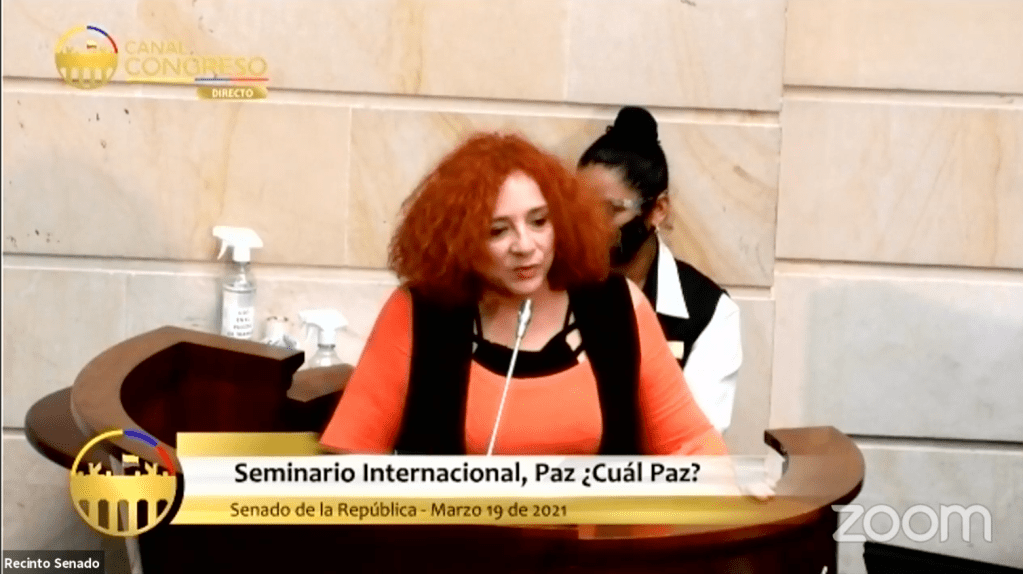
    Lilia Solano, a human rights defender who was one of the organisers of Peace, What Peace?

    In recent days, I participated in a zoom-based conference with the Peace Commission of Colombia’s Senate. Since a peace agreement between the Colombian government and the largest guerrilla army, the FARC, was signed in 2016, implementation has not gone well.

    By the end of 2020, at least 238 former fighters had been murdered—victims of targeted assassinations.

    Meanwhile, the UN Office of the High Commissioner for Human Rights has documented more than 400 slayings of human rights defenders since 2016, of which 108 happened in 2019 and 53 in 2020. Human rights defenders include community, small-farmer, women, LGBTI, Indigenous, and Afro-Colombian leaders as well as activists for the rights of victims and their families.

    My own presentation followed those of some of my friends and heroes: 

    • Former Senator Piedad Córdoba, who led efforts to free people who had been captured by the FARC in years before the peace accords
    • The Portuguese activist Boaventura de Sousa Santos, who said that “what has prevailed until now is neoliberal peace” that only opens space for transnational corporations. What has to change are the conditions that led young people to join the guerrillas.
    • From ecumenical colleagues came the reminder that the struggle for peace with justice must be global. Rudelmar Bueno de Faria of the ACT Alliance noted the role of religion in the conflict in Colombia, warning that history will not forgive those who have “played with the peace processes.”

    In my remarks, I went a bit further regarding the questionable role of religious organizations in the search for peace.

    I was at the marvellous ecumenical seminary in Matanzas, Cuba, in October 2016, when news came that a referendum to approve Colombia’s peace agreement had failed. It was quickly understood that fundamentalist Christians had intervened in the public debate, and rallied their bases to vote no by arguing that the peace agreement promoted “gender ideology” and would destroy the family. In reality, the FARC rebel army had acknowledged its crimes against women and LGBTI people, and apologized. Both sides pledged to do better on gender justice and the rights of LGBTI people.

    For me, having worked with faith-based organisations in Colombia and their allies abroad since 1993, the vote result and the reality that some Christians worked against peace, was a disappointment. I had seen people like Lilia Solano (pictured above), a Mennonite who works among human rights NGOs and in Colombia’s legislative branch, and Fr. Javier Giraldo, the Jesuit human rights defender and founder of the Inter-Ecclesial Commission for Justice and Peace, risk their lives for peace. I thought of friends who are leaders of the Methodist, Presbyterian, Episcopal, Lutheran and Mennonite Churches and Roman Catholic religious communities who would share my disappointment, together with people in organisations like the DiPaz inter-church peace coalition, the Mesa Ecuménica por la Paz, and the popular educators and trainers of community journalists at CEPALC.

    Their persistent witness guided me when I spoke the next morning to people who were gathered at the seminary to celebrate its 70th anniversary and to consider the future of ecumenical theological education in Latin America and the Caribbean, I said it seemed to me that the voices of moderate or progressive Christians were marginalised or discounted in a climate of fear generated by the shrill voices of the Christian right and their political backers. That day in Cuba, I said:

    “A good theological education, offers ways to read the bible, to interpret scripture, to understand the limits church authority in civil society. In a good theological school, one learns to use the Bible to interpret the Bible, to use the texts that we have of the teachings of Jesus about the love of God and of neighbour so as to understand other parts of the bible. Without good theological education—and, by extension, good Christian education within the churches—the public square is surrendered to the most retrograde and hate-filled voices of Christian fundamentalism, empty of love and forgiveness.”

    My remarks Thursday, March 18, to the Colombian Senate’s peace conference took up similar themes.

    “This increase of inequality and violence contrasts with the experience of churches and social movements that uphold fullness of life and defend the dignity of women and LGBTI people. They create spaces for mutual listening, weaving networks and planting seeds of peace and justice as they raise their voices for a world of greater solidarity.

    “Those of us who are too often the objects—and victims—of hate speech need your voices, you artisans of peace, and of religious leaders who promote an understanding of Christianity that is inclusive and respectful of diversity, who promote contextual and liberation theologies, who can join dialogue over differences and are reflections of the reality in which we live: who speak, in the end, of the love that should exist among all of us

    “In place of fear and prejudice, let us build alliances of solidarity across all borders.”

    In Haiti, once again: something must change

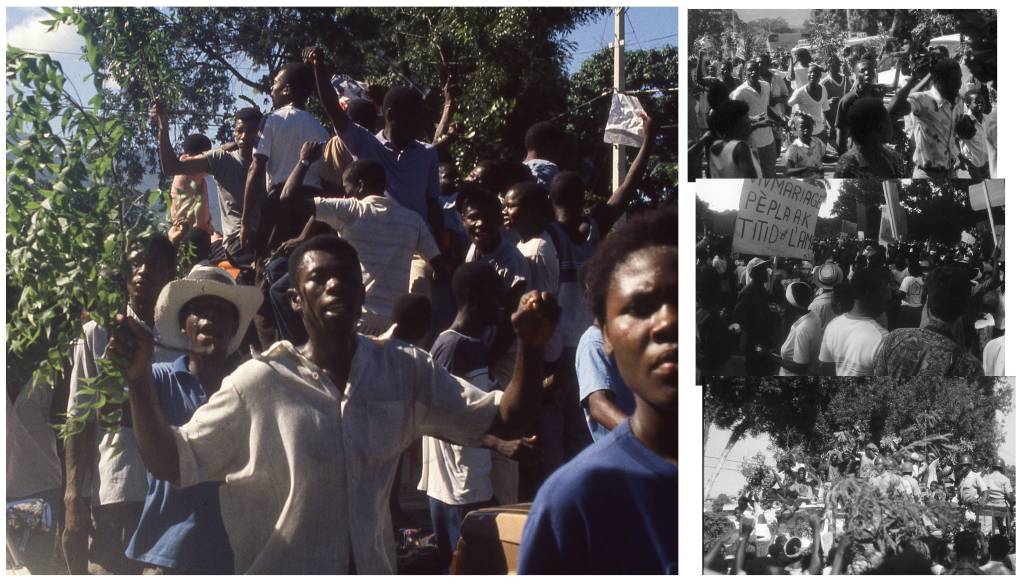
    My first visit to Haiti was in March 1984 when Jean-Claude “Baby Doc” Duvalier was still in power. Less than two years later, in the face of widespread demonstrations, he fled. Six years of jostling for influence and power followed, and the voice of a young priest in the impoverished neighbourhoods around Port-au-Prince was heard. A movement, Lavalas, a flood propelled Father Jean-Bertrand Aristide into the presidency. These are some of my photos of the celebration.

    A podcast that explores Christianity and the political left provoked me to think again about Haiti this week. On March 9, I was interviewed about events in Haiti for The Magnificast, a podcast produced by my friends Dean Detloff in Toronto and Matt Bernico in St. Louis. 

    Right now, tens of thousands of people are marching in the streets of Port-au-Prince and other cities. They want to bring down the president, bring about a new interim government that would lead a process of constitutional reform, and organize new elections.

    This time, however, they’re backed by a range of people and organizations that have not stood together since 1990 (Haiti’s first free election): churches, trade unions, community groups, students and teachers, the political left and centre.

    The Magnificast has been a great space for me to think with others about complex events in Venezuela,Bolivia and now Haiti. The title is adapted from Mary’s song of praise, The Magnificat::

    God has brought down the powerful from their thrones,
        and lifted up the lowly;

    God has filled the hungry with good things,
        and sent the rich away empty.

    Luke 1:52

    On March 8, a group of civil society organizations sent a letter to Prime Minister Justin Trudeau, calling for an end to Canada’s support for Haiti’s president, whose term of office has ended. Initiators of the letter were members of Concertation pour Haïti (CPH), a coalition of Quebec-based solidarity groups working in Haiti and individuals who support solidarity with Haiti. Members include The United Church of Canada (through its francophone ministries together with global partnership staff) and Development and Peace.

    The letter calls on Canada, the United Nations and others to “consider transitional alternatives, without external interference, proposed by the various sectors of the opposition and civil society instead of blindly supporting the government of Jovenel Moïse.”

    Over the past two years, Haitian organizations have proposed various ways forward. A transitional government should have taken office on Feb. 7, 2021, the date that the president’s term ended. The letter explains the next steps:

    “A new government, accompanied by a transitional body, should hold office for at least two years. In addition, it would be established according to a specific institutional procedure, determined in a concerted manner within civil society and the opposition, which would ensure its limited term and its independence. The goal is to work toward the adoption of a new constitution in accordance with the wishes of the Haitian people, to prepare new elections, to adopt a plan to alleviate the population’s misery, to restore order in the public administration and to reinstate the judicial system.”

    A day after the CPH letter, the Catholic religious communities that are part of the Haitian Religious Conference (CHR), used the occasion of the anniversary of Pope John Paul II’s visit to Haiti on March 9, 1983—three years before the end of the dictatorship of Jean-Claude “Baby Doc” Duvalier—to renew his call for change. “Il faut que quelque chose change ici,” the pope said, adding that impoverished people must recover hope. As he left, he encouraged unity: “Têt ansanm,” he said in Kreyol. All together.

    “Thirty-eight long years after that visit by the pope,” states the CRH letter, “the seeds of death now seem to outgrow the seeds of life. The country is dying, insecurity is rampant, the poor cannot go on, the population is in a disarray that borders on despair, and the country is no longer ruled. We are both witnesses to and victims of too much crime, too much injustice, and too much inequality.”

    So, what gives?

    Some forces resist change. Haiti’s six richest families, together with a few thousand wealthy enablers, have shown through the past 40 years that they will resist any change whatsoever. And that class is well-connected to corporations and centres of power elsewhere. The United States, as elsewhere in Latin America, is arbiter of what can be done. It may have shifted from the Cold War-view that saw the Duvalier regime as a buttress against communism. The presidency of Bill Clinton in the 1990s imposed a developmentalist approach: Haiti would be a nation of cheap-labour assembly plants. 

    Since 2011, in the presidencies of Michel Martelly and Jovenel Moïse, the United States and the local elites have finally had the presidents they wanted: men close to the business sector and close ties in the United States.

    Photo: Le Safimag

    But Haitians have other ideas. A few months after the 2010 earthquake, I was in Haiti with colleagues from The United Church of Canada. Among the people we met was Jesi Chancy-Manigat, a member of the coordinating committee of the National Feminist Platform. She was worried about the relief effort: “We are in danger of missing an opportunity.” It’s not enough, she added, just to consult with the president of Haiti. Civil society needed to be involved: citizens, organizations, women, workers, farmers, professionals.

    Yes, the opportunity was missed, and Jesi, sadly, did not live long enough to attain the changes she wanted: she died from cancer in 2013 at the age of 57.

    But she taught us a few things that those of us working for change now might keep in mind. First, listen to what Haitians say about themselves. Jesi introduced us to the work of the Kay Famn (House of Women) organization. In 2010, Kay Famn insisted that the country can be and must be rebuilt.

    To rebuild the country is:

    • To divorce ourselves from the practices of theft, corruption, dirty politics, and irresponsibility—where an executive or a Parliament can assume the right to ignore laws and rules.
    • To have authentic dialogue with the people.
    • To end the immense disorder that surrounds us: political disorder that prevents us from building a real democracy; electoral disorder that shackles the enjoyment of the rights of citizens; disorder in public administration, management of territory, justice, economy, education and health; disorder with respect to fundamental human rights, especially the rights to food, health care and housing.
    • To re-deal the cards so that the state serves the common good, and so that people receive services and can produce and improve their well-being.
    • To construct a system of social protection that permits action for the most vulnerable sectors: families headed by single women, those living with handicaps, those with low incomes, orphaned children, the elderly who have no resources.
    • To commit ourselves to a path that moves us away from dependence on the exterior so that Haitians may take decisions according to national interest.

    The demands today are not different from 38 years ago or 11 years ago. Yet, the people persist. And yes, we support their struggle.


    More resources

    An article in English by Marc-Arthur Fils-Aimé of the Karl Lévêque Cultural Institute (ICKL) and the Alternative Development Platform (PAPDA)

    Position paper by the Jesuits of Haiti on the current crisis

    “The Millionaires Of Haiti” Podcast