Development and Liberation

(Sept. 14, 2011)

Back in the 1960s, there was a kind of fervour to extend what had been learned from the post-war reconstruction of Europe to the so-called Third World. The United Nations declared successive “Decades of Development.”

Churches were part of the movement. In 1967, Pope Paul VI issued his development encyclical, Populorum Progressio (On the Development of Peoples) with its famous affirmation: “Development is the new name for peace.” He rejected unequivocally the basic precepts of capitalism, including unrestricted private property, the profit motive, and reliance on free trade in a world economy. He emphasized the right of poorer nations to the aid of wealthier nations.

Protestant and Orthodox churches met in Geneva in 1966 for a World Conference on Church and Society. They identified the close relationship between peace and justice: threats to peace do not arise only from military power, but also from hunger, oppression and injustice.

Even as governments, churches and non-governmental organizations (NGOs) embraced development programs, it was already clear that there were divergent views of what was intended by “development.”

Development as an ideology

Leaders in the global South saw that their nations’ poverty was a consequence of the wealth of other nations. People from India to Mexico questioned the so-called “green revolution,” seeing that it damaged small farmers and the ecology. In Latin America, there were warnings about desarrollismo—development as an ideology that only furthered the interests of traditional elites. We do well to remember that the landmark book by Gustavo Gutiérrez, A Theology of Liberation,* is a critique of what was wrong with development in Latin America in the 1960s.

In the face of “aseptic” development policies that gave “a false picture of a tragic and conflictual reality,” Gutiérrez insisted that development find its true place in “the more universal, profound, and radical perspective of liberation.”

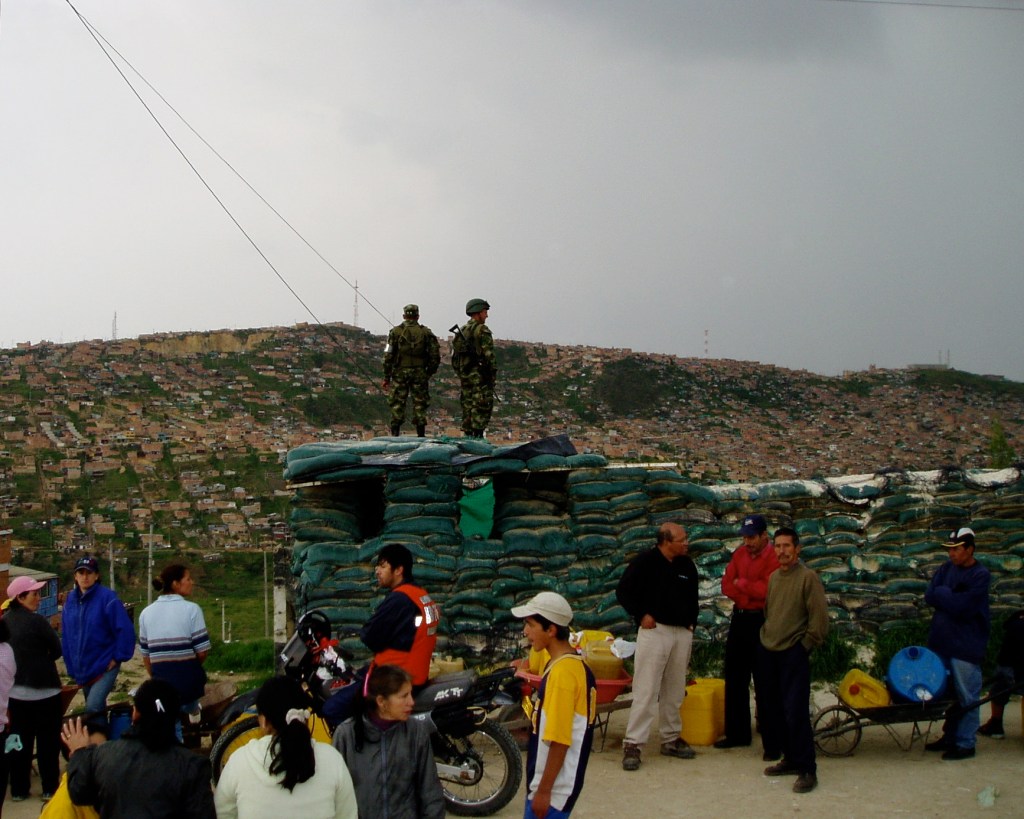
Soldiers watch over water distribution near Bogotá (2007)

For him, theological reflection begins with the real context of people’s lives—the poverty experienced in the lives of most Latin Americans. Liberation expressed “the aspirations or oppressed peoples and social classes, emphasizing the conflictual aspect of the economic, social and political processes which puts them at odds with wealthy nations and oppressive classes.” The biblical paradigm is the Hebrew story of escape from slavery in Egypt (told in Exodus).

For Gutiérrez, as for liberation and other contextual theologians who have followed, liberation is both political and religious, or both historical and salvific. Our practice of liberation from oppression is also the practice of salvation: liberation and the growth of the Reign of God “are directed toward complete communion of [humanity] with God and of men [and women] among themselves.”

* Bibliography – Gutiérrez, Gustavo (1973). A Theology of Liberation. Maryknoll, N.Y.: Orbis. (Ch. 2 and 9). Originally published in 1971 as Teología de la liberación, Perspectivas, by CEP, Lima.

What kind of development?

(Sept. 4, 2011)

Javier Sicilia (Proceso, 2011)

In 2011, a Mexican poet, journalist and social activist found himself leading a new social movement that found ready followers across Mexico. Javier Sicilia dared to protest the murder of his son Juan Francisco at the hands of a drug gang, and to link the death to the way the Mexican government carries out the so-called “War on Drugs.”

Although we lived in the same city, Cuernavaca, during the late 90s and to some extent moved in similar circles of people of faith concerned about human rights and social justice, I don’t recall that I ever met him. But I read his weekly columns in Proceso, Mexico’s leading national newsmagazine. Sicilia drew deeply from the best of Catholic social teaching and from the wisdom of the Zapatista Indigenous rebels in Chiapas to condemn globalized capitalism. For Sicilia, the problem today is not just capitalism or even the rule by wealthy elites in most countries. These are problems that have been obvious for centuries.

By the early 1980s, it was possible to discern a new and harsher form of capitalism, one that came to be called “neo-liberal economic globalization” (or more often simply either neo-liberalism or globalization).

Do we err in promoting development?

Sicilia also asserts that we who question neo-liberal capitalism and its free market model of development err in using the same terms as those who have provoked and maintain extreme poverty.

Among those who influenced Sicilia’s ways of thinking and acting was Ivan Illich, an Austrian priest and educator who was profoundly suspicious of church hierarchies and of formal education. Illich (who also lived at least part-time in Cuernavaca until his death in 2002) wrote that the contemporary concept of development was born from U.S. President Harry Truman’s 1949 inauguration speech. Truman announced a program of technical assistance to under-developed countries that was called “Point Four.”

Until then, according to Illich, “we only used the term [development] to refer to animal or plant species, the value of real estate or geometrical surfaces. And, in less than a generation, we were inundated with diverse theories about development.”

Adoption of these models, Illich argued, gradually destroyed local and subsistence economies, replacing them with export-oriented market economies and industrialization. Illich’s essay “Vernacular Values” is in a 1981 book called Shadow Work. The text can be found on many internet sites, including here. (Comments on development are in his “1st part.”)

When we talk about development, let’s be clear that we are talking about something other than approaches that not only damage local communities, but imperil the whole Earth.

A writer’s role

(Sept. 2, 2011)

“May those with pens expose all the crimes to the world”

As one who has a pen, I have sought to use it—and my computer—to share stories of people who hunger, thirst and struggle for justice.

I don’t remember where I heard the prayer cited above, but it stays with me as an incitement to write and speak.

I grew up in the Okanagan valley of British Columbia, the western-most province of Canada. My parents grew up on farms northwest of Calgary, Alberta. Like the generations before, we moved around a lot. By the time we settled in British Columbia when I was ten, I had already lived in three other provinces.

Food—central to development debates—is perhaps what unites a family extended over time and space. Production, transportation and sales. My grandfather and an uncle were cowboys and ranchers in the Alberta foothills and in northern British Columbia. One aunt worked in the Burn’s meat-packing plant in Calgary. An uncle was a travelling salesman for Burn’s and another uncle was a salesman in the Safeway supermarket chain. My parents ran a small grocery store: that’s where I had my first job. My sister and her family raise Berkshire pigs in the Cariboo region of British Columbia.

At my grandmother’s dining room table, I remember arguments over something called the “Crow rate.” A subsidy to facilitate grain exports made shipping anything else prohibitively expensive, locking in a model of development that (arguably) protected Canadian sovereignty, grain farmers, Ontario manufacturers and the Canadian Pacific Railway for close to a century.

Beyond the mountains

I’m the kid who was endlessly curious about what was going on beyond the mountains. I wanted to understand the ideas that led people to do things in different ways. And I had found that I could write.

Visiting a batey near Villa Altagracia, Dominican Republic (1983)

Eventually, I passed through the School of Journalism at Ottawa’s Carleton University. A few years later (in 1983), I found myself in the Dominican Republic and talking with people who made a sort of living from cutting sugar-cane.

I had gone to the “D.R.” to participate in a six-week exposure program for young adults sponsored by Youth Corps (a ministry of the Archdiocese of Toronto) and the Scarboro Foreign Mission Society (a Catholic religious order). The Dominican Republic Experience opened a door for me to the growing movements for social change in Latin America.

Over time, I will tell you more about what I learned from Haitian cane-cutters, and how their experience shaped the work I have done since then.