Fanning the fires of hope in Chiapas, still

There was one time when I was glad to see the riot place arrive: Sunday afternoon, February 19, 1995 in San Cristóbal de Las Casas, Chiapas. 

For more than a week, Maya Indigenous people of the Chiapas highlands had protected their cathedral, the seat of Bishop Samuel Ruiz. On that Sunday afternoon, the feared attack had become real as a larger group of about 400 “auténticos coletos” (denoting descendants of the European settlers in the city) hurled stones: the settlers saw the Indigenous people as interlopers, the ones who had no business in the heart of their city.

The defenders stood three deep in scraggly lines surrounding the cathedral. They held flowers. Men, women and children, old and young, Indigenous and Mestizo, Mexican and foreign, held marigolds, lilies and carnations and wore white ribbons across their chests as they faced the attack. They endured the attack, holding blankets over their heads and trying to duck the stones. The woman next to me whispered prayers and repeatedly blessed the rock-throwers: “God, forgive them.”

The mob tried for more than an hour to storm into the cathedral and the diocesan office next to it. Finally, the riot squad arrived and traced a line between the two groups. The people on the steps cheered; the mob dispersed. In the meantime, at least five people, including two reporters, had been injured. 

For 10 days, ever since Mexican President Ernesto Zedillo pledged to capture the leaders of the rebel Zapatista army (EZLN), the people of this diocese had maintained a vigil around the cathedral and diocesan office. That building also housed the National Mediation Commission (CONAI), chaired by Bishop Ruiz and in session at the time of the attack.

Left: a view of San Cristóbal de Las Casas. Right: a “wanted” poster that describes Bishop Ruiz variously as a traitor, existentialist, liberation theologian and Marxist – typical of the charges laid against him by his opponents over many years.

For more than a year, Ruiz had been at the centre of ecclesial and political controversies over his decades-long advocacy for and with Indigenous and impoverished people in Chiapas and his role as a mediator between the government and the Zapatistas. The EZLN uprising had begun on January 1, 1994, the day that the North America Free Trade Agreement (NAFTA) came into effect.

Zedillo failed to capture Zapatista leaders, but instead arrested people who worked for community development organizations (notably Jorge Santiago of DESMI, Economic and Social Development of Mexican Indigenous Peoples). His army also achieved what it considered to be better strategic positions near the Zapatista communities. 

Over the subsequent year, CONAI’s mediation work continued and bore fruit: on February 16, 1996, the government and EZLN representatives signed an Agreement on Indigenous Culture and Rights in San Andrés Sakamch’en. It was not a comprehensive peace deal, but rather the first step in a planned process to address Indigenous rights in Chiapas and beyond. “It was the first time in Mexican history that the state had sat down with Indigenous people to hear their demands,” wrote La Jornada columnist Magdalena Gómez recently. Later that year, the National Indigenous Congress (CNI) was created and continues its work today.

But from the government side, nothing happened! The first agreement has not been implemented; worse, the government negotiators essentially sabotaged a second round that was to address issues of democracy and justice, leading the EZLN to suspend the dialogue on September 4, 1996. It has not been renewed. The EZLN continues to press its cause in multiple public fora in Mexico and far beyond, and the communities persist in building a fairly successful example of Indigenous autonomy. 

Sadly, even the somewhat more progressive government of Andrés Manuel López Obrador, in power now for more than three years, has failed to move beyond what Gómez called “recycled, low-intensity, neo-Indigenous” policies of individual support and mega-projects without reference to the San Andrés Accords. 

A year ago, the Fray Bartolomé de Las Casas Human Rights Centre in San Cristóbal said the San Andrés Accords persist as a framework and reference for the people of Chiapas. “The people who struggle will continue to fan the fire of hope, and history will give an account of this, because despite the war of extermination, the construction of autonomy gives light and fire to women and men throughout the world.”

Parts of this post are adapted from two of my articles published in Catholic New Times, March 5 and 19, 1995.

“I give you a flower,” says a t-shirt from Yajalón, Chiapas.

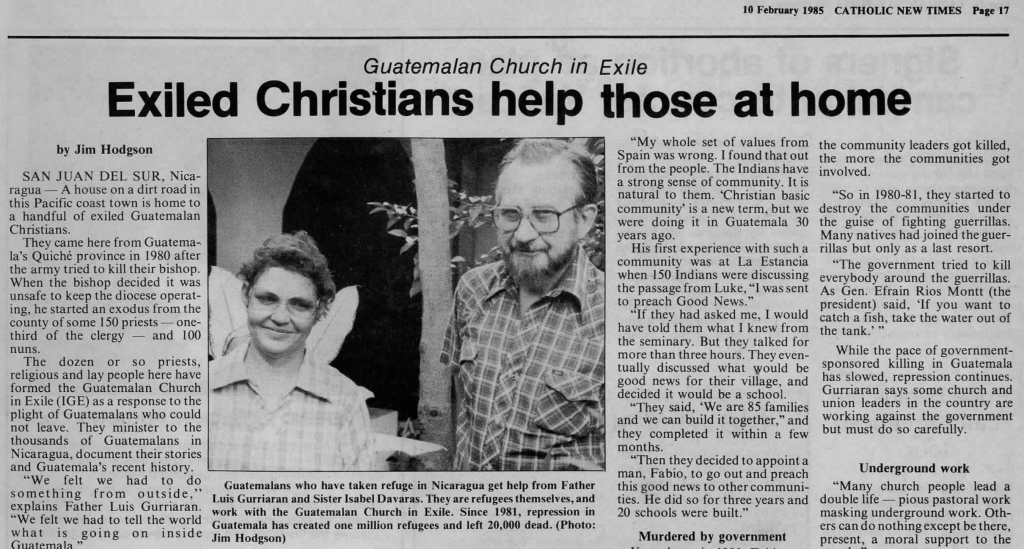
Salvadorans remember peace accords, celebrate martyrs, dream of a different possible world

by Jim Hodgson

This is a historic week in El Salvador. January 16 was the 30th anniversary of the Peace Accords that ended the country’s long civil war. And this weekend, four Christian martyrs will be beatified – a step toward sainthood – by the Roman Catholic Church.

The commemorations take place in a political and social context that is not what we hoped for when we watched news coverage showing the government and the rebels sign the accords at the Chapultepec Castle in Mexico City in 1992. The president today, Nayib Bukele, has dismissed the Accords as a “farce.” The country is on the edge of insolvency; Bukele flirts with cryptocurrencies that no-one understands; between 200,000 and 300,000 people leave the country each year.

Sometimes looking at the past can offer some signs for the future, and that’s why the celebration of the lives and witness of the martyrs this weekend matters.

Beatification of the Servants of God, Saturday, Jan. 22. Celebrant is Cardinal Gregorio Rosa Chávez.

Best-know in the group is Father Rutilio Grande, a Jesuit priest who was driving with 15-year-old Nelson Rutilio Lemus and 72-year-old Manuel Solórzano, to the small town of El Paisnal to join the town’s celebration of the feast of St. Joseph when they were gunned down on March 12, 1977, in Aguilares, 33 km north of San Salvador. 

The fourth man celebrated is Father Cosme Spessotto, an Italian missionary priest of a Franciscan order who had served in El Salvador since 1950, and was murdered on June 14, 1980, as he prepared to celebrate an evening Mass in his parish church in San Juan Nonualco, La Paz department. Like other church leaders, including Saint Oscar Romero (the archbishop of San Salvador, slain March 24, 1980), he had denounced the crimes of the military junta in the 1970s including the murder of Fr. Rutilio, thus drawing threats against his own life.

Fr. Rutilio’s death came as El Salvador’s civil war was beginning. Over the next dozen years, at least 75,000 people were killed; about 8,000 more were made to disappear; a million people fled. In 1993, the United Nations Truth Commission report attributed at least 85 per cent of the killings to government security forces and related paramilitary death squads. 

Salvadorans recognize many martyrs, among them the four U.S. church women who were killed near the San Salvador airport in December 1980, and the six Jesuit priests, their housekeeper and her daughter who were killed in November 1989 at their home in the University of Central America (remembered in the photo above). May they all be recognized soon too! As James T. Keane wrote in America magazine this week, “We need more dangerous saints.” Photo: Jim Hodgson (2019).

It’s important to remember what the martyrs represent: a persistent witness to life as experienced by people long oppressed, marginalized, landless, impoverished, unemployed, violated on a daily basis. Their sacrifice amplifies the cry of the poor, and I believe influenced the negotiations that produced the Peace Accords in 1992.

The Peace Accords brought about a new legal regime in El Salvador. One of the negotiators for the Farabundo Martí Liberation Movement (FMLN) at Chapultepec was Nidia Díaz, who spoke recently with Jacobin magazine:

“All those laws that oversee the new institutions that are the product of the peace accords were made in COPAZ, the National Peace Commission. They weren’t a whim. In COPAZ, you had the FMLN and the government as parties, and, as observers, the Catholic Church and the UN and the parties that were in the legislature at that moment. All the laws — the law for the National Civil Police, the army, the Supreme Electoral Tribunal, the Human Rights Ombudsman, etc. — were made in COPAZ and sent to Congress. There was a debate process. 

“Now Bukele comes along and says, ‘I don’t agree with these responsibilities and powers,’ and he tries to annul the laws and the constitution. He’s dismantling the democratic process that permitted his very election.”

Rev. Miguel Tomás Castro speaks at a Romero memorial event, March 24, 2009. Photo: Jim Hodgson

Another prominent defender of the peace accords is Rev. Miguel Tomás Castro of Emmanuel Baptist Church (known by its Spanish acronym, IBE). Speaking with the newspaper Diario Co Latino this week, he said:

“There is a lot of criticism of the Peace Accords and an attempt to diminish their value. I think we have to commemorate them, and why not celebrate that the Accords put an end to the armed confrontation? Of course there are various sectors, particularly in the city of San Salvador, and perhaps in other cities where people did not live the intensity of the war as it occurred in other parts of the country. We saw so many people suffer, our brothers and sisters in those communities, places where the war was very harsh and caused greater damage: those people celebrated the end of the war with much joy. And that cannot be hidden.

“And there’s more than one reason that it is important to commemorate and to give thanks to God for the end of the armed confrontations: it’s to say to our sons and daughters that we do not believe in hatred or in confrontation. The Peace Accords give a place for us to say to our younger generations that we want peace, a peace that reaches everyone and a peace that is the hand of justice.”

He was asked what his message would be on this 30th anniversary of the Accords:

“We say that there are two things that we have not been able to accomplish since the Peace Accords. As churches, really there are two themes: on truth, because we have not been able to close the chapter on the Accords without knowing the facts behind the conflict. That’s important; the United Nations recognized it. The second is reconciliation, because you can’t talk about Peace Accords without reconciliation. The church in that has a great responsibility, but it is also an ethical, more and spiritual debt with our people.

“Supposedly we were to go towards reconciliation, but there was an agenda of priorities and the theme of reconstruction was in first place, when reconciliation should have been the principal theme. Apart from whether we lived a conflict or no, the call of God is to see each other as sisters and brother, to build a spirit of family nation, where everyone of us makes an effort so that all of us have lives of dignity. It’s humiliating that every day people leave because there are no conditions here for that life. Something is going wrong.”

The model of reconstruction imposed after 1992 resulted in shopping malls and fast-food restaurants, not sustainable and participatory development or comprehensive land reform.

Even in the face of the current crises in Central America – violence, migration, the impacts of climate change – what gets proposed derives from tired models from the past. Social movements have a different vision.

In the United Church’s Mandate magazine (summer 2020), I reported on a conversation with Miguel Tomás and youth peace-makers in his church:

After 24 years, Acteal is still an open wound in Chiapas

In December of 1998, I travelled with several friends to Acteal to join events marking the first anniversary of the massacre. The survivors (including the woman at centre who faces the bishops) and families of those who died wore white shawls embroidered with red flowers. Today, reports (like this piece by Luis Hernández Navarro) show that little has been resolved in the community, the surrounding municipality of Chenalhó (where paramilitaries retain control), or Chiapas state.

Desire for reconciliation marks first anniversary of Acteal massacre

Text of an article I wrote that was published in Catholic New Times, Jan. 31, 1999.

ACTEAL, Chiapas, Mexico – The people who came to Acteal Dec. 22 made a brightly-coloured crowd.

Huipiles – hand-woven, brightly-coloured blouses – were evidence of the diversity of the people of Chiapas, many of whom used mountain paths to avoid military patrols. Baseball caps and t-shirts marked both the similarity and diversity of the rest of us who came from other parts of Mexico and the world.

Many people, perhaps 1,000 of the 5,000 who were there, wore ski-masks or bandanas to cover their faces. They were supporters of the Zapatista Army for National Liberation (EZLN), the mostly-indigenous guerrilla movement which launched a rebellion five years ago this New Year’s Day.

In the year since 21 women, 15 children and nine men were murdered here, Acteal has changed dramatically. There are many more buildings now, including a community kitchen and a new chapel, and one of bricks and cement: the tomb of the victims.

In another respect, Acteal is exactly the same: it is a community of refugees from other hamlets, people forced to come here out of fear of paramilitary death squads who operate in the mountains of Chiapas. The diocese of San Cristóbal estimates that there are 10,000 displaced people in the municipality of Chenalhó, where Acteal is located.

We gathered on the hillside near the tiny chapel where members of the community group known as Las Abejas (the bees) were at prayer the morning that the paramilitaries arrived. Below us was the ravine where most of them died. The permanent tomb is there now. On its cement roof, a makeshift altar was built, and this was where the two bishops of San Cristóbal, Samuel Ruiz and his coadjutor, Raul Vera, led the celebration of a memorial mass.

‘Tatic’ Samuel Ruiz (left) served as bishop of San Cristóbal de Las Casas from 1959 until his retirement in 1999; he died in 2011. Raúl Vera was coadjutor bishop in San Cristobal from 1995 to 1999, and was widely expected to succeed Ruiz. He was abruptly transferred to Saltillo in northern Mexico, where he served until his retirement in 2020. Vera grew into a role as a staunch human rights defender, including the rights of LGBTIQ people. Photos: Jim Hodgson, February 1999, Mexico City.

Las Abejas, still faithful to their vision of a non-violent solution to the conflict in spite of the Chiapas violence to which they have been subjected, planned the event. They were assisted by Pablo and Salvador, two former paramilitaries who helped plan the massacre and who repented their crimes. They were accepted the community’s punishment and were pardoned by the survivors.

The survivors and families of those who died wore white shawls embroidered with red flowers and sat in the centre of the large crowd.

As the community choir – something else that is new in Acteal – sang the first hymn, an army helicopter circled slowly overhead, three times in all with a final pass by several minutes later.

For many, it exemplified the kind of harassment to which the people have been subjected by the army over the past five years in this area, where there is one soldier for every 12 inhabitants. This, say human rights workers, is one aspect of the application here of low intensity conflict, a war strategy developed by the U.S. military to destroy the spirit of popular support for social change movements. 

The first reading was the story of a catechist, Alonso Vázquez Gómez, who saw his wife and baby killed in the first volley of shots. He came close to her and said, “Woman, get up. Woman, get up.” Neither she nor the baby responded. Alonso stood and cried out, “Forgive them, Lord, for they don’t know what they are doing!” He was cut down then by two bullets which entered his head. The Gospel reading was Luke’s brief, spare account of the crucifixion of Jesus Christ, who spoke the same words as he died.

Bishop Vera spoke of “the scandalous forgiveness” by Jesus and Alonso of their killers and said we stood on holy ground. While about 100 people are in jail on charges related to the massacre, human rights workers say those responsible for its planning have not been arrested. Bishop Vera invited all to accept the “divine amnesty” offered by the victims, but warned that any “human amnesty cannot be impunity, much less amnesia.”

Bishop Ruiz said we were in the presence of martyrs and that Acteal was a unique moment in salvation history – one, however, that must never be repeated. “Acteal is the seed of a new Mexico, the peaceful, just and worthy Mexico of which we all dream,” he said, adding that it is a monument to peace and hope in the resurrection.

After a sign of peace and the communion shared amongst masked and unmasked, pacifists and guerrillas, Mexicans and foreigners, we left Acteal. We passed nervously through the same two military checkpoints which had inspected and recorded our identification and travel documents on the way in.

The next day, we heard of five foreigners whose documents were taken from them at the same checkpoints and who would have to appear later before immigration authorities to explain why they had attended a mass in the mountains on a sunny December day.

Something else that hasn’t changed: the unquenchable fear that the Mexican government bears towards Christians, Indians, intellectuals, artists, peasants and a few half-awake foreigners.

This potent combination knows that what Samuel Ruiz said is true: Acteal is the seed of the peaceful and just Mexico of which we all dream, and we will not rest until those words become reality.

Solidarity: It was my privilege to accompany a Canadian Religious Conference visit to the diocese of San Cristóbal in March 1998. Here, Doryne Kirby, IBVM, and Jean-Claude Trottier, SM, stand beside Bishop Ruiz. Photo: Simon Appolloni, Development and Peace, Toronto.