
Oct. 5, 2017
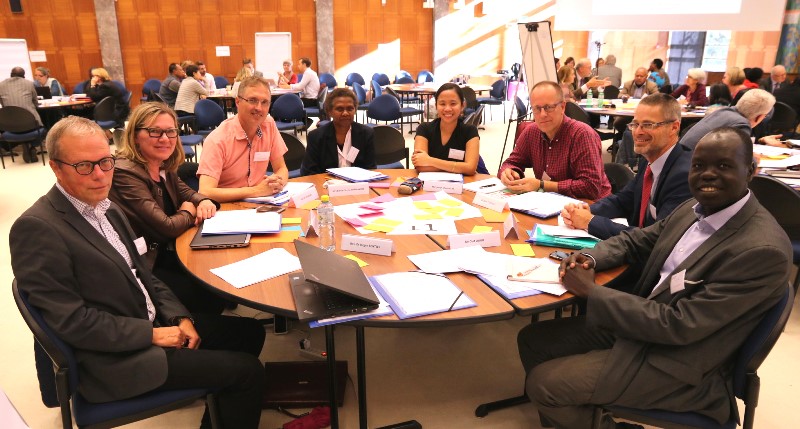
Tension between our passion for justice and having patience enough to work on framework concepts for work on religion and development seemed to increase through the second and third days of our encounter.
I knew I would have three minutes on Wednesday morning to say to the full plenary everything that I was thinking about diakonia and development, so I prepared my speaking points.
Then the facilitator asked me about the United Church’s role in development. I offered my briefest possible description of the United Church’s approach to global partnership—a long-term contribution to the ecumenical sharing of resourcesprocess, and a commitment to lift up the voices of partners in all possible spaces. And then I moved on to my points.
I encouraged the people at the Ecumenical Strategic Forum to be daring in their advocacy for gender justice, climate justice, and justice for Indigenous peoples. I expressed my concerns about the Sustainable Development Goals, especially No. 8 which seems to re-introduce the developmentalist concepts of economic growth that we have been criticising since the late 60s. (See chapter 2 of Gustavo Gutierrez, A Theology of Liberation.) And I shared the debate in my table group about “rights-based” approaches to development, which tend to be individualist and leave insufficient space for minority rights or collective rights.
Then others started speaking. One of my Latin American friends expressed his sadness at the political games that conservative Christians play: support for Trump, opposition to the peace accords in Colombia.
A German friend talked about the value of liberation theology in its emphasis on the subjects of action—that we not treat beneficiaries of development aid as objects.
Another of my Latin American friends recalled Brazilian Bishop Helder Camara, who said: “When I give food to the poor, they call me a saint. When I ask why the poor have no food, they call me a communist.” This friend went on to say that we’re living now in a world of emergencies—just recently, the three devastating hurricanes in the Caribbean and the United States, and the two earthquakes in Mexico—so much so that there is hardly enough time to catch up to development. “We have to think about development not just in Western terms, but in Indigenous terms.” Live into that cosmovision, I thought.
We shifted into a series of conversations about peace-building, justice (gender, health, economic, migrant, etc.), globalization, and work in multi-sector partnerships (interfaith, secular, government, UN agencies, etc.)—and what they have to do with SDGs.
In a sense, those conversations opened space to talk about our passion for our work. We talked about how gender equality globally (#5) is actually receding in many contexts: women are losing ground. We found space to raise concerns about issues that are submerged in the SDGs: #10, which is about reducing inequality, has no mention of race, but racism is an issue that must continue to be addressed if inequality is to be reduced.
Similarly, #8 revives notions of economic growth that are simply unrealistic if greenhouse gas emissions are to be reduced. Ecumenical advocacy must continue to uphold climate justice goals while sustaining the vision and policy recommendations contained in documents like Economy of Life for All Now.
For this work, the alliances being built across divisions of religious practice and secular spaces, as envisioned in this Forum, are essential as we find better ways to live together within planetary and social boundaries.

 Unwrapping Development