
by Jim Hodgson
Sadly, it’s not unusual for peace activists and the defenders of ecology or Indigenous rights to find themselves facing trumped-up criminal charges. It’s a bit weird when it happens to members of a modest community development organization in rural El Salvador.
But that’s what has happened to five people whose organization, the Santa Marta Association for Economic and Social Development (ADES). They’re people that I have know for more than 20 years.

This past week, five ADES members have been on trial, accused of a murder that supposedly occurred long ago during El Salvador’s civil war. No one, except zealous defenders of the government of Nayib Bukele, believes they are guilty of that crime. Rather: they built an alliance that reached around the globe, preventing a gold mine from operating in their Cabañas department and eventually winning a ban on metals mining in the whole country. While it is true that the five defendants were FMLN combatants during the 1980-1992 civil war, they are protected by the internationally-recognized Peace Agreement and the National Reconciliation Law, both signed in 1992.
Defence lawyers will present final arguments on Monday (Oct. 14) and a verdict could be issued as soon as Tuesday (Oct. 15). The next few days are a CRITICAL time to raise the visibility as much as we can to try to avoid a grave injustice.
Here below you will find a statement from observers of the trial and some suggestions about how you can show your solidarity.
Statement of the international observer delegation on the ongoing trail of the Santa Marta and ADES water defenders
October 11, 2024
Following three days of observing the trial of the five Santa Marta and ADES environmentalists, the international delegation convened by International Allies Against Mining in El Salvador releases the following statement:
San Salvador, we are international observers from King’s College Western University in Canada, Dartmouth College and UCLA Law School in the United States, and the Autonomous University of Mexico City in Mexico. At the conclusion of the third day of the trial, we offer the following observations:
- We witnessed a trial that, formally, appears to have followed most international standards of due process, however, the proceedings transgressed those standards on numerous occasions. We agree with the defense that sufficient proof was not presented to convict the five defendants. Based on what was presented in the courtroom, we believe that the only just resolution is the acquittal of all five defendants. Failure to acquit signals the lack of presumption of innocence and, therefore, the lack of an independent judiciary in El Salvador.
- For example, the Attorney General´s communications team violated the gag order imposed by the judges, exposing the identities of witnesses and observers, as well as depicting the defendants in ways that assumed their guilt across social media. We fear that this violation of the gag order without a court reprimand represents a lack of procedural impartiality. Additionally, while journalists were allowed to access court grounds on the final day of the trial, we believe this was a last minute measure to rectify the earlier breach of the gag order by the Attorney General. We lament that the measure was not announced widely to members of the wider press who were respecting the gag order. Throughout the proceedings, the independent press was not allowed to take photos or videos inside the courtroom.
- Additionally, we observed an overly aggressive strategy by the lawyers representing the Attorney General that included berating and a using of their bodies to put pressure on witnesses. For this behavior, they were repeatedly cautioned and corrected by the tribunal. Despite warnings and requests by the judges, the Attorney General´s lawyers ignored directions, interrupted procedures, and failed to respect courtroom decorum.
- At least one defendant was mistreated by the police who deprived him of sleep and food. Rather than transferring him directly to his residence following the day’s proceedings, he was held at a police substation and verbally abused, only to arrive home hours later underfed and exhausted. The following morning, police arrived at his home unexpectedly early and denied him a proper breakfast. We witnessed the visible fatigue and inability to focus on the proceedings from all of the accused. Mistreatment remains a concern as the defendants are of advanced age with a variety of preexisting conditions such as diabetes and hypertension. The well-being of the accused must be prioritized to ensure a fair trial.
Outside of the courtroom, we witnessed overwhelming support for the defendants from international human rights organizations, the Santa Marta community, Salvadoran civil society, and social movement organizations. Many have concluded that the case is an attempt by the Salvadoran government to intimidate the environmental movement that resulted in the landmark national ban on metallic mining in 2017. For us, the incessant pursuit of a conviction by the Attorney General’s lawyers despite a lack of evidence, cannot be unlinked from these broader politics and concerns against communities resisting the encroachment of extractive projects.
While we await the closing arguments and the tribunal’s decision, and based on our observations, we maintain that justice can only be served by a ruling that affirms the innocence of the accused. The community of Santa Marta too, aggrieved and impacted by this lengthy ordeal, must be presented with restitution and steps must be taken to ensure lasting transitional justice.
Given the mistreatment described against one of the defendants above, we recommend that the rest of the proceedings, particularly the logistics of transportation, are monitored by the Office of the Ombudsperson for the Defense of Human Rights in El Salvador (PDDH) to ensure their personal and physical integrity.
- Aideé Tassinari, Universidad Autónoma de la Ciudad de México
- Yvette Borja, Faculty of Law, University of California Los Angeles
- Jorge Cuéllar, Dartmouth College
- Bernie Hammond, King’s College, University of Western Ontario
What you can do:
Check out these suggestions from the Committee in Solidarity with the People of El Salvador (CISPES):
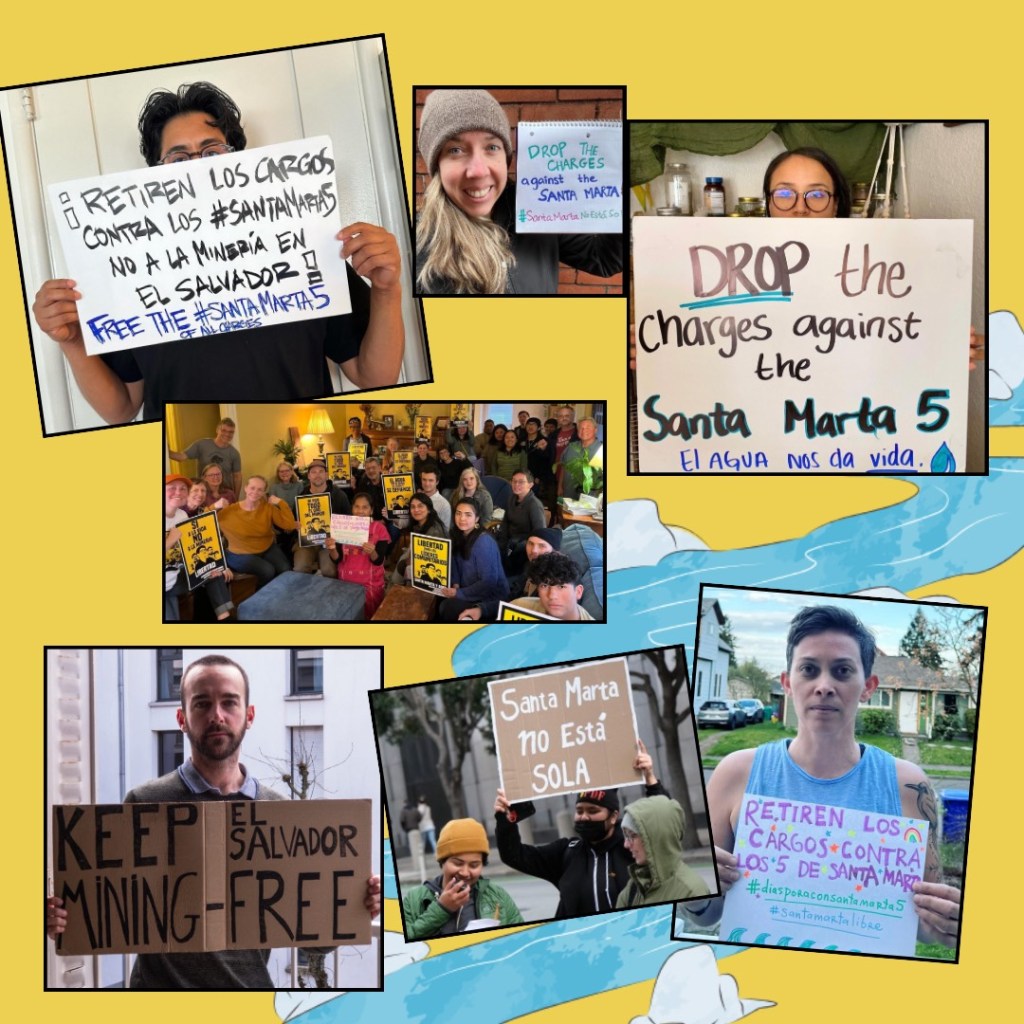
Social media solidarity posts: Make the case visible on social media & make sure the community knows we have their back! As the trial approaches, one of the most important things we can do is show the Salvadoran government that all eyes are on them. You can show your solidarity with the Santa Marta 5 by participating in the international social media campaign!
Write a brief statement of solidarity like:
- Drop the charges against the Santa Marta 5!
- ¡Retiren los cargos contra los Santa Marta 5!
- International solidarity is with the Santa Marta 5!
- The diaspora is watching! Free the #SantaMarta5 of all charges!
- Keep El Salvador metallic mining-free!
Take a picture OR make a short video with your sign
Post on social media with the following hashtags: #SantaMartaNoEstaSola #ComunidadSantaMarta #ADESNoEstáSola
Tag the following orgs on Twitter: @stopesmining @acafremin @CSantaMarta1987 @ades_sm@no_mineria_sv @cispes_solidarity
(On Facebook: @ComunidadSanta Marta, @Mesa Nacional frente a la Minería Metálica en El Salvador, @International Allies Against Mining, @acafremin, @ADES Santa Marta)
Check out these examples for inspiration from CISPES on X and Instagram
For more information, check out some of these resources:
El Salvador faces scrutiny for ‘political’ trial of five environmental activists, The Guardian, Oct. 9
La Justicia de Bukele vs los Defensores del Agua, Manuel Pérez Rocha, La Jornada, Oct.7
Solidarity with El Salvador’s Santa Marta 5 Grows Across Borders | NACLA
Minera Titán, la empresa que acecha para llevarse el oro de El Salvador – Voz Pública
Threat of Metal Mining Returns to El Salvador, Organizations Warn | CISPES
State of Deception: Fact Finding Report


 Unwrapping Development