Dismantling USAID: Yes, No, Maybe?

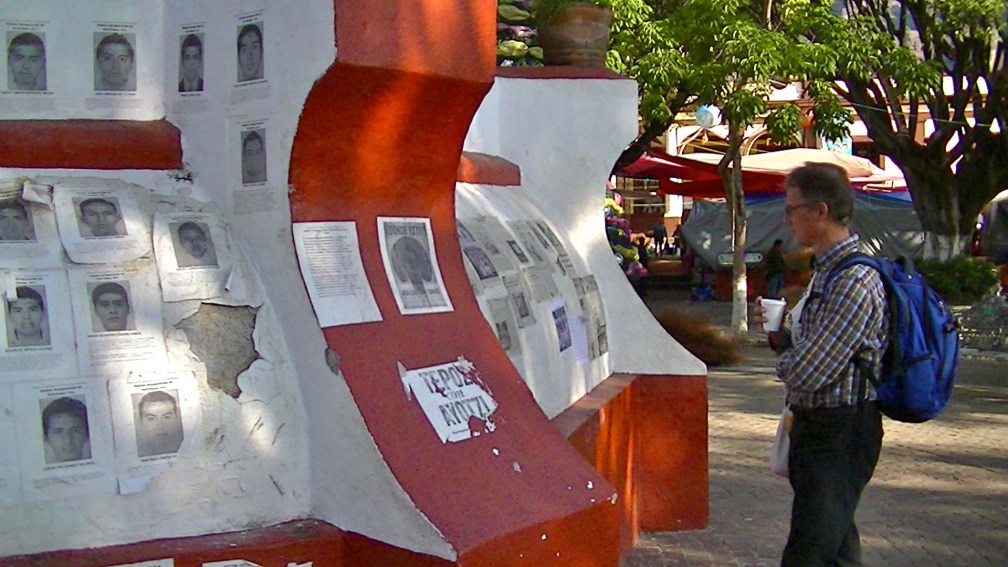
In late 1980, more than a year after the triumph of the Sandinista Revolution, the administration of President Jimmy Carter was still funding infrastructure in Nicaragua through USAID. By November 1984, with President Ronald Reagan’s “Contra War” well underway, your future bloguista was amused by this left-over sign at a road rebuilt near Matagalpa.

by Jim Hodgson

Back on launch day of Trump 2.0, the president issued an executive order that suspended international aid programs for 90 days, including those of the U.S. Agency for International Development (USAID).

The move came with a lot of over-the-top rhetoric and outright lies: that USAID spent “$100 million on condoms to Hamas” and that it “bankrolled” the Politico digital news company. “It’s been run by a bunch of radical lunatics. And we’re getting them out,” Trump told reporters on the evening of Feb. 2.

There are, of course, dozens of issues about which to criticize the Trump regime. But this is a blog that sets out to unwrap development issues, so let’s get into it.

Congress established USAID in 1961 to bring together programs that were administering foreign aid. Focusing on long-term social and economic development, USAID disbursed about $72 billion in 2023, less than 1% of the U.S. annual budget. It is one of the largest aid agencies in the world. 

You’ll remember, of course, that the United Nations target for spending on Official Development Assistance is 0.7 per cent of gross domestic product. Only five countries meet or exceed that goal: Norway, Luxembourg, Sweden, Germany and Denmark. In 2023, Canada contributed 0.37 per cent of GDP; the United States contributed just 0.24 per cent, seventh lowest among 31 OECD countries

Trump’s order, carried out by his government efficiency hatchet-man, Elon Musk, chopped humanitarian programs around the world: famine relief in war zones; programs to stall malaria in 22 African nations; vaccinations in vulnerable areas; and access to medications by people living with HIV and AIDS. Several U.S. government websites also removed resources on HIV. (That also happened when Trump first took office in 2017).
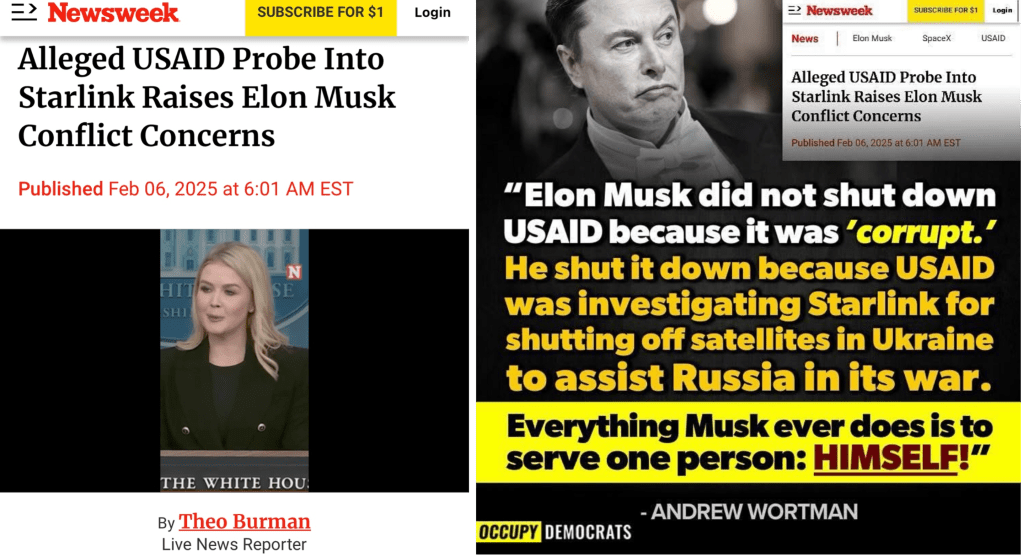
Newsweek reported Feb. 6 that just months before Musk shut down USAID, the agency was investigating its relationship with Musk’s Starlink satellite company.

In days since the order, enough voices were raised in alarm to get funding for HIV and other essential medicines restored—though it wasn’t clear if that included preventative drugs like PrEP. For more than 20 years, PEPFAR (the President’s Emergency Plan for AIDS Relief) worked within and alongside the Global Fund to Fight AIDS, TB and Malaria and the Joint United Nations Program on HIV/AIDS (UNAIDS).

Also, a federal judge on Feb. 7 temporarily blocked the administration from placing 2,200 USAID employees on paid leave, siding with workers who argued Trump and Musk lack the authority to immediately dismantle an agency created by congressional legislation.

The Trump regime blames “migrants” for much of what supposedly ails the United States, but in this time of unparalleled worldwide migration of people, the USAID cuts hit the United Nations High Commissioner for Refugees and the International Organization for Migration (IOM)—two agencies that are critical in managing and measuring the flows of people.

No one should argue against humanitarian aid, although Musk and Republican members of congress who see empathy as a character flaw will do so. In a world still suffering from massive inequality, such aid is urgently needed. The U.S. Christian magazine Sojourners offered a strong defence of the humanitarian work of USAID.

What happens after the 90-day review? My guess is that some functions will be folded into the State Department and thus more susceptible to narrow political goals, like subversion of other countries’ governments. I feel badly for beneficiaries of the humanitarian programs and for many well-intentioned employees; not so much for the vast array of U.S.-based independent contractors who get rich from the misery of others.

Sheinbaum: “It’s better they close it”
As noted above, USAID was created in 1961—just two years after the triumph of the Cuban Revolution. There was no artifice: USAID was to counter the influence of Soviet Union. In recent years, USAID has been at the heart of U.S. challenges to the growing influence of China, which has a successful “Belt and Road” foreign aid program of its own.
My venerable Mac laptop computer tells me that I have 226 files that mention USAID. Almost all of the documents are about the ways that USAID is used as an instrument of U.S. foreign policy, especially its work alongside other U.S. institutions that promote—or subvert—democracy in other countries: the National Endowment for Democracy (NED), the International Republican Institute, the National Democratic Institute for International Affairs and even the Central Intelligence Agency.

USAID even had an Office of Transition Initiatives (OTI) that gained infamy in 2014 over its covert “Cuban Twitter” (ZunZuneo) social media program that was aimed at overthrowing the Cuban government was revealed by Associated Press. 
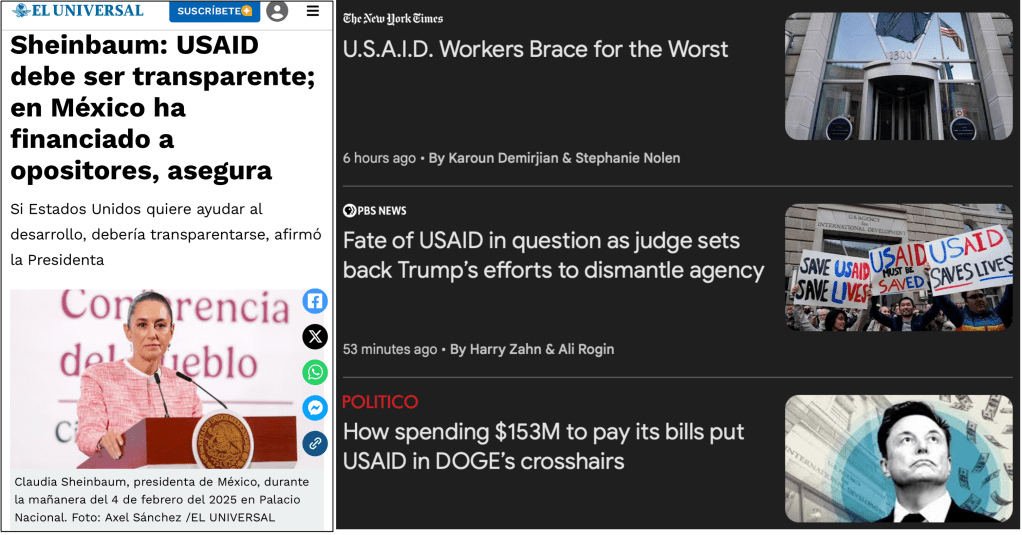
Sheinbaum (left): USAID must be transparent; in Mexico, it has funded the opposition. Right: USAID still in the headlines Feb. 8.

In her morning news conference on Feb. 4, Mexican President Claudia Sheinbaum, breaking away from the dispute over tariffs, lashed out at the overt political activity of USAID. “This agency has funded research projects and groups opposed to the government. That’s the case with Mexico.”
She mentioned an organization that she called, “Mexicans for Corruption.” (She was only half-joking: it’s Mexicans against Corruption. The group actively opposed her predecessor Andrés Manuel López Obrador’s effort to reform the judicial system, and it had support from USAID.) 
“And how is it that they get involved in politics, those agencies that are about aid. In that sense, if the United States wants to help with development, it should be transparent,” she continued.  “The truth is that there are so many things USAID does that in truth it is better they close it.”
In a similar vein, Colombian President Gustavo Petro said some U.S. help is not welcome and has to go. “Hundreds of immigration officials who guard our borders were paid by the United States. This aid is poison,” he said during a Feb. 3 cabinet meeting. “That should never be allowed. We are going to pay with our money.” In 2024, the agency paid nearly $385 million to Colombia.

Haïti chérie

Which brings me to Haiti, a country whose heartbreak I know well. For more than 45 years, it has been particularly afflicted by HIV and AIDS. The ongoing political crisis, worsened by uncontrolled activity by criminal gangs, continues to hamper relief efforts including support to people living with HIV and AIDS

Repeated U.S. interventions have made things worse. From 2011, with the presidencies of Michel Martellyand Jovenel Moïse and then the unelected leadership of Prime Minister Ariel Henry through early 2024, the United States and the local elites had the leaders they wanted: men close to the business sector who had close ties in the United States.

That fruitless model was finally shoved aside last June 11 with the installation of a transitional council (CPT). It’s wobbly but hope persists that it can finally organize new elections that produce leaders that Haitians want. A truth commission and an electoral council have been named.

In the meantime, the problem of gang violence is being addressed (though ineffectively) with the addition of the Multinational Security Support Mission (known as MMAS), led by police from Kenya and bolstered with police from El Salvador and Guatemala. Despite UN backing and many promises, it is underfunded and understaffed.

Feb. 4: U.S. aid to the security mission is frozen. Feb. 6: aid is renewed

A new blow came Feb. 4 when the UN announced that the shutdown of USAID meant funds for the MMAS were frozen. But two days later, U.S. Secretary of State Marco Rubio announced that MMAS would be protected despite the USAID cut, adding to speculation that Rubio, Musk and Trump are not all operating from the same playbook.

In the wake of the axing of USAID, the best piece that I have read about its activities in Haiti is by a long-time observer, Jake Johnston of the Center for Economic Policy and Research (CEPR). At the end of a Feb. 4 essay about the agency’s work in Haiti, he writes:

The term “aid” encompasses many different things: humanitarian assistance and development programming, contracts and grants, support to local organizations and multimillion dollar contracts to DC-area firms. 

There are many parts of the US foreign aid industry that can and should be stopped or significantly reformed. But that doesn’t mean that shutting down USAID, or making its assistance even more overtly political by placing it under the umbrella of the State Department, is going to be a good thing, either in the short or long term. 

The reality is that, where foreign assistance is least effective, it is largely because it is designed to promote US interests rather than address the needs of those ostensibly on the receiving end. The changes announced by the Trump administration are not likely to truly disrupt US soft power abroad. If anything, it will make political interventionism an even more explicit aim of US foreign assistance.

U.S. wins trade dispute, forces Mexico to end GM corn restrictions

by Jim Hodgson

A trade dispute panel has ruled against Mexico’s restrictions on the use of genetically modified (GM or genetically engineered) corn, siding with the United States in forcing Mexico to allow the use of GM corn for food. Canada backed the U.S. position. 

The decision, announced Friday afternoon, Dec. 21, is another demonstration of how free trade agreements are used to undermine policy options made in the public interest.

Mexico City’s La Jornada daily newspaper contains an excellent series of articles today about the consequences for Mexican agriculture of 30 years of free trade with the United States and Canada; climate change is another factor in the fall of production.

In Mexico, a coalition of 300 farming, Indigenous and environmental groups said the Mexican government should not modify its policy and called on civil society organizations to maintain their defense of native varieties of corn. 

The Sin Maíz no hay País (“Without Corn There is no Country”) group told La Jornada that the decision is designed “mostly to protect the interests of transnational corporations, instead of giving priority to the rights of the Mexican people or to sustainability of the environment.”

The trade panel, they added, was made up of three experts in international trade who were not “scientists or experts in public or environmental health” and had no “legitimacy or capacity to evaluate measures taken by a country that were intended to protect its population, preserve its biocultural richness and safeguard the genetic reservoir” of corn.

La Jornada editorial said the administration of President Joe Biden “fought a legal battle against food sovereignty, health, biodiversity, and the right to an adequate diet for Mexicans—not to favour its citizens, but rather four giant global corporations and a handful of rich farmers.”

The Mexican government said it would comply with the decision though it maintains that the restrictions are in line with the principles of public health and the rights of Indigenous peoples, established in national legislation and in the international treaties to which it is a party. On Feb. 13, 2023, Mexico published a Presidential Decree that included stopping the use of GM white corn intended for use in traditional foods such as tortillas and stated Mexico’s intention to eventually replace all GM (yellow) corn in processed food.

The United States challenged Mexico’s restrictions under the Canada-United States-Mexico trade agreement (referred to variously as USMCA or CUSMA) as being a disguised trade restriction. The restrictions were first announced by then-President Andrés Manuel López Obrador at the end of 2020, and revised in 2023.

“This trade panel decision runs counter to a national consensus in Mexico on the threat of GM corn to Mexico’s food sovereignty,” said Cathy Holtslander of the National Farmers Union (NFU) in Canada. “The people of Mexico have the right to protect their unique relationship with corn.”

Holtslander’s comments are included in a Dec. 23 joint news release from the NFU, the Canadian Biotechnology Action Network (CBAN), the Canadian Centre for Policy Alternatives and the Trade Justice Group of the Northumberland Chapter of the Council of Canadians.

“Canada joined the US challenge to force open an unwilling market to genetically modified corn,” said Lucy Sharratt of CBAN.

“This outcome demonstrates how free trade agreements can be used to overthrow democratic decisions for corporate interests,” said the joint news release.

The 117-page decision did not assess the scientific evidence on GM corn provided by Mexico but concluded that Mexico did not conduct a risk assessment that conforms to the terms of the trade agreement. “The Panel recommends that Mexico bring its Measures into conformity with its USMCA obligations under Chapters 2 and 9 of the USMCA. The Panel accepts that Mexico is seeking to address genuine concerns in good faith, and suggests that such concerns be channeled into an appropriate risk assessment process, measures based on scientific principles, and in dialogue among all USMCA Parties to facilitate a constructive path forward.”

“Mexico’s GM corn policy was clearly meant to achieve several goals at once, such as supporting biodiversity, cultural diversity, food sovereignty, Indigenous Peoples’ rights, public health and economic development,” said Stuart Trew, senior researcher with the CCPA. “It is disingenuous for the trade panel to claim the policy is a ‘disguised restriction on trade’ simply because it may affect imports of U.S. or Canadian corn. But doing so conveniently allowed the panel to sidestep Mexico’s strong defence of the GM corn restrictions based on environmental and Indigenous Peoples’ rights exceptions in CUSMA.” 

Canada does not export any corn to Mexico. In explaining its decision to back the U.S. complaint, the government of Canada stated that, to secure a future for genetically modified organisms (GMOs) in Canada and to prevent trade disruptions due to illegal GMO contamination, product developers need access to all markets.

Mexico is regarded as the birthplace of modern corn. It will continue to prohibit planting of GM corn because it may contaminate native strains of the grain. 

Mexico is the top foreign buyer of U.S.-grown yellow corn, nearly all of which is genetically modified. Half of the corn consumed in Mexico today is imported from the United States. The imports are mostly of “yellow corn,” used for animal feed and industrial food production. “White corn” produced in Mexico is used for human consumption.

Mexico has more than 60 native varieties of corn (known as landraces), coming in a variety of colours and with distinct flavours.

In April 2024, CCPA provided an excellent background analysis of the GM corn dispute.

CBAN has joined with US and Mexican groups to issue a new call to action: Groups and individuals in Canada, the US and Mexico are asked to sign a trinational statement in solidarity.

Almost a decade later, truth still elusive in case of the 43 students in Guerrero, Mexico 

They’ve been gone for almost 10 years now, those 43 education students who were taken one night in Iguala, Guerrero. Hypotheses abound but despite promises and investigations, the crime is not solved. 

But there are new revelations about the cover-up orchestrated at the highest levels of the Mexican state in weeks after the disappearance (see below).

President Andrés Manuel López Obrador (known popularly as AMLO) has done many good things as he nears completion of his six-year term. But his failure to press finally for the full truth of the Mexican army’s involvement in the disappearance of the students who attended the Ayotzinapa teachers training school stains his record. 

“A decade of failure,” says a headline in the Mexico City daily newspaper, La Jornada. Students, teachers and family members say their struggle will continue.

During a march in Mexico City on Monday, Aug. 27, Luz María Telumbre, mother of one of the disappeared students, told a reporter that she would be among the parents who would meet the president again the following day. This time, she said, it will be to say: “’thanks for nothing’ because we’re still walking, shouting in the streets for justice and truth.”

Another mother, Joaquína García, said “it isn’t fair that we should be in the streets for 10 years seeking justice and we still don’t know anything about the boys.” She added that she wants to tell the next president, Claudia Sheinbaum, “that we will not stop struggling until we find them and that as a woman and mother, we hope she will understand us.”

On the night of Sept. 26, 2014, students from the Ayotzinapa Normal School were attacked in Iguala, Guerrero, after they had commandeered buses to travel onward to Mexico City for a protest over the Oct. 2, 1968, massacre of student protesters at Tlatelolco plaza in Mexico City.

In Iguala, six people—including three students—were killed in the assault, 25 were injured and 43 students were abducted and presumably murdered later. Leading suspects are members of the Mexican army who worked alongside municipal officials and drug-traffickers who were trying to move opium gum (semi-processed heroin) on one of the buses that was taken.

What happened before?

One afternoon in the late 1990s, I accompanied a group of students from Canada and the United States to a meeting with rural teachers in the mountains near Tlapa in northeast Guerrero.

These teachers spoke for communities afflicted by poverty, military incursions and the drug war. They taught their students in Spanish as well as in Nahuatl or one of the other Indigenous languages spoken in the area. They dedicated their lives to strengthening rural communities through the education of children. They were convinced that people needed to be able to organize themselves and demand that their rights be respected so that things would begin to change.

“The rural teachers colleges are among the only means of social mobility within the reach of young people from campesino communities,” wrote Luis Hernández Navarro, opinion editor at La Jornada, back in 2011. “Through them, they have access to education, housing, food and later, with luck, a job they are qualified to do.” 

The first time I that I can recall hearing of the Ayotzinapa school was in January 2008, when Blanche Petrich, another La Jornada journalist, came to Toronto to support work by Canadian churches in defense of refugees from Mexico. She told us:

“To describe the panorama of repression in Guerrero, it’s enough to follow the route of the popular movement. ‘Wherever there is organization, protest, defense of human rights, mobilization of roadblocks, there is repression, irregular apprehensions and arrest warrants,’ we’re told by the [Tlachinollan] human rights organization in the La Montaña area, led by Abel Barrera. That is, the campesinos who oppose the taking of their lands for a dam in La Perota, close to Acapulco, the ecologists who resist cutting of trees in the Petatlán sierra, the laid-off workers of a government office in the state capital of Chipalcingo, the community leaders of Xochistlaguaca, the students at the normal school in Ayotzinapa: they all suffer persecution.”

And what’s new?

Through an access to information request, journalists obtained new information about the cover-up that was orchestrated after the abductions by high ranking authorities in the government during meetings presided over by then-President Enrique Peña Nieto and attended by then-Attorney General Jesús Murillo Karam and other officials. Their “historic truth” version—since proven false—contended that local police turned the students over to a drug gang which murdered them, burned the bodies at a garbage dump, and put the remains into a river.

AP photo and story (left) about revelations by a former senior official; a tweet by the Fábrica de Periodismo about the cover-up led by high officials of the previous Mexican government.

Tomás Zerón, former head of investigations for Mexico’s Attorney General’s Office, is now a fugitive hiding in Israel, beyond the reach of the Mexican justice system. But in 2022, he answered questions posed in writing by Alejandro Encinas, then Mexico’s Interior Undersecretary for Human Rights.

Appointed by AMLO’s government, Encinas chaired the Commission for Truth and Access to Justice in the Ayotzinapa Case (COVAJ). The commission included family members and their advisors. Their report, published in August 2022, said federal, state and municipal politicians, along with the armed forces and local police, knew what had happened. 

But that report and a subsequent one in September 2023 have been undermined by the refusal of President López Obrador to accept its conclusions and his accusations against the human rights groups that accompany the families, including Tlachinollan and the Jesuit-backed Miguel Augustín Pro Human Rights Centre.

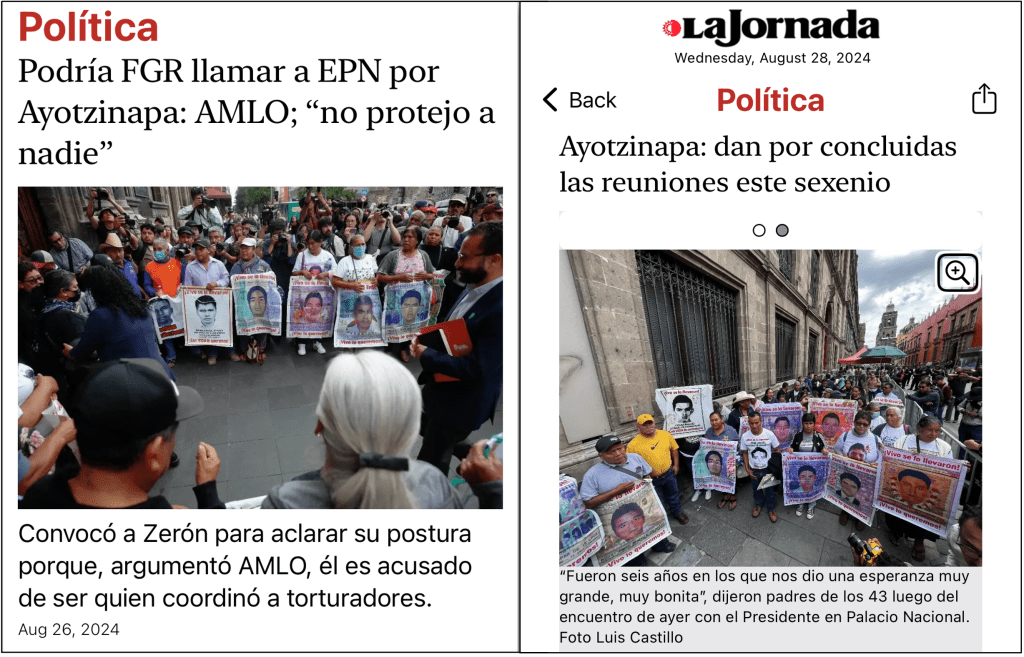
Left: La Jornada story Tuesday with headlines (adding my own details): federal prosecutors may call former president Ernesto Peña Nieto to testify about Ayotzinapa; AMLO: “I don’t protect anybody.” Below the photo, the text says that AMLO has also called on Zerón “to clarify his position because he is accused of coordinating the torturers.” Right: story today about the last of the parents’ meetings with AMLO.

After a meeting Tuesday (Aug. 27) with the president, the parents said it was the last one they would hold with him before he leaves office Oct. 1. 

“We ended badly,” said their lawyer, Vidulfo Rosales of Tlachinollan. He added that while in the first three years of this government, they saw clear good will to get to the truth, in 2022, the situation changed. “This is when we touched the sensitive fibres of the Mexican Army; we could advance no further. There was a break, a crisis, including in the relationship, the dialogue.”

“This government, unfortunately, could not give us truth and justice,” he added.