Almost a decade later, truth still elusive in case of the 43 students in Guerrero, Mexico 

They’ve been gone for almost 10 years now, those 43 education students who were taken one night in Iguala, Guerrero. Hypotheses abound but despite promises and investigations, the crime is not solved. 

But there are new revelations about the cover-up orchestrated at the highest levels of the Mexican state in weeks after the disappearance (see below).

President Andrés Manuel López Obrador (known popularly as AMLO) has done many good things as he nears completion of his six-year term. But his failure to press finally for the full truth of the Mexican army’s involvement in the disappearance of the students who attended the Ayotzinapa teachers training school stains his record. 

“A decade of failure,” says a headline in the Mexico City daily newspaper, La Jornada. Students, teachers and family members say their struggle will continue.

During a march in Mexico City on Monday, Aug. 27, Luz María Telumbre, mother of one of the disappeared students, told a reporter that she would be among the parents who would meet the president again the following day. This time, she said, it will be to say: “’thanks for nothing’ because we’re still walking, shouting in the streets for justice and truth.”

Another mother, Joaquína García, said “it isn’t fair that we should be in the streets for 10 years seeking justice and we still don’t know anything about the boys.” She added that she wants to tell the next president, Claudia Sheinbaum, “that we will not stop struggling until we find them and that as a woman and mother, we hope she will understand us.”

On the night of Sept. 26, 2014, students from the Ayotzinapa Normal School were attacked in Iguala, Guerrero, after they had commandeered buses to travel onward to Mexico City for a protest over the Oct. 2, 1968, massacre of student protesters at Tlatelolco plaza in Mexico City.

In Iguala, six people—including three students—were killed in the assault, 25 were injured and 43 students were abducted and presumably murdered later. Leading suspects are members of the Mexican army who worked alongside municipal officials and drug-traffickers who were trying to move opium gum (semi-processed heroin) on one of the buses that was taken.

What happened before?

One afternoon in the late 1990s, I accompanied a group of students from Canada and the United States to a meeting with rural teachers in the mountains near Tlapa in northeast Guerrero.

These teachers spoke for communities afflicted by poverty, military incursions and the drug war. They taught their students in Spanish as well as in Nahuatl or one of the other Indigenous languages spoken in the area. They dedicated their lives to strengthening rural communities through the education of children. They were convinced that people needed to be able to organize themselves and demand that their rights be respected so that things would begin to change.

“The rural teachers colleges are among the only means of social mobility within the reach of young people from campesino communities,” wrote Luis Hernández Navarro, opinion editor at La Jornada, back in 2011. “Through them, they have access to education, housing, food and later, with luck, a job they are qualified to do.” 

The first time I that I can recall hearing of the Ayotzinapa school was in January 2008, when Blanche Petrich, another La Jornada journalist, came to Toronto to support work by Canadian churches in defense of refugees from Mexico. She told us:

“To describe the panorama of repression in Guerrero, it’s enough to follow the route of the popular movement. ‘Wherever there is organization, protest, defense of human rights, mobilization of roadblocks, there is repression, irregular apprehensions and arrest warrants,’ we’re told by the [Tlachinollan] human rights organization in the La Montaña area, led by Abel Barrera. That is, the campesinos who oppose the taking of their lands for a dam in La Perota, close to Acapulco, the ecologists who resist cutting of trees in the Petatlán sierra, the laid-off workers of a government office in the state capital of Chipalcingo, the community leaders of Xochistlaguaca, the students at the normal school in Ayotzinapa: they all suffer persecution.”

And what’s new?

Through an access to information request, journalists obtained new information about the cover-up that was orchestrated after the abductions by high ranking authorities in the government during meetings presided over by then-President Enrique Peña Nieto and attended by then-Attorney General Jesús Murillo Karam and other officials. Their “historic truth” version—since proven false—contended that local police turned the students over to a drug gang which murdered them, burned the bodies at a garbage dump, and put the remains into a river.

AP photo and story (left) about revelations by a former senior official; a tweet by the Fábrica de Periodismo about the cover-up led by high officials of the previous Mexican government.

Tomás Zerón, former head of investigations for Mexico’s Attorney General’s Office, is now a fugitive hiding in Israel, beyond the reach of the Mexican justice system. But in 2022, he answered questions posed in writing by Alejandro Encinas, then Mexico’s Interior Undersecretary for Human Rights.

Appointed by AMLO’s government, Encinas chaired the Commission for Truth and Access to Justice in the Ayotzinapa Case (COVAJ). The commission included family members and their advisors. Their report, published in August 2022, said federal, state and municipal politicians, along with the armed forces and local police, knew what had happened. 

But that report and a subsequent one in September 2023 have been undermined by the refusal of President López Obrador to accept its conclusions and his accusations against the human rights groups that accompany the families, including Tlachinollan and the Jesuit-backed Miguel Augustín Pro Human Rights Centre.
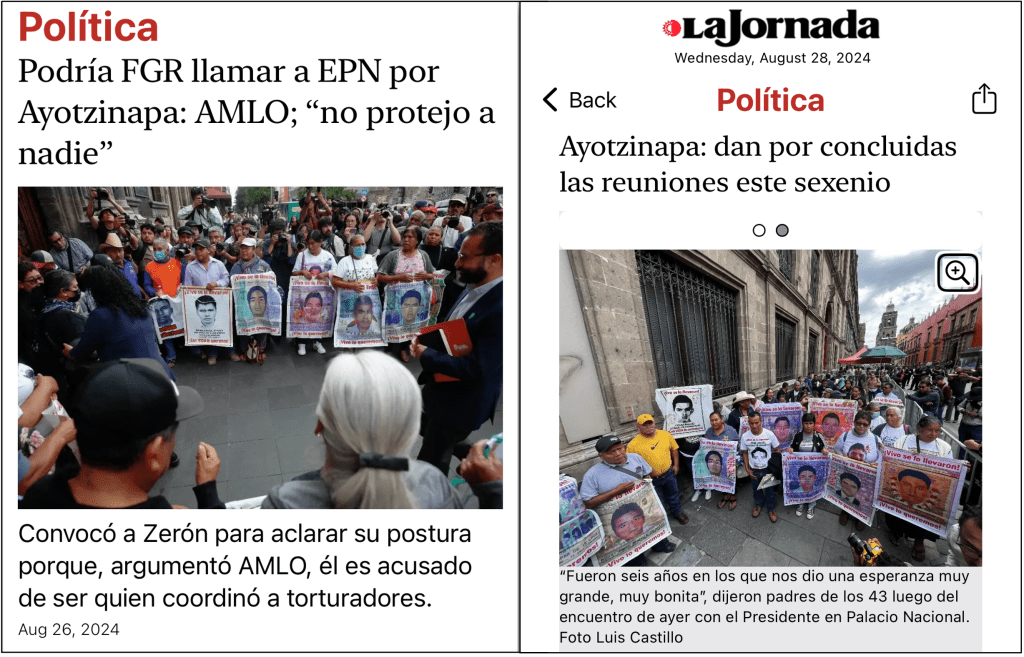
Left: La Jornada story Tuesday with headlines (adding my own details): federal prosecutors may call former president Ernesto Peña Nieto to testify about Ayotzinapa; AMLO: “I don’t protect anybody.” Below the photo, the text says that AMLO has also called on Zerón “to clarify his position because he is accused of coordinating the torturers.” Right: story today about the last of the parents’ meetings with AMLO.

After a meeting Tuesday (Aug. 27) with the president, the parents said it was the last one they would hold with him before he leaves office Oct. 1. 

“We ended badly,” said their lawyer, Vidulfo Rosales of Tlachinollan. He added that while in the first three years of this government, they saw clear good will to get to the truth, in 2022, the situation changed. “This is when we touched the sensitive fibres of the Mexican Army; we could advance no further. There was a break, a crisis, including in the relationship, the dialogue.”

“This government, unfortunately, could not give us truth and justice,” he added.
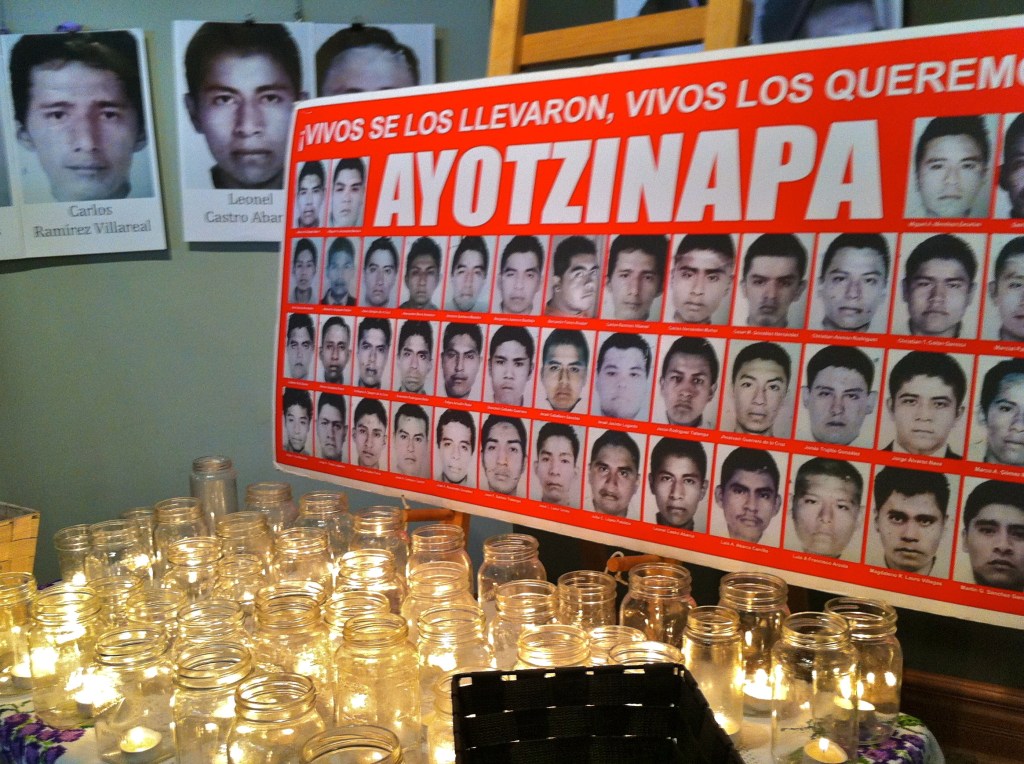
In Mexico, 43 students missing for eight years: not forgotten and still making headlines

By now, you might not remember the murders and forced disappearances of the “normalistas” – education  students who were training to be rural teachers in the state of Guerrero in southern Mexico. 

On the night of Sept. 26, 2014, students from the Ayotzinapa Normal School were attacked in Iguala, Guerrero, after they had commandeered buses to travel to Mexico City for a protest over the Oct. 2, 1968, massacre of student protesters at Tlatelolco plaza in Mexico City.

In Iguala, six people – including three students – were killed in the assault, 25 were injured and 43 students were abducted and presumably murdered later. Leading suspects are members of the Mexican army who worked alongside municipal officials and drug-traffickers who were trying to move opium gum (or semi-processed heroin) on one of the buses that was taken.

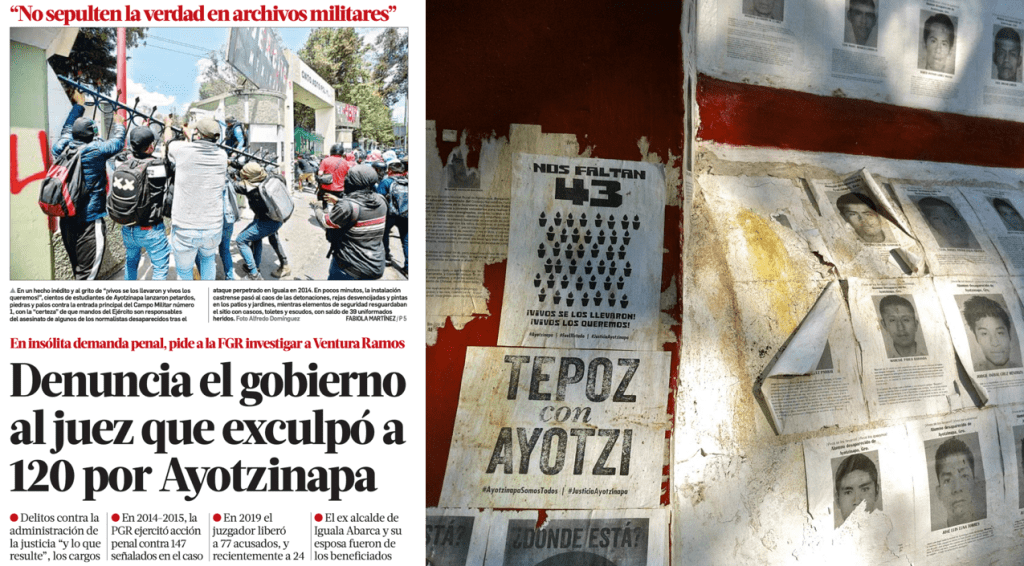
As the eighth anniversary approaches, a series of events reveals more about what happened as well as efforts by people tied to the former government of Enrique Peña Nieto to maintain the cover-up. 

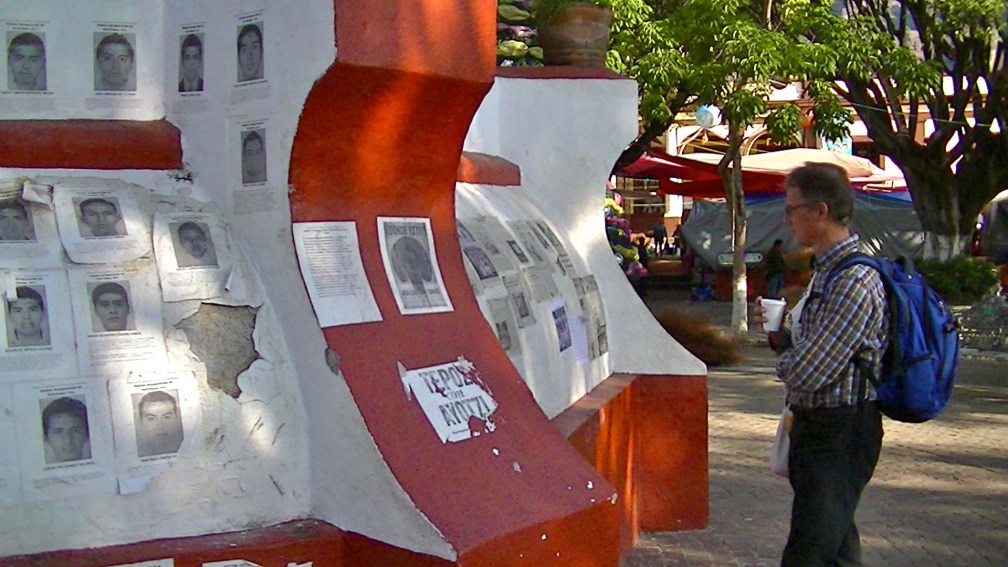
Left: La Jornada front page today: protests over judicial decisions, military cover-up. Right: remembering the 43 students in Tepoztlán, Morelos, December 2014.

First the news:

  • On Aug. 18, the report of the Commission for Truth and Access to Justice (appointed by the current government of President Andrés Manuel López Obrador) published its report, stating that the students’ disappearance was a “state-sponsored crime.” The report accuses Col. José Rodríguez Pérez, commander of the 27th infantry battalion located in Iguala, of giving the order to murder the missing students. He was arrested on Sept. 15.
  • By pointing to army collusion, the new report denounced the version offered by 2015 by the Peña Nieto administration that the students were killed by a local drug gang after being abducted by municipal cops acting on the orders of Iguala’s corrupt mayor, and that their bodies were incinerated at a dump in the nearby town of Cocula – which is not to say that those officials do not share part of the responsibility for the crimes. Following the report, Peña Nieto’s  attorney-general, Jesús Murillo Karam, was arrested for obstruction in administration of justice in the case. Another official whose arrest has been sought, Tomás Zerón de Lucio,head of Peña Nieto’s Criminal Investigation Agency, left Mexico and is hiding in Israel
  • Among the many stories that emerged from the report is that of one of the students, Julio César López Patolzin, a former soldier now revealed to have been an army spy infiltrated into the school. Even though he was in touch with his supervisors up to the night of the disappearances, the army made no effort to extricate him from among the other students, making him a victim along with the others. 
  • Despite the truth commission report, a judge assigned to the case by the former government has ordered the release of at least 121 police officers and government officials previously charged, including some of the municipal officials and accused drug-traffickers. The district court judge, Samuel Ventura Ramos, is located in Matamoros, Tamaulipas (in northeastern Mexico, close to the U.S. border).
  • Federal prosecutors are now bringing charges against the judge, and President López Obrador demanded Friday (Sept. 23) to know why the cases are not taken up again. “What has that to do with justice? Who chose that judge? And why is the Ayotzinapa case, which has to do with Guerrero, attended to by a judge in Tamaulipas?”

What does all this mean?

When looking at the news these days, it’s important to keep in mind that part of the game plan of globalized capitalism is to show the state as ineffective, whether against the COVID pandemic, inflation, or protecting human rights and public security.

In Mexico, where the present government is attempting to transform the system into one more amenable to the impoverished majority, economic power and some instruments of political and judicial power are still held by old elites. 

Moreover, the system as implemented over the past 30 years has made the students and their cultures redundant, wrote Alejandro Nadal of the Centre for Economic Studies at El Colegio de Mexico. Industrialized agriculture is privileged over traditional small-holder farms. “That is to say, there is no place for campesinofarmers who aspire to a dignified life in freedom. The youth of Ayotzinapa rebelled and the established powers responded,” Nadal wrote in La Jornada.

And, who are those powers? Again we see, as we have repeatedly over the past two decades of a stepped-up “war on drugs,” we see the collusion of a drug cartel (this one is called Guerreros Unidos, or United Warriors) with politicians and other state actors.

“The war on drugs has never controlled drug trafficking and has always been about social control,” wrote Laura Carlsen, director of the director of the Americas Program of the Center for International Policy. “Now it’s Mexico’s youth that are paying the price of that duplicity.”

I lived and worked in Mexico from 1994 to 2000. I was based in the city of Cuernavaca, about 90 km south of Mexico City in the state of Morelos and about 50 km north of the border with Guerrero. We frequently visited a Nahua Indigenous community near Taxco, Guerrero. If you take the libre (the two-lane, non-toll highway) towards Acapulco, you pass through Iguala.

During those years, I made several visits to the city of Tlapa in the eastern part of the state. I came to know the Tlachinollan human rights centre and once spent an afternoon near Olinalá talking with a group of rural teachers. Their option for the poor was absolute and inspiring.

The students reflected the context from which they emerged and to which they would have returned as teachers: impoverished and exploited rural Mexico. Their work was heroic.

The latter paragraphs of this text are adapted from a piece I wrote in a previous Unwrapping Development blog format in October 2014, days after the disappearances.