Vatican’s Jubilee commission urges systemic change as it launches new debt relief report

A Vatican-backed report authored by more than 30 prominent economists calls for urgent action and systemic reforms to address the global debt and development crises of our times.

The group, convened by the late Pope Francis for this Jubilee year, provides recommendations on debt relief and economic policy.

What follows is (mostly) from a news releases today by Jubilee USA and the Initiative for Policy Dialogue at Columbia University:
“This report is a blueprint to solve the current global debt crisis, prevent future economic crises and create an economy that radically reduces poverty,” said Eric LeCompte, executive director of the Jubilee USA Network and a Vatican advisor who is at the Pontifical Academy of Social Sciences (PASS) for the report launch. 

“While debt relief and a just economy are at the center of Catholic teaching, this is the first report convened by a Pope that focuses on technical recommendations to achieve an economy that serves everyone,” he added.
Nobel Prize-winning economist Joseph Stiglitz and former Argentine Minister of the Economy, Martín Guzmán, led the work of the expert group.

The report “seeks to contribute to a comprehensive rethinking of the global rules governing finance, taxation, trade, and the sharing of knowledge,” said PASS. “At its heart lies a clear and urgent goal: to help build a global economy that serves people, especially the most vulnerable, and truly leaves no one behind.”
Pope Francis reiterated the interfaith calls of Pope Benedict and Pope John Paul II on debt relief and economics, making these issues the focus of the Christian holy year of Jubilee 2025. Pope Leo XIV continues the efforts of his predecessors. 

Twenty-five years ago in Jubilee 2000, over $100 billion in international debt was cancelled, but a lack of structural reform, combined with recent world events, resulted in systemic vulnerabilities that are now undermining hard-won gains. 
The time for new Jubilee action is now.

Recommendations include:

  • Improve debt restructuring: Change multilateral institution policies and legislation in key jurisdictions so that creditors and debtor governments are newly incentivized to agree to more timely and sustainable debt restructurings.
  • End bailouts to private creditors: Multilateral institutions including the International Monetary Fund should change their policies and practices to support sustainable recoveries, not de facto bailouts of private creditors or crippling austerity.
  • Strengthen domestic policies: Developing countries should more extensively use capital account regulations to discourage destabilizing flows and create a more stable environment for long-term investments and should invest in structural transformation.
  • Enhance transparency: All should support financial policies that are transparent and have broad societal support.
  • Reimagine global finance: All should support a comprehensive change in global financing models to drive financing for sustainable development, including lending that supports long-term growth.

The report’s findings will be discussed at the 4th International Conference on Financing for Development in Seville, Spain, June 30-July 3 and other global gatherings where the global debt and development crises will be high on the agenda.
“Developing countries spent a record $1.4 trillion paying debt in 2023 and too many countries spend more on paying debt than they do on the urgent needs of their people,” said LeCompte who also serves on United Nations debt expert groups. “In African and low-income countries, debt payments are two-thirds higher than their combined spending on health, education and social services.”
According to the World Bank, more than 800 million people live in extreme poverty, over 100 million more than previously believed. The report calls for a range of reforms as a debt and poverty crisis that has been growing in the face of the pandemic, wars, cost-of-living and interest rate hikes rose to prominence in the agenda of global leaders in multiple forums. Proposals include greater transparency, reforms to the International Monetary Fund, changes to laws in New York and the United Kingdom which govern private sector debt, improving debt contracts and an international bankruptcy system akin to the national bankruptcy courts that exist in most countries.
“This report can move the G7, G20, IMF and United Nations to make short-term decisions to address the current crisis and lay a foundation to prevent future crises,” stated LeCompte.
“The experts who wrote this report are a critical part of the global Jubilee movement, which includes advocates in pews, development groups, conservatives, liberals and people of every faith,” shared LeCompte. 

Read or download the report here or here.

Read Pope Francis’ Jubilee 2025 debt focus speech here.

Systemic failure of global finance demands system change

by Jim Hodgson

If, as UN secretary general Antonio Guterres has said, the excessive debts of impoverished countries represent a “systemic failure,” then the solution would be reform of the system.

And so, for at least five decades, UN agencies, development NGOs and global justice activists like me have talked about a “New International Economic Order” (NIEO) or reform of the “international financial architecture.”

Left: media coverage of the summit was mixed; right: Prime Minister Mia Mottley of Barbados at the UN climate conference in Glasgow, 2021.

The latest tilt at the windmill of reform came in June from French President Emmanuel Macron working together with Barbados Prime Minister Mia Mottley. They invited world leaders to Paris June 22-23 to come up with a new “global pact” to fund the struggle to overcome poverty and human-caused climate change.

“What is required of us now is absolute transformation – and not reform – of our institutions,” said Mottley in her opening address. Mottley had earlier worked with other Global South nations to propose what is called the Bridgetown Initiative – a plan for changes to governance, policy and practice of North-controlled international financial institutions.

What followed, however, showed a “wide chasm” between what the Global South needs and what the Global North is willing to concede, said Iolanda Fresnillo, policy and advocacy manager for debt justice at Eurodad, an NGO focussing on debt and development.

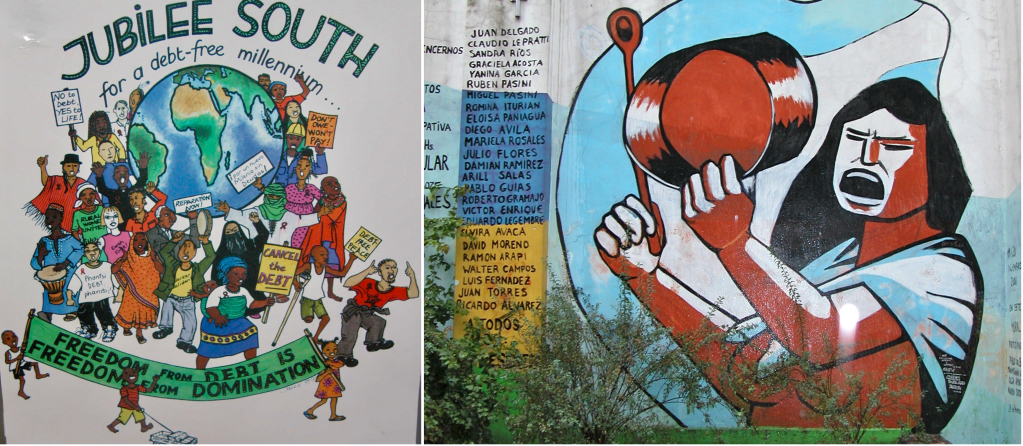
Images from the first years of our new millennium: a Lula campaign billboard in Brazil; a mural in Buenos Aires protesting the 2001-02 economic crisis.

Brazilian President Luiz Inácio (Lula) da Silva, insisted that leaders address global inequality. 

“It is not possible that, in a meeting between presidents of important countries, the word inequality does not appear: wage inequality, racial inequality, gender inequality, inequality in education, inequality in health. In other words, we are in an increasingly unequal world, and wealth is increasingly concentrated in the hands of fewer people, and poverty is increasingly concentrated in the hands of more people.”

With changes to taxation and provision of pensions, Brazil had lifted 36 million people out of poverty by 2010, he said. But after Jair Bolsonaro left office, 33 million were once again in poverty. Lula pledged to take steps again to improve the lot of the impoverished, to overcome deforestation in the Amazon and other forest regions of Brazil, and to collaborate with other governments for the sake of forests, climate and equity.

This August, Brazil will host a meeting of South American countries that share the Amazon basin. It’s a step toward 2025, when the Brazilian state of Pará will be the seat of that year’s climate negotiations, COP 30. Pará is where the Amazon River reaches the Atlantic Ocean.

But Lula also decried the ineffectiveness of global institutions that cannot enforce climate action and that represent the world as it existed in the late 1940s. “We cannot continue with institutions that work in the wrong way,” he said.

Western leaders “snub” Macron summit

Other than Macron, German Chancellor Olaf Scholz was the only G7 leader to attend. Canada was represented by then-International Development Minister Harjit Sajjan. (Sajjan was moved away from the development portfolio in the July 26 cabinet shuffle and replaced by Ahmed Hussen.)

But one searches in vain to find media commentary on Sajjan’s participation, and must turn instead to a government news release to find out what he said or did:

“While at the summit, Minister Sajjan participated in several high-level events, including an event on the key challenges, opportunities and tools required to achieve a new feminist financial architecture, as well as an event on increasing global investment in education to catalyze sustainable development. He also took part in a discussion on improving access to financing for Small Island Developing States (SIDS) through the Bridgetown Initiative and the Multidimensional Vulnerability Index. This discussion was particularly important to the Minister given his role of small states champion under the UN-Commonwealth Joint Advocacy Strategy for Small States. The Minister emphasized his commitment to amplifying the priorities of SIDS and helping to find solutions that work for them, particularly on climate vulnerabilities.”

Sajjan also announced that that Canada will invest $50 million in something called the BlueOrchard Latin America and the Caribbean Gender, Diversity, and Inclusion Fund “to increase access to financing for women, Indigenous peoples, Afro-Descendants and other underserved groups in Latin America and the Caribbean.”

BlueOrchard, the government news release explains, is “a member of the Schroders Group” and “a pioneer in the growing field of impact investing.” (Impact investing is defined elsewhere as an extension of socially responsible investing, and “goes a step further” by actively seeking investments that can create a significant impact.)

After a bit of digging, one learns that BlueOrchard Finance is a Swiss-based investment company that has been working in Latin America since 2007. It specializes in microfinance. “The strategy has financed 400,000 micro-entrepreneurs across 13 countries” in Latin America and the Caribbean. in 2019, BlueOrchard had about $3.5 billion in assets under management.

This is not the same as cooperatives, credit unions or even the microcredit “economy of solidarity”-style initiatives with which I have been involved in Haiti, Cuba, Guatemala and El Salvador. And it’s not about systemic change. 

“Feminist financial architecture” and other good intentions aside, Canada and the other wealthy nations are part of a continuing failure to finance the fight against impoverishment and climate change. 

Some among us have proposed changes to the global financial architecture for a very long time….

A post-script. Global South leaders do not see issues in the same way that their Global North counterparts see them. In Brussels a few weeks after the Paris summit, European Union leaders held their first meeting with Latin American leaders in eight years. While the EU pressed for more support for Ukraine, Latin Americans led by Lula pressed for dialogue and questioned new European demands ahead of a potential new trade deal. In the end, the joint statement could only say that the ongoing war is causing immense human suffering and increasing the global economy’s real vulnerabilities.

Debt crisis again provokes “deprivation and misery” in Global South

Asia Debt Monitor, April 2023 

by Jim Hodgson

Forty years ago, I spent five weeks of July and August in the Dominican Republic, learning from families, churches and unions about the ways people confronted their impoverishment. The people that I met taught me about long-haul, multi-generational struggle and solidarity.

Soon after that visit, protests in the D.R., Egypt and Peru erupted against conditions imposed by the International Monetary Fund (IMF) and foreign banks. The issue then – and again now – was how to cope with national debt, budget deficits, and rising interest rates.

The 1984 debt crisis: “Dominicans pay in blood”

You are plunging Global South countries into a greater debt debacle that will cause more deprivation and misery,” wrote the Asian Peoples’ Movement on Debt and Development (APMDD) to leaders of the G7 rich countries on the eve of their mid-May summit in Hiroshima, Japan. Countries as diverse as Argentina, Pakistan, Sri Lanka and Zambia have confronted large debt and harsh repayment conditions in recent months. (Zambia has reached an agreement with lenders to restructure $6.3 billion of debt.)

This month, new reports from two United Nations agencies provide warnings and suggest some solutions to the weight imposed by banks and Global North governments on the people of the Global South.

The UN Development Program (UNDP) said 165 million people were forced into poverty between 2020 to 2023 as debt servicing pushed aside expenditures for  social protection, health and education. All of these additionally impoverished people poor live in low- and lower-middle-income economies, with the most-impoverished 20 per cent in low-income countries suffering the most with incomes in 2023 still below the pre-pandemic levels. Their governments cannot do more to assist because of conditions attached to debt repayment plans.

The UN Conference on Trade and Development (UNCTAD) said that public debt has increased faster in developing countries compared to developed countries over the past decade. “When developing countries borrow money, they have to pay much higher interest rates compared to developed countries, even without considering the costs of exchange rate fluctuations. Countries in Africa borrow on average at rates that are four times higher than those of the United States and even eight times higher than those of Germany.”

UNCTAD reports that 3.3 billion people live in countries were interest payments on debts are greater than spending for education and health care. An editorial in Mexico City’s La Jornada daily newspaper recalled thatUN Secretary General Antonio Guterres has denounced this injustice as “systemic failure.”

In a second editorial a day later, La Jornada noted the impact of Global South debt on efforts to confront the climate emergency. “In 2015, the 10 per cent of the world’s wealthiest people were responsible for half of the greenhouse gas emissions, and only one per cent were responsible for 15 per cent of those emissions. The most impoverished half of the people of the Earth generated only seven per cent of the emissions, but it is they who are most affected by climate change, higher food prices and even the destruction of their homes in severe weather events. The countries whose transnational corporations devastate the environment of the Global South with their unceasing extraction of natural resources close their doors to migrants and condemn them to remain in regions that have become uninhabitable because of the actions of those corporations.”

Historically, the ways that the IMF, banks and Global North governments have contended with debt crises have been to use them as opportunities to push neoliberal development models: free trade, extractivism, privatisation of state-owned companies and services, low-wage factory jobs and export-focused agriculture. And they avoid conversations about debt cancellation and reparations for colonialism and slavery.

APMDD and other Global South movements propose different approaches. In the letter cited above, APMDD urged G7 governments to: 

  1. Cancel the debt for countries in need, including public debts of a questionable and fraudulent nature that violated human rights and contributed to exacerbating the climate crisis.
  2. Support the elimination of IMF surcharges, which penalizes the most debt-distressed countries and further erodes the capacity of developing countries to respond to urgent social needs. 
  3. Enact/strengthen national legislation to require the participation of private creditors in debt relief, which is a key element in any serious wide scale debt reduction or restructuring effort. 
  4. Immediately deliver new, additional and non-debt creating climate finance for adaptation, mitigation and loss and damage, much more than the unfulfilled $100 billion/year pledge, to adequately meet the needs of the Global South. 

Once in a while, cracks appear in the wall of Global North indifference. In June, French President Emmanuel Macron convened a summit to reach a new “global pact” to finance the fight against poverty and human-induced climate change. I’ll share some outcomes in coming days.

Womin is a network of women’s organisations across Africa that proposes cancellation of African debt and ecofeminist alternatives to extractives models of development.