From Bogotá, the Global South charges Israel with genocide

A two-day meeting this week in the Colombian capital ended with renewed commitment to pursue accountability for Israeli abuses in Gaza, including by preventing the transfer of weapons to Israel.
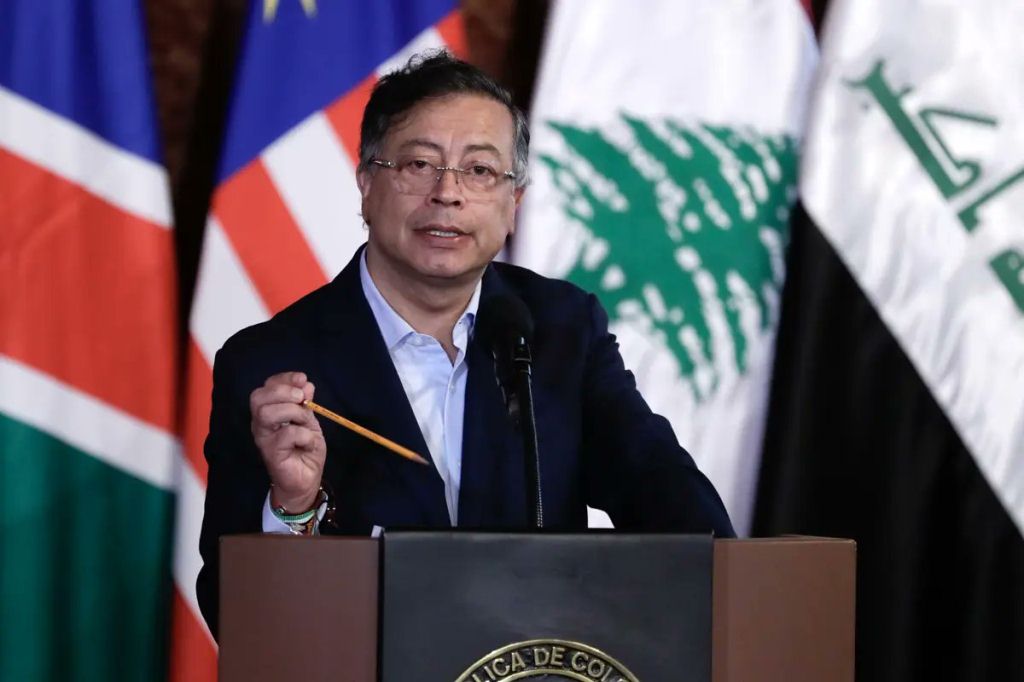
As the event drew to a close Wednesday (July 16), Colombian President Gustavo Petro (above) told participants, “Gaza is simply an experiment by the ultra-rich to show the impoverished people of the world how they will respond to humanity’s rebellion.”

Petro also distanced himself further from the North Atlantic Treaty Organization (NATO), which in 2022 had designated Colombia as a “non-member strategic ally.” 

“What are we doing in NATO, if its principal leaders are with the genocide?” he asked. “We must leave.”

A coalition known as The Hague Group organised the summit. It was born in January last year through the help of Progressive International (PI), an organization founded in 2020 to unite, organize, and mobilize progressive forces around the world. PI called the Bogotá meeting the “most ambitious multilateral action since the start of Gaza genocide 21 months ago.”

Jointly convened by the governments of Colombia and South Africa as co-chairs, the Hague Group also includes Bolivia, Cuba, Indonesia, Iraq, Libya, Malaysia, Namibia, Nicaragua, Oman and Saint Vincent and the Grenadines. At least 18 other countries, plus the United Nations and the World Council of Churches, sent representatives. Qatar and Egypt, which are overseeing negotiations between Hamas and the Israeli government, attended.
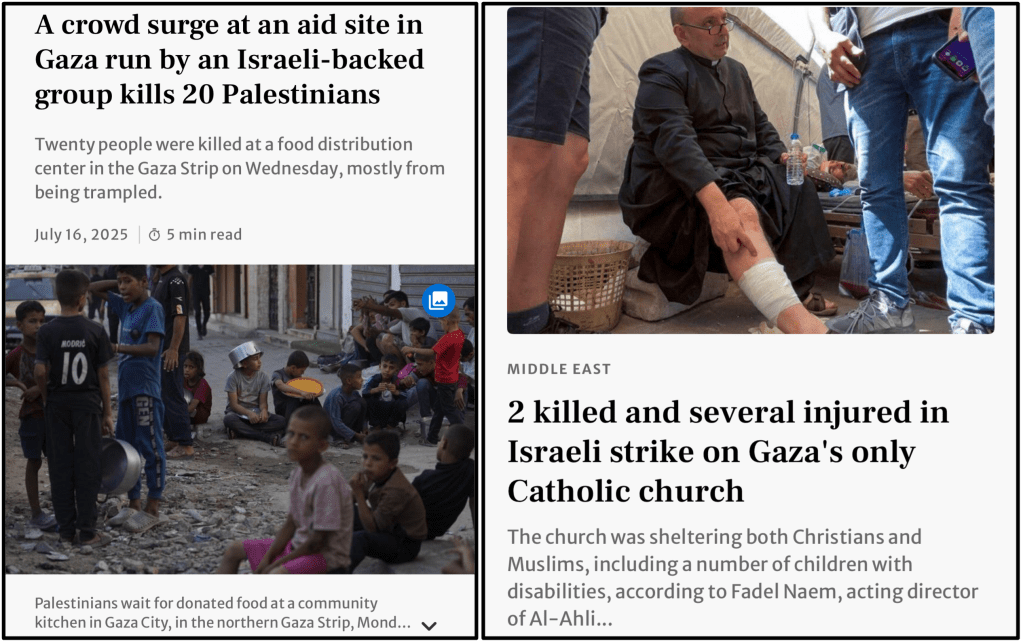
Israel’s offensive in Gaza has killed more than 58,000 Palestinians, according to Gaza’s Health Ministry, which has said women and children make up more than half of the dead. At least 90 were killed on Thursday (July 16), including those who were crushed at an Israeli-controlled food distribution site. Holy Family Church also came under attack, sparking criticism and new calls for peace from Pope Leo XIV and from the World Council of Churches.

During Tuesday morning’s opening event, various officials spoke, calling for an end to Israel’s attacks on Gaza. Colombia’s foreign minister, Rosa Yolanda Villavicencio, said during her morning address that Israel’s attacks constitute an unequivocal “genocide.”
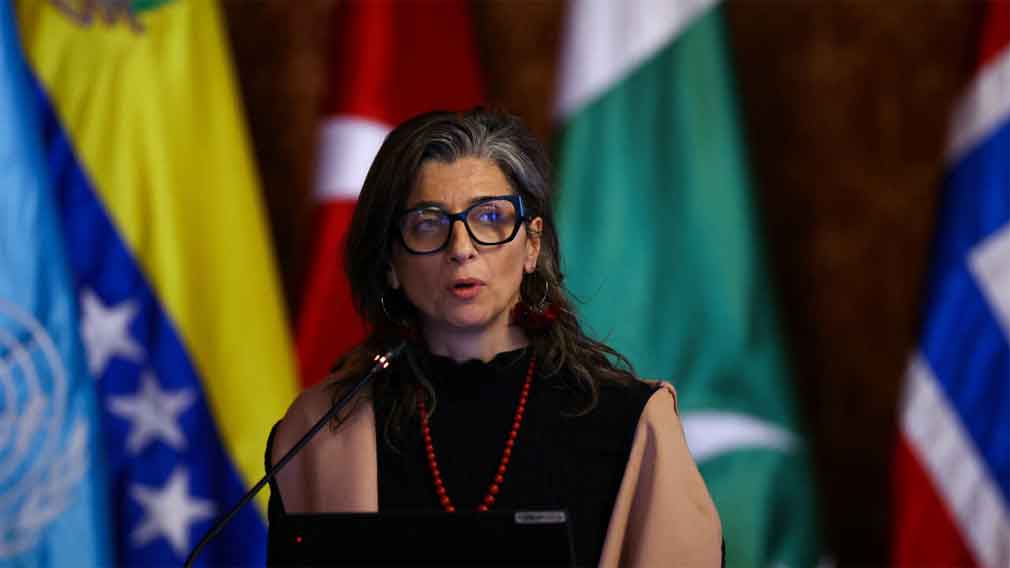
Another key participant was Francesca Albanese (above), the U.N. special rapporteur for the Palestinian Territories. She denounced the inaction of the international community. She accused the West of justifying Israeli actions as the “right to defense” and said the vetos in the U.N. Security Council “protect war crimes” carried out in the sight of all.

“Palestine has changed global consciousness, drawing a clear line between those who oppose genocide and those who accept it or are part of it,” she said. Albanese was recently sanctioned by the US for her outspoken criticism of Israel’s actions.

“We believe in protagonism, not supplication,” said Varsha Gandikota-Nellutla, the executive secretary of The Hague Group. “Today marks an end to the era of the impunity and the beginning of collective state action by governments of conscience.”

The group members committed to implementing six measures immediately through their domestic legal and administrative systems to break the ties of complicity with Israel’s campaign of devastation in Palestine. They set September 20 as a date for other states to join them, coinciding with the 80th U.N. General Assembly. Consultations with capitals across the world are now ongoing.

“We hereby announce the following measures,” the Joint Statement on the Conclusion of the Emergency Ministerial Conference on Palestine reads, “to be adopted based on states’ domestic legal and legislative frameworks:”

  • Prevent the provision or transfer of arms, munitions, military fuel, related military equipment, and dual-use items to Israel…
  • Prevent the transit, docking, and servicing of vessels at any port…. in all cases where there is a clear risk of the vessel being used to carry arms, munitions, military fuel, related military equipment, and dual-use items to Israel
  • Prevent the carriage of arms, munitions, military fuel, related military equipment, and dual-use items to Israel on vessels bearing our flag… and ensure full accountability, including de-flagging, for non-compliance with this prohibition.
  • Commence an urgent review of all public contracts, to prevent public institutions and funds from supporting Israel’s illegal occupation of the Palestinian Territory and entrenching its unlawful presence.
  • Comply with obligations to ensure accountability for the most serious crimes under international law, through robust, impartial and independent investigations and prosecutions at national or international levels, to ensure justice for all victims and the prevention of future crimes.
  • Support universal jurisdiction mandates, as and where applicable in national legal frameworks and judiciaries, to ensure justice for victims of international crimes committed in the Occupied Palestinian Territory.

“These 12 states have taken a momentous step forward,” said Albanese about the joint statement. “The clock is now ticking for states—from Europe to the Arab world and beyond—to join them.”

The full joint statement is here.

Complete text of Albanese’s remarks is here.

Liberation theologians see relationships as key to overcoming Israel-Palestine conflict

A demonstration in Toronto during the July 2014 Gaza War.

by Jim Hodgson

For people like me whose faith found new grounding in the waves of liberation theology that have emerged over the past 55 years or so, a global conversation about solidarity with Palestine offered a chance to reflect with people who are living with the effects not just of the present war, but of generations of conflict that preceded it.

The zoom conversation – “Transnational Solidarity Amongst Liberation Theologies: Palestine & Beyond” – organized by the Sabeel Ecumenical Liberation Theology Centre (a United Church of Canada global partner) in Jerusalem, was held Nov. 10 and drew together about 100 people from around the world.

Sabeel’s director, Rev. Dr. Naim Ateek (an Anglican priest) spoke of both the immediacy of the “crushed children of Gaza” and of the urgent need to “understand the other, respect the other, accept the other. Without those, there is not a healthy or productive exchange.”

“These are absolutely crucial when we think about rebuilding relationships (not just homes), and building solidarity for the future of all the people of Palestine and inside Israel,” he said, adding: “Have in mind the tragedy and the suffering; that is the departure point for us.”

Ateek encouraged those who would be in solidarity with Palestinians to be “pro-peace, pro-understanding, pro-liberation, and pro-reconciliation. We need to be looking for justice in accordance with international law.”

Sabeel is a space where community reflection continues to drives new action for justice and peace, and to build relationships far beyond Jerusalem. You can also follow Canadian Friends of Sabeel (CFOS) on Facebook.

Dr. Farid Esack of the University of Johannesburg (and a member of the United Church of Canada’s first partners council a decade ago) spoke of the reflection-action process in liberation theology that drives praxis beyond theorizing. “We must always reflect on our praxis, and make that affect our praxis,” he said. “Colonialism, imperialism and capitalism always view the Earth as territory to be captured.” For Palestinians, he added, the task is to elaborate a vision of what a “post-Zionist society would look like, and for the rest of us, to follow that.”

Esack, a Muslim scholar of liberation theology in South Africa, emphasized the need to “not demonize all Jews and to always fight anti-Semitism, but I will not fall into the white trap, not privilege that above other forms of racism.”

In response to a question about the role of inter-religious dialogue in seeking justice and peace, he warned against platitudes and “a butterfly dance of escapism and digression.”

“The occupation is not a result of Jews not understanding Muslims or Christians not understanding Jews. In liberation theology, the priority now is inter-religious solidarity against occupation, the armaments industry, the military, and not to remove attention from the occupation.”

This is to put it mildly, but global South views of current conflicts tend to be different from the positions taken by leaders in countries like Canada. A Brazilian Methodist feminist theologian, Rev. Dr. Nancy Cardoso, hoped to press that point as one of the speakers invited to be part of the Sabeel conference. Working now in Angola, she was unable to join the zoom call because of internet problems. I have known her for many years, and contacted her later because I was curious about what she would have said.

“Doing liberation theology implies a distrust of the tradition of bourgeois knowledge, a guerrilla war relationship with the church, university and their bunkers and dictators, a difficult relationship with publishers and their audiences, because it is always marked by class struggle,” says the text she shared with me. 

She drew attention to the actions of “Christian Zionists” – Christian fundamentalists who think Israel needed to be re-founded so as to bring about the return of Jesus Christ – whose “apocalyptic and hypocritical visions… dream with the past.”  

“Reconstruction of hope,” Cardoso insisted, “to be real and not illusion, should spring from the poor and excluded.”

The methods of liberation theology demand re-reading of religious texts including the Bible from the perspective of the poor, she said, and “returning the text methodologically to poor communities, not as a book of power and authority but as a possibility of dialogue with other narratives of faith present in cultures.”

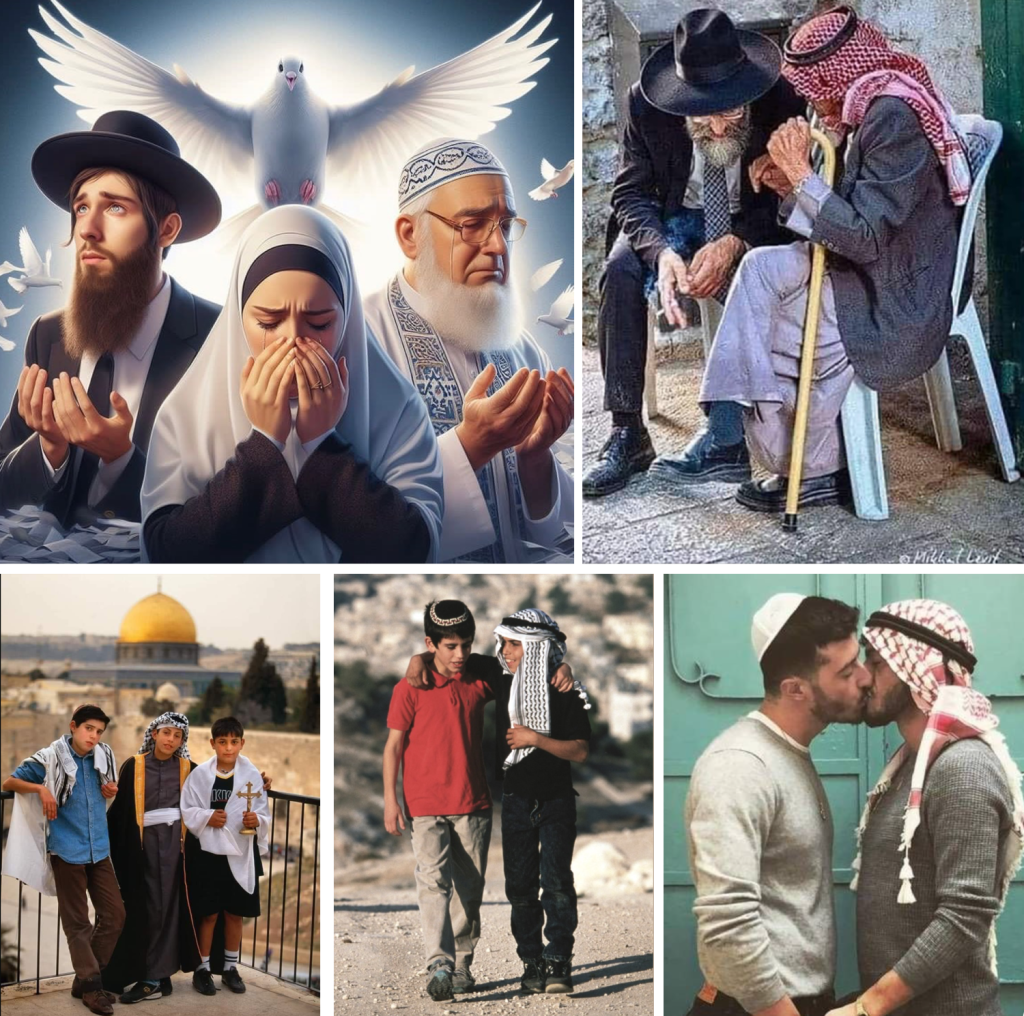
In the days after the Oct. 7 Hamas attack on an Israeli music festival and kibbutz, and then the overwhelming Israeli military response, images like these proliferated in social media – a sign of the hope, perhaps, that the rest of the world holds for peace between Palestinians and Israelis and among religions.
You can find some good content analysis of Canadian reporting on Palestine and Israel at The Breach.