Disappointment and fury in the wake of failed climate talks—and hope for the road ahead

by Jim Hodgson

“I am infuriated to come home to the aftermath of six typhoons that have struck the Philippines in the space of just four weeks with basically zero gains from COP29,” said Patricia Mungcal, a young climate advocate who serves as humanitarian manager with the National Council of Churches in the Philippines. 

“I will be telling thousands of Filipino families who were devastated by these strong typhoons that world leaders have left us to suffer the heaviest impacts of the climate crisis and disregarded our demands for finance and reparations. This failure to address loss and damage is a grave disregard of our human dignity and rights. We charge this failure of COP29 to the moral bankruptcy of the rich, polluting nations.”

News from Philippines and (right) Patricia Mungcal (screenshot from WCC video)

At the recent climate conference in Baku, Azerbaijan, world leaders failed miserably in their response to the climate crisis and its consequences. Of the $1.3 trillion of climate finance that independent experts estimate will be required annually by 2030, the UN climate conference agreed to provide just $300bn every year – by 2035 (Progressive International newsletter, Dec. 3).

Meanwhile, governments around the globe (including Canada) are still ploughing billions of dollars into fossil fuel subsidies to shelter citizens from higher energy costs, but that comes with a fiscal burden and impedes the goal of reducing overall use.

And Philippines had six typhoons. In the Canadian Rockies, Jasper townsite burned—just days after I had written about climate disasters in British Columbia.

What is to be done?

More often now, we are seeing the connection between the climate crisis and the growing indebtedness of the so-called “highly indebted poor countries” (HIPC). And proposals for a new international financial architecture are once again getting attention. 

In June, Pope Francis pressed leading economists and world finance ministers to support new mechanisms to ease foreign debt, lamenting that “poorly managed globalization” has deprived millions of people of a “dignified future.”

Ecological debt and foreign debt are two sides of the same coin that mortgages the future,” the pope said. “For this reason, dear friends, the Holy Year of 2025, to which we are heading, calls us to open our minds and hearts to be able to untie the knots of the ties that strangle the present, without forgetting that we are only custodians and stewards, not masters.”

The focus of this Jubilee Year is gaining ecumenical and inter-faith support. In Canada, KAIROS will lead a Canadian Ecumenical Jubilee campaign, in step with global debt relief efforts. “These are inspired by the Jubilee tradition from the Book of Leviticus. Rooted in faith, Jubilee calls for the release of debts, liberation from servitude, and the return of seized lands—principles that resonate deeply in today’s world,” says KAIROS. This campaign aims to:

  • Cancel unjust debts. 
  • Establish a UN-led mechanism for debt resolution. 
  • Prevent future cycles of crippling debt.

The 2025 meeting of G7 (leaders of the richest countries) will be held June 15-17 in Kananaskis, Alberta (southwest of Calgary).
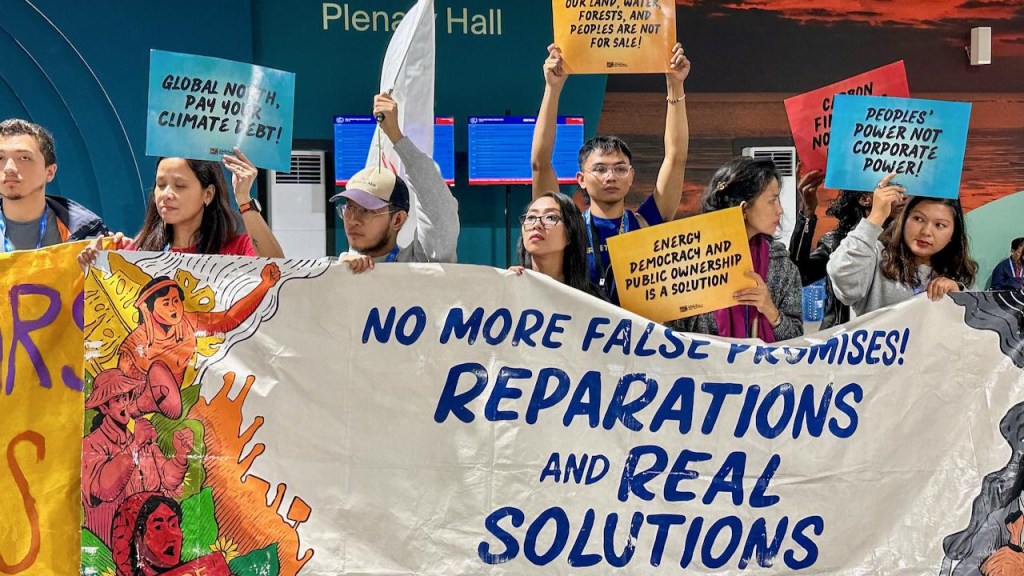
Confronting threats to the living planet.” Photo: Valter Muniz, WCC)

A “Manual for Mutiny”

The global Progressive International network, meanwhile, is presenting a Program of Action on the Construction of a New International Economic Order. It speaks of a “polycrisis”—the combination of the “old crises of debt, dependency and under-development” combined now with “an accelerating crisis of climate to threaten not only the developmental prospects of the South—but also, in the case of many small island states, their very existence.”

The Program of Action offers nearly three dozen measures across five broad sections: to leverage the South’s natural wealth, labor power, and collective voice in order to extract concessions from Northern partners; to bolster the sovereign development agenda by building Southern alternatives to Northern institutions; and to pool Southern knowledge, resources, and ingenuity in service of a whole that is greater than the sum of its parts.

To that, I would add: Systemic failure demands system change.

What you can do

Keep an eye on KAIROS, of course, and on Development and Peace-Caritas Canada for ways to get involved in the new Jubilee campaigns.

I also want to share with you some suggestions from Katharine Hayhoe, a Canadian atmospheric scientist whose research focuses on understanding the impacts of climate change on people and the planet.

“For climate action to happen at scale, conversations have to move beyond international summits to what’s happening in our communities, our workplaces, and our organizations. And there, change isn’t something we wait for. It’s something we catalyze,” she wrote after COP29.

She suggests starting conversations “about climate solutions where you work or study. Ask what your organization is already doing, and what more it could do—and share that with people around you, particularly those who can make decisions.”

That will be especially important as Canadians vote in a federal election in 2025, and as one party opts for simplistic slogans over serious conversations about climate policy.
Looking beyond the crises: A new agenda for peace

by Jim Hodgson

For years, I have gathered and often shared the stories of how people organize for a better future for their communities and the planet. A few days ago, I started gathering articles as they appeared about the ecological crisis.

And I am alarmed – though the rational part of my brain reminds me that I have long-known of the intersection of ecological disaster with civil conflict and war. 

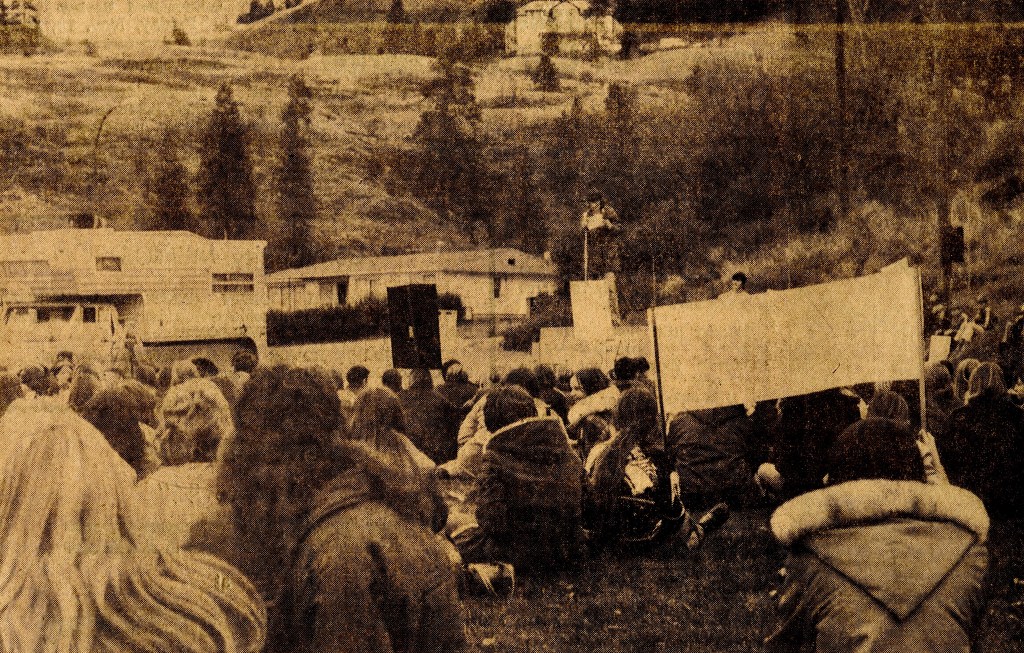
In 1971, I was 13 when I attended my first demonstration. It was about peace and the environment: opposing the third in a series of U.S. nuclear tests at Amchitka in the Aleutian Islands between Alaska and Siberia. Again today, war and ongoing failure to respect ecology bring us closer to collapse. A previous test in 1969 gave rise to the Don’t Make A Wave Committee in Vancouver. The group became the global movement Greenpeace. (Photo: an old clipping from the Summerland Review, November 1971).

Addressing the UN General Assembly a week ago, Secretary General António Guterres pointed to the two canals most vital to world trade and management of supply chains.

Trade via the Panama Canal is down 36 per cent in the past month because of low water levels – a consequence of the climate crisis. 

Trade via the Suez Canal is down by 42 per cent, since the start of Houthi attacks on shipping in the Red Sea more than three months ago. Those attacks in turn are a foreseeable consequence of the excessive – many argue “genocidal” – Israeli response to the Hamas-led attack on Israeli civilians from the Gaza strip last Oct. 7.

The Pressenza news service reports this week that for the first time on record, the average global temperature exceeded 1.5 degree Celsius over a 12-month period, according to data from the Copernicus Climate Change Service (C3S). Last month was also the warmest January globally since C3S records began in 1950, with an average air surface temperature 0.7 degrees Celsius higher than the January average from 1991 to 2020.

Meanwhile, the Atlantic Ocean system of ocean currents may already be on course to collapse, according to a new report published Feb. 9 in the journal Science Advances. Such collapse could lead to further sea level rise and cause temperatures to plunge dramatically in Europe and rise in the southern hemisphere.

A new UN report shows that about 44 per cent of migratory species worldwide are declining in population. More than a fifth of the nearly 1,200 species monitored by the UN are threatened with extinction.

In Mexico, prolonged drought led to sharp drops in production of corn and avocados last year. Lack of rainfall has affected water reservoirs used for agriculture. Across the country, water storage is at 42.7 per cent of normal, and down 34.8 per cent from 2022. This is leading producers to plant less in the winter 2023-24 season. Images from La Jornada: (left) “corn production dropped 40 per cent because of the drought;” (centre) “Monarch butterflies occupy 59.3 per cent less surface area than the previous year because of climate impacts;” (right) “Industrial activity in Iztapalapa (the east side of Mexico City) could be paralyzed for lack of water.”

In January, Mexico’s national weather service reported that 2023 was the driest in 82 years, with just 21.1 per cent of normal rainfall. Last year also saw the largest amount of land afflicted by wildfires.

The Aqueduct Water Risk Atlas has published an interactive map where you look at drought risks in any part of the planet. Half of Mexico and large parts of the western United States are in red, along with most of northern Alberta. 

Raúl Zibechi, the Uruguayan observer of social movements in Latin America, published a column recently that examined these and other risks.

“We continue to be stuck in the minuteness (‘chiquitismo’) of consumerist and narcissist daily life,” he wrote – “the latest telephone or clothing; the football game where we are merely spectators; the electoral campaign that only entertains, but does not resolve anything profound. This is the strategic triumph of capitalism: taking us headlong toward collapse while we look at the screen, ignoring the destruction and massacre of life.”

Views from Corpus Christi, Texas, June 2007. (Photos: Jim Hodgson)

In the speech by António Guterres that I noted above, he denounced the wars and ecological destruction, and offered some signs of ways forward. He spoke of A New Agenda for Peace.

“Peace is a rallying cry,” he said. “It is a call to action.” And he went on to describe the actions that must be taken: ceasefires, negotiations, addressing causes of migration, protection of species, debt and development finance, real action on climate, and reform of UN systems including the Security Council.

“We must also make peace with the planet. Humanity has waged a war we can only lose: our war with nature,” Guterres said. “For my part, I can guarantee that I will never give up pushing for peace.”