From Bogotá, the Global South charges Israel with genocide

A two-day meeting this week in the Colombian capital ended with renewed commitment to pursue accountability for Israeli abuses in Gaza, including by preventing the transfer of weapons to Israel.
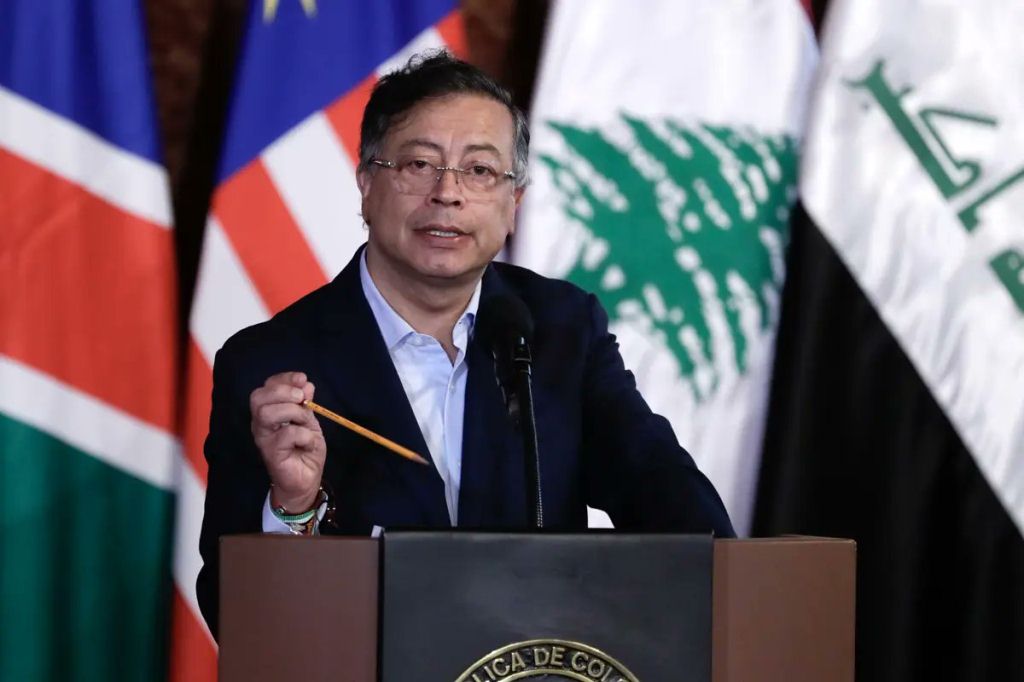
As the event drew to a close Wednesday (July 16), Colombian President Gustavo Petro (above) told participants, “Gaza is simply an experiment by the ultra-rich to show the impoverished people of the world how they will respond to humanity’s rebellion.”

Petro also distanced himself further from the North Atlantic Treaty Organization (NATO), which in 2022 had designated Colombia as a “non-member strategic ally.” 

“What are we doing in NATO, if its principal leaders are with the genocide?” he asked. “We must leave.”

A coalition known as The Hague Group organised the summit. It was born in January last year through the help of Progressive International (PI), an organization founded in 2020 to unite, organize, and mobilize progressive forces around the world. PI called the Bogotá meeting the “most ambitious multilateral action since the start of Gaza genocide 21 months ago.”

Jointly convened by the governments of Colombia and South Africa as co-chairs, the Hague Group also includes Bolivia, Cuba, Indonesia, Iraq, Libya, Malaysia, Namibia, Nicaragua, Oman and Saint Vincent and the Grenadines. At least 18 other countries, plus the United Nations and the World Council of Churches, sent representatives. Qatar and Egypt, which are overseeing negotiations between Hamas and the Israeli government, attended.
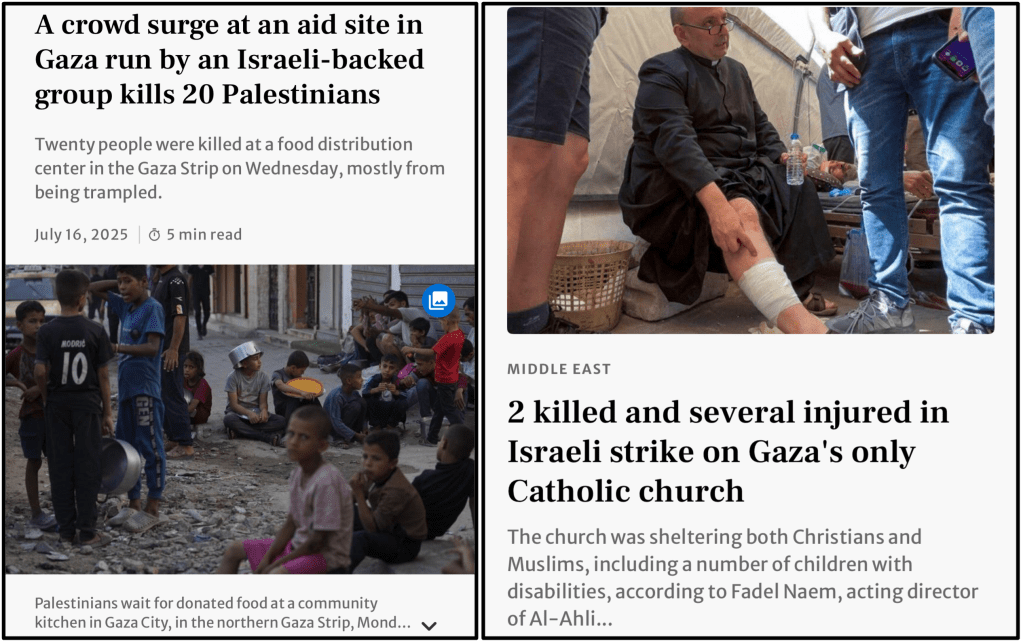
Israel’s offensive in Gaza has killed more than 58,000 Palestinians, according to Gaza’s Health Ministry, which has said women and children make up more than half of the dead. At least 90 were killed on Thursday (July 16), including those who were crushed at an Israeli-controlled food distribution site. Holy Family Church also came under attack, sparking criticism and new calls for peace from Pope Leo XIV and from the World Council of Churches.

During Tuesday morning’s opening event, various officials spoke, calling for an end to Israel’s attacks on Gaza. Colombia’s foreign minister, Rosa Yolanda Villavicencio, said during her morning address that Israel’s attacks constitute an unequivocal “genocide.”
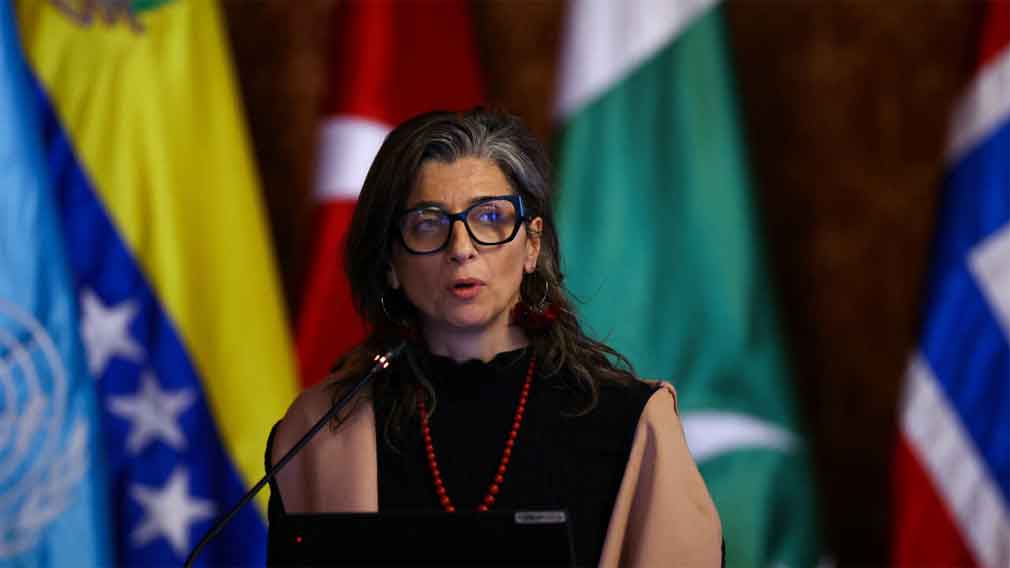
Another key participant was Francesca Albanese (above), the U.N. special rapporteur for the Palestinian Territories. She denounced the inaction of the international community. She accused the West of justifying Israeli actions as the “right to defense” and said the vetos in the U.N. Security Council “protect war crimes” carried out in the sight of all.

“Palestine has changed global consciousness, drawing a clear line between those who oppose genocide and those who accept it or are part of it,” she said. Albanese was recently sanctioned by the US for her outspoken criticism of Israel’s actions.

“We believe in protagonism, not supplication,” said Varsha Gandikota-Nellutla, the executive secretary of The Hague Group. “Today marks an end to the era of the impunity and the beginning of collective state action by governments of conscience.”

The group members committed to implementing six measures immediately through their domestic legal and administrative systems to break the ties of complicity with Israel’s campaign of devastation in Palestine. They set September 20 as a date for other states to join them, coinciding with the 80th U.N. General Assembly. Consultations with capitals across the world are now ongoing.

“We hereby announce the following measures,” the Joint Statement on the Conclusion of the Emergency Ministerial Conference on Palestine reads, “to be adopted based on states’ domestic legal and legislative frameworks:”

  • Prevent the provision or transfer of arms, munitions, military fuel, related military equipment, and dual-use items to Israel…
  • Prevent the transit, docking, and servicing of vessels at any port…. in all cases where there is a clear risk of the vessel being used to carry arms, munitions, military fuel, related military equipment, and dual-use items to Israel
  • Prevent the carriage of arms, munitions, military fuel, related military equipment, and dual-use items to Israel on vessels bearing our flag… and ensure full accountability, including de-flagging, for non-compliance with this prohibition.
  • Commence an urgent review of all public contracts, to prevent public institutions and funds from supporting Israel’s illegal occupation of the Palestinian Territory and entrenching its unlawful presence.
  • Comply with obligations to ensure accountability for the most serious crimes under international law, through robust, impartial and independent investigations and prosecutions at national or international levels, to ensure justice for all victims and the prevention of future crimes.
  • Support universal jurisdiction mandates, as and where applicable in national legal frameworks and judiciaries, to ensure justice for victims of international crimes committed in the Occupied Palestinian Territory.

“These 12 states have taken a momentous step forward,” said Albanese about the joint statement. “The clock is now ticking for states—from Europe to the Arab world and beyond—to join them.”

The full joint statement is here.

Complete text of Albanese’s remarks is here.
Looking beyond the crises: A new agenda for peace

by Jim Hodgson

For years, I have gathered and often shared the stories of how people organize for a better future for their communities and the planet. A few days ago, I started gathering articles as they appeared about the ecological crisis.

And I am alarmed – though the rational part of my brain reminds me that I have long-known of the intersection of ecological disaster with civil conflict and war. 

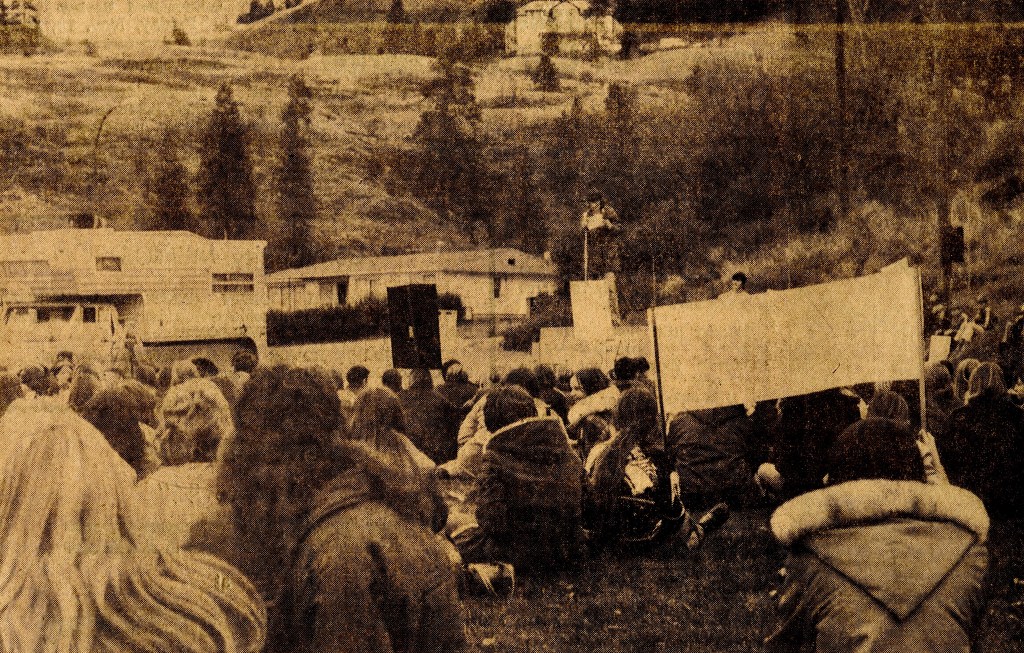
In 1971, I was 13 when I attended my first demonstration. It was about peace and the environment: opposing the third in a series of U.S. nuclear tests at Amchitka in the Aleutian Islands between Alaska and Siberia. Again today, war and ongoing failure to respect ecology bring us closer to collapse. A previous test in 1969 gave rise to the Don’t Make A Wave Committee in Vancouver. The group became the global movement Greenpeace. (Photo: an old clipping from the Summerland Review, November 1971).

Addressing the UN General Assembly a week ago, Secretary General António Guterres pointed to the two canals most vital to world trade and management of supply chains.

Trade via the Panama Canal is down 36 per cent in the past month because of low water levels – a consequence of the climate crisis. 

Trade via the Suez Canal is down by 42 per cent, since the start of Houthi attacks on shipping in the Red Sea more than three months ago. Those attacks in turn are a foreseeable consequence of the excessive – many argue “genocidal” – Israeli response to the Hamas-led attack on Israeli civilians from the Gaza strip last Oct. 7.

The Pressenza news service reports this week that for the first time on record, the average global temperature exceeded 1.5 degree Celsius over a 12-month period, according to data from the Copernicus Climate Change Service (C3S). Last month was also the warmest January globally since C3S records began in 1950, with an average air surface temperature 0.7 degrees Celsius higher than the January average from 1991 to 2020.

Meanwhile, the Atlantic Ocean system of ocean currents may already be on course to collapse, according to a new report published Feb. 9 in the journal Science Advances. Such collapse could lead to further sea level rise and cause temperatures to plunge dramatically in Europe and rise in the southern hemisphere.

A new UN report shows that about 44 per cent of migratory species worldwide are declining in population. More than a fifth of the nearly 1,200 species monitored by the UN are threatened with extinction.

In Mexico, prolonged drought led to sharp drops in production of corn and avocados last year. Lack of rainfall has affected water reservoirs used for agriculture. Across the country, water storage is at 42.7 per cent of normal, and down 34.8 per cent from 2022. This is leading producers to plant less in the winter 2023-24 season. Images from La Jornada: (left) “corn production dropped 40 per cent because of the drought;” (centre) “Monarch butterflies occupy 59.3 per cent less surface area than the previous year because of climate impacts;” (right) “Industrial activity in Iztapalapa (the east side of Mexico City) could be paralyzed for lack of water.”

In January, Mexico’s national weather service reported that 2023 was the driest in 82 years, with just 21.1 per cent of normal rainfall. Last year also saw the largest amount of land afflicted by wildfires.

The Aqueduct Water Risk Atlas has published an interactive map where you look at drought risks in any part of the planet. Half of Mexico and large parts of the western United States are in red, along with most of northern Alberta. 

Raúl Zibechi, the Uruguayan observer of social movements in Latin America, published a column recently that examined these and other risks.

“We continue to be stuck in the minuteness (‘chiquitismo’) of consumerist and narcissist daily life,” he wrote – “the latest telephone or clothing; the football game where we are merely spectators; the electoral campaign that only entertains, but does not resolve anything profound. This is the strategic triumph of capitalism: taking us headlong toward collapse while we look at the screen, ignoring the destruction and massacre of life.”

Views from Corpus Christi, Texas, June 2007. (Photos: Jim Hodgson)

In the speech by António Guterres that I noted above, he denounced the wars and ecological destruction, and offered some signs of ways forward. He spoke of A New Agenda for Peace.

“Peace is a rallying cry,” he said. “It is a call to action.” And he went on to describe the actions that must be taken: ceasefires, negotiations, addressing causes of migration, protection of species, debt and development finance, real action on climate, and reform of UN systems including the Security Council.

“We must also make peace with the planet. Humanity has waged a war we can only lose: our war with nature,” Guterres said. “For my part, I can guarantee that I will never give up pushing for peace.”

Talking about peace when there is no peace*

Jim Hodgson, May 23, 2023

Peace is a pre-condition for any possibility of transforming the global economy for the sake of humanity and the Earth – or, more modestly, achieving those elusive Sustainable Development Goals by 2030.

In the weeks after Russia’s invasion of Ukraine, I added my voice to those of others who pleaded for peace talks. In recent weeks, new efforts from church leaders and global South political leaders are underway to bring the sides together. But peace initiatives are either ignored or disdained by most media and “Western” leaders.

Headlines and images from Mexico’s La Jornada and Argentina’s Página 12 newspapers. On the left, Lula asks that a new Cold War between China and the United States be avoided and defends the use for currencies other than the U.S. dollar for international trade. On the right, from top: Zelensky asks for support from G7 powers; G7 leaders create new sanctions against Russia and debated in Hiroshima the nuclear arsenals of other countries; The Vatican makes its peace effort official so as to end the war in Ukraine.

Case in point: the participation at the recent G7 meeting in Hiroshima of Brazilian President Luiz Inácio “Lula” da Silva and Indian Prime Minister Narendra ModiFinancial Times dismissed Lula and Modi as Russian President Vladimir “Putin’s apologists.” Their participation was eclipsed by that of Ukrainian President Volodymyr Zelensky, who did meet with Modi, but blamed scheduling conflicts for not meeting Lula – and then joked with reporters that Lula was more disappointed than he was. 

Well, yes. Lula’s interest in peace has everything to do with funds diverted to war and away from efforts for authentic development that could help alleviate the other crises of climate change and migration. (Lula also said that Zelensky did not show up for a meeting they had scheduled.)

In Hiroshima,  Lula criticized the division (or re-division) of countries into two antagonistic blocs and abandonment of a multipolar world that seemed to be emerging in the wake of the pre-1991 Cold War.

Meanwhile, South African President Cyril Ramaphosa was not even invited. But he and other African leaders are involved in a peace initiative to end the war in Ukraine. In a news conference May 17, he said he had had “separate telephone calls” with Putin and Zelensky over the weekend, where he presented an initiative drawn up by Zambia, Senegal, the Republic of Congo, Uganda, Egypt and South Africa. Leaders of the six countries say they plan to travel to Russia and Ukraine “as soon as is possible.”

In his weekly newsletter on May 15, Ramaphosa said South Africa would not be drawn “into a contest between global powers” despite having faced “extraordinary pressure” to do so.

“We do not accept that our non-aligned position favours Russia above other countries. Nor do we accept that it should imperil our relations with other countries,” Ramaphosa said.

During the same week, Chinese envoy Li Hui visited Moscow, his first stop in a European tour that would also take him to Kyiv, to develop a 12-point plan proposed by Beijing on the first anniversary of the Russian invasion. 

Last September, Mexican President Andrés Manuel López Obrador called for establishment of a Commission for Dialogue and Peace that would facilitate the search for a solution through negotiations. 

Nobody has a “magical formula to achieve peace,” writes Juan Pablo DuchLa Jornada’s Moscow correspondent. “But [proponents of peace] hope that Russia and Ukraine would establish a ceasefire and sit down to negotiate their conditions with the objective of putting an end to the bloodshed and devastation. All that is lacking is that Moscow and Kiev by open to making concessions – the first not wanting to cede Ukrainians regions already annexed and the latter refusing to lose territory – but without concessions, it does not seem possible to open a path toward peace in a war that, say what you will, only brings calamities.”

WCC delegation with Ukrainian church leaders in Kyiv on May 11 (WCC photo); Patriarch Kirill with WCC general secretary in Moscow on May 17 (ROC photo).

Meanwhile, the World Council of Church and Pope Francis have both renewed their efforts for peace. 

In mid-May, a delegation led by WCC general secretary Jerry Pillay visited church and government leaders in Kyiv and Moscow. In Kyiv, the WCC delegation met with senior leaders of both the Ukrainian Orthodox Church and the Orthodox Church of Ukraine, two churches whose dispute has intensified since the Russian invasion. In Moscow, they met with Patriarch Kirill, head of the Russian Orthodox Church and widely viewed as a supporter of President Putin.

For his part, Pope Francis has given Italian Cardinal Matteo Zuppi the task of leading a mission in hopes it can “ease tensions” in the Ukraine war and lead to a path of peace. The pope has said has said he would go to Kyiv if such a journey would help bring peace, but said that could happen only if he could also visit Moscow.

* The phrase “peace, peace, when there is no peace” is found in Jeremiah 6:14 and later at 8:11. It is also found in Ezekiel 13:10 and 16. The direct criticism is of those who build flimsy walls and smear them with whitewash: a makeshift solution to a problem. The metaphor then and now is points to poor leadership. In our time, we can think of leaders who promise that war will lead to peace. “They have treated the wounds of my people carelessly,” writes the prophet Jeremiah, “saying ‘peace, peace,’ when there is no peace.”

War Never Again – Westerplatte, Gdansk, Poland (site of the first battle of World War II in 1939).