Catholic bishops from Latin America, Africa and Asia demand climate justice

by Jim Hodgson

In a new document, Catholic church leaders from across the Global South blasted the “openly denialist and apathetic stance” of “so-called elites of power” in the industrialized world who pressure their governments to back away from much-needed mitigation and adaptation measures.

Preparing for the next United Nations climate change gathering, COP30, which will take place in November in Brazil, conferences of bishops from Asia, Africa and Latin America (FADM, SECAM and CELAM respectively) published a joint document entitled A call for climate justice and the common home: ecological conversion, transformation and resistance to false solutions. (You can download the document here.)
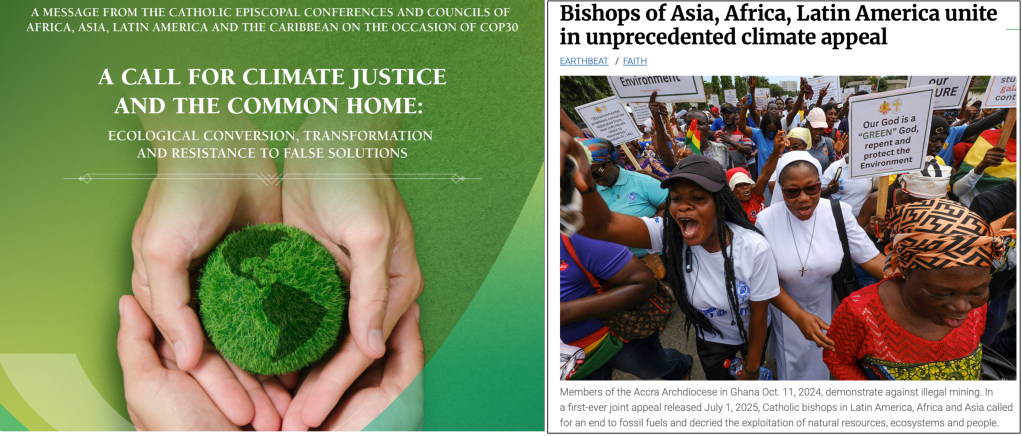
It’s the first time the three regional bodies have created a joint statement. The document offers an expansive vision for the U.N. climate conference. “At COP30, we demand that States take transformative action based on human dignity, the common good, solidarity and social justice, prioritising the most vulnerable, including our sister Mother Earth,” the bishops said.

They described the U.N. climate gathering as a moment for the church “to reaffirm its prophetic stance.”

Part of the 32-page document states:

Our demand

The climate crisis is an urgent reality, with global warming reaching 1.55°C in 2024. It is not just a technical problem: it is an existential issue of justice, dignity and care for our common home.

The science is clear: we must limit global warming to 1.5°C to avoid catastrophic effects. We must never abandon this goal. It is the Global South and future generations who are already suffering the consequences.

We reject false solutions such as ‘green’ capitalism, technocracy, the commodification of nature, and extractivism, which perpetuate exploitation and injustice.

Instead, we demand:

Equity: Rich nations must pay their ecological debt with fair climate finance without further indebting the Global South, to recover losses and damages in Africa, Asia, Latin America and the Caribbean, and Oceania.

Justice: Promote economic degrowth and phase out fossil fuels, ending all new infrastructure and properly taxing those who have profited from them, ushering in a new era of governance that includes and prioritises the communities most affected by the climate and nature crises.

“I am raising a voice that is not mine alone, but that of the Amazonian peoples, of the martyrs of the land—we could say of the climate—and of the riverside, Indigenous, Afro-descendant, peasant and urban communities,” said Cardinal Jaime Spengler, archbishop of Porto Alegre in southern Brazil and president of CELAM. He was speaking at a news conference July 1 at the Vatican.

Vatican News reported that Canadian Cardinal Michael Czerny, prefect of the Vatican’s human development office, spoke spontaneously in the news conference to point to the document’s connection to the legacy of Pope Francis. “Ten years ago, I wonder if there is anyone who could have imagined this press conference as a fulfilment and implementation of Laudato si’. This is an extraordinary expression of what Pope Francis has called for and what Pope Leo is continuing to underline and call. I am grateful,” he said.

WCC begins Ecumenical Decade of Climate Justice Action

In Johannesburg ten days earlier, the World Council of Churches launched its Ecumenical Decade of Climate Justice Action.

During a plenary session June 21 of the WCC central committee, church leaders from six continents shared reflections and urged action for climate justice.

The plenary emphasized the biblical concept of jubilee as a framework for systemic transformation—a key foundation of the Ecumenical Decade. Speakers called for churches to move beyond charitable responses toward addressing root causes of climate injustice, particularly the disproportionate impact on vulnerable communities.

“Our lifestyle consumes 1.8 times what Earth can renew. Economic transformation must begin in the heart; theology must shape discipleship and discipleship must shape the world,” said Rev. Dr. Charissa Suli, president of the Uniting Church in Australia, during a theological reflection on “Jubilee for People and Earth.”

[When I shared Dr. Suli’s comment on Facebook several days ago, my colleague and friend Mark Hathaway pointed out: “In the Global North, it is more like 4.5 times what the Earth can renew—and even higher in the U.S. and Canada (I think about 6 times). The richest 10-20 per cent of humanity is responsible for most consumption and most GHGs [greenhouse gases] and a mere 100 large corporations are responsible for 70 per cent of GHGs.”

WCC has held previous ecumenical decades in the past, including The Ecumenical Decade of the Churches in Solidarity with Women (1988-1998) and The Ecumenical Decade to Overcome Violence (2001-2010).

"Another World is Possible," World Social Forum, Porto Alegre, Brasil (2005)

Pope Francis and Our Common Home

By Jim Hodgson

On this Earth Day, I want to share with you a reflection by Bishop Francisco Duque of the Anglican Church in Colombia. I worked with him in a larger team in one period (already a dozen years or more ago) of ecumenical efforts for peace with justice in Colombia. 

Indeed, it was during that work that I stood with friends in a coffee shop in Bogotá and watched news of the election of the archbishop of Buenos Aires, Jorge Mario Bergoglio, as pope on March 13, 2013.  I did not rejoice. All that I knew of Bergoglio was that he had opposed several of the initiatives of the governments of Néstor Kirchner and Cristina Fernández as it expanded sex education in public schools and legalized same-sex marriage in 2010.

Images of St. Francis. Left: preaching to the birds. Right: “Make me an instrument of your peace / Bless your people, Lord” is one I saw in Real de Catorce, San Luis de Potosí, in October 2024.

But Pope Francis surprised me: first by choosing to be known by the name Francis, signalling he would follow St. Francis of Assisi, long admired for his inspiration to contemporary ecological commitment and for initiating dialogue with Muslim leaders during Christian Europe’s “crusades” in the Middle East. And then he surprised me again with steps that showed respect for LGBTQIA+ people: first, “Who am I to judge?”, and later with his openness to diverse voices heard through synods, his advocacy for peace, the rights of migrants and debt forgiveness. I can only wish he had done more with regard to the rights of women and pray that his successor can go further.

In Canada, Pope Francis will undoubtedly be remembered most for his “penitential pilgrimage” and encounters with Indigenous peoples in 2022. Despite resistance from most of Canada’s Catholic bishops, he came, offered a (not fully accepted) apology, and gave truth and reconciliation efforts a dramatic push forward in public awareness.

But I think his lasting global legacy will be his way of holding faithful action for social justice and action for ecological justice together coherently. Here’s what Bishop Duque had to say.

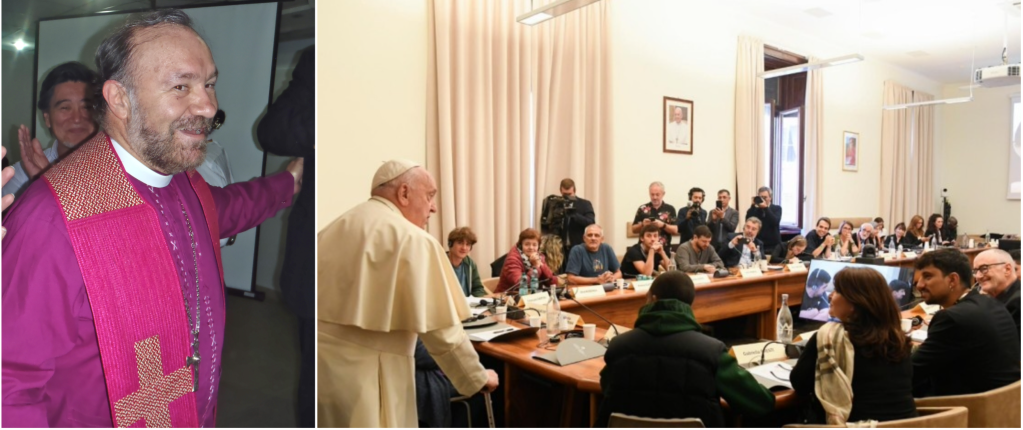
Left: Bishop Duque at a Methodist assembly in Medellín in 2012. Right: Pope Francis meets representatives of social movements in 2024.

Francis, pope of Amazonia and our common home

Francisco Duque

The world mourns the loss of a spiritual leader who transcended borders, creeds and generations. Pope Francis not only was the first Latin American pontiff. He was, above all, the pope of the Amazon and caretaker of our Common Home. His legacy, immense and profoundly humanist, will remain inscribed in the planet’s memory as a prophetic voice that urges us to hear the clamour of the earth and the cry of the poor as a single call.

From the time of the publication of his encyclical Laudato Si’ in 2015, Pope Francis illuminated the ways of global ecological awareness. With valiant and committed language, he denounced the structural causes of environmental collapse, unlimited resource extraction, climate injustice and indifference toward the suffering of communities that are most vulnerable, especially those who live in the lungs of the world: tropical forests, the Amazon in particular. 

His spiritual leadership was also political and ethical. He convened scientists, Indigenous leaders, activists and religious authorities from around the world to make a new pact between humanity and nature. He promoted an integral ecology that did not separate the environment from the social. He recognized in Indigenous peoples that they are millennial guardians of wisdom. His encouragement of the Synod of the Amazon in 2019 marked a before and after: Amazonia was heard in the heart of the Vatican, not as a forgotten periphery but as a vital centre for the future of the planet.

From the Inter-Religious Initiative for the Tropical Forests (IRI-Colombia), we hold up a prayer of gratitude and hope. Gratitude for his strong words, for his planetary vision, for having returned to the faith its active dimension of protection of creation. Hope because the fertile seeds he planted will continue to bear fruit in the struggles of those who do not resign ourselves to ecocide or silence in the face of injustice.

Pope Francis leaves us a road map for humanity. There will not be peace without environmental justice. There will be no future without forests. There will be no reconciliation without a deep ecological conversion. His legacy challenges governments, businesses, religions and people. His voice remains alive, inspiring a global inter-religious movement that is committed to life. In these days of farewell, we echo his own question, charged with urgency and tenderness:

“What kind of world do we want to leave to those who come after us, to children who are now growing up?” (LS 160).?”

Thank you, Pope Francis, for reminding us that care for Amazonia is an act of faith, love and justice.

Disappointment and fury in the wake of failed climate talks—and hope for the road ahead

by Jim Hodgson

“I am infuriated to come home to the aftermath of six typhoons that have struck the Philippines in the space of just four weeks with basically zero gains from COP29,” said Patricia Mungcal, a young climate advocate who serves as humanitarian manager with the National Council of Churches in the Philippines. 

“I will be telling thousands of Filipino families who were devastated by these strong typhoons that world leaders have left us to suffer the heaviest impacts of the climate crisis and disregarded our demands for finance and reparations. This failure to address loss and damage is a grave disregard of our human dignity and rights. We charge this failure of COP29 to the moral bankruptcy of the rich, polluting nations.”

News from Philippines and (right) Patricia Mungcal (screenshot from WCC video)

At the recent climate conference in Baku, Azerbaijan, world leaders failed miserably in their response to the climate crisis and its consequences. Of the $1.3 trillion of climate finance that independent experts estimate will be required annually by 2030, the UN climate conference agreed to provide just $300bn every year – by 2035 (Progressive International newsletter, Dec. 3).

Meanwhile, governments around the globe (including Canada) are still ploughing billions of dollars into fossil fuel subsidies to shelter citizens from higher energy costs, but that comes with a fiscal burden and impedes the goal of reducing overall use.

And Philippines had six typhoons. In the Canadian Rockies, Jasper townsite burned—just days after I had written about climate disasters in British Columbia.

What is to be done?

More often now, we are seeing the connection between the climate crisis and the growing indebtedness of the so-called “highly indebted poor countries” (HIPC). And proposals for a new international financial architecture are once again getting attention. 

In June, Pope Francis pressed leading economists and world finance ministers to support new mechanisms to ease foreign debt, lamenting that “poorly managed globalization” has deprived millions of people of a “dignified future.”

Ecological debt and foreign debt are two sides of the same coin that mortgages the future,” the pope said. “For this reason, dear friends, the Holy Year of 2025, to which we are heading, calls us to open our minds and hearts to be able to untie the knots of the ties that strangle the present, without forgetting that we are only custodians and stewards, not masters.”

The focus of this Jubilee Year is gaining ecumenical and inter-faith support. In Canada, KAIROS will lead a Canadian Ecumenical Jubilee campaign, in step with global debt relief efforts. “These are inspired by the Jubilee tradition from the Book of Leviticus. Rooted in faith, Jubilee calls for the release of debts, liberation from servitude, and the return of seized lands—principles that resonate deeply in today’s world,” says KAIROS. This campaign aims to:

  • Cancel unjust debts. 
  • Establish a UN-led mechanism for debt resolution. 
  • Prevent future cycles of crippling debt.

The 2025 meeting of G7 (leaders of the richest countries) will be held June 15-17 in Kananaskis, Alberta (southwest of Calgary).

Confronting threats to the living planet.” Photo: Valter Muniz, WCC)

A “Manual for Mutiny”

The global Progressive International network, meanwhile, is presenting a Program of Action on the Construction of a New International Economic Order. It speaks of a “polycrisis”—the combination of the “old crises of debt, dependency and under-development” combined now with “an accelerating crisis of climate to threaten not only the developmental prospects of the South—but also, in the case of many small island states, their very existence.”

The Program of Action offers nearly three dozen measures across five broad sections: to leverage the South’s natural wealth, labor power, and collective voice in order to extract concessions from Northern partners; to bolster the sovereign development agenda by building Southern alternatives to Northern institutions; and to pool Southern knowledge, resources, and ingenuity in service of a whole that is greater than the sum of its parts.

To that, I would add: Systemic failure demands system change.

What you can do

Keep an eye on KAIROS, of course, and on Development and Peace-Caritas Canada for ways to get involved in the new Jubilee campaigns.

I also want to share with you some suggestions from Katharine Hayhoe, a Canadian atmospheric scientist whose research focuses on understanding the impacts of climate change on people and the planet.

“For climate action to happen at scale, conversations have to move beyond international summits to what’s happening in our communities, our workplaces, and our organizations. And there, change isn’t something we wait for. It’s something we catalyze,” she wrote after COP29.

She suggests starting conversations “about climate solutions where you work or study. Ask what your organization is already doing, and what more it could do—and share that with people around you, particularly those who can make decisions.”

That will be especially important as Canadians vote in a federal election in 2025, and as one party opts for simplistic slogans over serious conversations about climate policy.