From Palenque, Chiapas, Latin American leaders call for migration solutions

In recent weeks, my partner and I took a long drive from British Columbia through the western United States and then almost the length of Mexico to arrive in Chiapas.

While people who migrate northwards either for seasonal work or for more permanent refuge from poverty, violence and impacts of climate change were on our minds and in the news, at least some of the people we met alongside us in gas stations and cafés were seasonal workers heading home for the winter. 

Migration, my friends, is normal. In southern Texas and northern Mexico, we encountered thousands of monarch butterflies as they headed for Michoacán. And here in Chiapas, the migratory birds are arriving daily.

At around the time of our trip, leaders of ten nations of Latin America and the Caribbean – frustrated by slow progress with the United States (and other northern countries) in advancing meaningful human development and managing the flow of people – gathered in the historic Maya city of Palenque, Chiapas, and proposed some ways forward.

Photo from the Office of the President of Mexico

Led by Mexico, the governments of Belize, Colombia, Costa Rica, Cuba, El Salvador, Haiti, Honduras, Panama and Venezuela signed the Palenque Declaration on Oct. 22 and called for solutions. (A representative of the newly-elected government in Guatemala also joined the talks.)

In the declaration, presented by the Mexican Foreign Minister, Alicia Bárcena, the leaders described several structural causes of migration: internally political, economic, social factors and the effects of climate change. But they also pointed to “external factors such as unilateral coercive measures of an indiscriminate nature – dictated from the United States – that negatively affect entire populations and, to a greater extent, the most vulnerable people and communities.”

They urged the United States to lift the sanctions imposed on Cuba and Venezuela that help drive the exodus. Such sanctions are against international law and, as the migration flow shows, they have impacts beyond the countries to which they are applied.

The document also proposed undertaking efforts to modify the financial architecture of debt; to close social gaps to as to reduce the impulse to migrate; push for measures aimed at increasing agricultural activity to promote food self-sufficiency in the region; and to promote intraregional trade and investment for socioeconomic development.

The signatory nations stressed that measures must be taken to confront transnational organized crime, human trafficking and corruption, as well as promote joint cooperation in security matters.

They called for destination countries to “adopt immigration policies and practices in line with the current reality of our region and abandon those that are inconsistent and selective, to avoid arbitrarily producing both ‘call effects’ and ‘deterrent effects’ – advantages given to certain countries for political reasons while nationals of other countries are blocked.

They encouraged destination countries to widen their regular migration pathways, with emphasis on labour mobility and promotion of re-integration and safe return of temporary workers to their homes.

The declaration makes special mention of Haiti, and called on nations to support efforts by the United Nations and others to re-establish conditions for human security so that the political, economic and social situation may be normalized, and to focus on sustainable development. (The presence of the Haitian president at the gathering angered some of the Haitian migrants camped out in the centre of Palenque, reported La Jornada.)
Undated photo from Prensa Latina.

The declaration’s emphasis on economic drivers of migration did not satisfy everyone. Eunice Rendón of the Mexican advocacy group Agenda Migrante told Courthouse News Service that while insecurity was mentioned as a factor driving migration, “it’s not one of the causes, it’s the principal cause,” Rendón said.

“People go because the gang members threaten to kill them, because they try to forcibly recruit them,” she said. (Some might argue that the lack of education and employment opportunities are drivers as well in recruitment for organized crime.)

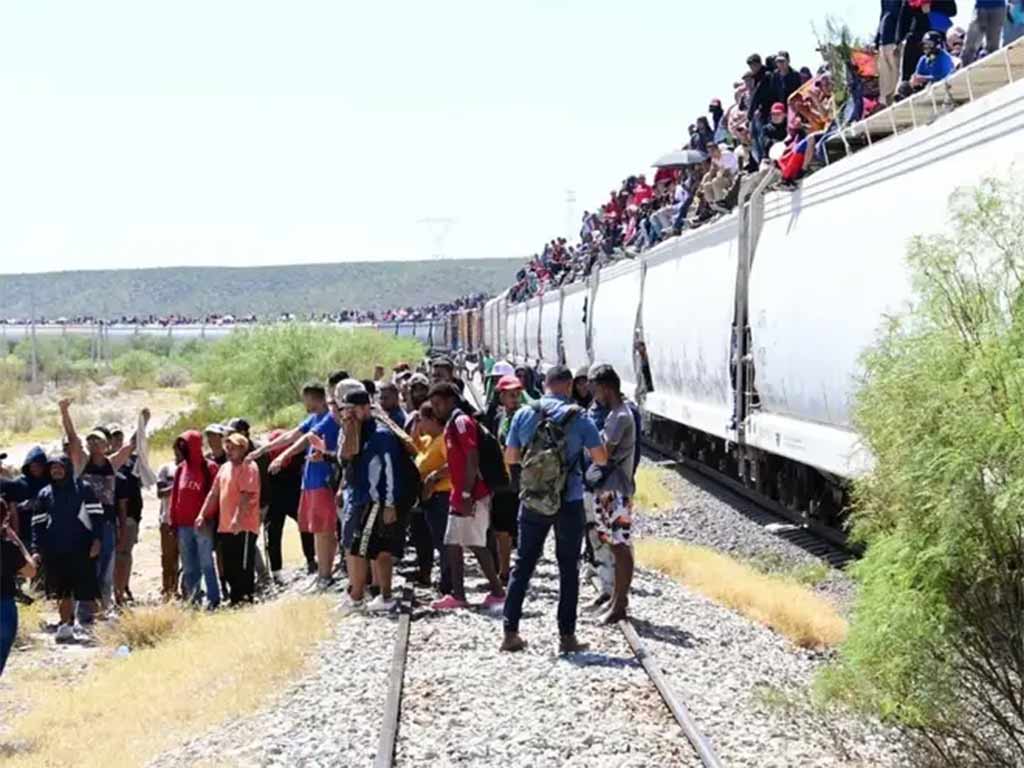
Meanwhile, migration dramas continue. On Nov. 9, authorities reported that they found found 123 Central and South American migrants trapped in a trailer in Matehuala, San Luís Potosí (less than a week after we passed through there). And than 400,000 migrants have crossed the Darien Gap from Colombia into Panama in 2023, according to the Panamanian government, up from 250,000 in 2022.

People at greatest risk need ‘politics of friendship’

Away back in May of 2007, David and I were driving toward the Mexican border on Highway 77 near Victoria, Texas, when we noticed flowers and signs by the side of the road. We stopped and soon realized we were at a place where people were remembering a tragedy.

On May 14, 2003, 19 migrants died here after a driver abandoned a trailer truck that carried as many as 100 people.

We remembered them last week as news came that 53 migrants had died after the trailer in which they were being carried had been abandoned off Interstate 35 near San Antonio, Texas. 

That incident came only three days after 23 African men lost their lives in a desperate attempt to reach Europe by trying to enter the Spanish enclave of Melilla from neighbouring Morocco.

Politicians have tried to excuse their culpability in all of these deaths by blaming them on “human smugglers,” but the true problem is migration policies that are inhumane – “criminal,” said an editorial in Mexico’s La Jornada newspaper.

Back in 2003, the chair of the U.S. Catholic bishops’ Committee on Migration, Bishop Thomas G. Wenski (now the archbishop of Miami) said the deaths in Victoria were the result of a “flawed and inhumane” border policy. 

“It is time for our elected officials to acknowledge that the border blockade strategy our nation has pursued since 1993 is a flawed and inhumane policy,” he said in a written statement issued a day after the tragedy. (His comments were published by National Catholic Reporter on May 30, 2003, but the article is no longer available on line.)

Politics of friendship

As I thought about the migrants who died last week, it seemed to me that many people in the wealthier countries of the global North lack empathy with people faced by extreme levels of violence and poverty in the global South. 

And then a line from José Cueti (psychologist, author and columnist at Mexico City’s La Jornada daily newspaper) caught my eye: 

“Lo real es que no existen las políticas de amistad hacia los más necesitados.”  Or, fairly literally: “What’s real is that politics of friendship towards those in greatest need do not exist.”

So then I found myself in a fairly deep dive into the thinking of Jacques Derrida on politiques de l’amitié. That led to Pope Francis’s encyclical Fratelli tutti, where he proposes “a better kind of politics.” The politics we need, he argues in chapter 5, “is a politics centred on human dignity and not subjected to finance because ‘the marketplace, by itself, cannot resolve every problem.’” And finally I read a comment by the Argentinean-Mexican philosopher and historian Enrique Dussel where he proposes the concept of solidarity as a way to overcome contradictions and limitations that occur in some uses of friendship and fraternity (including not only the limited gender sense of the latter).

Empathy. Friendship. Fraternity. Solidarity. We don’t have enough of any of those, and we fail to allow those values to inform our politics, much less our refugee determination policies. Instead, greed limits our human response to the tragedies that lead people into the back of a trailer, or on to a rubber lifeboat in the Mediterranean, or over a wall between Melilla and Morocco.

Immigration policies that do not allow migrants to present a refugee claim are part of the problem, and I have frequently decried economic development practices that augment poverty, violence and desperation in countless countries around the world.

Consider the choices (or lack of them) that might have driven your ancestors to migrate.

A few words about a book that might help you understand better the limited choices facing huge numbers of people.

John Vaillant, The Jaguar’s Children. (Knopf Canada, 2015).

Most North American writers get Mexico wrong. Vaillant gets it mostly right. He even grasps México profundo—the people, places and stories that are distant from official Mexico. He gets inside the faith of the people—that practice of Christianity that is woven together with the spiritual traditions of Nahua, Zapotec, Maya and many other Indigenous peoples.

Here is a novel that speaks specifically of Indigenous Mexican’s profound relationship with corn and the threat they feel from industrial agriculture and its genetic modifications, terminator seeds and exclusion of all that is valuable in the shameless search for profit.

If you can’t afford to buy the book, or you’re too impatient to wait for a library copy, or you think that you don’t read novels: go and stand in a bookstore or a library and read chapter 24. Here, concisely, is all the horror of what is going on in Mexico and Central America these days: the free trade schemes that destroy traditional agriculture, decimate rural communities and drive hundreds of thousands of migrants into the cities and across the northern border.