
by Jim Hodgson
After four postponements in delivering the final written ruling to confirm the acquittal of the defendants, family members of five anti-mining leaders in El Salvador have filed an official complaint against the judges who provided only a verbal not-guilty verdict after trial five months ago.
The defendants are people that I have known for nearly 25 years through their involvement in the Santa Marta Association for Economic and Social Development (ADES).
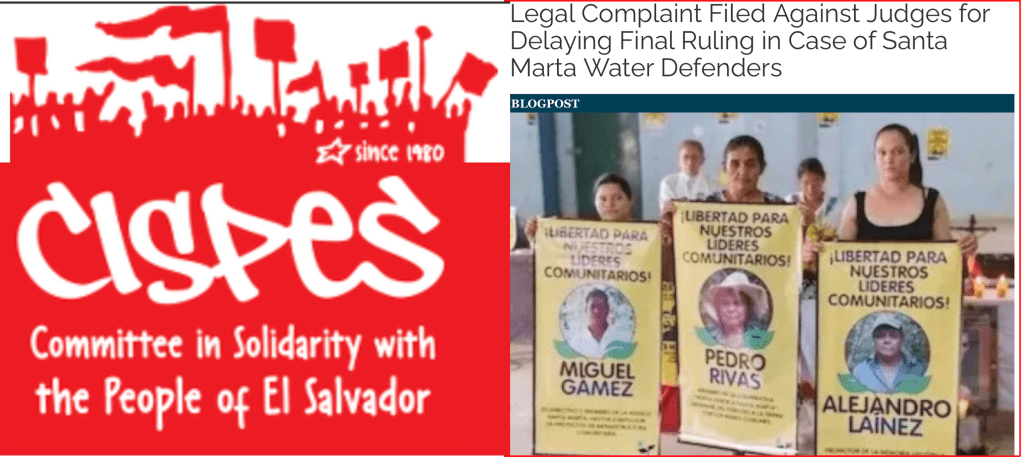
The text that follows is a based on a text published this week by the Committee in Solidarity with the People of El Salvador (CISPES), supplemented by other media reports.
The complaint against the judges was filed with the Judicial Investigation Directorate of the Supreme Court of Justice (CSJ) Jan. 20, 2026, and adds to a series of public actions undertaken by the families, organizations, and human rights groups to demand the definitive closure of the judicial process against the water defenders. They had previously been part of a successful struggle to stop a gold mine from re-opening in the northern part of Cabañas department.
The Santa Marta 5 were arrested Jan. 11, 2023, and charged in connection with the alleged disappearance of a woman during El Salvador’s civil war. The charges were widely denounced as political persecution: the community leaders had been sounding the alarm over indications that the Nayib Bukele government was seeking to overturn El Salvador’s 2017 ban on metal mining, the first and only in the world.
They were imprisoned for eight months while awaiting trial and subsequently placed under house arrest, a measure that was granted only after pressure from national and international human rights organizations and elected officials.
In December of 2025, El Salvador’s legislature, dominated by Bukele’s New Ideas party, did in fact overturn the law prohibiting mining in the country.
The defendants were acquitted of all charges in October 2024. The Attorney General appealed the decision, and in November 2024, the Cojutepeque Criminal Chamber overturned the dismissal of the charges and allowed a retrial in a new jurisdiction.
When the second trial concluded in September 2025, the San Vicente Sentencing Court reached the same conclusion in its oral ruling, acquitting the defendants of criminal charges. But the court has since delayed delivering its final written ruling four times, unjustifiably prolonging the judicial process and leaving the case without definitive closure.
On Jan. 9, the judges once again postponed the delivery of the written ruling until Jan. 30, a decision that the families believe could constitute a delay of justice in violation to the principle of “prompt and fair justice” and keeps a process indefinitely open that already has two acquittal rulings.
In the document they submitted to the CSJ, the families of the defendants requested an investigation into the delays as they have prevented the sentence from becoming final. Without a written ruling, the procedural deadlines for either a possible appeal or the definitive closure of the case cannot commence.
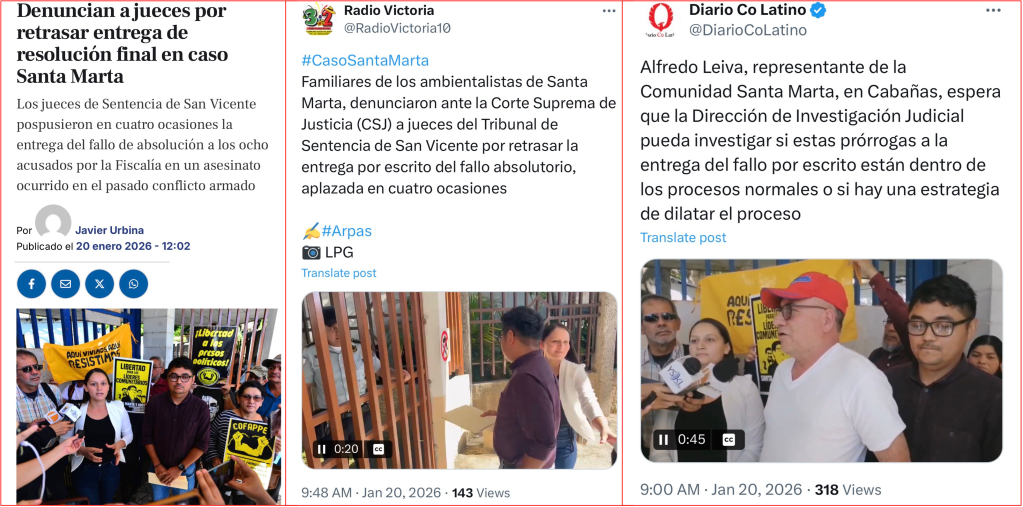
Milton Rivas, son of Pedro Antonio Rivas, one of the defendants, explained to the media that the judges “have been delaying the final ruling” and that the complaint filed seeks to demand justice for his family members. “We are not asking for anything, nor have we come to beg for anything; we have come to demand justice, because it is unacceptable that it takes them about five months to submit a document that they could have delivered the same day the hearing ended,” he declared.
Social movements, human rights groups, community representatives, and family members of the defendants denounced the court’s stall tactic during a press conference on Jan. 13. Rivas, joined by community leader Alfredo Leiva, stated that the failure to deliver the written ruling has both prolonged the legal uncertainty and kept the defendants, their families, and the community in a constant state of anxiety. “This delay keeps our family members in a situation of constant anguish and constitutes a denial of justice,” they declared.
A representative of the University Movement for Critical Thought also warned of a broader context of increasing persecution and criminalization in the country. Currently, at least 38 human rights, environmental, labour, and political activists remain imprisoned, while human rights defenders and community journalists continue to report receiving threats, police harassment, and intimidation campaigns against them.
“We demand an immediate end to [this] persecution and respect for the right to defend the environment, to inform, and to organize,” the organizations stated, issuing an urgent call to Salvadoran society and the international community to remain vigilant given the risk of additional arbitrary arrests targeting critical voices and community organizing efforts.
Finally, they reported that a permanent vigil is being held in front of the Metropolitan Cathedral in San Salvador every day at six in the evening as a peaceful act of protest and a demand for justice, freedom, and respect for human rights.
 Unwrapping Development