International allies against mining in El Salvador applaud new “not guilty” verdict

by Jim Hodgson

I write to share the statement Wednesday, Sept. 24, celebrating a second not guilty verdict in the political persecution of five environmental protectors in El Salvador. They should never have been arrested. See below for an action request. The statement comes from allies around the world who came together more than 15 years ago to accompany communities in El Salvador in their defence of water resources against a Canadian mining company….
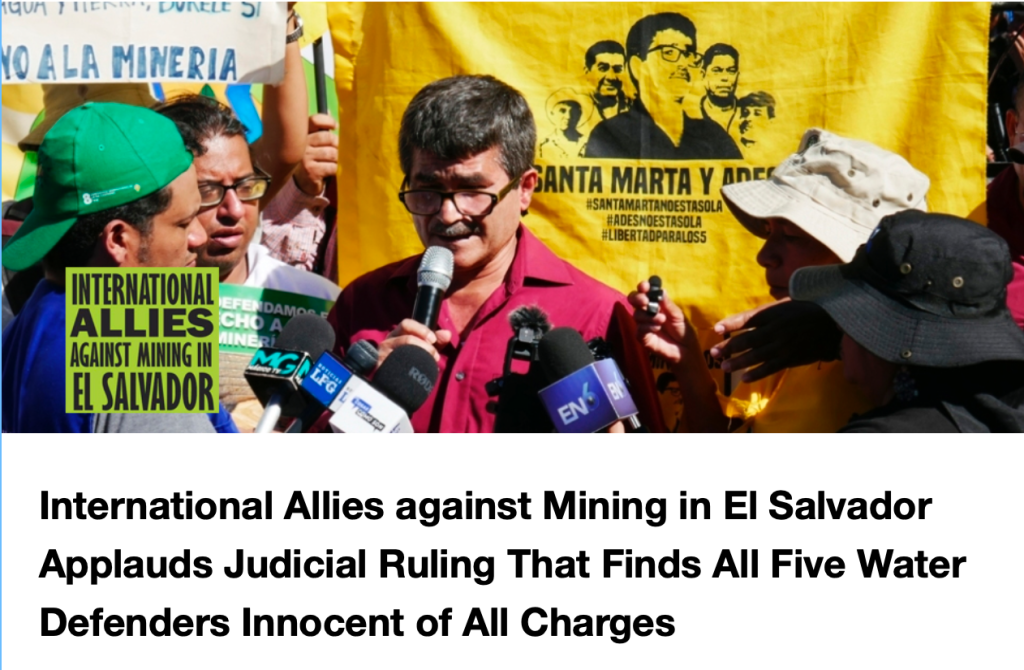
San Salvador – On September 24, the presiding tribunal in San Vicente, El Salvador, found five prominent water defenders from Santa Marta, Miguel Ángel Gámez, Alejandro Laínez García, Pedro Antonio Rivas Laínez, Antonio Pacheco, and Saúl Agustín Rivas Ortega, innocent of charges of murder,  kidnapping, and illicit association. 

Once again, the five prominent Water Defenders who faced politically-motivated charges have been declared innocent — and they should never have been arrested. International Allies against Mining in El Salvador calls upon the Salvadoran Attorney General to abstain from further legal action and demands that all civil liabilities are dropped.

Representatives from the governments of Canada, France, and Germany appeared at the court today to observe the ruling, a reminder that governments and international civil society are watching this case closely.

“We call on the Attorney General’s office to respect the decision of the tribunal, to abstain from appealing this decision and stop wasting government resources to keep up the farce,” stated Alfredo Leiva from the community of Santa Marta, whose leading members were among those on trial. “Rather than insisting on prolonging this process any further, the Attorney General’s office should apologize to the five and to the community, and should dedicate themselves to investigating the real war crimes, starting with the massacres that were committed against Santa Marta and other communities.”

“The five Water Defenders should never have been charged, and the Salvadoran government’s willingness to pursue these accusations despite their clear innocence signals a worrying willingness to persecute the movement that these five water defenders represent. We call on the Salvadoran government to forgo future sham prosecutions and uphold the democratic rule of law in future pursuit of true justice,” said John Cavanagh, Senior Advisor at the Institute for Policy Studies. 

“We celebrate that the Water Defenders have on two occasions now been found innocent of all the charges laid against them. However, we are deeply concerned that the judicial system may continue to be used as a tool to persecute the leaders for their role in protecting the country’s scarce water resources. We ask that the findings of the two courts be respected. We look forward to the day when the Defenders can return to their community and families in full liberty, free from the threat of further persecution,” said Christie Neufeldt, Global Partnerships Coordinator for Latin America, The United Church of Canada.

“Despite the positive results, the international community should be aware that the struggle is far from over. The Attorney General still has the possibility of appealing the case and taking it all the way to the Supreme Court level, and it may take years before the Santa Marta Five are declared fully innocent,” said Pedro Cabezas, coordinator of the Central American Alliance on Mining.

“As was the case in their trial in Sensuntepeque in October 2024, the five water defenders of Santa Marta who were subjected to another trial have today again been found innocent of the charges of murder, kidnapping, and illicit association,” said Prof. Bernie Hammond, an international observer at the trial. “It is to be hoped that the Attorney General will have the good sense to let go of this case against the five. It has become clear to the legal community and to the general public that these charges were politically motivated and are a clear example of “lawfare” in which anti-mining advocacy on the part of the five were criminalized in order to change the 2017 law prohibiting mining in El Salvador.” 

In January 2023, police arrested the five prominent water defenders from the rural community of Santa Marta and the Association for Social and Economic Development of El Salvador (ADES) on charges allegedly dating back to the country’s civil war and held them incommunicado for over eight months and then placed them on house arrest until their trial date. The five had played an instrumental role in the country’s heroic and successful struggle to pass a historic 2017 law prohibiting toxic metals mining in El Salvador,  and were the first ones to denounce President Nayib Bukele’s intentions to  overturn it.

When the five were finally tried in October 2024,  after a long legal defense campaign that denounced a series of irregularities with the proceedings, the tribunal dismissed all charges against them due to lack of evidence, ruled that all five were completely innocent of the two sham charges of murder and illicit association that were laid against them. However, in aruling that has been widely condemned as a travesty of justice, an appeals court annulled the innocent verdict, allowing the Attorney General’s Office to try them again on the same charges.

Beyond the lack of evidence, the Salvadoran Attorney General’s pursuit of this case even after the original determination of innocence in October 2024 has dealt a serious blow to the Salvadoran government’s credibility, belying its claim that it remains a democracy and that it holds no political prisoners. The unceasing and courageous pressure from grassroots organizations in El Salvador – in concert with international solidarity – may have worked in favour of the Water Defenders today, but hundreds of political opponents, labour leaders and human rights defenders remain imprisoned. The community-led movement of water defenders still stands strong in the face of future attempts to undermine land and water protections for communities in El Salvador.

Our organizations support the call by Salvadoran civil society groups that the Salvadoran Attorney General should apologize to the five defendants, whose health has suffered greatly over the past two years that they have stood accused of false charges, and to the Santa Marta community, which suffered from genuine military atrocities during the Salvadoran Civil War in 1980-1992. 

Media contacts:

Action Request:

Can you join us in uplifting the calls of the community that the Attorney General [ @FGR_SV ] respect the tribunal’s ruling? The International Allies Against Mining in El Salvador is calling on our network to:

1) Share the International Allies against Mining in El Salvador’s statement with your networks (here in Spanish). You can also share posts from the Committee in Solidarity with the People of El Salvador on X and on Facebook.

2) Call on the Attorney General not to appeal the ruling and, in the words of the Santa Marta community, “end this judicial farce.”

Sample tweets:

  • I applaud this week’s ruling that found no basis for the charges brought against the #SantaMarta5 water defenders of El Salvador & call on the @FGR_SV to cease their unjust persecution. #NoALaMineria #EyesOnSantaMarta http://bit.ly/46Udt53
  • Aplaudo la decisión del tribunal que dejo absueltos de todas las acusaciones en contra de los defensores de agua de #SantaMarta y hago un llamado a la @FGR_SV que deje su persecución injusta en contra de ellos. #NoALaMineria #SantaMartaNoEstaSola http://bit.ly/4nlIZyD

Political trial of El Salvador’s water defenders continues

by Jim Hodgson

Sadly, it’s not unusual for peace activists and the defenders of ecology or Indigenous rights to find themselves facing trumped-up criminal charges. It’s a bit weird when it happens to members of a modest community development organization in rural El Salvador.

But that’s what has happened to five people whose organization, the Santa Marta Association for Economic and Social Development (ADES). They’re people that I have know for more than 20 years.

This past week, five ADES members have been on trial, accused of a murder that supposedly occurred long ago during El Salvador’s civil war. No one, except zealous defenders of the government of Nayib Bukele, believes they are guilty of that crime. Rather: they built an alliance that reached around the globe, preventing a gold mine from operating in their Cabañas department and eventually winning a ban on metals mining in the whole country. While it is true that the five defendants were FMLN combatants during the 1980-1992 civil war, they are protected by the internationally-recognized Peace Agreement and the National Reconciliation Law, both signed in 1992.

Defence lawyers will present final arguments on Monday (Oct. 14) and a verdict could be issued as soon as Tuesday (Oct. 15). The next few days are a CRITICAL time to raise the visibility as much as we can to try to avoid a grave injustice. 

Here below you will find a statement from observers of the trial and some suggestions about how you can show your solidarity.

Statement of the international observer delegation on the ongoing trail of the Santa Marta and ADES water defenders  

October 11, 2024

Following three days of observing the trial of the five Santa Marta and ADES environmentalists, the international delegation convened by International Allies Against Mining in El Salvador releases the following statement:

San Salvador, we are international observers from King’s College Western University in Canada, Dartmouth College and UCLA Law School in the United States, and the Autonomous University of Mexico City in Mexico. At the conclusion of the third day of the trial, we offer the following observations:

  1. We witnessed a trial that, formally, appears to have followed most international standards of due process, however, the proceedings transgressed those standards on numerous occasions. We agree with the defense that sufficient proof was not presented to convict the five defendants. Based on what was presented in the courtroom, we believe that the only just resolution is the acquittal of all five defendants. Failure to acquit signals the lack of presumption of innocence and, therefore, the lack of an independent judiciary in El Salvador. 
  2. For example, the Attorney General´s communications team violated the gag order imposed by the judges, exposing the identities of witnesses and observers, as well as depicting the defendants in ways that assumed their guilt across social media. We fear that this violation of the gag order without a court reprimand represents a lack of procedural impartiality. Additionally, while journalists were allowed to access court grounds on the final day of the trial, we believe this was a last minute measure to rectify the earlier breach of the gag order by the Attorney General. We lament that the measure was not announced widely to members of the wider press who were respecting the gag order. Throughout the proceedings, the independent press was not allowed to take photos or videos inside the courtroom.
  3. Additionally, we observed an overly aggressive strategy by the lawyers representing the Attorney General that included berating and a using of their bodies to put pressure on witnesses. For this behavior, they were repeatedly cautioned and corrected by the tribunal. Despite warnings and requests by the judges, the Attorney General´s lawyers ignored directions, interrupted procedures, and failed to respect courtroom decorum. 
  4. At least one defendant was mistreated by the police who deprived him of sleep and food. Rather than transferring him directly to his residence following the day’s proceedings, he was held at a police substation and verbally abused, only to arrive home hours later underfed and exhausted. The following morning, police arrived at his home unexpectedly early and denied him a proper breakfast. We witnessed the visible fatigue and inability to focus on the proceedings from all of the accused. Mistreatment remains a concern as the defendants are of advanced age with a variety of preexisting conditions such as diabetes and hypertension. The well-being of the accused must be prioritized to ensure a fair trial. 

Outside of the courtroom, we witnessed overwhelming support for the defendants from international human rights organizations, the Santa Marta community, Salvadoran civil society, and social movement organizations. Many have concluded that the case is an attempt by the Salvadoran government to intimidate the environmental movement that resulted in the landmark national ban on metallic mining in 2017. For us, the incessant pursuit of a conviction by the Attorney General’s lawyers despite a lack of evidence, cannot be unlinked from these broader politics and concerns against communities resisting the encroachment of extractive projects.

While we await the closing arguments and the tribunal’s decision, and based on our observations, we maintain that justice can only be served by a ruling that affirms the innocence of the accused. The community of Santa Marta too, aggrieved and impacted by this lengthy ordeal, must be presented with restitution and steps must be taken to ensure lasting transitional justice.

Given the mistreatment described against one of the defendants above, we recommend that the rest of the proceedings, particularly the logistics of transportation, are monitored by the Office of the Ombudsperson for the Defense of Human Rights in El Salvador (PDDH) to ensure their personal and physical integrity.

  • Aideé Tassinari, Universidad Autónoma de la Ciudad de México
  • Yvette Borja, Faculty of Law, University of California Los Angeles
  • Jorge Cuéllar, Dartmouth College
  • Bernie Hammond, King’s College, University of Western Ontario

What you can do: 

Check out these suggestions from the Committee in Solidarity with the People of El Salvador (CISPES): 

Social media solidarity posts: Make the case visible on social media & make sure the community knows we have their back! As the trial approaches, one of the most important things we can do is show the Salvadoran government that all eyes are on them. You can show your solidarity with the Santa Marta 5 by participating in the international social media campaign!

Write a brief statement of solidarity like:

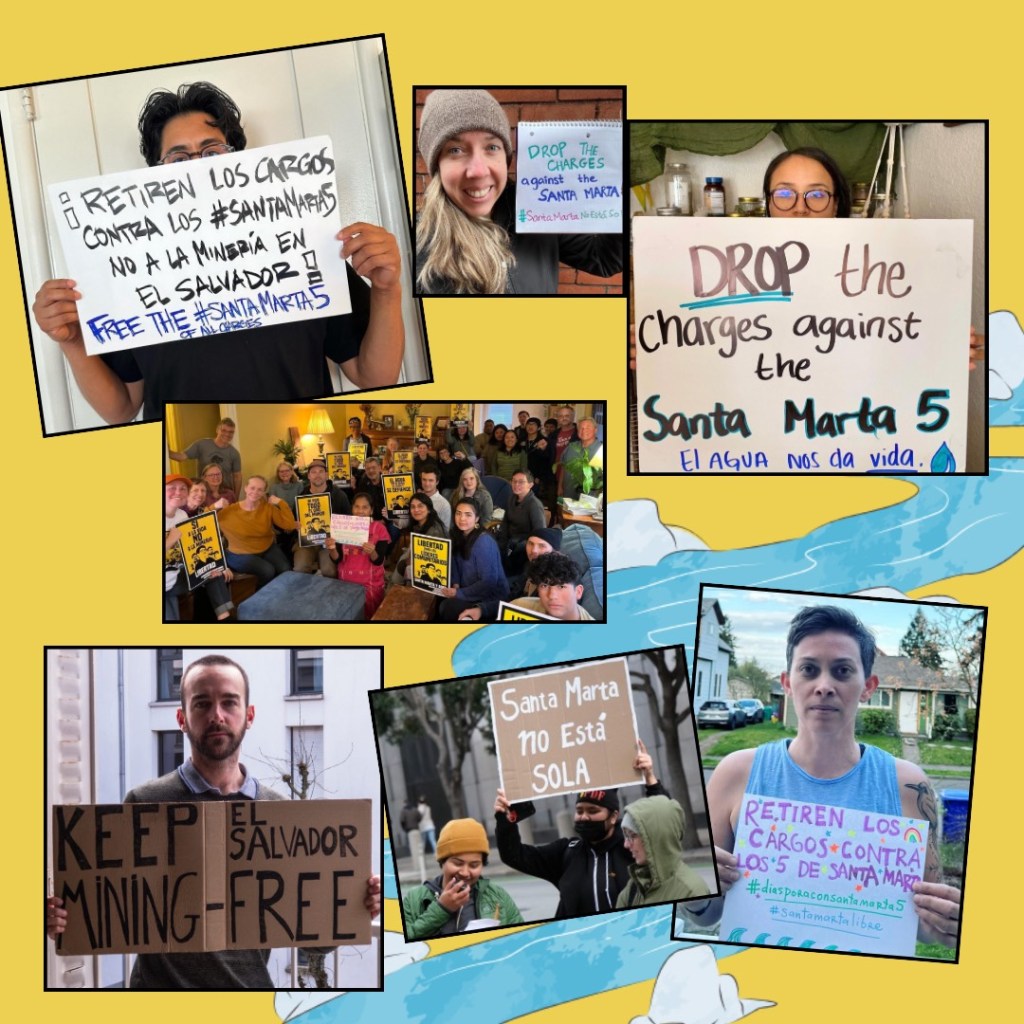
  • Drop the charges against the Santa Marta 5!
  • ¡Retiren los cargos contra los Santa Marta 5!
  • International solidarity is with the Santa Marta 5!
  • The diaspora is watching! Free the #SantaMarta5 of all charges!
  • Keep El Salvador metallic mining-free!

Take a picture OR make a short video with your sign

Post on social media with the following hashtags: #SantaMartaNoEstaSola  #ComunidadSantaMarta #ADESNoEstáSola

Tag the following orgs on Twitter: @stopesmining @acafremin @CSantaMarta1987 @ades_sm@no_mineria_sv @cispes_solidarity 
(On Facebook: @ComunidadSanta Marta, @Mesa Nacional frente a la Minería Metálica en El Salvador, @International Allies Against Mining, @acafremin, @ADES Santa Marta)

Check out these examples for inspiration from CISPES on X and Instagram

For more information, check out some of these resources:

El Salvador faces scrutiny for ‘political’ trial of five environmental activistsThe Guardian, Oct. 9

La Justicia de Bukele vs los Defensores del Agua, Manuel Pérez Rocha, La Jornada, Oct.7

Solidarity with El Salvador’s Santa Marta 5 Grows Across Borders | NACLA
Minera Titán, la empresa que acecha para llevarse el oro de El Salvador – Voz Pública
Threat of Metal Mining Returns to El Salvador, Organizations Warn | CISPES
State of Deception: Fact Finding Report

Global allies stand with El Salvador’s water defenders

by Jim Hodgson

The global allies that united to accompany communities in El Salvador in their defence of water  resources against a Canadian mining company are working together again to defend five community leaders and to ensure that a national ban on open-pit mining stays in place.

Thursday, Jan. 11 marks one year since Antonio Pacheco and four colleagues were arrested in and near Santa Marta in northern Cabañas. 

On Jan. 5, 185 academics and lawyers, and 13 organizations from 21 countries sent an open letter to the Salvadoran Attorney General calling for the case against the five to be dropped. 

The five water defenders were FMLN combatants during the 1980-1992 civil war in El Salvador and are protected, the lawyers argue, by El Salvador’s internationally-recognized Peace Agreement and the National Reconciliation Law, both signed in 1992.

The lawyers’ letter says that Salvadoran prosecutors lack evidence, but the men – released from jail in September – still face charges of murder, unlawful deprivation of liberty, and unlawful association, alleged crimes that took place 33 years ago within the context of the civil war.

Rallies to support the Santa Marta Five are happening on Wednesday, Jan. 10 in person at the above-named locations at 4 PM local time. 

Water protectors in El Salvador say the arrests are politically motivated and a strategy to demobilize strong community opposition to mining as the government of President Nayib Bukele seeks to end the 2017 national prohibition of metals mining.

“The selective violation of the National Reconciliation Law to muzzle key leaders of the anti-mining movement while stifling any meaningful attempt to bring the largest perpetrators of human rights violations during the civil war – the Salvadoran military – to justice is a telling sign of the political motivations behind this case,” says the lawyers’ letter.

The perpetrators of the largest massacres of the civil war and of several high-profile assassinations have never been prosecuted in El Salvador. A series of massacres in northern Cabañas in late 1980 and in 1981 that led the people of Santa Marta and nearby communities to flee across the Lempa River into a six-year exile in Honduras have scarcely been investigated.

Late last year, an international delegation visited Santa Marta and other parts of El Salvador to look more deeply at the charges against the Santa Marta Five and the broader context of human rights violations in El Salvador. Their report “State of Deception: Fact Finding Report on the Detained Santa Marta Water Defenders, Mining, and the State of Human Rights under the Bukele Administration, will be released Thursday, Jan. 11.  

The report will show how Bukele has – in the words of Manuel Perez-Rocha of the Institute for Policy Studies – “reduced the independence of the judiciary, violated basic human rights, suspended civil liberties, and upended the rule of law.”

The United Church of Canada (my previous employer) has two funded partners in El Salvador. In 2019, when Emmanuel Baptist Church recognized its long relationship with the United Church, two colleagues from the Santa Marta Association for Economic and Social Development (ADES) travelled from Cabañas to San Salvador to join our celebration. Shown here are: Antonio Pacheco, the ADES executive director (one of the five men arrested a year ago); Kathy Brett, a member of the United Church’s executive; former Moderator Jordan Cantwell; ADES President Vidalina Morales; and Jim Hodgson, Latin America program coordinator at that time.

Human rights groups including Amnesty International have documented severe abuses of human rights under the guise of overcoming street-gang violence. Says Amnesty: “As of October 2023, local victims movements and human rights organizations had recorded more than 73,800 detentions, 327 cases of forced disappearances, approximately 102,000 people imprisoned – making El Salvador the country with the world’s highest incarceration rate – a rate of prison overcrowding of approximately 236%, and more than 190 deaths in state custody.”

Among the most recently-targeted is Rubén Zamora, the 81-year-old former politician and diplomat who was, for many, the public face of the coalition of groups aligned against the government during the civil war. Zamora was a Christian Democrat who left his party in 1980 over its alliance with the armed forces. He was a member of congress in the early 90s, and ran for the FMLN as its presidential candidate in 2004. 

After a life-long career in politics, Rubén Zamora served as El Salvador’s ambassador to the United States in 2013-14, and then served until 2019 as ambassador to the United Nations.

Absurdly, he is accused of helping to cover up one of the high-profile massacres – El Mozote in 1981, when about 1,000 people were murdered, the largest single massacre of civilians in modern Latin American history – by being a member of congress when the abysmal 1993 amnesty law was approved. But Zamora opposed that law and refused to add his signature to it once it was approved by other legislators. (That law was overturned by the Supreme Court in 2016.)

ADES and other Cabañas organizations that support the Santa Marta Five have also called for support to Zamora. There is also an on-line petition that you can sign.