
by Jim Hodgson (from a text published on Dec. 11, 2011 in a previous version of this blog site)
One of the people that I used to visit in Cuernavaca was Doña Guadalupe, an elderly woman who lived with her many beautiful cats in the Patios de la Estación neighbourhood, near the former train station and Casino de la Selva hotel.
To make a living, she made tortilla cloths (including the one shown here) and other embroideries that she sold to visitors who came from the Cuernavaca Centre for Intercultural Dialogue on Development (CCIDD) where I worked in the mid and late 90s. This image shows the Virgin of Guadalupe, for whom our friend was named. (She died in July 2000, just before I returned to Canada.)

Tonight, six million people will fill the streets around Mexico City’s Guadalupe basilica (shown below). Many will have travelled on foot, by bicycle and in trucks and buses, to get there. Most sleep in the street. All expect to get in to the basilica to greet La Virgen on her feast day.
Inside, there will be a succession of Masses and celebrity stars in a televised variety show. What you don’t see on television is the flood of people whose focus is not on centre stage. And those who can’t get to Mexico City are celebrating across Mexico and increasingly, throughout the Americas and beyond.
It’s the confluence of different spiritualities around The Feast of Our Lady of Guadalupe. And there are different ways of telling the story. But let me give you a basic outline.
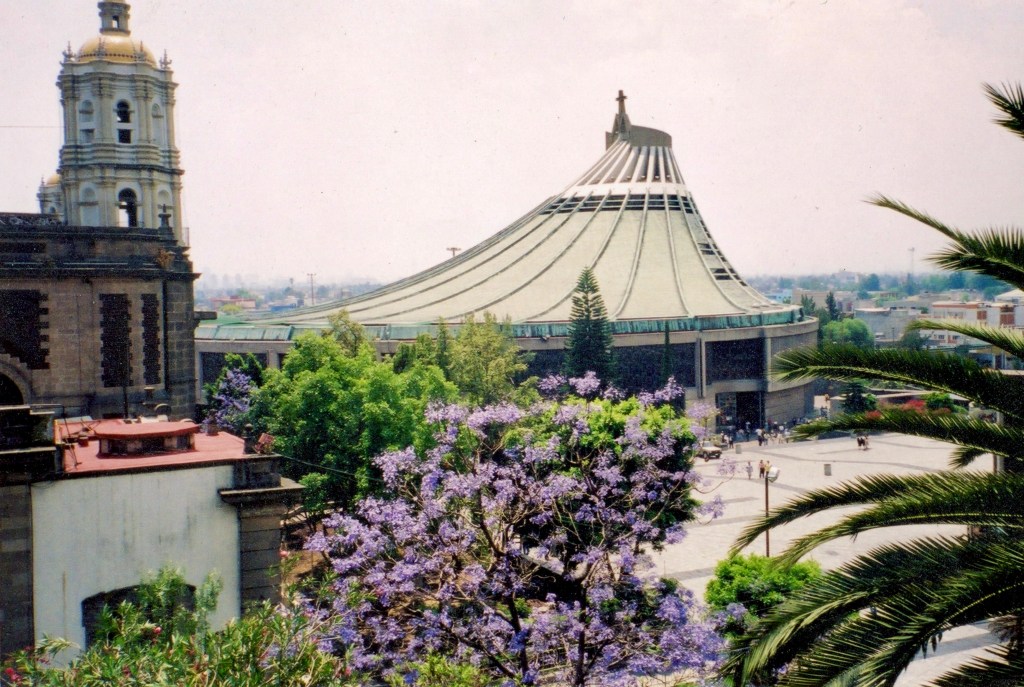
The Virgin Mary is believed to have appeared to an Indigenous man, Juan Diego, on three occasions in December 1531, 10 years after Spain’s conquest of the Aztec empire. She encountered him on a hill known as Tepeyac, on the north edge of Mexico City—formerly Tenochtitlan, the Mexica (or Aztec) capital). The hillside was associated with the worship of Tonantzin, a mother of gods in the Mexica faith.
Mary spoke to Juan Diego in Nahuatl, the language of the Aztecs that is still spoken by about three million people in central Mexico. She addressed him with an honorific title and asked him to tell the bishop that she wanted a church built on the site. When the bishop later asked Juan Diego for proof that she had made this request, Juan Diego returned to Tepeyac. Mary told him to gather roses in his cloak and to take them to the bishop.
When Juan Diego unrolled his cloak to reveal the roses to the bishop, the cloak itself was emblazoned with the image of Mary, dressed as a dark-skinned Aztec princess, standing in front of the sun and on top of a crescent moon.
In the apparitions, Mary called herself Tecuatlaxopeuh, a Nahuatl word which means “one who drives away those who eat us.” The Spanish called her Guadalupe, after a popular devotion to Mary in Estremadura, Spain.
“Flowers of life in the crude winter”
The message was understood to be an affirmation of the Indigenous people in the midst of their defeat and oppression. It’s another one of those stories (like that of Jesus born in a stable in Bethlehem under Roman occupation) that tell of God’s action at the margins, among the poor, away from power.
The hillside where Mary appeared, Tepeyac, is the focal point of popular religiosity in Mexico and all of the Americas, wrote Fr. Miguel Concha of the Dominican religious order in Mexico. (Fr. Miguel passed away in January 2023.)
“There is no greater moral and religious strength that unites so many people precisely because of what she represents,” he wrote in La Jornada newspaper Jan. 23, 1999.
“She is a Marian symbol, it’s true, but she has connotations that go beyond what the institutional church holds forth in its doctrines. Guadalupe is the product of the synthesis that the poor developed from what Christianity offers, bringing that together with the essence of the oldest indigenous religious traditions,” wrote Concha.
“To come today to Tepeyac to proclaim from here the commitment of the church in the face of the third millenium is to assume the trajectory of those who, like Juan Diego, are the bearers of the few flowers of life which still survive in this crude winter which is imposed on humanity.”

Development and the faith of the people
Why is a blog about development dealing with Latin American celebrations of the Virgin Mary? Aside from being in the midst of the Advent and Christmas season, when Mary’s central role in the Jesus story is celebrated, it seems to me that a lot of development activities are carried out as (apparently) benevolent foreign interventions. People come from some place else to build a school. Experts lead an agricultural project. Funds are shared from North to South in support of some cause or other.
At their best, these activities represent cross-cultural cooperation. Southern partners make the key decisions; Northern partners are but a supporting cast; solidarity grows.
At their worst, zealous to promote a better pig or construction technique, foreign development workers (like bad missionaries) feel no need to understand local cultures or practices.
One time, we accompanied Doña Guadalupe on a visit to her huesera, a healer of bones and their aches. In small barrels, the huesera had a spectacular collection of different varieties of beans, in all their many colours—seed varieties disparaged by the agro-industrialists with their monocrops.
A bit of time spent in friendship and solidarity with Guadalupe showed me vividly how Indigenous people and small farmers are the keepers of seeds and of the wisdom and knowledge that we will need to survive the warm decades to come.
 Unwrapping Development