Time to end the hypocrisy on global debt

by Jim Hodgson

“From collapsing ecosystems to collapsing economies, our communities have been battered by a storm of climate chaos, debt distress, deepening inequality, and systemic exploitation. These crises are the direct result of a global economic system built to extract from our lands, our people, our futures—so the rich and powerful can thrive off our suffering.”

That was the message May 29 of the Asian Peoples’ Movement on Debt and Development (APMDD), a Manila-based network that calls for change in debt, climate, economic and development systems.

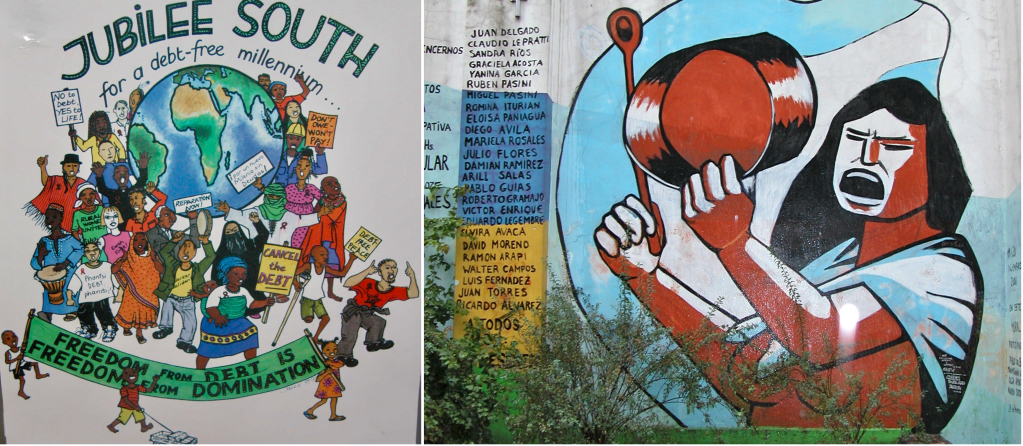
In June 2024, Pope Francis and other church leaders around the world launched a new Jubilee campaign for debt cancellation. In Canada, the call is taken up by KAIROS, the Canadian Council of Churches and by Development and Peace (D&P) — among others. KAIROS launched a “Turn Debt into Hope” Jubilee 2025 petition that by June 13 had been signed by more than 36,400 Canadians.

Promoters of the campaign gathered for a People’s Forum in Calgary this past weekend ahead of the G7 summit and joined Sunday’s protests in the heart of the city. The Catholic Register reported on the event:

Salome Owuonda, executive director at the Africa Centre for Sustainable and Inclusive Development (Africa CSID), spoke about the consequences of crushing debt in Kenya…. She told participants that in her East African country “50 per cent of revenue generated is directed toward paying debt” and that puts health care, education, climate action and food security at risk. “And things are not getting better,” said Owuonda. “The government is calling for more taxes as they have to try and pay the debt.”

Dean Dettloff, a research and advocacy officer at D&P, shared that over “3.3. billion people in the world live in countries that spend more paying the interest of their debt than health care and education.” He added that many nation states also direct more funds to these expenditures than safeguarding the environment.

Tarek Al-Zoughbi, a Palestinian Christian who serves as the project and youth coordinator at Wi’am: The Palestinian Conflict Transformation Centre in the West Bank, spoke about the suffering in Gaza and many countries around the world.

Al-Zoughbi said that during this Jubilee year, we “must begin to recognize this image of God that is in each of us and that is in the spirit of creation.” He called for an end to environmentally exploitative practices that contribute to ecological debt. 

Some readers will recall the the Millennium Jubilee of 2000, which mobilized millions globally to demand debt cancellation for nations in the Global South. KAIROS reminds us:

In Canada, this movement took shape as The Canadian Ecumenical Jubilee Initiative, the country’s most successful faith-based advocacy campaign. This powerful campaign, led by church-based justice organizations, KAIROS’ predecessor coalitions, and the Canadian Council of Churches, played a crucial role in achieving over $100 billion in global debt relief.  

Yet, 25 years later, a worsening global debt crisis continues to affect vulnerable populations, exacerbated by rising interest rates, climate change, and economic inequality. An unacknowledged “ecological debt” owed by the North to the South and Indigenous Peoples further exacerbates the crisis.

Global “Financing for Development” system is part of the problem

When Pope Francis launched the new Jubilee debt campaign a year ago, he called for a “new international financial architecture” that breaks the financial-debt cycle that has contributed to a current global debt now estimated at $313 trillion. 

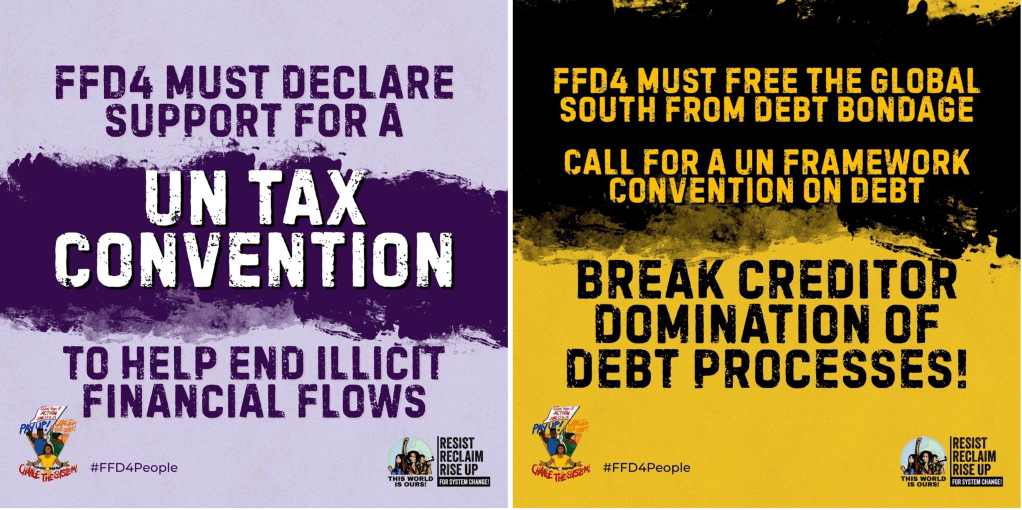
That APMDD statement that I referred to above presses hard on that global financial architecture, describing a “rigged system” that favours creditors. It criticizes the Financing for Development (FfD) process, which was created to ensure fair and just financing for development and climate action—especially for the Global South. “Instead, it has become another space for the Global North to rewrite the rules to protect their power, shirk their responsibilities, and advance false solutions. Their hypocrisy is most glaring when it comes to climate finance.”

At the end of June, world leaders will gather in Seville, Spain, for the fourth international conference on financing for development, dubbed FfD4. (I attended an ecumenical pre-event at the first FfD conference in Monterrey, Mexico, in 2002 and wrote about it here.) In recent months, negotiations on the outcome document have sparked intense civil society campaigning

The Global Policy Forum said June 17 that the final draft retains an intergovernmental process for managing debt, but weakened its mandate to making “recommendations”. Critics argue that this could kill whatever hope remains for achieving Sustainable Development Goals (SDG) as “debt crises strangle fiscal space and derail the implementation of the Agenda 2030 for Sustainable Development.” Global Policy Forum describes some of what is gone from the outcome document (referred to now as the “Compromiso de Sevilla”):

The paragraph on phasing out fossil fuel subsidies (27i) has been deleted entirely, as well as the specification of asset types to be covered by national and global asset registries (28g). The language around the UN Framework Convention on International Tax Convention was also softened just two months before the first round of negotiations starts: “We support” was downgraded to “we encourage support” (28b).  A similar change occurred in the paragraph on investor-state dispute settlement, where the “we undertake reform” was replaced by “we support efforts to reform” (43l).

Meanwhile, the rich countries led by the United States are cutting international aid and increasing their military spending.

The G7 meeting near Calgary issued a series of statements (CBC, left) but one searches in vain for anything about debt cancellation or development assistance. The statement on “migrant smuggling” fails to address the question of why people leave their homes or how development aid and peace-making strategies can ease the problem.

The APMDD statement concludes:

“We are here to expose the Global North—not just for failing to deliver climate finance, but for actively sabotaging it in bad faith. This is no accident. It is a calculated strategy to protect their profits and deny justice to those they have exploited for centuries…. We see through every lie. We reject every excuse.”

El Salvador’s Bukele arrests rights defender Ruth López

El Salvador’s government has arrested Ruth Eleonora López, a prominent human rights lawyer, as it steps up attacks on rights defenders, environmentalists and journalists.


López leads anti-corruption work at Cristosal, one of the country’s leading human rights groups. It was created in 2000 with backing from the global Anglican communion in 2000. “To this day, our work is inspired by the Anglican communion’s commitment to justice and the dignity of every human being and demonstrated through the role of the church during El Salvador’s civil war,” its website states.

Cristosal helps document evidence of state crimes under El Salvador’s ongoing three-year state of emergency.The measure is used to arrest people believed to be associated with gang violence, but other people have been swept up as well. It restricts the right to gather, to be informed of rights and to have access to a lawyer. It extends to 15 days the time that someone can be held without charges. Associated Press says that some 85,000 people have been arrested under the state of emergency.

Al Jazeera reported that Cristosal has also tried to assist more than 250 Venezuelans who were sent by the United States to a jail in El Salvador.

On Sunday night (May 18), two weeks before Nayib Bukele reaches his sixth anniversary in power in El Salvador, the Attorney General’s Office announced the arrest of López via X (formerly Twitter). As of late afternoon Monday, her whereabouts were still unknown and her family joined Cristosal in demanding the government provide more information.

The English-language service of El Faro newspaper—itself under attack by the Bukele regime— said the arrest derives from accusations of embezzlement, but the case file is declared secret. Prosecutors claimed to have gathered information during raids carried out against Eugenio Chicas, a former president of the Supreme Electoral Tribunal arrested in February, and who remains in custody.

“The only reason for this detention is that I am a human rights defender and work for an NGO uncomfortable for the government,” López said upon her arrest. She told the officers: “Have some decency; one day this will all end. You must not play into this.”

El Faro said May 5 that a reliable source had told its reporters that the Bukele-controlled Attorney General’s Office is preparing at least seven arrest warrants for members of El Faro. The source reached out following the publication of interviews with former leaders of the Revolucionario faction of the 18th Street Gang (Barrio 18) about Bukele’s years-long relationship to gangs. 

If carried out, such arrests would be the first time in decades that prosecutors seek to press charges against individual journalists for their journalistic efforts.

One of the gang leaders said that he had been secretly released from custody at the height of the country’s ongoing state of exception as part of his gang’s continued negotiations with Bukele’s government. The interview focus attention on the extent to which Bukele’s rise to power was tied to secret negotiations with the country’s gangs.

The NACLA Update summarizes the interviews this way: 

El Faro’s reporting shows that the links between the Barrio 18 gang and Bukele began all the way back in 2014, when Bukele was a council member of small-town Nuevo Cuscatlán looking to run for mayor of San Salvador. During his campaign for mayor, a close Bukele ally warned gang members of impending police raids and delivered community development projects to the gang’s turf; in exchange, gang leaders cracked down on opposition activists and forced community members to vote for Bukele.

Ties between Bukele and the country’s gangs, including MS-13, have long been documented by El Faro and other outlets and have caused tensions with the United States. Nevertheless, news that a gang leader convicted of murder was released at the height of the crackdown brings unwanted scrutiny on the Salvadoran government at a time when Bukele has enthusiastically sought favor with the Trump administration.   

“Cuba does not live in peace. Cuba lives with permanent aggression.”

The Mexico City daily newspaper, La Jornadapublished an interview May 9 with Cuba’s vice-minister of external relations, Carlos Fernández De Cossío.

Cuba’s lack of peace, he emphasized, is caused by Washington’s policies against the people of Cuba, characterized by economic coercion with the blockade. He warned that while practically the whole world has been the object of tariff threats by the administration of Donald Trump, “towards Cuba, the onslaught is already underway, and only military aggression is lacking” to complete the siege.

In the face of new global geopolitics, with Trump in power, he warned that the White House now attacks several countries: “you see this in Panama, Greenland, Canada;” the focus could also be the progressive governments elsewhere in Latin America.

“There are threats against several governments, and the United States will attempt, through force, economic pressure, and other methods, to influence the political processes of our countries. Venezuela is a country under attack. It’s evident that the region faces that reality….  The absence of armed conflict does not mean living in peace.” He also said that there is pressure on nations in the hemisphere to adopt measures to “reduce the ‘harmful influence’ of China.”

Over the past two-and-a-half years, I have worked with my former colleagues at The United Church of Canada, other churches, several trade unions and international development organizations to draw attention to the impact of U.S. sanctions (“the blockade”) on the Cuban people. Now that Canada’s new cabinet ministers are confirmed, we’ll likely launch a new call to “take action” in solidarity with Cuba.

Fernández de Cossío was in Mexico City for meetings May 8 with Mexico’s External Relations department (SRE) to talk about migration issues. 

With a long career in diplomacy, Fernández de Cossío has served as director for the United States in the Cuban foreign ministry. He also served as ambassador in Canada (2004-05) and South Africa, and was Cuba’s representative in the peace process between the government of Colombia and the Revolutionary Armed Forces of Colombia (FARC).

He said spaces like the Community of Latin American and Caribbean States (CELAC) are key to creating a counterweight to Washington. “They must move beyond declarations and formality. Getting there is not easy.” What follows is a lightly-edited translation of his interview with La Jornada writers, Emir Olivares and Arturo Sánchez Jiménez.

Migration challenges

Q: What are the challenges to the region from the new anti-migration policies of Trump?

R: If the great gap between the industrialized, developed countries and the countries in processes of development is not reduced, it’s natural that there will be a growing flow from the south toward the north to seek better living conditions. That goes on in Africa, in Asia and in our continent, where the flow toward the United States, whether it be regular or irregular. The reality varies by each country.

Q: And for Cuba?

R: The case of Cuba is unique. The United States has applied a dynamic against it that both pushes and pulls migration, whether regular or irregular. Washington’s official policy is economic coercion. The blockade, aimed at depressing and making living conditions as difficult as possible, provokes a migration drive.

Furthermore, since the 1960s, Cuban immigrants have been privileged, regardless of how they cross the border, by sea or by land. They are assimilated, granted refugee status, protected, and provided with employment. Additionally, there is the Cuban Adjustment Act, which means that regardless of how they entered the United States, Cuban migrants can acquire residency within one year of arriving in the United States. No citizen of any other country in the world has that privilege. If Washington does not put an end to this reality, the irregular flow will continue.

Q: What do you think of the U.S. propaganda shared in mass media and internet platforms against migration, headed by the secretary of homeland security, Kristi Noem?

R: It’s media opportunism that seeks support in the population. They unfairly criminalize all immigrants. To a certain extent, society has been polarized since its inception, with cultural and racial prejudices. And it’s not difficult for these politicians to try to stir up those feelings to promote a policy of rejecting immigrants and blaming them for many of the problems: drug use, unemployment, crime, and social polarization. If some migrants participate in crime and social unrest, it’s because these phenomena already exist in the United States.

Historically, the United States has believed that Cuba belongs to them, but in reality, it is an inability to accept that Cuba is, and has the right to be, a sovereign state.

Medical students at the University of Medical Sciences in Matanzas come from around the world. (Photo: Jim Hodgson, 2007)

Campaign against the health brigades

Q: The campaign against Cuba’s medical brigades is within these new coercive measures?

R: Yes. Since February, they have threatened that countries that continue medical cooperation programs with Cuba, their officials and family members will lose their visas and their ability to travel to the United States. Today, around 60 nations have these programs. They provide care to thousands of people. It is a historic project, for which Cuba has been praised by governments, several UN secretaries-general, and even a US president (Barack Obama).

The campaign seeks two things: to discredit this symbol of the success of Cuban society, since one of the priorities of anti-Cuban sectors is to prevent recognition of Cuba’s successes. The second is to cut off a legitimate source of income obtained from agreements with countries that are more favourable (such as Mexico), although historically these are services for which not a cent has been received.

Q: Do Trump’s new geopolitics bring additional pressures to the hemisphere?

R: It’s part of the US government’s hostile and imposing behavior toward the region, and it’s a challenge not only for Cuba but for the entire region. There’s pressure to adopt measures to reduce “China’s harmful influence.” We find it absurd. In a recent congressional hearing, they showed alleged Chinese military bases in Cuba (they used to say they were Russian, during the Cold War). They presented images of what could have been a soccer field or a rice field to say: “This is evidence that there are Chinese military bases in Cuba,” but there wasn’t a single military officer there, no one from the Pentagon or the CIA, from the institutions that are supposed to bear witness to this.

There’s threatening behavior that tries to impose their will on the hemisphere. We saw this in Panama. We see it in Greenland (even though it is not part of the region) and with Canada. It’s a challenge for us all and it’s dangerous.

Q: What have been the errors of the revolutionary regime?

R: Fidel Castro once said that the biggest mistake was thinking that anyone knew how to build socialism and that it would be easy to do so. In Cuba, specific errors may have been made in some aspects of economic policy, in elements of social policy, but it’s very difficult to judge if one takes into account the challenges posed by the aggression of a power like the United States.

Q: Are the ideals of Martí, Castro and others still valid?

R: The ideas of Martí, Fidel, Marx, Engels, Lenin and other Marxists remain relevant and continue to shape our thinking. The challenge we face with youth is enormous, due to the communication influence that large corporations have exerted, a monopoly that is difficult to break. This, combined with a very depressed economic situation, has a serious and dangerous impact on the population. We are working with this; we accept it as a challenge, a very great challenge facing Cuban society.