U.S. interference mars Latin American elections

by Jim Hodgson

As I write, Colombians and Peruvians await confirmation of a victor after presidential election day results proved too close to call.

Like mid-term elections in Argentina last October and the Honduras election in November, Colombia’s vote was marred by overt U.S. interference. 
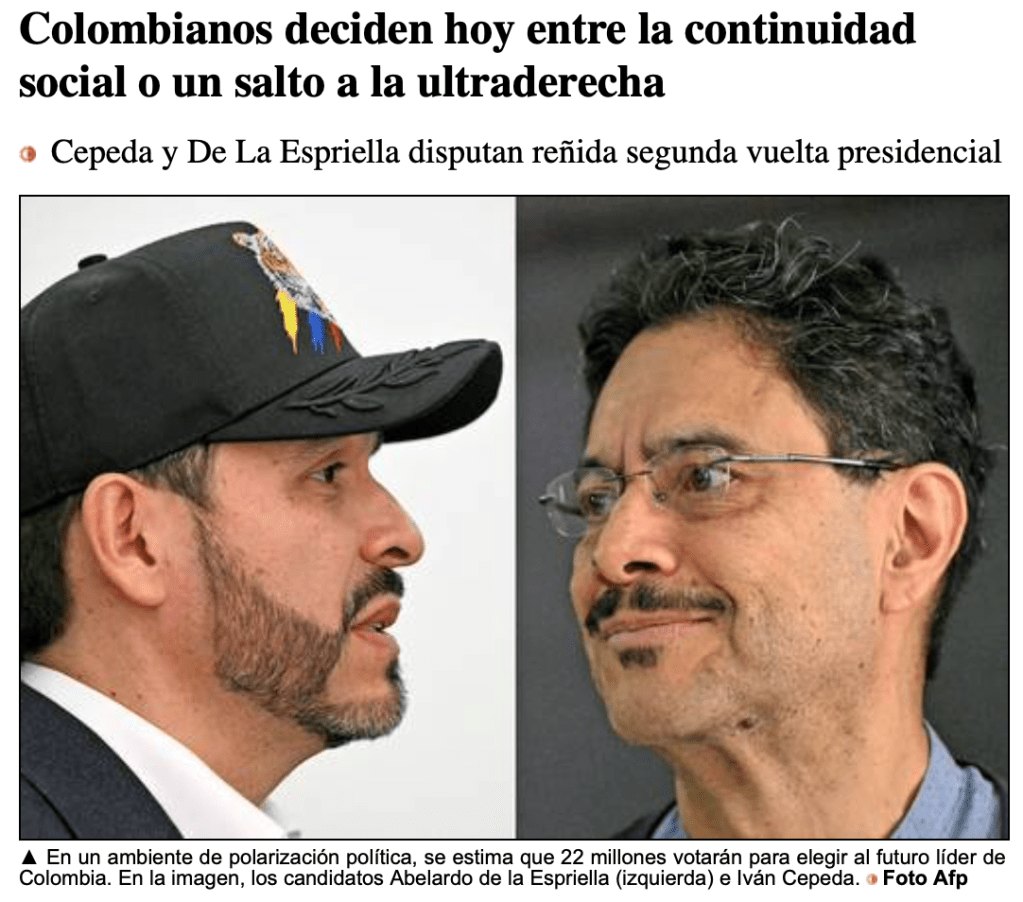
On June 21, Colombians had to choose between a progressive human rights defender, Iván Cepeda, and a far-right political new-comer, Abelardo de la Espriella. Cepeda would continue current President Gustavo Petro’s commitment to achieving peace with several armed groups that have so far resisted joining a prolonged peace process.

As Colombians headed for the polls, I received an email from Dayana Mosquera, Colombia consultant at Global Exchange

In recent days, foreign figures have openly inserted themselves into Colombia’s campaign. 

It began in Washington. President Trump posted his “Complete and Total Endorsement” on Truth Social, and de la Espriella answered on X, casting the two countries as “sister nations” bound to defend Western civilization. A chorus followed. Secretary of State Marco Rubio, whom de la Espriella met privately this year, said Washington would be “very forceful in guaranteeing” a free and fair vote. U.S. Representative María Elvira Salazar urged Colombians to rally behind him.

It did not stop there. Beyond Washington, de la Espriella has secured the unconditional support of other leaders including Presidents Daniel Noboa of Ecuador, José Antonio Kast of Chile and Argentina’s Javier Milei, who interpreted the result as a rejection of the “failed socialist model” and said the forces of freedom across the region were watching and lending their support. From Madrid, Vox leader Santiago Abascal said Colombians could recover the “sovereignty taken from them.” 

Each framed it the same way: as a defense of Colombia’s freedom and even its sovereignty. 

That is the contradiction at the heart of this election. Sovereignty and freedom are not gifts foreign politicians can hand a country by meddling in its vote. They are the very things such interference denies. Nor is this happening in isolation. 

Since Trump reshaped American politics, a familiar style has spread: elections become contests to be won by any means, opponents are cast as enemies, and institutions are treated as obstacles. That style is no longer staying home. It is carried across borders by a networked right, by officials willing to amplify it, and by compliant allies in the region eager to satisfy Washington for their own gain. This weekend, Colombia is where the line is drawn.

Next target for the far-right will be Brazil, where presidential elections are set for October.

Crime and the far-right backlash

In Peru, voters have waited since June 7 for a final result. Keiko Fujimori – daughter of a former dictator – faced Roberto Sánchez who served as foreign minister under former president Pedro Castillo, elected in 2021 but forced from office in December 2022. 
Like Castillo, Sánchez wears a traditional hat popular in rural parts of Peru. He says his hat serves as “the expression of all hats and of the diversity” of Peru. His economic proposals differ from the “market-friendly,” neo-liberal policies applied in recent decades by most Peruvian leaders. He has said he would renegotiate contracts with mining companies, saying that the state should collect more taxes. He has also said that rural communities should own a share of the mines operating in their territory and that he opposes open-pit operations.

Fujimori ran on a law-and-order platform, promising to deploy the military in prisons and on borders. In Peru, where extortion has increased fivefold in the past five years, the approach won votes, as it did in February in Costa Rica in February. Shaken by higher levels of drug-related killings, Costa Ricans chose conservative Laura Fernández for her tough-on-crime platform. 

To an extent, these right-wing politicians draw inspiration (and slogans) from El Salvador’s president, Nayib Bukele, another Trump ally. His heavy-handed security strategies have seen tens of thousands of young men imprisoned without due process, and have targeted environmental protectors (the Santa Marta 5) and human rights defenders like Ruth López Alfaro.

Proposals from the centre and left for community violence prevention programs, better police training, and prison and judicial reforms, show results over years. But the right uses crime as an emotional rallying cry. Their short-term security strategies promise to make people feel safe soon. They come with a high price to human rights and democracy, but to people who live with real fear on a daily basis, those values seem abstract. 

Meanwhile, another right-wing strong man, Daniel Noboa, holds power in Ecuador, neighbour to Peru and Colombia. A week ago, he declared a new 60-day state of emergency across ten provinces and several additional municipalities on Tuesday, suspending constitutional rights and authorizing security forces to conduct searches of private homes without a judicial warrant when organized crime is suspected. His decree came shortly after a meeting at the Pentagon with U.S. Secretary of War Pete Hegseth to discuss joint military operations.

Trump officials, including his ambassadors, insist on such joint operations, often with the threat of acting unilaterally if governments do not comply – and the example of U.S.-government-sponsored killings of more than 200 people in aerial attacks on small boats in international waters that are alleged (without evidence) to be carrying illegal drugs.

As a result, the centre-left government of Guatemala declared a state of emergency to crack down on gang violence this year and welcomed Trump’s “help” targeting drug traffickers.

In Mexico, the U.S. Central Intelligence Agency was found to be working hand-in-hand with the conservative government of the northern border state of Chihuahua – without the knowledge of the federal government – after two agents were killed in a car crash. As that scandal exploded in Mexico, the U.S. government launched indictments against the governor and other officials of Sinaloa state, and sought their extradition. 

In an editorial, La Jornada newspaper described these events as “heavily charged acts of political interference, compounded, to top it off, with an implicit threat.” 

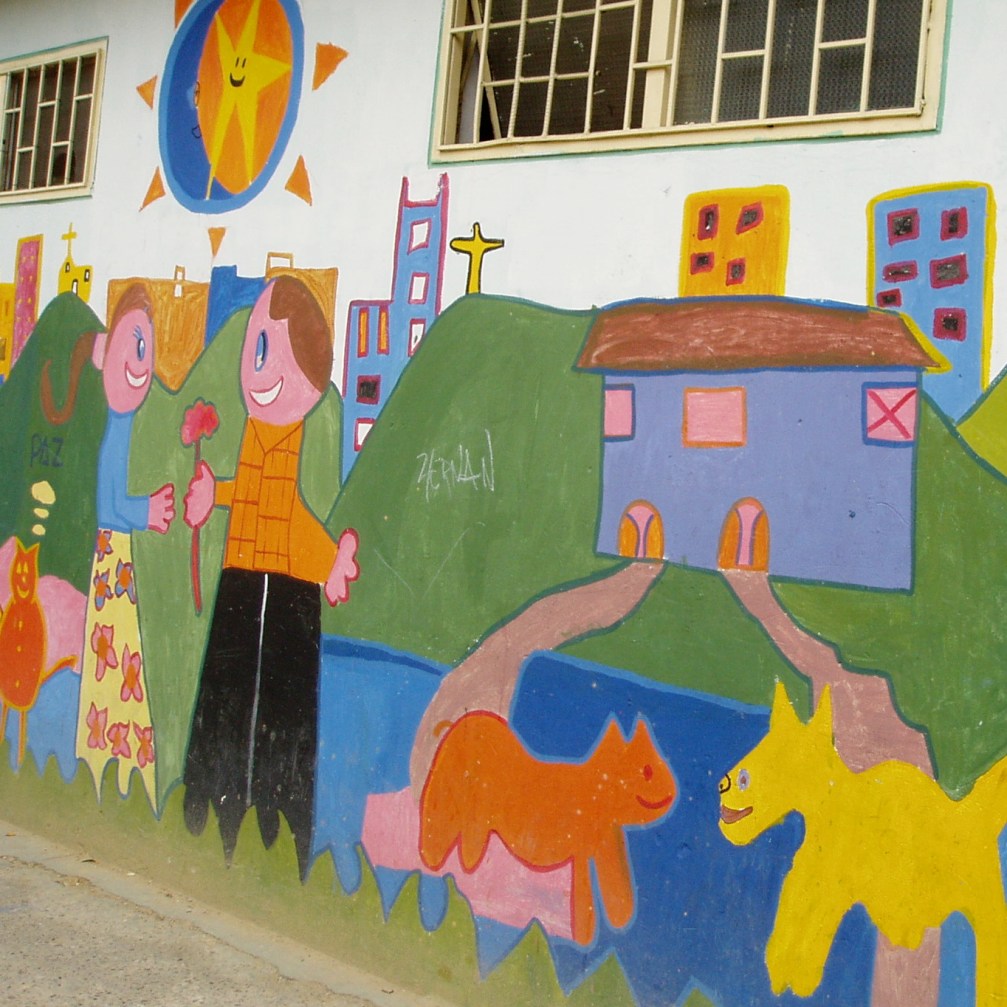
"Another World is Possible," World Social Forum, Porto Alegre, Brasil (2005)

The old order is dead. Let’s make a new, more just order.

by Jim Hodgson

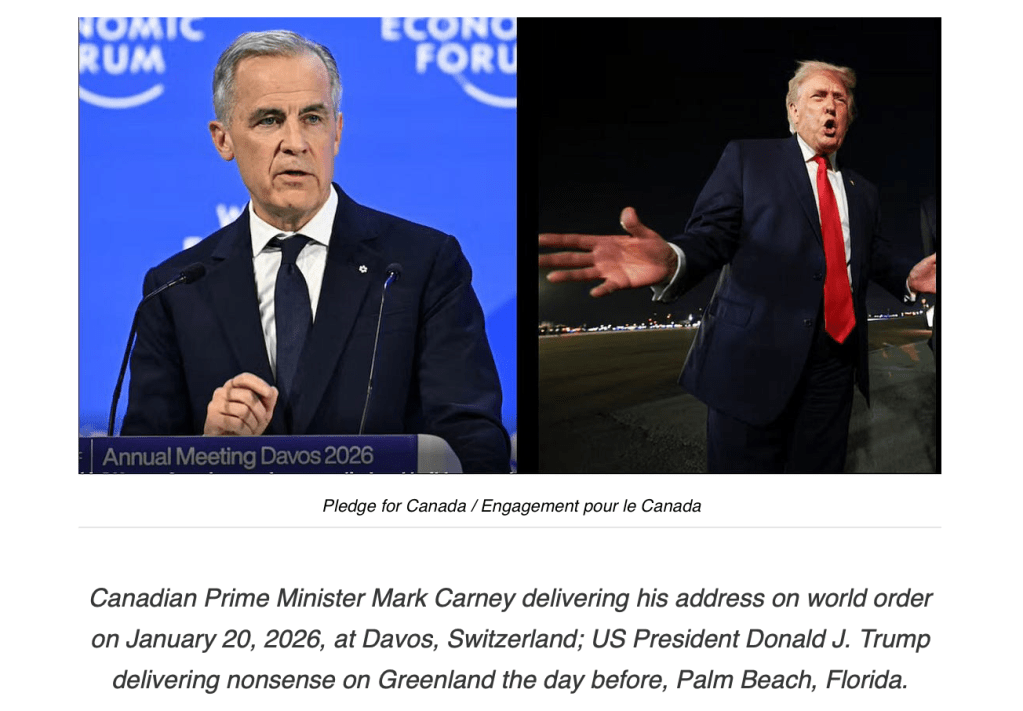
It was too much to hope that the well-heeled audience at Davos would boo Donald Trump from the stage a day after they had offered Mark Carney a standing ovation. But by the end of Wednesday, it seemed that the wall of resistance to any U.S. take-over of Greenland was successful, and the president backed down. An important victory.


Still, “la rupture de l’ordre mondial” of which Carney spoke remains. And he’s right: we shouldn’t mourn it. The international financial institutions invented in 1944 at Bretton Woods, New Hampshire, gave overwhelming power to the rich countries of the Global North. 

And the United Nations system that followed, with a veto given to each of the five most powerful countries, has protected their interests – even in the face of overwhelming contrarian votes in the UN General Assembly. Think, for example, of the annual vote to end the cruel U.S. blockade of Cuba.

That order was designed by the nations that existed at the end of World War II, especially the colonial or neo-colonial states of Europe and the Americas. Most of the Caribbean, Africa and large parts of south Asia were still under colonial rule. That order imposed and perpetuated a Global North-based order on all the new nations that were born in the 25 years or so after the war: the majority of nations that exist today.

And that order, at least in the eyes of three of the five veto-holders, effectively imposed capitalism as a synonym for democracy. The United States and its allies were satisfied with a sort of formal democracy, a certain alternance between parties of the right and centre-right, and if that failed, then a military government was a useful interlude until the real order could be re-established and markets were safe. 

Canada would “go along to get along,” as Carney admitted. 

Just as it did less than three weeks ago when the United States bombed Venezuela and kidnapped its president. And just as it has for more than two years over Israel’s genocide in Gaza.

In his speech, Carney seemed to offer a vision of capitalism without the now-erratic United States. It’s still reliant on resource extraction, military spending, and massive capital investment.

But if we are all to grow and thrive, we must demand more. We require an end to practices that exploit social inequities and our shared ecology. 

Alternatives

Because of the paths on which my life has taken me, one that is especially close to my heart is the call from the Indigenous people of Zapatista communities in southern Mexico for “a world with room for all” – “un mundo donde quepan muchos mundos.” But other visions come from other places, including three decades of gatherings of the World Social Forum.

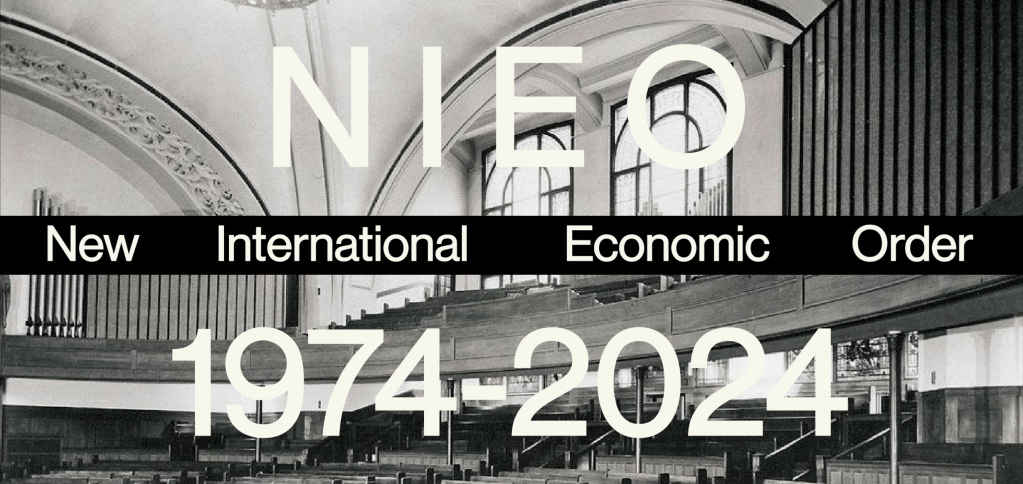
More than 50 years ago, the majority world united behind a vision of economic decolonization, sovereign development, and international cooperation across areas such as debt, trade, finance, and technology. That vision became known as the New International Economic Order (NIEO) and was adopted by the UN General Assembly. But, power relations being what they are, it was never implemented. (Progressive International put together a set of reflections that trace its history and update the proposals for the 21st century.)

In March last year, the World Council of Churches and several global communions of churches repeated their call for a New International Financial and Economic Architecture (NIFEA). “It is immoral that over a billion people – half of them children – subsist in poverty whilst billionaires increased their wealth by over 15% in 2024 to US$15 trillion. It is outrageous that the richest 10% of the global population receives more than half of global income, whereas the poorest half earns merely 8.5% of it,” they said in a statement.

They expressed deep concern about “a rapidly escalating climate and biodiversity emergency that jeopardises livelihoods and poses an existential threat to all life.” It notes that “several tipping points are close to being crossed or have already been crossed, leading us to recognise that we may be beyond a point of no return.”

The old order is dead. The time in which we are living demands we do better.

The “feminist foreign policy” is dead. What next?

by Jim Hodgson

A decade of promises and at least a measure of good will were flushed away with Prime Minister Mark Carney’s declaration that his government does not have a feminist foreign policy.

Speaking in Johannesburg at the end of the G20 summit, he said issues such as gender equality and reducing gender-based violence are an “aspect” of his government’s foreign policy. “But I wouldn’t describe our foreign policy as feminist foreign policy.”

Frankly, it was always hard to reconcile proclamations of feminist foreign policy (FFP, as it came to be known) by Prime Minister Justin Trudeau and his foreign ministers with Canada’s efforts to sell weapons abroadinaction in Gaza, and preference for threats and sanctions over dialogue in Venezuela. After all: wouldn’t a truly feminist foreign policy veto arms sales to Saudi Arabia because of its suppression of women’s rights? 

House of Commons finance committee chair Karina Gould, who served in several cabinet posts under Trudeau and ran against Carney for the Liberal leadership, told the Canadian Press that Carney’s words “certainly” mark a departure from the previous government. But she insisted the policy the prime minister described remains feminist.

“The ideals that he was talking about continue to be feminist, and I think that what it means is that as Canadians, we expect that we’re going to stand up for gender equality around the world and here in Canada,” she said.

“Prime Minister Carney is making it very clear he is no friend to women and he is no friend to gender equality in this country,” NDP MP Leah Gazan told reporters Nov. 24.

International Women’s Day march, Guatemala City, March 8, 2023 (Jim Hodgson photo)

Feminist aid policy

The Trudeau government did somewhat better with its Feminist International Assistance Policy (FIAP). Beyond policy documents, FIAP seemed to produce some results across the development cooperation sector with promotion of gender equity, empowerment of women and girls, and rights and inclusion for 2SLGBTQIA+ people. 

Even so, there were calls for more. Canada’s ecumenical justice coalition KAIROS said FIAP was “sound policy” but that its funding priorities needed “to align the advancement of human rights and women, peace and security with economic empowerment.”

After the Harper government in 2009 refused to support the KAIROS international assistance work, funding was restored by the Trudeau government to a revamped KAIROS Women, Peace and Security program. 

Now Trudeau is gone, his “sunny ways” undermined by the SNC Lavalin affair and his treatment of cabinet ministers who were women. And international development cooperation is being buried in favour of investment regimes, eternal debt and oceans that rise along with temperatures.

“Inside/outside strategies”

And so I find myself thinking in different ways. Sometimes I feel that I placed too much faith in the official spaces, even as I always identified most strongly with social movements. Sometimes we used “inside/outside” strategies: those who could talk to the politicians would do so; the rest of us would march in the street outside. I think of anti-free-trade demonstrations in Québec City in 2001 or the protests at the Toronto G7/G20 meeting in 2010.

Today in Mexico City’s La Jornada newspaper, Raúl Zibechi has a column in which he decries the “pyramids” of power we build within our progressive movements even as we denounce the pyramids of power in our capitalist “democracies.” He points to an event the Zapatistas will hold in San Cristóbal de Las Casas,  Chiapas, Dec. 26-30 this year. Zibechi and others will offer their “analyses on pyramids and on how histories are handled within the economic system, bad governments, laws and the judicial structure, resistance movements, the left and progressivism, human rights, the feminist struggle, and the arts.”

I can’t attend this year, but I will pay attention. As the new accord between Carney and the premier of Alberta showed this week, we can’t trust conventional power to make good choices on behalf of the people. We need to propose alternatives and press to make them reality.