Liberation theologians see relationships as key to overcoming Israel-Palestine conflict

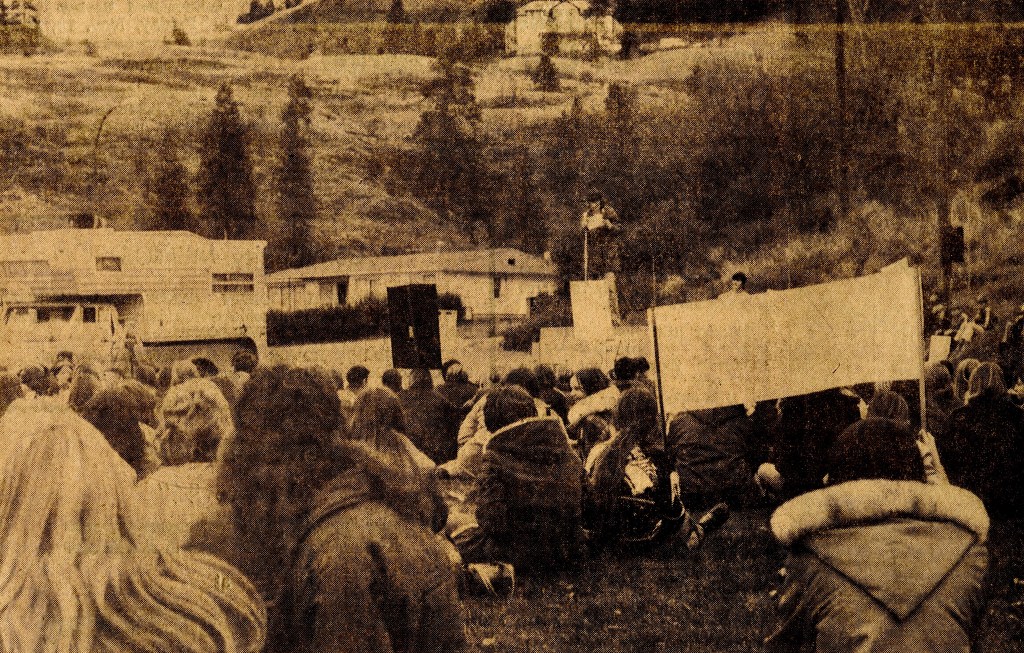
A demonstration in Toronto during the July 2014 Gaza War.

by Jim Hodgson

For people like me whose faith found new grounding in the waves of liberation theology that have emerged over the past 55 years or so, a global conversation about solidarity with Palestine offered a chance to reflect with people who are living with the effects not just of the present war, but of generations of conflict that preceded it.

The zoom conversation – “Transnational Solidarity Amongst Liberation Theologies: Palestine & Beyond” – organized by the Sabeel Ecumenical Liberation Theology Centre (a United Church of Canada global partner) in Jerusalem, was held Nov. 10 and drew together about 100 people from around the world.

Sabeel’s director, Rev. Dr. Naim Ateek (an Anglican priest) spoke of both the immediacy of the “crushed children of Gaza” and of the urgent need to “understand the other, respect the other, accept the other. Without those, there is not a healthy or productive exchange.”

“These are absolutely crucial when we think about rebuilding relationships (not just homes), and building solidarity for the future of all the people of Palestine and inside Israel,” he said, adding: “Have in mind the tragedy and the suffering; that is the departure point for us.”

Ateek encouraged those who would be in solidarity with Palestinians to be “pro-peace, pro-understanding, pro-liberation, and pro-reconciliation. We need to be looking for justice in accordance with international law.”

Sabeel is a space where community reflection continues to drives new action for justice and peace, and to build relationships far beyond Jerusalem. You can also follow Canadian Friends of Sabeel (CFOS) on Facebook.

Dr. Farid Esack of the University of Johannesburg (and a member of the United Church of Canada’s first partners council a decade ago) spoke of the reflection-action process in liberation theology that drives praxis beyond theorizing. “We must always reflect on our praxis, and make that affect our praxis,” he said. “Colonialism, imperialism and capitalism always view the Earth as territory to be captured.” For Palestinians, he added, the task is to elaborate a vision of what a “post-Zionist society would look like, and for the rest of us, to follow that.”

Esack, a Muslim scholar of liberation theology in South Africa, emphasized the need to “not demonize all Jews and to always fight anti-Semitism, but I will not fall into the white trap, not privilege that above other forms of racism.”

In response to a question about the role of inter-religious dialogue in seeking justice and peace, he warned against platitudes and “a butterfly dance of escapism and digression.”

“The occupation is not a result of Jews not understanding Muslims or Christians not understanding Jews. In liberation theology, the priority now is inter-religious solidarity against occupation, the armaments industry, the military, and not to remove attention from the occupation.”

This is to put it mildly, but global South views of current conflicts tend to be different from the positions taken by leaders in countries like Canada. A Brazilian Methodist feminist theologian, Rev. Dr. Nancy Cardoso, hoped to press that point as one of the speakers invited to be part of the Sabeel conference. Working now in Angola, she was unable to join the zoom call because of internet problems. I have known her for many years, and contacted her later because I was curious about what she would have said.

“Doing liberation theology implies a distrust of the tradition of bourgeois knowledge, a guerrilla war relationship with the church, university and their bunkers and dictators, a difficult relationship with publishers and their audiences, because it is always marked by class struggle,” says the text she shared with me. 

She drew attention to the actions of “Christian Zionists” – Christian fundamentalists who think Israel needed to be re-founded so as to bring about the return of Jesus Christ – whose “apocalyptic and hypocritical visions… dream with the past.”  

“Reconstruction of hope,” Cardoso insisted, “to be real and not illusion, should spring from the poor and excluded.”

The methods of liberation theology demand re-reading of religious texts including the Bible from the perspective of the poor, she said, and “returning the text methodologically to poor communities, not as a book of power and authority but as a possibility of dialogue with other narratives of faith present in cultures.”

In the days after the Oct. 7 Hamas attack on an Israeli music festival and kibbutz, and then the overwhelming Israeli military response, images like these proliferated in social media – a sign of the hope, perhaps, that the rest of the world holds for peace between Palestinians and Israelis and among religions.
You can find some good content analysis of Canadian reporting on Palestine and Israel at The Breach.

Guadalupe, Tonantzin and roses in December

by Jim Hodgson (from a text published on Dec. 11, 2011 in a previous version of this blog site)

One of the people that I used to visit in Cuernavaca was Doña Guadalupe, an elderly woman who lived with her many beautiful cats in the Patios de la Estación neighbourhood, near the former train station and Casino de la Selva hotel.

To make a living, she made tortilla cloths (including the one shown here) and other embroideries that she sold to visitors who came from the Cuernavaca Centre for Intercultural Dialogue on Development (CCIDD) where I worked in the mid and late 90s. This image shows the Virgin of Guadalupe, for whom our friend was named. (She died in July 2000, just before I returned to Canada.)

Tonight, six million people will fill the streets around Mexico City’s Guadalupe basilica (shown below). Many will have travelled on foot, by bicycle and in trucks and buses, to get there. Most sleep in the street. All expect to get in to the basilica to greet La Virgen on her feast day.

Inside, there will be a succession of Masses and celebrity stars in a televised variety show. What you don’t see on television is the flood of people whose focus is not on centre stage. And those who can’t get to Mexico City are celebrating across Mexico and increasingly, throughout the Americas and beyond.

It’s the confluence of different spiritualities around The Feast of Our Lady of Guadalupe. And there are different ways of telling the story. But let me give you a basic outline.

The Virgin Mary is believed to have appeared to an Indigenous man, Juan Diego, on three occasions in December 1531, 10 years after Spain’s conquest of the Aztec empire. She encountered him on a hill known as Tepeyac, on the north edge of Mexico City—formerly Tenochtitlan, the Mexica (or Aztec) capital). The hillside was associated with the worship of Tonantzin, a mother of gods in the Mexica faith.

Mary spoke to Juan Diego in Nahuatl, the language of the Aztecs that is still spoken by about three million people in central Mexico. She addressed him with an honorific title and asked him to tell the bishop that she wanted a church built on the site. When the bishop later asked Juan Diego for proof that she had made this request, Juan Diego returned to Tepeyac. Mary told him to gather roses in his cloak and to take them to the bishop.

When Juan Diego unrolled his cloak to reveal the roses to the bishop, the cloak itself was emblazoned with the image of Mary, dressed as a dark-skinned Aztec princess, standing in front of the sun and on top of a crescent moon.

In the apparitions, Mary called herself Tecuatlaxopeuh, a Nahuatl word which means “one who drives away those who eat us.” The Spanish called her Guadalupe, after a popular devotion to Mary in Estremadura, Spain.

“Flowers of life in the crude winter”

The message was understood to be an affirmation of the Indigenous people in the midst of their defeat and oppression. It’s another one of those stories (like that of Jesus born in a stable in Bethlehem under Roman occupation) that tell of God’s action at the margins, among the poor, away from power.

The hillside where Mary appeared, Tepeyac, is the focal point of popular religiosity in Mexico and all of the Americas, wrote Fr. Miguel Concha of the Dominican religious order in Mexico. (Fr. Miguel passed away in January 2023.)

“There is no greater moral and religious strength that unites so many people precisely because of what she represents,” he wrote in La Jornada newspaper Jan. 23, 1999.

“She is a Marian symbol, it’s true, but she has connotations that go beyond what the institutional church holds forth in its doctrines. Guadalupe is the product of the synthesis that the poor developed from what Christianity offers, bringing that together with the essence of the oldest indigenous religious traditions,” wrote Concha.

“To come today to Tepeyac to proclaim from here the commitment of the church in the face of the third millenium is to assume the trajectory of those who, like Juan Diego, are the bearers of the few flowers of life which still survive in this crude winter which is imposed on humanity.”

Images on the church in Santa Marta, Cabañas department, El Salvador: Guadalupe and Saint Oscar Romero.

Development and the faith of the people

Why is a blog about development dealing with Latin American celebrations of the Virgin Mary? Aside from being in the midst of the Advent and Christmas season, when Mary’s central role in the Jesus story is celebrated, it seems to me that a lot of development activities are carried out as (apparently) benevolent foreign interventions. People come from some place else to build a school. Experts lead an agricultural project. Funds are shared from North to South in support of some cause or other.

At their best, these activities represent cross-cultural cooperation. Southern partners make the key decisions; Northern partners are but a supporting cast; solidarity grows.

At their worst, zealous to promote a better pig or construction technique, foreign development workers (like bad missionaries) feel no need to understand local cultures or practices.

One time, we accompanied Doña Guadalupe on a visit to her huesera, a healer of bones and their aches. In small barrels, the huesera had a spectacular collection of different varieties of beans, in all their many colours—seed varieties disparaged by the agro-industrialists with their monocrops.

A bit of time spent in friendship and solidarity with Guadalupe showed me vividly how Indigenous people and small farmers are the keepers of seeds and of the wisdom and knowledge that we will need to survive the warm decades to come.

Unwrapping populism: the Milei victory in Argentina

Images: Página/12

Jim Hodgson

There’s that word again: populism. This month, it’s used to describe Javier Milei, the right-wing politician who won the presidential election in Argentina. Saying that he’ll take a chainsaw to chop down government spending, Milei is compared to politicians of the right, including Donald Trump in the United States, Jair Bolsonaro in Brazil, Giorgia Meloni in Italy and Marine Le Pen in France.

In other moments, the term populist is used to describe politicians of the left, like Mexican President Andrés Manuel López Obrador (AMLO), or the Podemos movement in Spain or Syriza in Greece. 

At times I think populism is a term devoid of meaning. A Venezuelan colleague says that it’s used by élites and mainstream journalists when they don’t understand what is going on. Rather than using it, I look instead at the content of a political program. 

But sometimes, the meaning is clear. Populism as a “people” that must be protected from some external or internal “other”—has an obvious fascist stink, but that doesn’t hold back Trump or a crop of other leaders from using its methods to rally the people against refugees.

But none of that is what left leaders like Hugo Chávez in Venezuela (1999-2013) or Lázaro Cárdenas in Mexico (1934-40) were about. If they talked about the “people,” it was to build solidarity across regions and identities (workers, farmers, Indigenous)—class  consciousness, if you will—so as to turn the attention of the state towards resolving their problems, but not at the cost of other disadvantaged or racialized people

When journalists and politicians use the term populism to denounce leaders of the left, beware: they are pretending that the ruling class is equivalent to some disadvantaged group—immigrants in the U.S. or European contexts—and promoting another big lie.

A mural in the Boca neighbourhood of Buenos Aires created 10 years after the December 2001 rebellion that ended a series of presidencies. New elections in 2003 were won by Néstor Kirchner, who was succeeded in 2007 by Cristina Fernández de Kirchner. She is shown in the bottom panel driving the train forward. (Photos: Jim Hodgson, 2013)

What happened in Argentina?

“People chose change, without considering its cost,” wrote Washington Uranga in the Buenos Aires daily Página/12. “Change was put above any other value. Voters chose to launch themselves into the unknown so as to reject continuity of the critical situation in which they live now: inflation.”

Almost 25 years ago, on Dec. 6, 1998, another so-called populist, Hugo Chávez Frías, won the presidential election in Venezuela. “The people, weary of corruption and ever more sceptical of the traditional way of carrying out politics, bet on a new type of candidate,” wrote Marta Harnecker, a close co-worker and one of his biographers.

“Into the unknown.” “A new type of candidate.” But any similarity ends right there. The program of Chávez (like that of AMLO or Lula in Brazil) was to turn the capacity of the state and the wealth of the nation in favour of the majority of the people so as to ease or end their poverty. 

Milei faces enormous challenges. The state has no money, and there is a $44 billion debt that ballooned during the 2015-19 neo-liberal government of Mauricio Macri. Inflation is running at 150%. He wants to dollarize Argentina (as El Salvador and Ecuador have done), removing any capacity to shape the country’s economic future.

Milei will weaken the state through what he calls a program of “anarcho-capitalism.” Don’t be fooled: Milei is an extreme neo-liberal, holding more in common with the 1970s “Chicago School” of liberal economic theory and 1980s politicians like Ronald Reagan and Margaret Thatcher. He also calls himself a libertarian. He says he will remove legal protections for workers and eliminate the ministries of health and education. But he would also use the power of the state to restrict the rights of women. His vice-president, Victoria Villarruel, is a daughter of soldiers and already, lobbying has begun to free military people found guilty during the past two decades for crimes against humanity they committed during the military dictatorship.

A mural in Buenos Aires shows Néstor Kirchner and Cristina Fernández with several of their “pink tide” colleagues. In the background are leaders who offer inspiration, including Emiliano Zapata, Evita Duarte, Salvador Allende, Che Guevara and José Martí. The mural is based on a photo of Kirchner and other leaders in 2007 when they formed the Banco del Sur as an alternative to the International Monetary Fund.

After the victories by Chávez in 1998 and Luiz Inácio (Lula) da Silva in Brazil in 2002, some of us starting talking about a “pink tide” sweeping across Latin America (forgetting perhaps that tides also recede). Since then, the tide has indeed ebbed and flowed, with electoral victories and defeats, along with coups or attempted coups in several countries and the phenomenon of “lawfare” – the “deployment of judicial power to persecute political opponents: candidates, parties, even entire organizations and social movements.” A current example is the Guatemalan attorney-general’s harassment of President-elect Bernardo Arévalo and of his Semilla (Seed) party.

In Argentina, after the collapse of a series of governments at the end of 2001 in the wake of a banking crises brought on by foreign debt acquired during the time of the military dictators, Néstor Kirchner and his spouse, Cristina Fernández, emerged from the left side of the Peronist party to lead the country from 2003 to 2015. Success they had in managing the debt, provoking economic growth and reducing poverty was undone by Macri, their successor, who resorted to new borrowing and a toxic relationship with the and the International Monetary Fund. 

Cristina Fernández returned in 2019, this time as running mate to Alberto Fernández (no relation), who won the election. But their government (weakened somewhat by disagreements between the two and among their followers) was unable to undo the damage done by Macri. After the Milei victory, Nora Cortiñas of the Mothers of the Plaza de Mayo human rights group said that the business sector had driven prices of food and medicine higher so as to weaken the Fernández government.