News reports last week said that levels of hunger in Central America have almost quadrupled in the past four years, a consequence of the economic crisis caused by COVID-19 and years of extreme climate events.
That news set me to thinking about that comforting notion that the pandemic has somehow placed us all in the same boat—and then as well to the reactions to it: we may be in the same storm, but we’re in different boats.
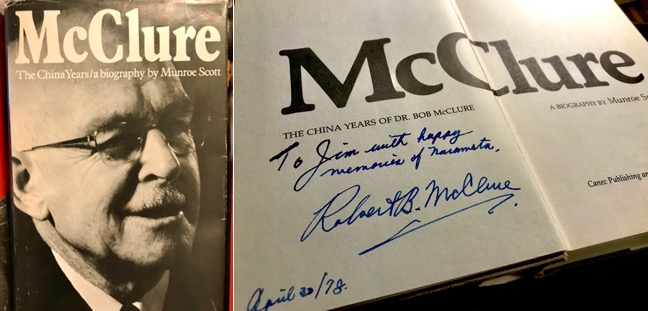
I first encountered the metaphor of a lifeboat to represent all of humanity when I was very young, perhaps 12 years old. My parents thought it was important that we hear a presentation by Dr. Robert McClure, the renowned medical missionary who was serving as Moderator of The United Church of Canada (1968-71). He was best known for his years of service in China in the decades before the triumph of the revolution in 1949, but he served after that in many parts of the world.
The auditorium of Kelowna’s First United Church was full, and we sat near the back. My memory is that Dr. McClure used the technology of the time, an overhead projector, and that one of the images was a simple line drawing of people in a boat. Most of them were at one end of the boat, and the boat looked like it was about to capsize. On the other hand, it may be that his words enabled me to make in my mind a drawing of the boat that he described. His point was about global distribution of resources. Some of us have too much; others nothing at all. It is one boat one planet: your stuff won’t save you.
Not quite a decade later, I met Dr. McClure again. We were both at the United Church’s Naramata Centre at the end of April 1978.
And, surprise, I found my notes of the event. He was in Naramata to speak at a United Church men’s conference; I was there with a very ecumenical group of about 40 youth that was attached to the Kamloops Okanagan Presbytery, and with which I stayed connected over several years during breaks from my studies in Ottawa. I had not remembered this, but my notes say that our resource person for the weekend was Gary Paterson, then the minister of the United Church congregation in Winfield, BC; decades later he too would be a Moderator. And it was Gary who introduced Dr. McClure to our group in a Saturday afternoon gathering in the upper room of a building called The Loft.
He began by “taking us” in a Concorde super-sonic jet, six-and-a-half-hours from London to Singapore. “Our world isn’t shrinking. It’s shrunk, and will continue to do so.” He spoke for about 35 minutes, and concluded: “Canada is your blessing. Now: what will you do with it?”
In between, he told us of his life in Toronto, where he lived on the 19th floor of an apartment building. He told us of the rules designed for safe living: you are not to talk to your neighbours; walk only in well-lit areas, etc.
Then he spoke of the river people of Sarawak (a Malaysian state on north coast of northern Borneo). “They live in long houses, like an apartment building turned on its side.” The long houses were divided into small apartments, side-by-side, each family having a part that was its own. “They’ve been there for 3,000 years,” he said. “They adopted this system of mutual support.” The apartments were joined together by a long, covered verandah over the river. “Neighbours are close and friends are forever.”
He offered an example. “My hospital was near the river mouth. A woman came down—a week-long journey in each direction—for a hysterectomy. I asked her, ‘Where are your children? How could you leave your children?’ ‘Oh, but doctor,’ she said, ‘we’re long-house people. The neighbours will care for them while I’m gone. Next month when my neighbour comes down, I’ll care for her children. We’re long-house people.’”
That’s mutual support. “When you’re invited to a wedding in Borneo, it’s a commitment for you too. You pledge to see that Joe and Sally will stay together, and when problems arise, you go see Joe and tell him to get his act together, and you can bet Sally will be told something by the women. One marriage in a thousand breaks down. That’s mutual support.”
He talked about the role of youth in other countries that he had visited. Read 42 years later, some of his examples of youthful collaboration seem debateable—Singapore in the years when Lee Kuan Yew exercised firm control—but the point was that governments should trust youth with more responsibility for positive social change, and that youth should take advantage of the responsibility they have now.
Twice, then, I was inspired by McClure to think of issues in their global dimensions. In subsequent years, I learned more about him and about China and about the role of Canadian missionaries there.
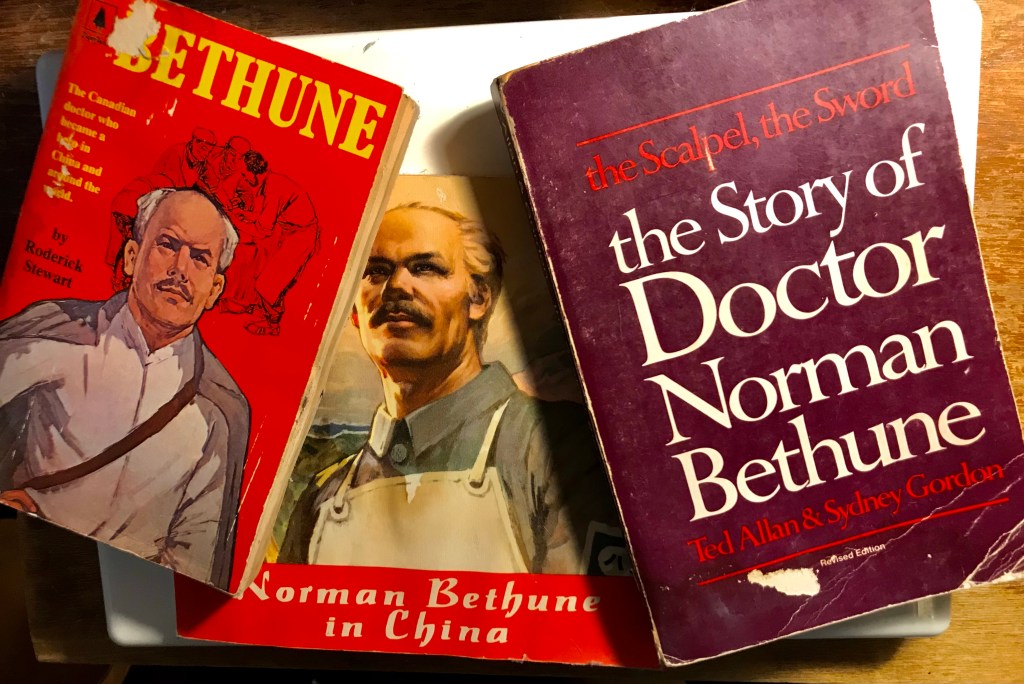
Dr. McClure is sometimes held in tension with the life and witness of Canadian supporters of the Chinese Revolution, including Rev. James Endicott, a United Church missionary, and Dr. Norman Bethune (son of a Presbyterian minister) who died in 1939 while serving as a battlefield surgeon with one of Mao Zedong’s revolutionary armies.
While I tend to the Endicott and Bethune sides of those political and theological reflections, I also celebrate McClure’s choice to live most of his life among the impoverished and marginalized peoples of the Earth, and his challenge to the rest of us to use our blessings to care for each other and the planet.
As I was putting together these notes about my memories of Dr. McClure, I was invited by a friend to see actors in a Zoom reading of a new play, China 1938, by Diane Forrest held March 8. Forrest is a writer and editor long involved in Alumnae Theatre’s new play development group and is also co-author with McClure of a 1988 volume, Vintage McClure. The play tells the story of the single encounter between McClure and Bethune in China in 1938, and is told from the perspective of the one woman who knows what happened: McClure’s widow, Amy. This play is also an inspiration, and I hope that (after the pandemic), it gets a full stage treatment.
In a rare show of unanimity, the UN Security Council approved a resolution Feb. 26 that encouraged Covid-19 vaccine equity and called for a “sustained humanitarian pause” to local conflicts.
Speaking with journalists afterwards, World Health Organization (WHO) chief Tedros Ghebreyesus argued that more could be done.
“I understand full well that all governments have an obligation to protect their own people. But the best way to do that is by suppressing the virus everywhere at the same time,” said Ghebreyesus.
“Now is the time to use every tool to scale up production, including licensing and technology transfer, and where necessary, intellectual property waivers. If not now, then when?”
The WHO leader’s words add weight to calls inside the World Trade Organisation (WTO)—calls that are already supported by about 100 countries—for a waiver from certain provisions of patent rules to allow greater production of vaccines.
Given that Canada is not yet among the countries supporting the waivers, Canadians are invited to sign a petition to the House of Commons in support of the proposal.
Together with calls within the G20 nations and the International Monetary Fund (IMF) to release $3 trillion of global reserve funds (“Special Drawing Rights”) to support crisis response and recovery efforts in developing countries, action in the WTO on patents represent the two largest challenges to “standard operating procedures” in the IMF and WTO seen in many years.
We’ve done this before
These systems have been challenged before. In the IMF’s case, it was the demand for debt relief by so-called “highly-indebted poor countries” in the 1980s and 1990s that inspired massive Jubilee campaigns in many countries, including Canada. Now, more than 215 groups from around the world have sent an open letter to G20 Finance Ministers and the IMF calling for a quick allocation of global reserve funds – Special Drawing Rights – to support developing countries’ global coronavirus crisis responses and recovery efforts.
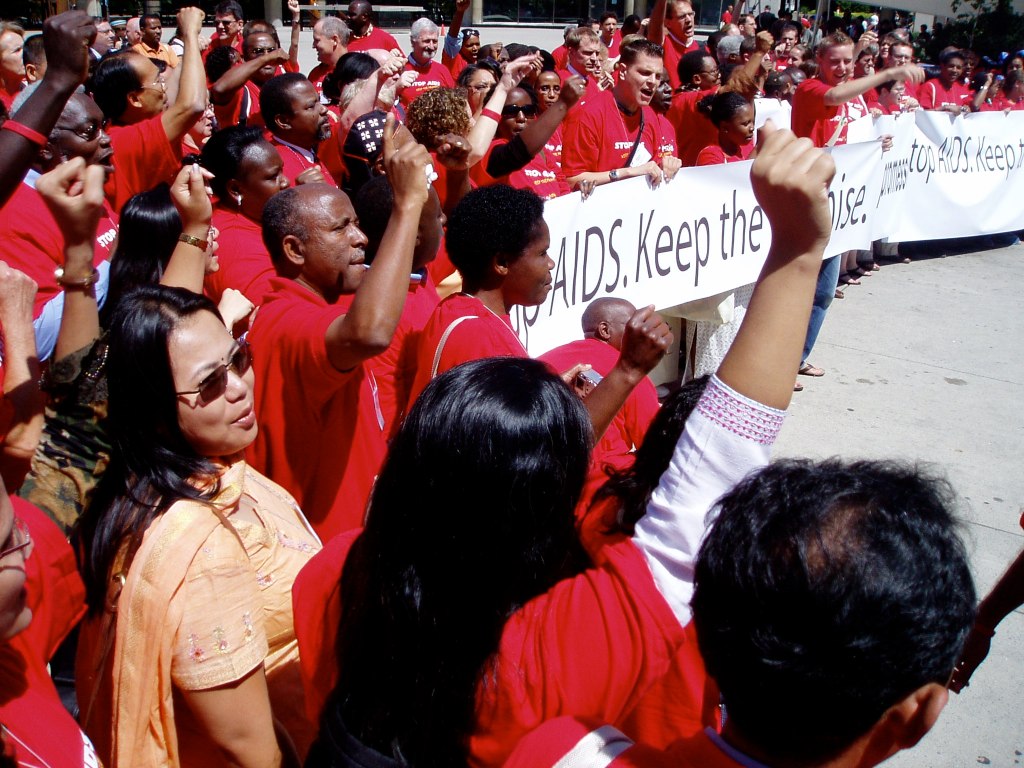
“Stop AIDS! Keep The Promise!” was the cry outside the International AIDS Conference in Toronto in 2006. (Jim Hodgson photo)
With the WTO, it was the need to ease patent protection so as to produce less costly generic versions of medicines used to treat HIV and AIDS. Again, efforts were broadly supported by churches and NGOs around the world. Eventually, in at least partial responses, less-costly generics and the Global Fund to Fight AIDS, Tuberculosis and Malaria helped save lives in many countries.
Vaccine Equity
The WHO has long called upon rich countries to ensure that vaccines are shared equitably. The global organisation is one of the leaders of COVAX, a program that aims to supply 1.3 billion vaccine doses to low- and middle-income countries this year. But so far, COVAX has had a slow roll-out.
The British-drafted resolution in the Security Council, co-sponsored by 112 countries, recognized the importance of extensive use of vaccines in this pandemic time as a “global public good for health.” It emphasised the need to develop international partnerships to scale-up manufacturing and distribution capacities.
Further, the Council requested the Secretary-General to provide a full assessment of the impediments to vaccine access in the pandemic response. It said it would review situations brought to its attention by the Secretary-General where hostilities and armed group activities are impeding COVID‑19 vaccination and to consider what further measures may be necessary to ensure such impediments are removed, and hostilities paused to enable vaccination.
It emphasized the urgent need for “solidarity, equity and efficacy,” inviting donation of vaccine doses from developed economies and all those in a position to do so to low- and middle-income countries and other countries in need, particularly through the COVAX facility.
These are complex initiatives but they—together with action for patent and debt relief, and additional funds for vaccines and other public health need—are essential for overcoming the global pandemic and for the reconstruction that will follow.
People in Canada are also invited to sign a petition to ensure full access to Covid-19 vaccines by all migrants regardless of immigration status. See the Vaccines For All petition here.
At the end of 2020, a United Church of Canada magazine, Mandate, published an article that I wrote about the impact of sanctions in Venezuela and North Korea. The text follows after the photo below. Read or download a PDF copy here.
Since then, more voices have joined the call on governments and the United Nations to ease up on use of sanctions because of humanitarian consequences for ordinary people in sanctioned countries.
Pope Francis appealed to governments to relax sanctions on various countries. “In various cases, humanitarian crises are aggravated by economic sanctions, which, more often than not, affect mainly the more vulnerable segments of the population rather than political leaders,” he told the Vatican’s diplomatic corps on Feb. 8.“While understanding the reasons for imposing sanctions, the Holy See does not view them as effective, and hopes that they will be relaxed, not least to improve the flow of humanitarian aid, especially medicines and healthcare equipment, so very necessary in this time of pandemic.”
On Feb. 12, at the end of a two-week visit to Venezuela, a United Nations human rights expert urged an end to unilateral sanctions against Venezuela. Alena Douhan, the UN Special Rapporteur on unilateral coercive measures and human rights, said the sanctions have exacerbated pre-existing calamities. “Humanitarian exemptions are lengthy, costly, ineffective and inefficient,” she said as she shared her preliminary report. Douhan’s final report will be presented to the UN Human Rights Council in September.
In February, the U.S. Government Accountability Office (GAO) reported that U.S. sanctions likely exacerbated Venezuela’s economic decline and that that more can be done to remove obstacles to the delivery of humanitarian assistance.
A clerk in a subsidized bakery in Caracas (May 2019).
Sanctioned Ignorance: International sanctions in countries like North Korea and Venezuela hurt more than help
When I became involved in movements for global justice in the 1980s, economic and political sanctions were viewed as tools of liberation. They were a potential means to end colonial rule and, in the South African context, apartheid.
Today, sanctions are most often used by rich and powerful countries to pressure smaller states. Food and medicine are supposed to be exempt from sanctions, but banks block payments and transport companies won’t carry the goods out of fear of contravening the rules. Thus, Venezuela can’t buy wheat from Canada, fertilizers from Colombia, or insulin from Germany. North Korea can’t buy X-ray machines or finish building a hospital because it is prohibited from buying metals abroad.
Since 2018, the United Church of Canada and a handful of other organizations have pressed the Government of Canada and the United Nations to ease up on use of sanctions because of unintended humanitarian consequences for ordinary people in sanctioned countries. For the United Church, these calls are rooted in the United Church’s practice of partnership, and often in its mission history—in the case of North Korea—or in wider ecumenical action—as with Venezuela.
In 1998, two years before I joined the United Church staff as its Latin America-Caribbean partnership coordinator, Venezuelans chose Hugo Chávez to be their new president. Chávez began turning the country’s oil revenue to serve of the country’s impoverished majority by focusing on housing, health care, and education. In 2000, the people of the United States chose George Bush to be their new president, who in 2002, would refer to North Korea, together with Iraq and Iran, as part of the “Axis of Evil.” The stage was set for confrontations that reverberate today.
Sanctions harm the vulnerable in North Korea
For Patti Talbot, the United Church’s north–east Asia partnership coordinator, the connection between The United Church of Canada and its partners in Korea—North and South—is deeply felt. It dates back to 1898 when Canadian Presbyterians established a mission in the northern port city of Wonsan, in what is now the Democratic People’s Republic of Korea (DPRK), also known as North Korea.
“The Canadian mission action combined a concern with the well-being of the person and the soul, the physical and the spiritual,” says Talbot. “Attention focused on people who were left out of traditional structures: education for women and girls, for example.” Church planting, she adds, went on in ways that developed Korean leadership and capacity building. Missionaries demonstrated respect for the Korean language and culture, particularly during the Japanese colonial period when the Korean people were brutally suppressed.
But “liberation” from the Japanese, with the end of World War Two in 1945, saw the division of the Korean peninsula between Soviet-led forces in the north and U.S.-led forces in south. The subsequent Korean War in the early 1950s was one of many proxy wars carried out between the Soviet Union and the United States and their allies as well as a civil war that pitted Koreans against each other. Many Christians fled to the south. Today, Koreans on both sides of the border yearn for reconciliation, but hope ebbs and flows depending on forces not at all within their control.
The late 1980s and the 1990s saw gradual opening as Cold War tensions eased. The Korean Christian Federation, a body representing North Korean Protestant Christians, was able to connect with the World Council of Churches, the United Church, and others. The Canadian Foodgrains Bank (CFGB) implemented a food aid program during and after a serious famine. Canada established diplomatic relations in 2001.
When more conservative governments came to power in Washington and Seoul in the early 2000s, official collaboration and dialogue with the DPRK dwindled. In 2006, North Korea tested a nuclear weapon. While this may have been a sort of bargaining chip to renew talks about demilitarization of the whole Korean peninsula, the United Nations Security Council responded by imposing sanctions. These were strengthened several times later over further nuclear tests and ballistic missile activities. Canada imposed its own set of sanctions in 2011.
Severe environmental and climate change–related challenges have led, in recent years, to prolonged dry, hot spells in some areas and major flooding in others. With international sanctions blocking access to agricultural inputs and tools, and the near complete lockdown response to the COVID-19 pandemic, food insecurity has steadily increased throughout the DPRK. In early 2020, UN agencies feared widespread undernutrition would threaten an entire generation of children in North Korea, with the growth of one in five children stunted due to chronic undernutrition.
Today, the United Church supports a modest maternal-child nutrition effort led by First Steps Canada, a Vancouver-based organization committed to preventing child malnutrition in the DPRK. Every day, First Steps provides more than 100,000 children with soymilk and 20,000 mothers and their babies with sachets of micro-nutrients in powder form that are added to food. First Steps does the arduous work of seeking exemptions from the sanctions so as to provide the aid.
And the United Church hopes to work again with CFGB and with Finland’s Lutheran relief organization, Finn Church Aid, to provide food assistance, but the effort is delayed because of the COVID-19 pandemic.
The United Church is part of a global effort to press for easing of sanctions against the DPRK, as it becomes increasingly clear sanctions are not achieving the intended goal of denuclearizing North Korea.
“What we bring to this sanctions conversation with other civil society organizations is this history of relationship as well as a moral and ethical objection to the use of sanctions,” says Talbot. “Sanctions do the most harm to those who are already vulnerable. We know that women and children suffer.”
Food distribution from a truck in Caracas (May 2018).
Sanctions are “warfare” in Venezuela
If some good came of all the threats made against Venezuela in recent years—including an attempted coup in April 2019, and a failed invasion by mercenaries in May 2020—it is that the threats seemed to provide new impetus for dialogue and for humanitarian aid.
Until the 2008 global economic crisis, Venezuela was providing more international assistance in Latin America than the United States. Oil was provided at reduced prices or with long-term, low-interest loans to Cuba, Haiti, Nicaragua and other countries.
Oil prices collapsed in 2009, rose again between 2012 and 2014, and collapsed in 2015 with no recovery in sight. The United States had shifted to fracking to produce oil domestically, and found it no longer needed Venezuela’s oil. And while it is tempting to blame the arrival of Donald Trump in power at the beginning of 2017 for current problems, relations with the United States worsened in 2015 when the Obama administration declared that Venezuela represented a “security threat” to the United States, and began a series of political and economic measures against Venezuela. Faced with economic hardship derived both from the collapse of the oil industry and the impact of sanctions, several million Venezuelans left for Colombia and other countries.
Inside Venezuela, the government expanded its food distribution program to reach about 60 percent of the population. Gradually, United Nations agencies and the Pan American Health Organization became more involved, along with non-governmental organizations and a network supported by the global ACT Alliance of faith-based relief organizations.
“Sanctions are warfare tied to U.S. policy to provoke regime change,” said Teri Mattson of the U.S. women’s solidarity network Codepink during a visit to Ottawa in November 2019. The strategy doesn’t work, she said, and only seems to result in pushing countries like Russia, China, Venezuela, Iran, Cuba, North Korea and Syria closer together.
Mattson was part of a panel on the unintended humanitarian consequences of sanctions at a forum organized by the Canadian Council for International Cooperation (CCIC, now called Cooperation Canada). A response to calls for sanctions should always consider who is making the call and who will be most affected by their implementation, she insisted.
On the same panel, the person responsible for emergency operations of the Canadian Red Cross, Chiran Livera, said there may be good reasons for sanctions, but they should always exempt humanitarian activities. Even when disasters occur, such as the earthquake in Iran in November 2017, transfers of funds for emergency assistance were blocked.
Another speaker, Kee Park, lecturer on global health and social medicine at Harvard Medical School, works frequently with doctors in North Korea. “Surgeons are using old scalpels because new ones cannot be obtained,” he said. “I am outraged as a humanitarian aid worker.”
Park noted the issues of international power—that the U.S. government “has unchecked power, coercive power, and there is no accountability.” Policies can be divergent, he added, and Canada’s relationship with Cuba is an example of what can happen a country chooses a different tack.
Consequences of sanctions panel: Kee Park, Teri Mattson, Chiran Livera and Rachel Vincent, moderator. (Ottawa, November 2019).
Calls for new approaches
For more than 60 years, Canada has defied U.S. sanctions against Cuba. Canada calls its approach to Cuba “constructive engagement,” a model that could be encouraged with other countries. Norway, Mexico and Uruguay are among countries that have persevered in promotion of dialogue as a means to resolve conflict in Venezuela.
Canada should similarly re-engage with North Korea right now, argued the United Church’s former Moderator, Very Rev. Lois Wilson, in an opinion piece published in the Ottawa Citizen. “If we want peace, we need to help make it happen,” she wrote. “Of course, Canada should maintain its commitments to human rights and to an international system based on rules, but at the same time Canada should re-establish direct communications and re-build official relationships with North Korea.”
Calls for new approaches sharpened as the COVID-19 pandemic spread. “Sanctions that were imposed in the name of delivering human rights are in fact killing people and depriving them of fundamental rights, including the rights to health, to food and to life itself,” said an August statement by five United Nations experts. Water, soap, electricity, fuel, and food, are all in short supply because of sanctions—a situation made more acute because of the global pandemic.
In May, the United Church joined with Mennonite Central Committee Canada and the Nobel Women’s Initiative in telling Canada’s then-foreign minister, François-Philippe Champagne, to ensure that aid is not blocked by sanctions during the crisis. “We join with others who share a vocation to be peacemakers and a commitment to work for the health and wholeness of the human and created world,” their letter said. “As civil society actors, we have active relationships with partner organizations and friends in Cuba, the Democratic People’s Republic of Korea, Gaza, Iran, South Sudan, Syria, Venezuela, and Zimbabwe working for a peaceful end to conflict, the creation of conditions for reconciliation and peace, and the provision of basic needs for everyone.”
Their words echoed calls for suspension of sanctions from UN Secretary General António Guterres and UN High Commissioner for Human Rights Michelle Bachelet, as well as statements from the ACT Alliance and the U.S. National Council of Churches, among others.
However we conceive of our motivation for justice—social gospel, right relations, preferential option for the poor—we should be suspicious of cures that are worse than the supposed diseases. We can argue over politics in Korea or Venezuela or Iran, and work for change, but sanctions these days hurt more than they help.




 Unwrapping Development