On the use and misuse of sanctions in a time of empire

by Jim Hodgson

Venezuela’s catastrophic double-tap earthquake on June 24 raises yet again the issues that surround use of sanctions and their humanitarian consequences.

Forgive me for repeating myself, but most sanctions – “unilateral coercive measures” – are almost exclusively applied by rich northern countries against less-wealthy southern countries.
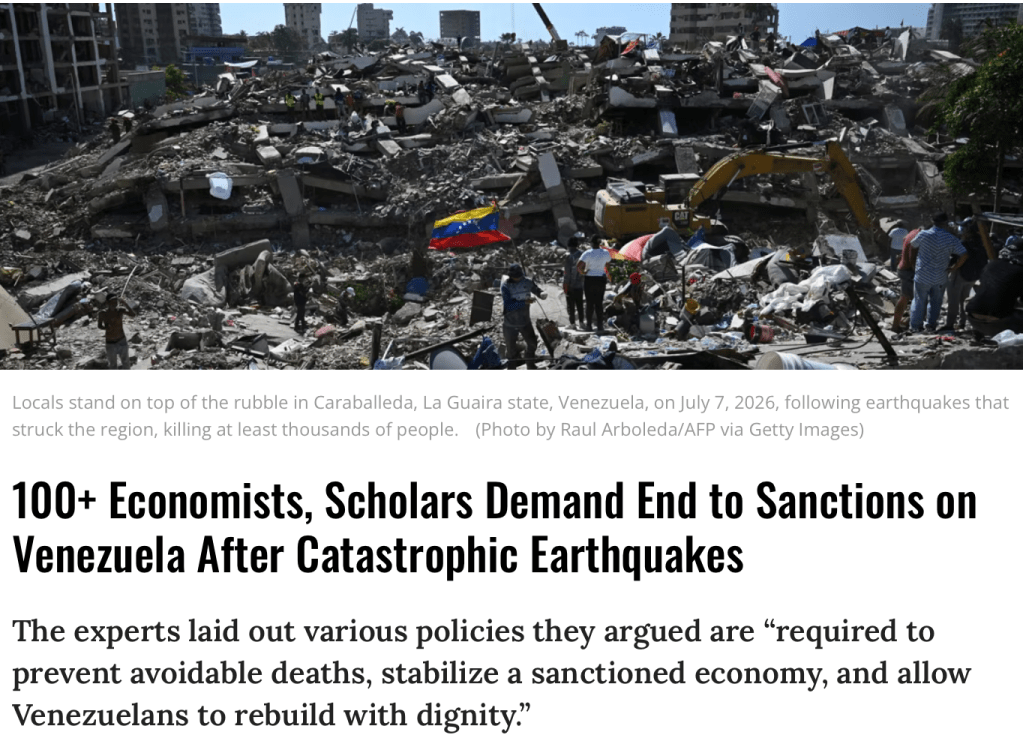
See Common Dreams, July 7, 2026

Venezuela’s drama plays out in the context of historic U.S. refusal to accept the development in this hemisphere of a political and economic model other than the capitalist one. At the end of 1998, Venezuelans chose Hugo Chávez to be their president because he represented a shift away from an oligarchy that used the country’s oil wealth for its own benefit and some allies in an aspiring middle class. In 2004, the United States backed a coup attempt against Chávez: it failed.

Since 2005, U.S. administrations have made annual determination that Venezuela has “failed demonstrably to adhere to its obligations under international narcotics agreements.” The United States began applying sanctions in 2006, saying that Venezuela was not cooperating fully with anti-terrorism efforts, and prohibited all U.S. commercial arms sales and retransfers to Venezuela.

Persistent U.S. action against Venezuela began after the death of Chávez in 2013. His successor, Nicolás Maduro, was perceived as less charismatic (and in the U.S. view, therefore less popular) than Chávez. Oil prices, moreover, had collapsed in 2009, rose again between 2012 and 2014, and collapsed again in 2015. Maduro seemed more vulnerable to external pressure.

Days before Christmas in December 2014, the U.S. Congress voted to give the United States the right to intervene in Venezuela “in defense of democracy and civil society.” Members of congress justified themselves by citing the need to defend “peaceful Venezuelan protesters,” alluding to protests that left 43 people dead. That “defense of civil society” law established the legal framework and paved the way for future sanctions against Venezuela.

These and other measures have been strengthened since 2015. They include a prohibition on use of currencies issued by the Venezuelan government, seizures of accounts and material goods owned by the Venezuelan state and the state-owned oil company and its subsidiaries, and measures against “third parties,” targeting companies that provide services to the Venezuelan state (including transportation of oil). 

Three months later, President Barack Obama cited that law as he issued a presidential decree declaring Venezuela an “unusual and extraordinary threat to the national security and foreign policy of the United States,” and launching what would become a program of more than 1,000 unilateral coercive measures: sanctions.

Assets of Venezuela’s national oil company, PDVSA, including its U.S. subsidiary, CITGO, were eventually blocked or seized, preventing the companies from renegotiating international commitments or attracting new investment. Venezuela went from receiving $39 billion in foreign earnings in 2014 to receiving $743 million in 2020. Measures taken during the first Trump administration led to Venezuela’s effective exclusion from international banking (including SWIFT).

Assets held abroad were confiscated by the United States and handed over to a fake government led by an opposition politician, Juan Guaidó, for whom nobody had voted and yet was backed by Canada and a handful of Latin American countries called the Lima Group.

A variety of situations show limits and possibilities of sanctions. Their use is said to be a “stick in the diplomatic toolkit,”[1] alongside others like dialogue, human rights protection, democracy promotion, mediation, or election observation. For decades after World War II, sanctions were applied by international organizations like the United Nations or the African Union against a member.

After the end of the Cold War in 1991, the UN Security Council used sanctions with mixed success in Yugoslavia and Africa—and also to tragic effect against Iraq in the 1990s. More recently, unilateral sanctions applied by individual states or groups of states against non-members have become more common—and denunciations of their illegality have become louder.

Critics see sanctions as a neocolonial tool available only to powerful states, and one that should be removed from the kit permanently. Indeed, the five permanent members of the UN Security Council are a combination of historic colonial powers and contemporary super-powers that are repeatedly accused of threatening or interfering in the internal affairs of other countries. Moreover, sharp differences among the permanent five have made it more difficult both to impose new multilateral sanctions and to ease existing ones.

Currently, the Venezuelan Anti-Blockade Observatory has documented approximately 930 active sanctions against hundreds of individuals, companies, aircraft, and vessels. A recent article in TeleSUR documents the impact of the sanctions on earthquake recovery efforts.

In a July 7 piece for Just Security, a pair of experts—George Lopez, professor emeritus of peace studies at the University of Notre Dame, and Venezuelan economist and Francisco Rodríguez of the Center for Economic Policy and Research (CEPR)—noted that post-earthquakes, “the United States pledged $300 million to relief agencies, mobilized civilian and military teams to Venezuela that are trained on disaster relief, and issued a limited sanctions waiver for earthquake relief activities.

“But these measures are far from enough,” they stressed, explaining that “the United Nations estimates the losses from the quakes stand at $37 billion,” or 32 per cent of Venezuela’s gross domestic product.
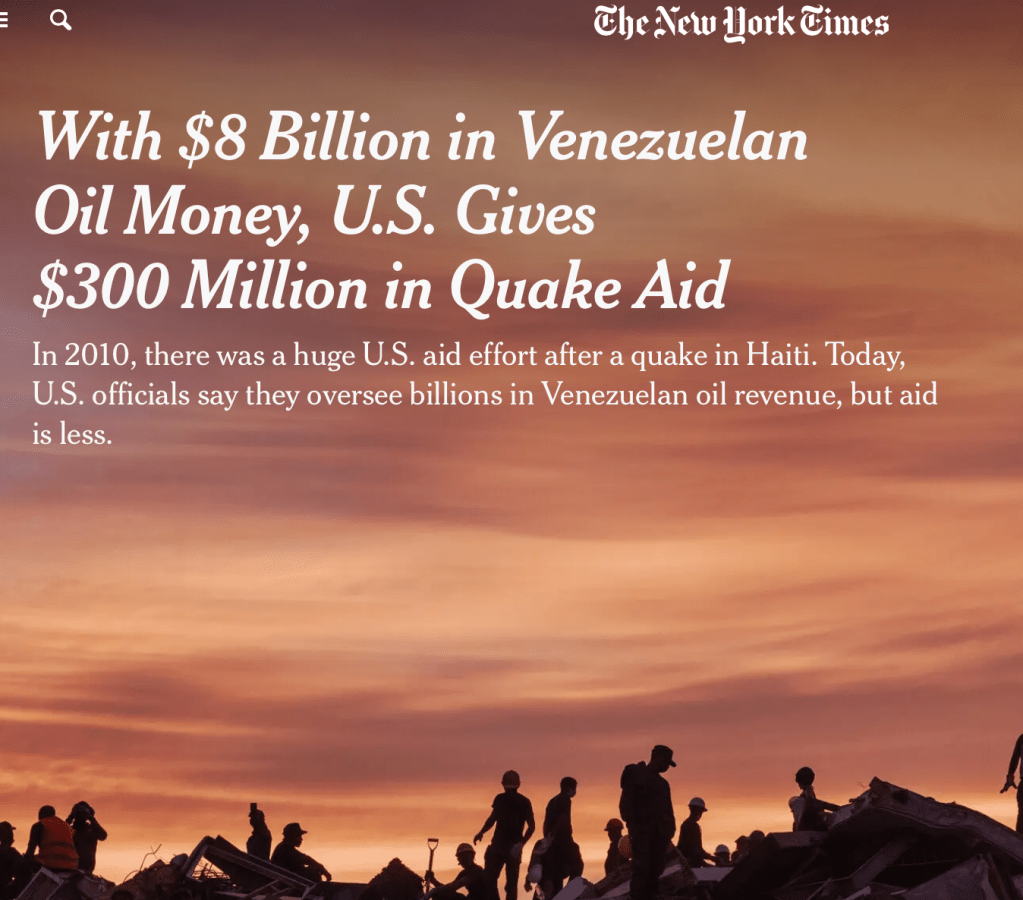
Even The New York Times can see the enormous gap between the U.S. relief offer and the billions of dollars in Venezuelan assets it controls.

Calls to end the sanctions on Venezuela are not new: the damage has been felt for more than a decade. In 2020, more than 40 churches and ecumenical organizations in Latin America and the Caribbean signed a letter calling for an end to U.S. sanctions. “These strategies will not serve any purpose other than to harm those who are already suffering, and who are the most vulnerable to COVID-19. The economic sanctions will also negatively affect the political and social environments needed for a peaceful solution to the crisis in Venezuela.”

That letter followed a statement the previous month from the U.S. National Council of Churches that condemned any possible military intervention in Venezuela and urged elimination of all economic sanctions. It also called on the global ecumenical movement to oppose intervention and sanctions, and to affirm Venezuela’s right to self-determination and sovereignty.

These issues were taken up again by the World Council of Churches and its Commission on International Affairs in a July 16 webinar.

“From the standpoint of international law, interventions such as those perpetrated by the Russian federation in Ukraine and by the U.S. in Venezuela raise serious concerns,” said Peter Prove, director of the commission. “For the WCC, such illegal violations are also theological and ethical violations.” The webinar can be viewed here.


[1] Michael Nesbitt, “Canada’s ‘Unilateral’ Sanctions Regime Under Review: Extraterritoriality, Human Rights, Due Process, and Enforcement in Canada’s Special Economic Measures Act,” (2017), 48-2 Ottawa Law Review 509, CanLIIDocs 119: https://canlii.ca/t/71w.
Venezuela in the wake of quakes, kidnapping and theft of its assets

by Jim Hodgson

I begin with a confession. In the wake of the catastrophic double-tap earthquakes that struck Venezuela on June 24, I have been slow in sharing my thoughts and what I have learned.

My delay is partly due to memories of other disasters, especially my involvement in efforts to rebuild in Haiti after its 2010 earthquake

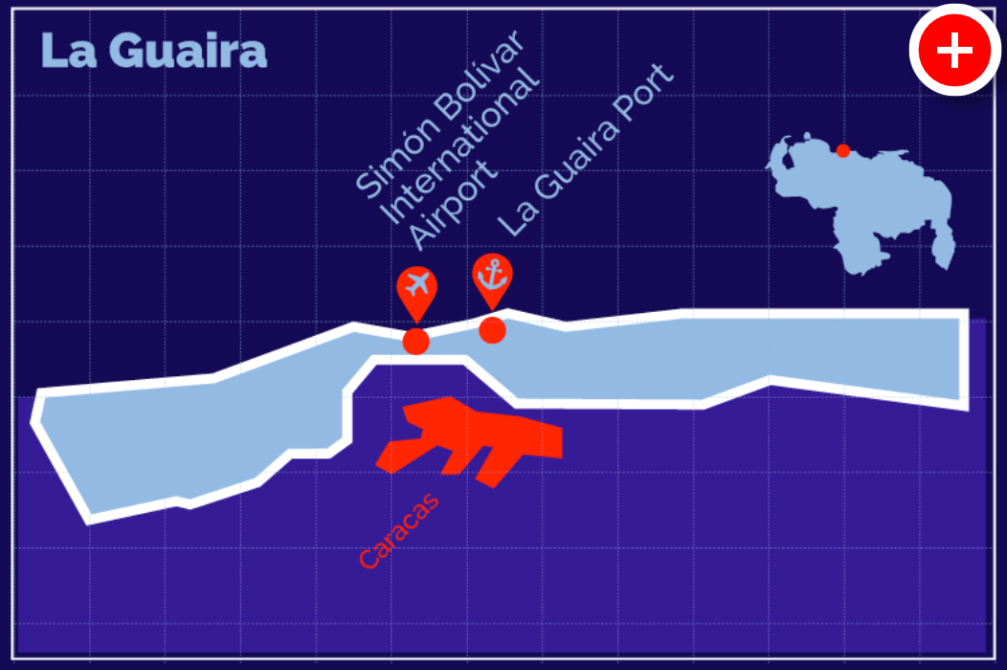
I am also remembering visits in better moments to the area most affected by current calamity: the north coast communities in La Guaira state. It’s the Caribbean Sea, so there are hotels, beaches, pools, yacht clubs and high-rise condominiums, as well as homes for the people who work in the airport, the seaports, and in fishing and service industries.

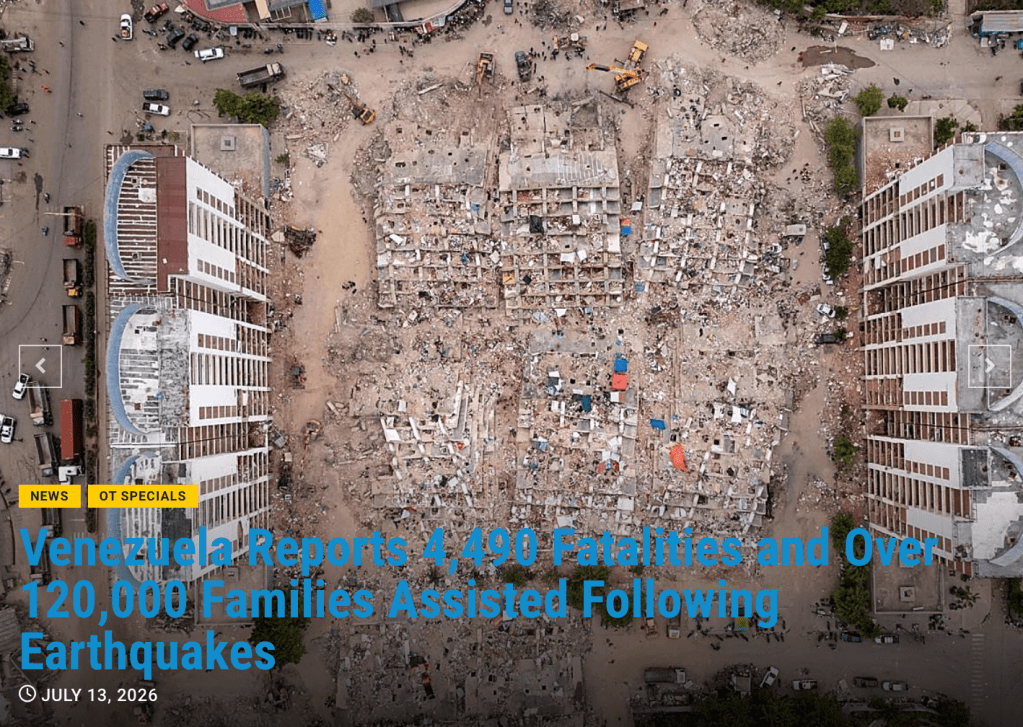
The disaster has slipped from Global North headlines. As of Wednesday, July 15, the official death toll had risen to 4,829 (up from the number shown in the above graphic). The number of reported injuries remained stable at 16,740. (Image: Orinoco Tribune, July 13)

If you travel to Venezuela by air, odds are you arrive in La Guaira at the Simón Bolívar International Airport (often called Maiquetia for a nearby community). Caracas, the capital, is a 25-km drive south and high up into the mountains.

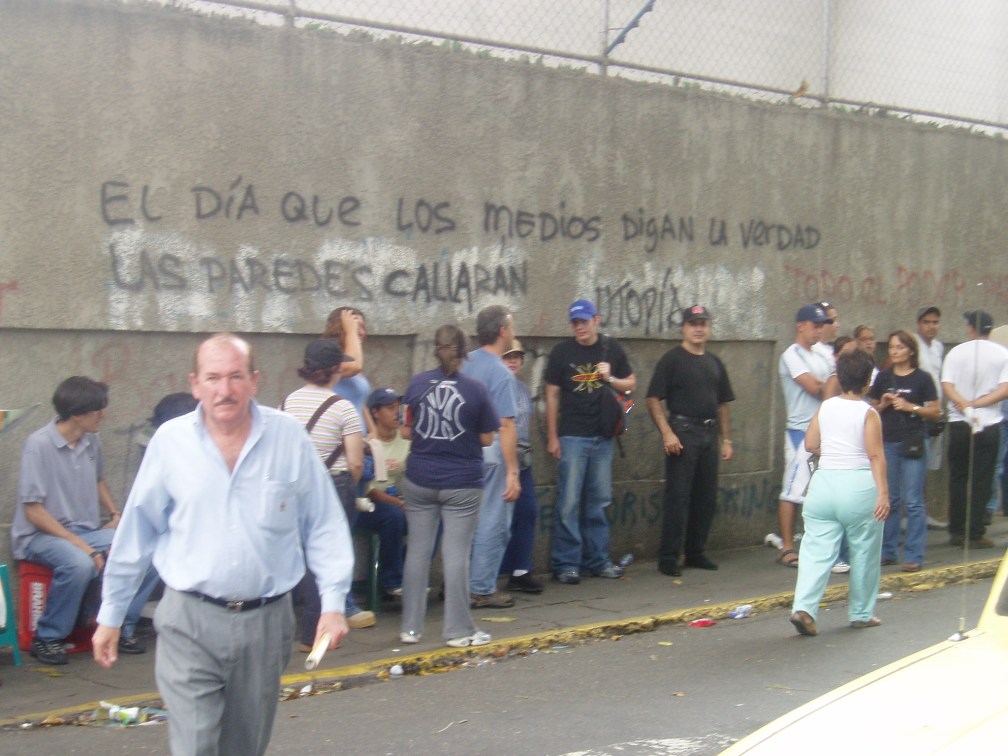
On two of my trips to Venezuela, I observed elections in Caracas and La Guaira. In 2004, an opposition attempt to remove then-President Hugo Chávez proceeded through a revocatory referendum. An election in 2018 (boycotted by part of the opposition) returned President Nicolás Maduro to office. (I wrote about the latter experience in a series of articles for rabble.ca.) 

The day before the 2018 vote, we spent an afternoon visiting communities in La Guaira, including a new social housing project, “Urbanización Hugo Chávez,” located in Catia La Mar just beyond the west end of the airport.

In the wake of the earthquakes, it feels like every building in Guaira has become a point of contention in Venezuela’s polarization. While the government says only five per cent of the damaged buildings are newly built housing, this natural disaster is politicized: something known to happen elsewhere, as in the current wildfire season in Canada. 

But whether you are looking at a pancaked high-rise or a home dislodged from its foundation in a social housing project, people needed to be rescued and survivors still need support.

Economic and social context

To understand what happened in the immediate aftermath of the earthquake, “it’s necessary to place the place the tragedy in its economic and social context,” wrote La Jornada’s Ángel González from Caracas

“Venezuela has spent years with a public health system that has not been able to reach optimal conditions after 11 years under U.S. sanctions. That led to a reduction of more than 90 per cent in the budget for public health and education (with 80 per cent of the overall budget allocated to social welfare programs).” Moreover, sanctions prevented the government from buying parts for heavy equipment or new machinery needed for an emergency such as this.

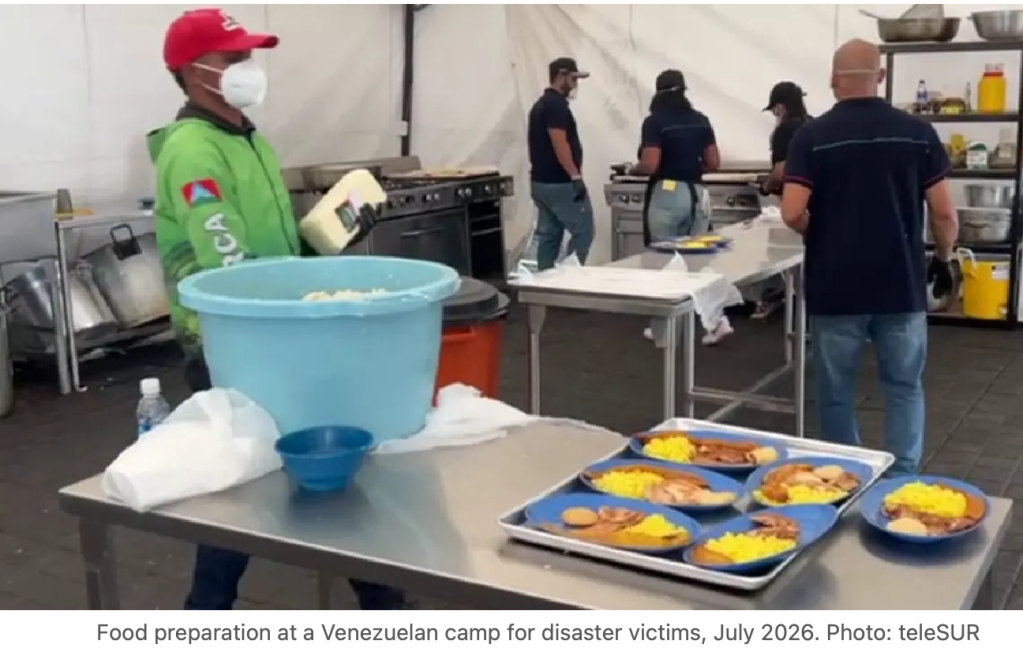
Even so, within a few days, added González, the situation in La Guaira had begun to be addressed with field hospitals set up by the Venezuelan army and international brigades. Two weeks later, temporary shelters with services for more than 22,000 people were in place. About 18,000 people are left without a home.

Acting President Delcy Rodríguez announced July 8 that her government was already working with experts to identify appropriate areas to “build new earthquake-resistant homes and cities.” She added that local and international companies had also been called up “for the rapid and aggressive construction of housing.” That will take time. And money.

And here again, politics enter in. While rescue missions and immediate relief efforts shift to longer-term support and re-building, U.S., Canadian and European sanctions must be eased and Venezuelan assets held abroad must be unblocked.

I have witnessed the humanitarian consequences of sanctions that are misused in cruel attempts to induce regime change in Venezuela, Cuba and other countries, and so have searched almost in vain for news articles that mention sanctions. One exception is an AP News item July 9 that covered the president’s housing announcement. Rodríguez said she had “decided to send a letter, among others, to the King of England” to request the release of 31 metric tons of Venezuelan gold reserves frozen at the Bank of England due to economic sanctions. The gold, valued at USD $1.2 billion in 2019, is now worth about $4.6 billion.

I’ll share more about the use and misuse of sanctions in Venezuela and elsewhere in another post in days ahead.

Meanwhile, you might like to read this op-ed by Mark Weisbrot published in the Los Angeles Times and on the site of the Center for Economic Policy and Research. Sanctions, he writes, “target and punish the civilian population in pursuit of a political goal. Once relatively rare, they have become a ‘tool of first resort, according to the US Treasury — probably because the resulting fatalities are mostly unseen.”

And, to my surprise, there is a relatively good piece in The New York Times about U.S. Secretary of State Marco Rubio acting as Venezuela’s de facto viceroy. I think this link will take you past the paywall to the article.

The Shield of the Americas: a summit of nations on their knees

by Jim Hodgson

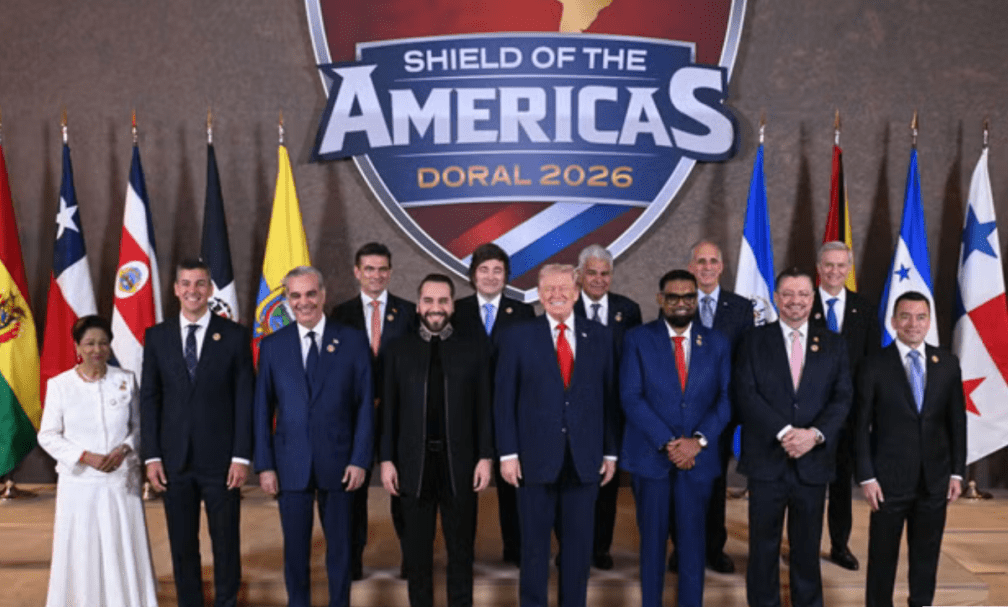
Leaders of a dozen Latin American and Caribbean nations spent a few hours last week with President Donald Trump at one of his golf courses near Miami. This was the launch of the “Shield of the Americas,” a bloc of right-wing governments that have pledged to join Trump’s war against so-called “narco-terrorism.”

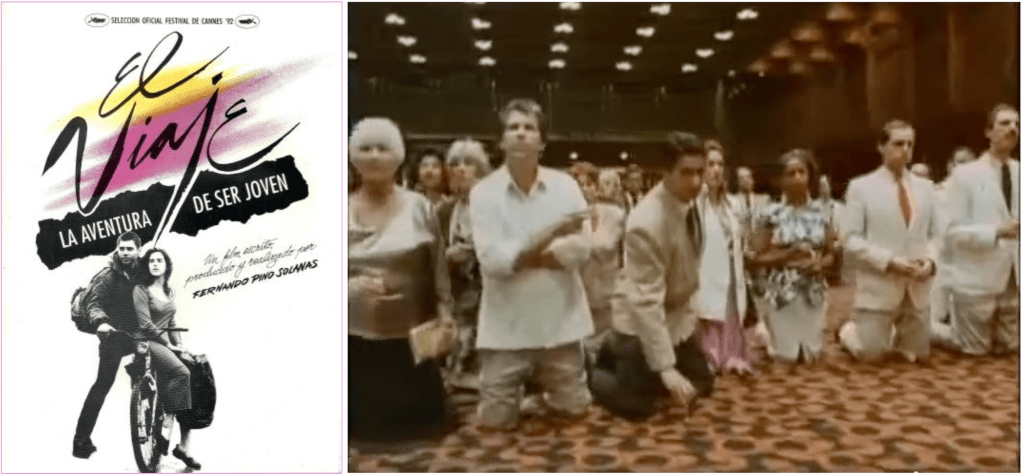
The spectacle recalled for me a 1992 film, El Viaje (The Journey), by Argentinian director Fernando “Pino” Solanas. It won prizes at film festivals in Cannes and Havana, and I saw it in Toronto.

El Viaje satirizes the way Latin American governments in the 1980s and 90s knelt before the rich countries for the sake of debt forgiveness, implementing austerity programs that harmed their own people. One scene (above right) shows a meeting of the Organización de Países Arrodillados (the Organization of Countries on their Knees). You can see a clip on Facebook.

In Miami, the leaders plainly knew that their face time with Trump was squeezed out from his preoccupation with his ill-conceived and unpopular war on Iran. They even applauded his insults: “I’m not learning your damn language,” said Trump. “I don’t have time.”

Beyond the farce, however, there is harsh reality to be faced. 

Trump called for an “anti-cartel coalition” that would use military might to “eradicate” drug cartels. A day earlier, his “war secretary,” Pete Hegseth, warned representatives from 16 countries in the region that if they didn’t adopt more aggressive strategies against drug cartels, the Trump regime would do it for them. Hegseth urged the countries to remain “Christian nations, under God, proud of our shared heritage with strong borders,” and not to be led astray by “radical narco-communism, anarcho-tyranny… and uncontrolled mass migration.”

Since his return to power 14 months ago:

Trump’s threat at the summit to “take care of” Cuba drew an immediate response from Havana. President Miguel Díaz-Canel wrote on X:

“The little reactionary and neocolonial summit in Florida, convened by the United States and attended by right-wing governments from the region, commit themselves to accept lethal use of U.S. military force to resolve internal problems of order and tranquility in their countries.”

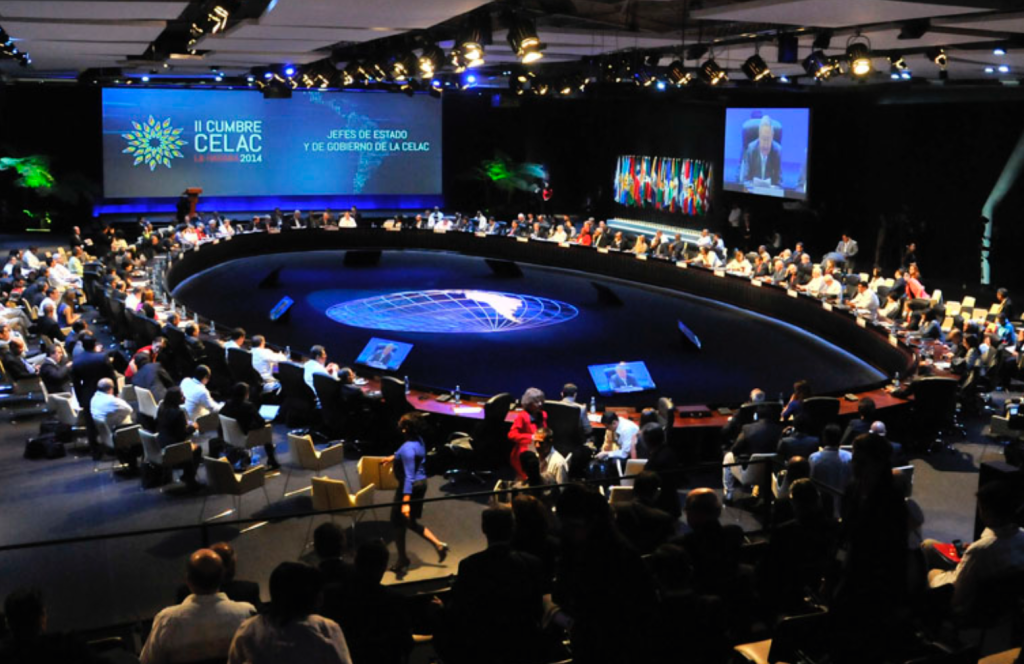
Díaz-Canel said the summit was an attack on the 2014 proclamation of Latin America and the Caribbean as a Zone of Peace, a declaration signed in Havana (photo above by René Pérez Massola.) The summit, he added, also attacked “aspirations for regional integration” and was “a sign of their willingness to subordinate themselves to the interests of the powerful nation to the north.”

Cuba’s foreign minister, Bruno Rodríguez, said the Miami summit was “a clear and dangerous setback in the long and difficult process of independence for the peoples of Latin America and the Caribbean.”

In his speech, Trump said that Mexico was the “epicentre” of drug-trafficking. The cartels, he said, “are getting worse and taking over the country. The cartels are running Mexico. We can’t have that. Too close to us, too close to you.”

Hours later, President Claudia Sheinbaum, pleaded for “cabeza fría” (cool heads) as Mexico determines its next moves – all (like Canada) under the pressure of new free trade talks with the United States.

A few days before the summit, Costa Rica’s president-elect, Laura Fernández, called Mexico “a reference point for where we do not want to go” regarding violence, organized crime and drug-trafficking. She was the minister of national planning and economic policy under the out-going president, Rodrigo Chaves. Chaves attended the Sheild summit, not Fernández, but her comment got attention in Mexico.

In an editorial, the daily newspaper La Jornada said that if Fernández wants to avoid the suffering experienced in Mexico over the past two decades, she should bear in mind that the crisis of insecurity was launched by a politician of the same ultra-right current that she represents. After his election in 2006, President Felipe Calderón began Mexico’s war on drugs by:

“opening the country to U.S. spy agencies, subordinating national interests to those of Washington, ignoring the social and economic roots of the crime phenomenon, and declaring a war against his own citizens. The violence of the state became a criterion for measuring success. The lessons of the Calderón years are important to for the other governments (and the governed) that still see or pretend to see the White House ‘war on drugs’ as an offensive against criminal structures and not the mechanism of imperial domination that it is.”