After successful negotiations with the United States and El Salvador, Venezuela welcomed home 252 men held for five months in the infamous CECOT prison.
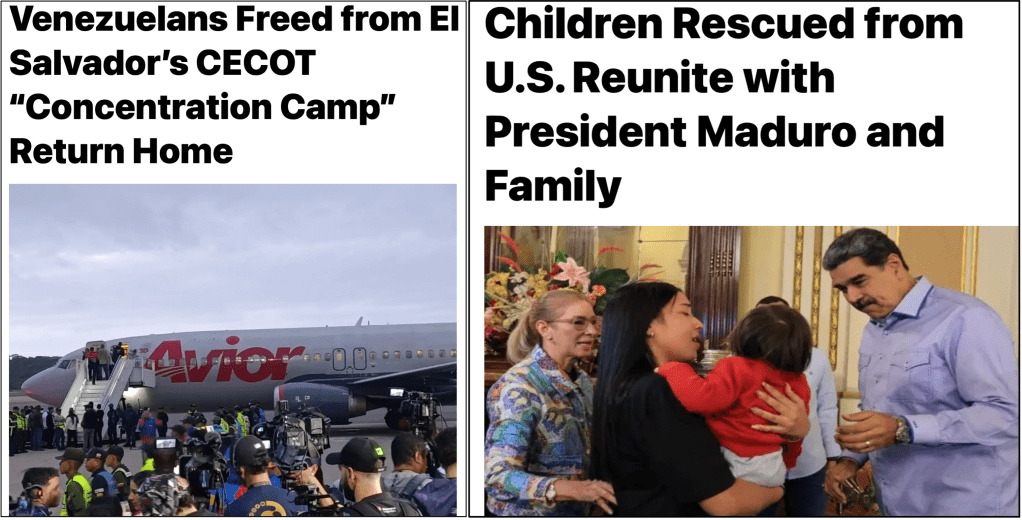
Headlines and photos from TeleSUR.
They arrived Friday, July 18, in two flights at Maiquetía International Airport north of Caracas, marking what TeleSUR called “a remarkable diplomatic victory for Venezuela’s ongoing campaign to defend its citizens abroad.” Earlier in the day, seven children separated by the U.S. government from their parents also arrived back in Venezuela after a flight from Texas.
In return, Venezuela freed ten U.S. citizens and permanent residents accused of political crimes. “Terrorists for innocents,” said President Nicolás Maduro. “We went to look for them from the concentration camps and we brought them back safe and sound.”
He explained that the prisoner exchange involved the release of confessed “foreign terrorists” and “agents of U.S. intelligence” accused of planning violent attacks in Venezuela, underscoring Venezuela’s commitment to protect its sovereignty and people.
U.S. Rep. Robert Garcia (a Democrat from California) confirmed that Andry Hernández Romero, the 31-year-old gay hair stylist, was among the men returned to Venezuela.
The Trump administration’s choice to send scores of young men to a high-security prison in El Salvador was based on a lie: that they were part of a Venezuelan gang called Tren de Aragua. But investigations by journalists and civil society groups like thedisappeared.org showed that most (if not all) of the men had no ties to organised crime, no criminal records and had been admitted legally to have their asylum claims heard.
Aside from outright cruelty and the lack of even the pretence of due process, these extraordinary renditions (to borrow a phrase from the George W. Bush years) have damaged Trump’s credibility on immigration issues. In her Substack column July 14, U.S. historian Heather Cox Richardson pointed to recent polls that show his actions are not going over well with the U.S. public.
Seventy-nine per cent of adults say immigration is good for the country. Eighty-five per cent of adults want laws to allow “immigrants, who were brought to the U.S. illegally as children, the chance to become U.S. citizens if they meet certain requirements over a period of time.” Seventy-eight per cent of adults want the law to allow “immigrants living in the U.S. illegally the chance to become U.S. citizens if they meet certain requirements over a period of time.” Only 38 per cent want the government to deport “all immigrants who are living in the United States illegally back to their home country.”
El Salvador’s government has arrested Ruth Eleonora López, a prominent human rights lawyer, as it steps up attacks on rights defenders, environmentalists and journalists.
López leads anti-corruption work at Cristosal, one of the country’s leading human rights groups. It was created in 2000 with backing from the global Anglican communion in 2000. “To this day, our work is inspired by the Anglican communion’s commitment to justice and the dignity of every human being and demonstrated through the role of the church during El Salvador’s civil war,” its website states.
Cristosal helps document evidence of state crimes under El Salvador’s ongoing three-year state of emergency.The measure is used to arrest people believed to be associated with gang violence, but other people have been swept up as well. It restricts the right to gather, to be informed of rights and to have access to a lawyer. It extends to 15 days the time that someone can be held without charges. Associated Press says that some 85,000 people have been arrested under the state of emergency.
Al Jazeera reported that Cristosal has also tried to assist more than 250 Venezuelans who were sent by the United States to a jail in El Salvador.
On Sunday night (May 18), two weeks before Nayib Bukele reaches his sixth anniversary in power in El Salvador, the Attorney General’s Office announced the arrest of López via X (formerly Twitter). As of late afternoon Monday, her whereabouts were still unknown and her family joined Cristosal in demanding the government provide more information.
The English-language service of El Faro newspaper—itself under attack by the Bukele regime— said the arrest derives from accusations of embezzlement, but the case file is declared secret. Prosecutors claimed to have gathered information during raids carried out against Eugenio Chicas, a former president of the Supreme Electoral Tribunal arrested in February, and who remains in custody.
“The only reason for this detention is that I am a human rights defender and work for an NGO uncomfortable for the government,” López said upon her arrest. She told the officers: “Have some decency; one day this will all end. You must not play into this.”
El Faro said May 5 that a reliable source had told its reporters that the Bukele-controlled Attorney General’s Office is preparing at least seven arrest warrants for members of El Faro. The source reached out following the publication of interviews with former leaders of the Revolucionario faction of the 18th Street Gang (Barrio 18) about Bukele’s years-long relationship to gangs.
If carried out, such arrests would be the first time in decades that prosecutors seek to press charges against individual journalists for their journalistic efforts.
One of the gang leaders said that he had been secretly released from custody at the height of the country’s ongoing state of exception as part of his gang’s continued negotiations with Bukele’s government. The interview focus attention on the extent to which Bukele’s rise to power was tied to secret negotiations with the country’s gangs.
The NACLA Updatesummarizes the interviews this way:
El Faro’s reporting shows that the links between the Barrio 18 gang and Bukele began all the way back in 2014, when Bukele was a council member of small-town Nuevo Cuscatlán looking to run for mayor of San Salvador. During his campaign for mayor, a close Bukele ally warned gang members of impending police raids and delivered community development projects to the gang’s turf; in exchange, gang leaders cracked down on opposition activists and forced community members to vote for Bukele.
Ties between Bukele and the country’s gangs, including MS-13, have long been documented by El Faro and other outlets and have caused tensions with the United States. Nevertheless, news that a gang leader convicted of murder was released at the height of the crackdown brings unwanted scrutiny on the Salvadoran government at a time when Bukele has enthusiastically sought favor with the Trump administration.
Even in the face of the Trump regime’s horrific arrests, extraordinary renditions, and forced disappearances of immigrants and asylum-seekers, there are shreds of hope.
Activists and journalists are gradually identifying and sharing the stories of victims, including the 238 Venezuelans and 23 Salvadorans shipped to a prison in El Salvador on March 15. And judges and some politicians are more vocal in support of “due process”—the U.S. constitutional guarantee of at least being heard before being deprived of liberty—for all migrants.
One group has built a website: thedisappeared.org. They make prominent use of the blue triangle, the symbol used by Nazis in their concentration camps to designate migrants. About the 238 Venezuelans, they say: “There is no evidence to support the allegations that they are hardened criminals.” The group also posts on Facebook.
Above on the left is Andry Hernández Romero, age 31. I learned of his case the way many others did. A photojournalist, Philip Holsinger, met the airplanes that brought the Venezuelans to El Salvador and then accompanied them to the prison. A man who caught Holsinger’s attention shouted “I’m innocent” and “I’m gay,” and was crying as his head was shaved. From Holsinger’s photo, friends and family members identified him as Andry. Details of his situation were covered first in LGBTQIA+ media (The Advocate and the Washington Blade) and later by NBC, CBS and elsewhere. His lawyer has mobilized political support in California, including that of Gov. Gavin Newsom and U.S. Rep. Robert Garcia.
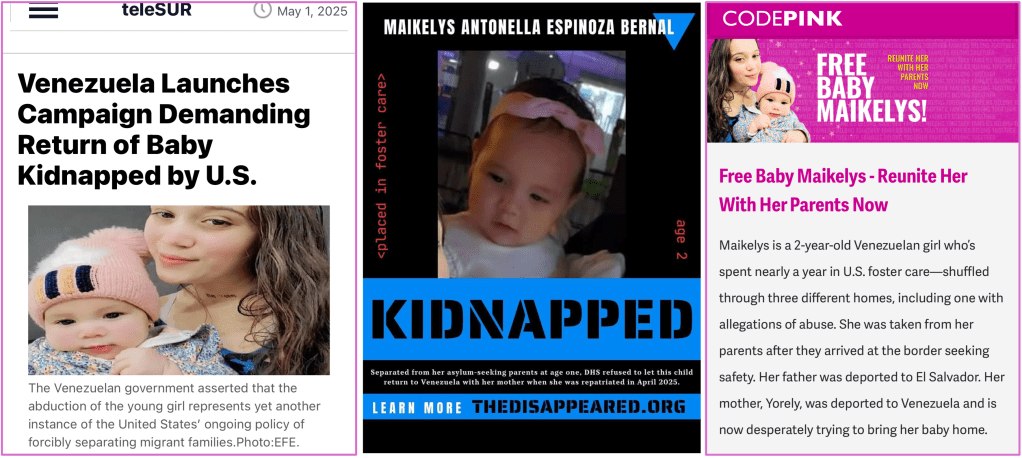
The disappeared.org site draws attention to many other cases, including that of two-year-old Maikelys Antonella Espinoza Bernal (below) whose father, Maiker Espinoza Escalona, was sent to the prison in El Salvador. She and her mother Yorely Bernal Inciarte, were supposed to be sent together on a deportation flight back to Venezuela—part of her homeland’s “Vuelta a la Patria” program for citizens willing to go home. But the United States refused to return the child to her mother before she left.
When Yorely arrived back home alone, Venezuelan media and the government took up the family’s cause (image on the left, above). So too did CodePink (right), a women’s peace network in the United States with which I have collaborated to draw attention to the negative impact on Venezuelans of U.S. economic sanctions.
The Disappeared shared a piece from a group called United Strength for Action about the U.S. role in creating the disaster that Venezuelans face. I can’t concur with all the group said–many people in the United States just can’t see the historical context of U.S. imperialism–but I am relieved that they at least acknowledged the role of U.S. sanctions in creating a humanitarian crisis that drives the exodus of refugees. “This wasn’t foreign policy; it was collective punishment that pushed millions of Venezuelans past their breaking point.”
Since 1998, successive U.S. administrations have done all they could to be rid of Nicolás Maduro and his predecessor, Hugo Chávez: a coup attempt in 2002, a “revocatory” referendum in 2004, the effort to impose a “president” (Juan Guaidó) whom nobody had voted for, and through waves of sanctions. Given the failure of those efforts to induce regime change and seeing the flow of migrants out of Venezuela, President Joe Biden for a time tried a different approach, one of dialogue and engagement. The early weeks of Trump’s administration gave some hope this could continue, but the hard-liners seem to hold sway once again.
At a May Day march, President Maduro vowed to “rescue” Maikelys along with the Venezuelans now held by El Salvador. He also spoke directly to the hundreds of thousands of Venezuelans who have tried to reach the United States in recent years:
“Stop going there. The true dream is that of our land to build with our hands. Stop being victims of xenophobia, of abuse… The only land that will welcome you and serve you like the prodigal son is called the Bolivarian Republic of Venezuela. We must take care of it, fertilize it, and build it. This homeland belongs to all!”
Maduro emphasized Venezuela’s right to build its own social model. “We have the right to true democracy, to our cultural identity. We are not gringos. We are proudly Bolivarian, Latin American, Caribbean. We are Venezuelans!”
Venezuela says it is willing to receive people deported from other countries. Between February and April 25 this year, 3,241 Venezuelans had returned on 16 government-funded flights. Yorely (the mother of Maikelys) came home on just such a flight.
Two more issues. Trump officials say that the people sent to jail in El Salvador were linked to the Tren de Aragua criminal gang, and that they used tattoos to identify the gang members.
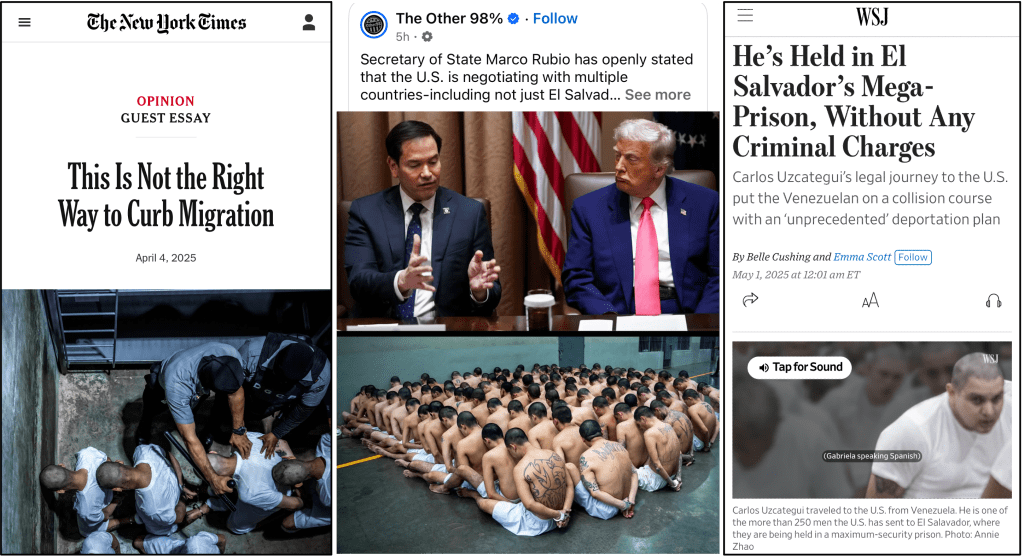
It’s good to see “mainstream” media like The New York Times (left) and Wall Street Journal (right) join the rest of us rabble-rousers in calling attention to the Trump regime’s actions.
Trump’s executive order decreeing the deportations said the gang is “conducting irregular warfare and undertaking hostile actions against the United States.”
But that is not true. In an article for The New York Times, a team of experts on violence in Venezuela said Tren de Aragua is not invading the United States. Nor is it a “terrorist organization,” and to call such “criminal groups terrorist is always a stretch since they usually do not aim at changing government policy.” The article goes on to show that Tren de Aragua is not centrally organized, though members were involved in migrant smuggling and the sexual exploitation of Venezuelan migrants in Colombia, Chile and Peru.
The NYT piece adds that even U.S. intelligence officials do not believe the Maduro government is colluding with the gang, the key assertion in Trump’s justification for invoking the 1798 Alien Enemies Act to render Venezuelan migrants to El Salvador.
Immigration officials used tattoos to “determine” if someone was linked to Tren de Aragua, but the authors of the NYT piece say Venezuelan gangs (unlike Salvador groups like the MS-13) do not use tattoos that way. “Many young Venezuelans, like young people everywhere, borrow from the global culture of iconic symbols and get tattoos. That doesn’t mean they’re in a gang,” they wrote.
Moreover, the Tren de Aragua gang network in Venezuela is largely dismantled.
“The Tren de Aragua is cosmic dust in Venezuela; it no longer exists, we defeated it,” President Maduro said March 19. He was quoted by the English-language Orinoco Tribune in a longer article about the gang’s history in Venezuela.
Interior Minister Diosdado Cabello questioned whether all deportees were Tren de Aragua members, and demanded the US extradite captured suspects. “The US is acting in a confusing manner. They promised to send us Tren de Aragua members, but they have not. Someone there is lying.”
* Update, May 14 * Two-year-old Maikelys has been re-united with her mother in Venezuela. Her father remains in the Trump-Bukele prison in El Salvador. See the statement from CodePink.



 Unwrapping Development