Bruce McLeod: an inspiring ecumenical educator and communicator

by Jim Hodgson

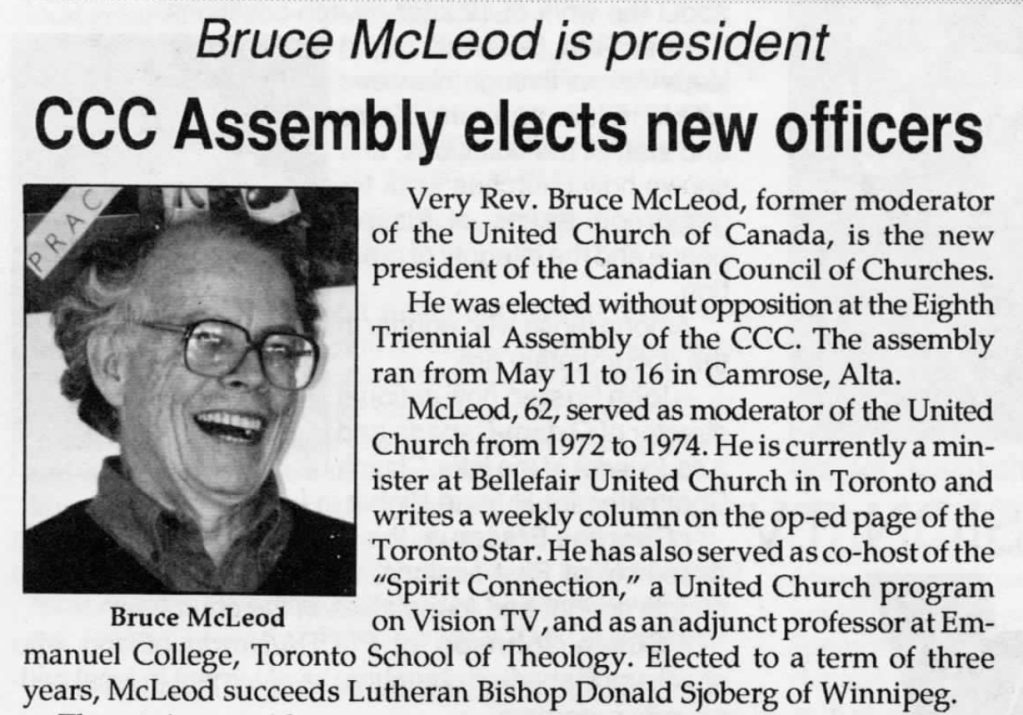
Here today, I want to share some of the words and teaching of the Very Rev. Dr. Bruce McLeod, former moderator of The United Church of Canada (1972-74) and former president of the Canadian Council of Churches (1991-94). He passed away this week at age 96.

It was in that latter role that I knew him best. (The United Church’s memorial is here, and there is more information too on the site of the United Church’s archives.) He was interviewed by Broadview magazine less than a year ago.

I can’t be sure, but I think I first met him in the mid-80s when he co-hosted the United Church’s weekly television program Spirit Connection. (Bruce was also an early ally to 2SLGBTQIA+ people who sought full inclusion and ministry in the United Church and beyond.)

In 1989, I had joined the CCC staff to serve as its secretary for ecumenical education and communication. Bruce was an inspiration for me in my new role (and long since). Some reflections from those years follow.
Entre-nous (the CCC newsletter), July 1991, p.3

Soon after his election as CCC president, he spoke to the CCC’s executive (June 21, 1991):

It’s especially important, in this kairos time of economic retrenchment in which God speaks to us for the Council to address the churches from which we come.

  • To remind them again of the Lund Principle which commits churches to doing separately in God’s world only those things which cannot be done together;
  • To summon our member churches from those ingrown, competing and duplicated enterprises which often preoccupy us;
  • To challenge separated structures (and our own denominational hearts) to think and act together – nationally, regionally and locally – in the name of Jesus who prays that we might be one.

Not for our sakes; but that the world might know that it’s bathed in the love of God, whose Spirit uses us, with others, to make the breaking world a home.

Refugee rights: “We saw their faces”

Back in the late 1980s, the government of Brian Mulroney brought in new rules to restrict the numbers of people who could claim refugee protection in Canada. Bruce was part of the CCC’s board when it launched a court challenge to a new refugee determination system in January 1989.

The churches’ concern then was much as it is today: rules were too tight and would endanger the lives of some refugee claimants by sending them back to persecution, imprisonment or possible death. The specific alarm was over the process for determining whether individuals were eligible to make a claim, and if rejected, whether they would be able to make a meaningful appeal. (We didn’t win the suit then and the fight for protection continues in the face of ever-harsher anti-refugee rhetoric and stricter measures in many parts of the world.)

In a sermon at the council’s assembly in Charlottetown in 1994, he said the churches challenged the new rules “because they knew refugees not as numbers or statistics; they saw their faces, knew their stories and wiped their tears. They heard God calling them to come; they did together what they couldn’t have done separately. It was as though something more than the initiative of the churches was at work here — as though a presence or purpose was waiting in the issues themselves, plucking at the churches to respond.”

Bruce McLeod with his successor as president of the CCC, Dr. Alexandra Johnston (1994).

To cherish and preserve this small world

I heard Bruce tell the story of his encounter in 1992 with astronomer Carl Sagan more than once. They met at a “religion and science” gathering in Washington, and he included the story in a report to the CCC executive that I reproduced in Entre-nous, the CCC newsletter, in July 1992:

“Sagan said that when the Voyager spacecraft spun past Neptune and Pluto edging beyond the solar system to wander forever across the Milky Way, its cameras focused backward for one last glimpse of home.

“’Planet earth from there is not the same as looking at it from the moon where you see the outlines of the continents. Planet earth from there is just a pale blue point of light. That’s where we live,’ he said, his brooding face alight. ‘Where every human being who ever lived, lived – every couple in love – every political leader,’ every church with its earnest positions. Voyager’s photographs he said, ‘conveyed a sense of vulnerability. At least to me it cries out the need to cherish and preserve this small world.’”

Bruce continued: “Here where it is night, we remember the words of Rubem Alves: ‘Hope is the melody of hearing God’s future, faith is dancing it now.’ Together in Jesus name, taking each other’s hands around this table and beyond our different churches, we dance as well we can.”

“God’s single love in the world”

In 1994, at the end of his term as CCC president, Bruce challenged the churches over funding cuts to ecumenical bodies. “Over-lapping mandates” was among the reasons cited for cuts to the council and the inter-church justice coalitions.

Bruce refused to accept those excuses. In a sermon delivered in Charlottetown in 1994 at the CCC’s triennial assembly, he said: “For all the shared ministries at the unpublicized edge, there’s no dearth of ecclesiastical leaders ready to explain why there have to be ten different churches, all struggling to repair their roofs, in one Ontario town with 2,200 people. For all the examples of coalition cooperation, there remain competing church publishing houses (each with separate, crushingly expensive, hymn book projects) and duplicated church head offices, each with floors devoted to world outreach and justice issues, all claiming their share of sacrificial weekly gifts dedicated, to the accompaniment of doxologies across the land, for the work of God’s single love in the world.”
From bishop of Chiclayo to Pope Leo XIV

by Jim Hodgson

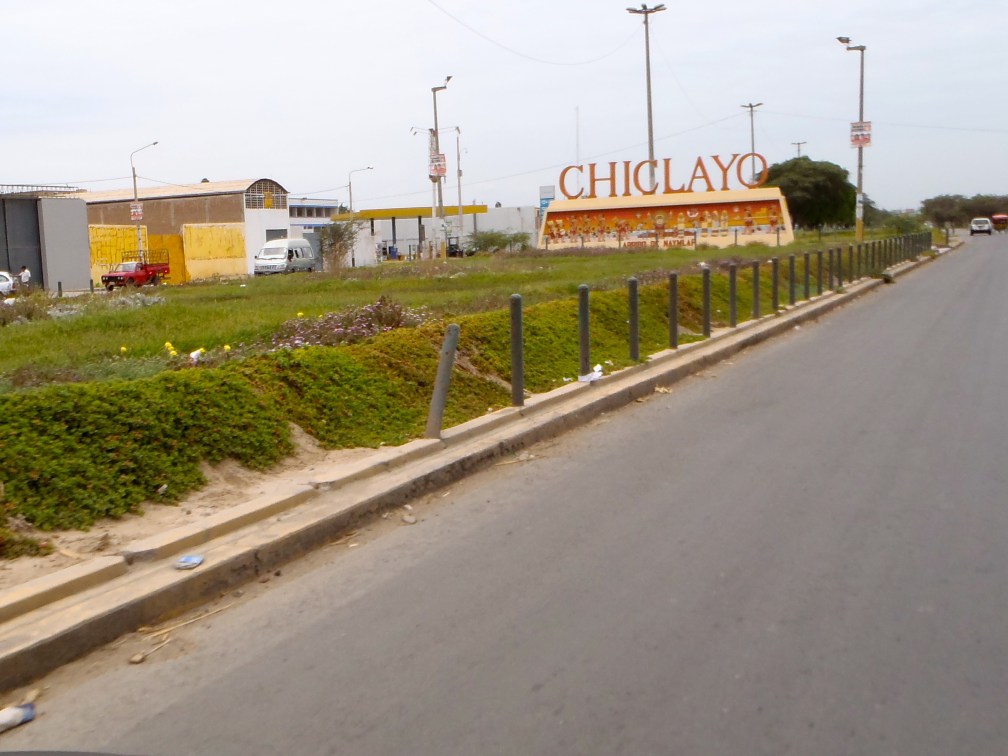
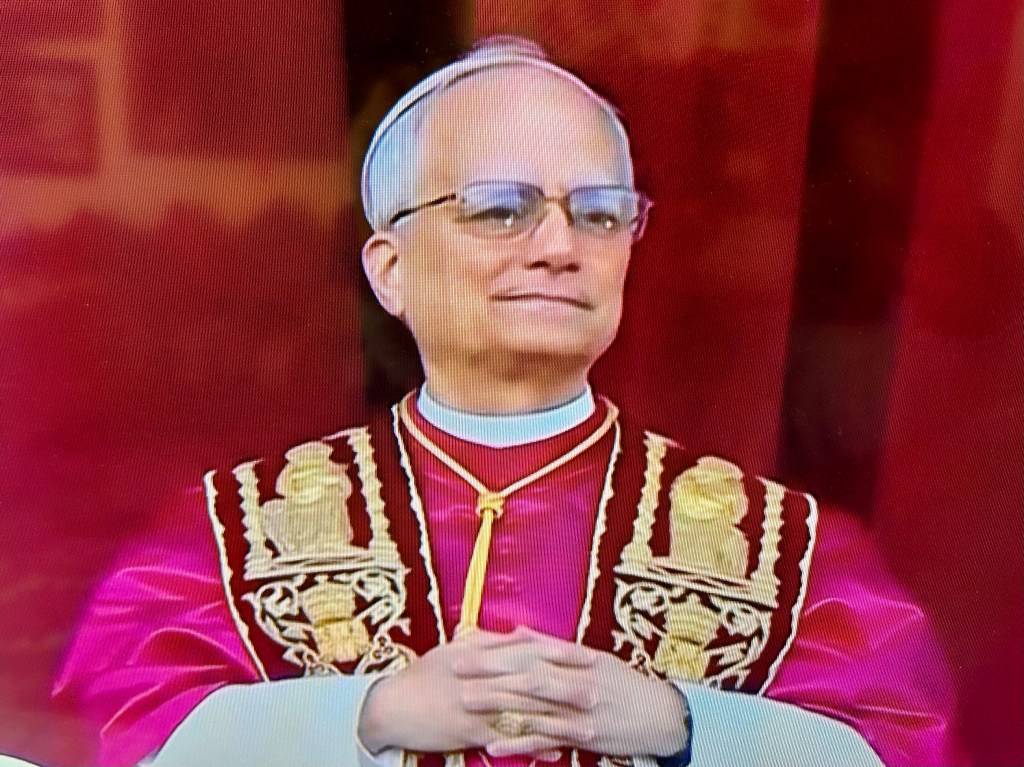
Like many who have worked in Latin America, I rejoiced when I saw that cardinal-electors chose Robert Francis Prevost, the former bishop of Chiclayo (Peru) to serve as Pope, the bishop of Rome. 

And as one who believes Catholic social teaching is not studied sufficiently, I was over the moon when I understood that Prevost had chosen to be called Leo XIV. The last Leo was Pope Leo XIII, who served from 1878 to 1903. He is respected as a pioneer of modern Catholic social teaching. In his famous 1891 encyclical Rerum novarum, Pope Leo outlined the rights of workers to a fair wage, safe working conditions, and the formation of trade unions.

Yes, there are controversies over the selection of Prevost. 

Prevost talked negatively in 2012 about sexual and gender diversity. But in that same year, Archbishop Jorge Bergoglio (a year later Pope Francis) was still in Buenos Aires and fighting legal reforms promoted by the Kirchner-Fernández governments in favour of same-sex marriage. Jesuit Father James Martin, long an ally of LGBTQIA+ people, spoke positively about Prevost after being part of a table group with him during the Vatican’s Synod on Synodality.

There are allegations that Prevost did not pay sufficient attention to victims of clerical sexual harassment while bishop in Chiclayo. Tragically, it is hard to find any bishop, living or dead, who has adequately served survivors of clerical abuse. The real issue is making rules that are effective in making dioceses submit to civil authorities in cases of crime, and to take victims’ allegations seriously in all cases of harassment or abuse. Perhaps his proximity to scandal will help him and others take further steps toward justice for all victims of clerical abuse. 

Much has changed; more needs to change; and Leo XIV may be a step in the right direction. Let’s work toward full inclusion of—and leadership by—women and 2SLGBTQIA+ people.

The church in Chiclayo

Today, I found myself going back through decades of notes. Here is something I wrote during a visit to Chiclayo in 2017:

“Chiclayo has a new bishop who is more in the line of Pope Francis—a positive sign after many years of traditionalist Opus Dei bishops. The new bishop, my friends said, still needs some education around gender justice, but he’s pretty good on economic justice and on developing lay leadership. Social movements here have bloomed outside of the church, including the LGBTIQ and People Living with HIV and AIDS (PLWHA) movements.”

That conversation unfolded with members of Centro Esperanza, a United Church partner from 2006 to 2018. Their work had roots in progressive Christian base communities. It began with a focus on women, particularly those who were involved in community kitchens organized and run by women in impoverished neighbourhoods. Over time, activities expanded to include programs to prevent domestic violence, stimulate learning in early childhood, and gender justice education among high school students.

Several of my Canadian friends have worked in Chiclayo over the decades, beginning with members of the Scarboro Foreign Missionary Society. Their leadership is part of what shaped Chiclayo’s influence on its new bishop.

Catholic Social Teaching

And I went back through my notes on Catholic social teaching. One of the most complete—and still quite short—summaries is a presentation by Bill Ryan, a Canadian Jesuit and social activist. He was a general secretary of the Canadian Conference of Catholic Bishops (CCCB) during part of the time I worked with the Canadian Council of Churches.

In 2000, he spoke to the Coady International Institute at St. Francis Xavier University in Antigonish, Nova Scotia, on the development of Catholic social teaching. Some key points:

What is Catholic Social Teaching? It is a formula or a set of principles for reflection to evaluate the framework of society and to provide criteria for prudential judgment and direction for current policy and action.

  • The inherent human dignity of every person that makes them “sacred”—created in God’s image. This is the ultimate grounding for human rights.
  • The principle of human solidarity. Every person is radically social by nature and by nurture, destined to build up and share human community. The basic element of all creation is interconnectivity, interdependence, and relationships between and among all creatures. Without community we are not human.
  • The principle of subsidiarity. This principle balances the power between the individual and community. It calls for a pluralistic structuring of power in society. That is, human society is more than government; it is the thousands of voluntary and corporate associations that make up civil society. Decisions in society should be taken at the lowest competent level of society.
  • The neediest among us have a special claim on our care and compassion.
  • The common good: the social conditions that allow people to reach their full human potential and to realize their human dignity.
  • And remember that fidelity in relationships extends also to our caring for our “mother” earth.

All of this, it seems to me, is “teaching”—asserting principles, not doctrine.

Ryan said it was untidy, and it is. Church leaders, he said, attempt “to balance the maintenance needs of the church with those of its prophetic mission. What priority should they place on safeguarding unity in the church while preaching the prophetic preferential option for the poor?”

The process, he added, may become even more untidy as more conferences of bishops learn with their people how better to “read the signs of the times” and to “engage Christian communities in believing, preaching and acting on a preferential option for the poor.”

Pope Francis opened a process—“synodality”—for bishops to talk with their people. From his opening remarks, Pope Leo XIV seems determined to keep that door open.

The next morning, the new pope said Christians must offer witness in a world that prefers power, pleasure, and success to faith. Where Christians are “mocked, opposed, despised or at best tolerated and pitied” is where the Catholic Church’s “missionary outreach is most desperately needed,” he said in his first homily as leader of the world’s 1.4 billion Catholics.

"Another World is Possible," World Social Forum, Porto Alegre, Brasil (2005)

Pope Francis and Our Common Home

By Jim Hodgson

On this Earth Day, I want to share with you a reflection by Bishop Francisco Duque of the Anglican Church in Colombia. I worked with him in a larger team in one period (already a dozen years or more ago) of ecumenical efforts for peace with justice in Colombia. 

Indeed, it was during that work that I stood with friends in a coffee shop in Bogotá and watched news of the election of the archbishop of Buenos Aires, Jorge Mario Bergoglio, as pope on March 13, 2013.  I did not rejoice. All that I knew of Bergoglio was that he had opposed several of the initiatives of the governments of Néstor Kirchner and Cristina Fernández as it expanded sex education in public schools and legalized same-sex marriage in 2010.

Images of St. Francis. Left: preaching to the birds. Right: “Make me an instrument of your peace / Bless your people, Lord” is one I saw in Real de Catorce, San Luis de Potosí, in October 2024.

But Pope Francis surprised me: first by choosing to be known by the name Francis, signalling he would follow St. Francis of Assisi, long admired for his inspiration to contemporary ecological commitment and for initiating dialogue with Muslim leaders during Christian Europe’s “crusades” in the Middle East. And then he surprised me again with steps that showed respect for LGBTQIA+ people: first, “Who am I to judge?”, and later with his openness to diverse voices heard through synods, his advocacy for peace, the rights of migrants and debt forgiveness. I can only wish he had done more with regard to the rights of women and pray that his successor can go further.

In Canada, Pope Francis will undoubtedly be remembered most for his “penitential pilgrimage” and encounters with Indigenous peoples in 2022. Despite resistance from most of Canada’s Catholic bishops, he came, offered a (not fully accepted) apology, and gave truth and reconciliation efforts a dramatic push forward in public awareness.

But I think his lasting global legacy will be his way of holding faithful action for social justice and action for ecological justice together coherently. Here’s what Bishop Duque had to say.

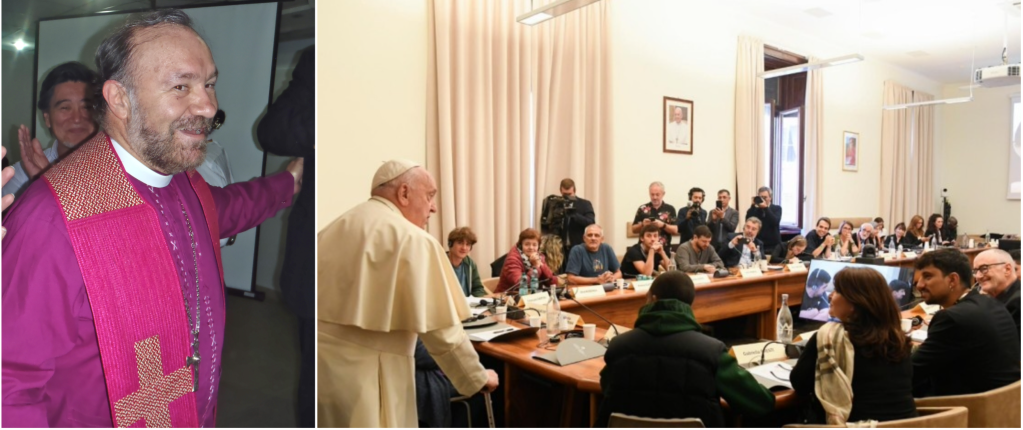
Left: Bishop Duque at a Methodist assembly in Medellín in 2012. Right: Pope Francis meets representatives of social movements in 2024.

Francis, pope of Amazonia and our common home

Francisco Duque

The world mourns the loss of a spiritual leader who transcended borders, creeds and generations. Pope Francis not only was the first Latin American pontiff. He was, above all, the pope of the Amazon and caretaker of our Common Home. His legacy, immense and profoundly humanist, will remain inscribed in the planet’s memory as a prophetic voice that urges us to hear the clamour of the earth and the cry of the poor as a single call.

From the time of the publication of his encyclical Laudato Si’ in 2015, Pope Francis illuminated the ways of global ecological awareness. With valiant and committed language, he denounced the structural causes of environmental collapse, unlimited resource extraction, climate injustice and indifference toward the suffering of communities that are most vulnerable, especially those who live in the lungs of the world: tropical forests, the Amazon in particular. 

His spiritual leadership was also political and ethical. He convened scientists, Indigenous leaders, activists and religious authorities from around the world to make a new pact between humanity and nature. He promoted an integral ecology that did not separate the environment from the social. He recognized in Indigenous peoples that they are millennial guardians of wisdom. His encouragement of the Synod of the Amazon in 2019 marked a before and after: Amazonia was heard in the heart of the Vatican, not as a forgotten periphery but as a vital centre for the future of the planet.

From the Inter-Religious Initiative for the Tropical Forests (IRI-Colombia), we hold up a prayer of gratitude and hope. Gratitude for his strong words, for his planetary vision, for having returned to the faith its active dimension of protection of creation. Hope because the fertile seeds he planted will continue to bear fruit in the struggles of those who do not resign ourselves to ecocide or silence in the face of injustice.

Pope Francis leaves us a road map for humanity. There will not be peace without environmental justice. There will be no future without forests. There will be no reconciliation without a deep ecological conversion. His legacy challenges governments, businesses, religions and people. His voice remains alive, inspiring a global inter-religious movement that is committed to life. In these days of farewell, we echo his own question, charged with urgency and tenderness:

“What kind of world do we want to leave to those who come after us, to children who are now growing up?” (LS 160).?”

Thank you, Pope Francis, for reminding us that care for Amazonia is an act of faith, love and justice.