U.S. interference mars Latin American elections

by Jim Hodgson

As I write, Colombians and Peruvians await confirmation of a victor after presidential election day results proved too close to call.

Like mid-term elections in Argentina last October and the Honduras election in November, Colombia’s vote was marred by overt U.S. interference. 
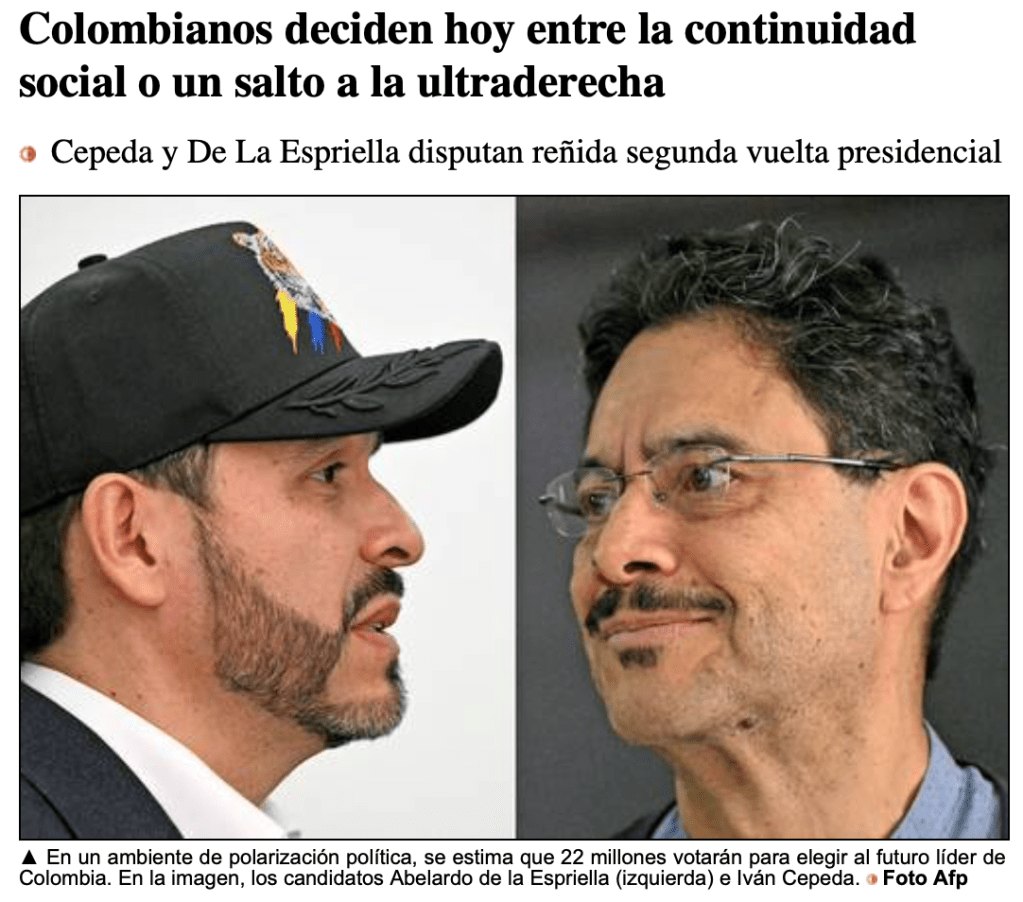
On June 21, Colombians had to choose between a progressive human rights defender, Iván Cepeda, and a far-right political new-comer, Abelardo de la Espriella. Cepeda would continue current President Gustavo Petro’s commitment to achieving peace with several armed groups that have so far resisted joining a prolonged peace process.

As Colombians headed for the polls, I received an email from Dayana Mosquera, Colombia consultant at Global Exchange

In recent days, foreign figures have openly inserted themselves into Colombia’s campaign. 

It began in Washington. President Trump posted his “Complete and Total Endorsement” on Truth Social, and de la Espriella answered on X, casting the two countries as “sister nations” bound to defend Western civilization. A chorus followed. Secretary of State Marco Rubio, whom de la Espriella met privately this year, said Washington would be “very forceful in guaranteeing” a free and fair vote. U.S. Representative María Elvira Salazar urged Colombians to rally behind him.

It did not stop there. Beyond Washington, de la Espriella has secured the unconditional support of other leaders including Presidents Daniel Noboa of Ecuador, José Antonio Kast of Chile and Argentina’s Javier Milei, who interpreted the result as a rejection of the “failed socialist model” and said the forces of freedom across the region were watching and lending their support. From Madrid, Vox leader Santiago Abascal said Colombians could recover the “sovereignty taken from them.” 

Each framed it the same way: as a defense of Colombia’s freedom and even its sovereignty. 

That is the contradiction at the heart of this election. Sovereignty and freedom are not gifts foreign politicians can hand a country by meddling in its vote. They are the very things such interference denies. Nor is this happening in isolation. 

Since Trump reshaped American politics, a familiar style has spread: elections become contests to be won by any means, opponents are cast as enemies, and institutions are treated as obstacles. That style is no longer staying home. It is carried across borders by a networked right, by officials willing to amplify it, and by compliant allies in the region eager to satisfy Washington for their own gain. This weekend, Colombia is where the line is drawn.

Next target for the far-right will be Brazil, where presidential elections are set for October.

Crime and the far-right backlash

In Peru, voters have waited since June 7 for a final result. Keiko Fujimori – daughter of a former dictator – faced Roberto Sánchez who served as foreign minister under former president Pedro Castillo, elected in 2021 but forced from office in December 2022. 
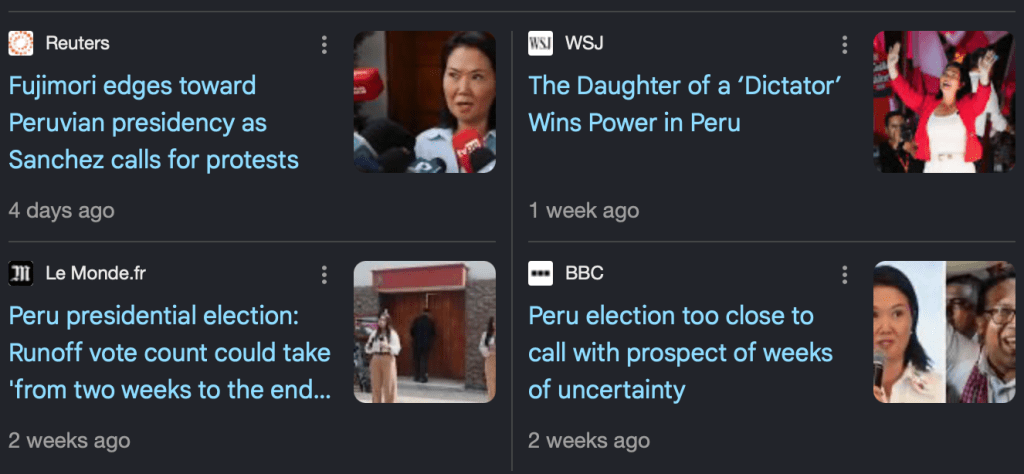
Like Castillo, Sánchez wears a traditional hat popular in rural parts of Peru. He says his hat serves as “the expression of all hats and of the diversity” of Peru. His economic proposals differ from the “market-friendly,” neo-liberal policies applied in recent decades by most Peruvian leaders. He has said he would renegotiate contracts with mining companies, saying that the state should collect more taxes. He has also said that rural communities should own a share of the mines operating in their territory and that he opposes open-pit operations.

Fujimori ran on a law-and-order platform, promising to deploy the military in prisons and on borders. In Peru, where extortion has increased fivefold in the past five years, the approach won votes, as it did in February in Costa Rica in February. Shaken by higher levels of drug-related killings, Costa Ricans chose conservative Laura Fernández for her tough-on-crime platform. 

To an extent, these right-wing politicians draw inspiration (and slogans) from El Salvador’s president, Nayib Bukele, another Trump ally. His heavy-handed security strategies have seen tens of thousands of young men imprisoned without due process, and have targeted environmental protectors (the Santa Marta 5) and human rights defenders like Ruth López Alfaro.

Proposals from the centre and left for community violence prevention programs, better police training, and prison and judicial reforms, show results over years. But the right uses crime as an emotional rallying cry. Their short-term security strategies promise to make people feel safe soon. They come with a high price to human rights and democracy, but to people who live with real fear on a daily basis, those values seem abstract. 

Meanwhile, another right-wing strong man, Daniel Noboa, holds power in Ecuador, neighbour to Peru and Colombia. A week ago, he declared a new 60-day state of emergency across ten provinces and several additional municipalities on Tuesday, suspending constitutional rights and authorizing security forces to conduct searches of private homes without a judicial warrant when organized crime is suspected. His decree came shortly after a meeting at the Pentagon with U.S. Secretary of War Pete Hegseth to discuss joint military operations.

Trump officials, including his ambassadors, insist on such joint operations, often with the threat of acting unilaterally if governments do not comply – and the example of U.S.-government-sponsored killings of more than 200 people in aerial attacks on small boats in international waters that are alleged (without evidence) to be carrying illegal drugs.

As a result, the centre-left government of Guatemala declared a state of emergency to crack down on gang violence this year and welcomed Trump’s “help” targeting drug traffickers.

In Mexico, the U.S. Central Intelligence Agency was found to be working hand-in-hand with the conservative government of the northern border state of Chihuahua – without the knowledge of the federal government – after two agents were killed in a car crash. As that scandal exploded in Mexico, the U.S. government launched indictments against the governor and other officials of Sinaloa state, and sought their extradition. 

In an editorial, La Jornada newspaper described these events as “heavily charged acts of political interference, compounded, to top it off, with an implicit threat.” 
From bishop of Chiclayo to Pope Leo XIV

by Jim Hodgson

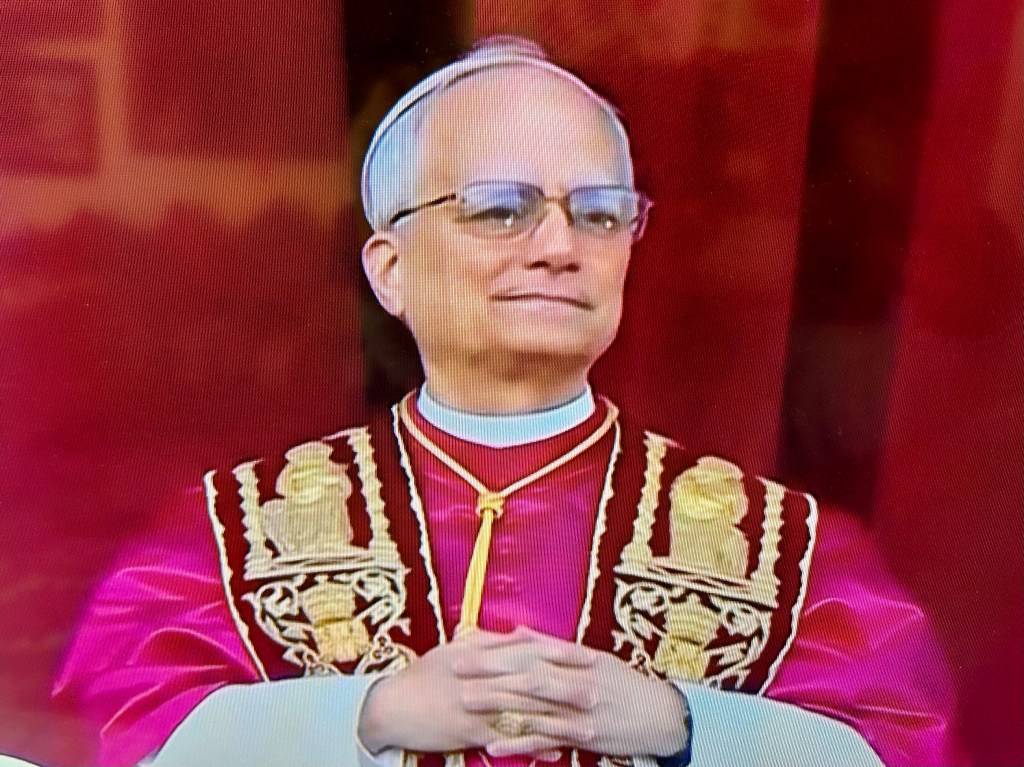
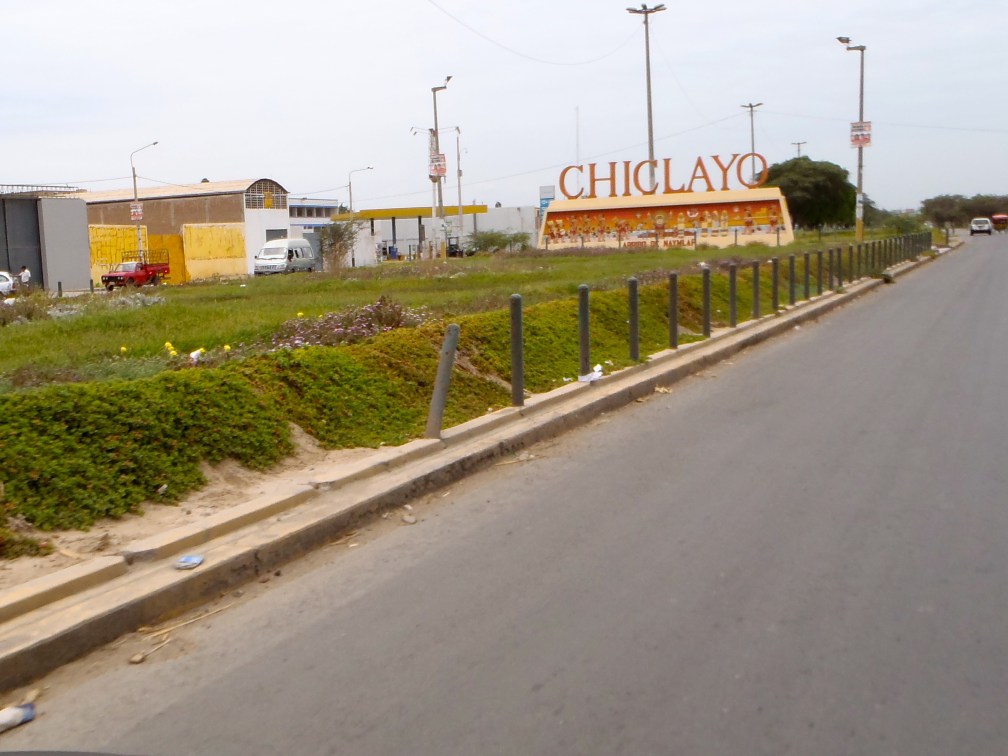
Like many who have worked in Latin America, I rejoiced when I saw that cardinal-electors chose Robert Francis Prevost, the former bishop of Chiclayo (Peru) to serve as Pope, the bishop of Rome. 

And as one who believes Catholic social teaching is not studied sufficiently, I was over the moon when I understood that Prevost had chosen to be called Leo XIV. The last Leo was Pope Leo XIII, who served from 1878 to 1903. He is respected as a pioneer of modern Catholic social teaching. In his famous 1891 encyclical Rerum novarum, Pope Leo outlined the rights of workers to a fair wage, safe working conditions, and the formation of trade unions.

Yes, there are controversies over the selection of Prevost. 

Prevost talked negatively in 2012 about sexual and gender diversity. But in that same year, Archbishop Jorge Bergoglio (a year later Pope Francis) was still in Buenos Aires and fighting legal reforms promoted by the Kirchner-Fernández governments in favour of same-sex marriage. Jesuit Father James Martin, long an ally of LGBTQIA+ people, spoke positively about Prevost after being part of a table group with him during the Vatican’s Synod on Synodality.

There are allegations that Prevost did not pay sufficient attention to victims of clerical sexual harassment while bishop in Chiclayo. Tragically, it is hard to find any bishop, living or dead, who has adequately served survivors of clerical abuse. The real issue is making rules that are effective in making dioceses submit to civil authorities in cases of crime, and to take victims’ allegations seriously in all cases of harassment or abuse. Perhaps his proximity to scandal will help him and others take further steps toward justice for all victims of clerical abuse. 

Much has changed; more needs to change; and Leo XIV may be a step in the right direction. Let’s work toward full inclusion of—and leadership by—women and 2SLGBTQIA+ people.

The church in Chiclayo

Today, I found myself going back through decades of notes. Here is something I wrote during a visit to Chiclayo in 2017:

“Chiclayo has a new bishop who is more in the line of Pope Francis—a positive sign after many years of traditionalist Opus Dei bishops. The new bishop, my friends said, still needs some education around gender justice, but he’s pretty good on economic justice and on developing lay leadership. Social movements here have bloomed outside of the church, including the LGBTIQ and People Living with HIV and AIDS (PLWHA) movements.”

That conversation unfolded with members of Centro Esperanza, a United Church partner from 2006 to 2018. Their work had roots in progressive Christian base communities. It began with a focus on women, particularly those who were involved in community kitchens organized and run by women in impoverished neighbourhoods. Over time, activities expanded to include programs to prevent domestic violence, stimulate learning in early childhood, and gender justice education among high school students.

Several of my Canadian friends have worked in Chiclayo over the decades, beginning with members of the Scarboro Foreign Missionary Society. Their leadership is part of what shaped Chiclayo’s influence on its new bishop.

Catholic Social Teaching

And I went back through my notes on Catholic social teaching. One of the most complete—and still quite short—summaries is a presentation by Bill Ryan, a Canadian Jesuit and social activist. He was a general secretary of the Canadian Conference of Catholic Bishops (CCCB) during part of the time I worked with the Canadian Council of Churches.

In 2000, he spoke to the Coady International Institute at St. Francis Xavier University in Antigonish, Nova Scotia, on the development of Catholic social teaching. Some key points:

What is Catholic Social Teaching? It is a formula or a set of principles for reflection to evaluate the framework of society and to provide criteria for prudential judgment and direction for current policy and action.

  • The inherent human dignity of every person that makes them “sacred”—created in God’s image. This is the ultimate grounding for human rights.
  • The principle of human solidarity. Every person is radically social by nature and by nurture, destined to build up and share human community. The basic element of all creation is interconnectivity, interdependence, and relationships between and among all creatures. Without community we are not human.
  • The principle of subsidiarity. This principle balances the power between the individual and community. It calls for a pluralistic structuring of power in society. That is, human society is more than government; it is the thousands of voluntary and corporate associations that make up civil society. Decisions in society should be taken at the lowest competent level of society.
  • The neediest among us have a special claim on our care and compassion.
  • The common good: the social conditions that allow people to reach their full human potential and to realize their human dignity.
  • And remember that fidelity in relationships extends also to our caring for our “mother” earth.

All of this, it seems to me, is “teaching”—asserting principles, not doctrine.

Ryan said it was untidy, and it is. Church leaders, he said, attempt “to balance the maintenance needs of the church with those of its prophetic mission. What priority should they place on safeguarding unity in the church while preaching the prophetic preferential option for the poor?”

The process, he added, may become even more untidy as more conferences of bishops learn with their people how better to “read the signs of the times” and to “engage Christian communities in believing, preaching and acting on a preferential option for the poor.”

Pope Francis opened a process—“synodality”—for bishops to talk with their people. From his opening remarks, Pope Leo XIV seems determined to keep that door open.

The next morning, the new pope said Christians must offer witness in a world that prefers power, pleasure, and success to faith. Where Christians are “mocked, opposed, despised or at best tolerated and pitied” is where the Catholic Church’s “missionary outreach is most desperately needed,” he said in his first homily as leader of the world’s 1.4 billion Catholics.