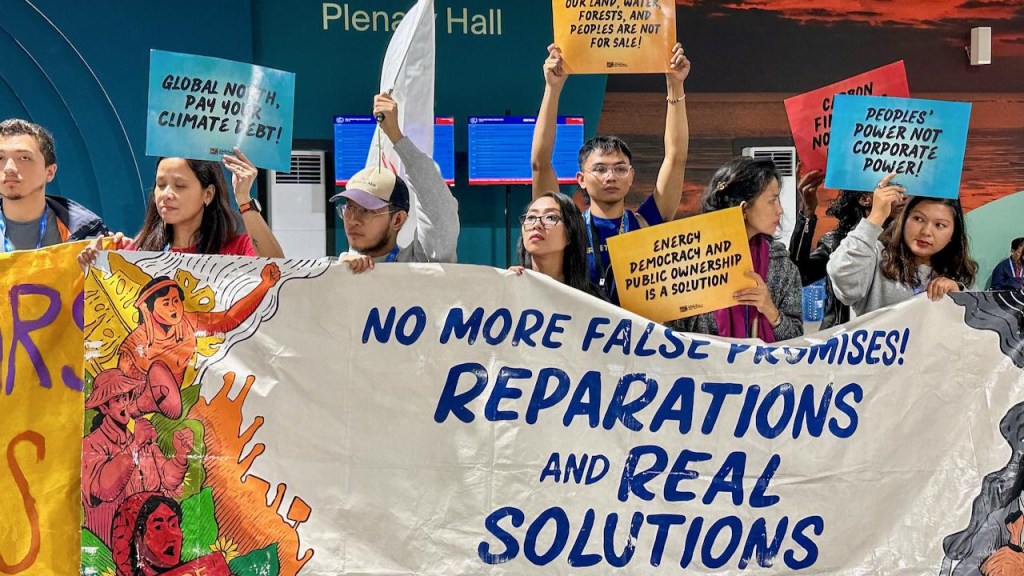
“From collapsing ecosystems to collapsing economies, our communities have been battered by a storm of climate chaos, debt distress, deepening inequality, and systemic exploitation. These crises are the direct result of a global economic system built to extract from our lands, our people, our futures—so the rich and powerful can thrive off our suffering.”
That was the message May 29 of the Asian Peoples’ Movement on Debt and Development (APMDD), a Manila-based network that calls for change in debt, climate, economic and development systems.
In June 2024, Pope Francis and other church leaders around the world launched a new Jubilee campaign for debt cancellation. In Canada, the call is taken up by KAIROS, the Canadian Council of Churches and by Development and Peace (D&P) — among others. KAIROS launched a “Turn Debt into Hope” Jubilee 2025 petition that by June 13 had been signed by more than 36,400 Canadians.
Promoters of the campaign gathered for a People’s Forum in Calgary this past weekend ahead of the G7 summit and joined Sunday’s protests in the heart of the city. The Catholic Register reported on the event:
Salome Owuonda, executive director at the Africa Centre for Sustainable and Inclusive Development (Africa CSID), spoke about the consequences of crushing debt in Kenya…. She told participants that in her East African country “50 per cent of revenue generated is directed toward paying debt” and that puts health care, education, climate action and food security at risk. “And things are not getting better,” said Owuonda. “The government is calling for more taxes as they have to try and pay the debt.”
Dean Dettloff, a research and advocacy officer at D&P, shared that over “3.3. billion people in the world live in countries that spend more paying the interest of their debt than health care and education.” He added that many nation states also direct more funds to these expenditures than safeguarding the environment.
Tarek Al-Zoughbi, a Palestinian Christian who serves as the project and youth coordinator at Wi’am: The Palestinian Conflict Transformation Centre in the West Bank, spoke about the suffering in Gaza and many countries around the world.
Al-Zoughbi said that during this Jubilee year, we “must begin to recognize this image of God that is in each of us and that is in the spirit of creation.” He called for an end to environmentally exploitative practices that contribute to ecological debt.
Some readers will recall the the Millennium Jubilee of 2000, which mobilized millions globally to demand debt cancellation for nations in the Global South. KAIROS reminds us:
In Canada, this movement took shape as The Canadian Ecumenical Jubilee Initiative, the country’s most successful faith-based advocacy campaign. This powerful campaign, led by church-based justice organizations, KAIROS’ predecessor coalitions, and the Canadian Council of Churches, played a crucial role in achieving over $100 billion in global debt relief.
Yet, 25 years later, a worsening global debt crisis continues to affect vulnerable populations, exacerbated by rising interest rates, climate change, and economic inequality. An unacknowledged “ecological debt” owed by the North to the South and Indigenous Peoples further exacerbates the crisis.
Global “Financing for Development” system is part of the problem
When Pope Francis launched the new Jubilee debt campaign a year ago, he called for a “new international financial architecture” that breaks the financial-debt cycle that has contributed to a current global debt now estimated at $313 trillion.
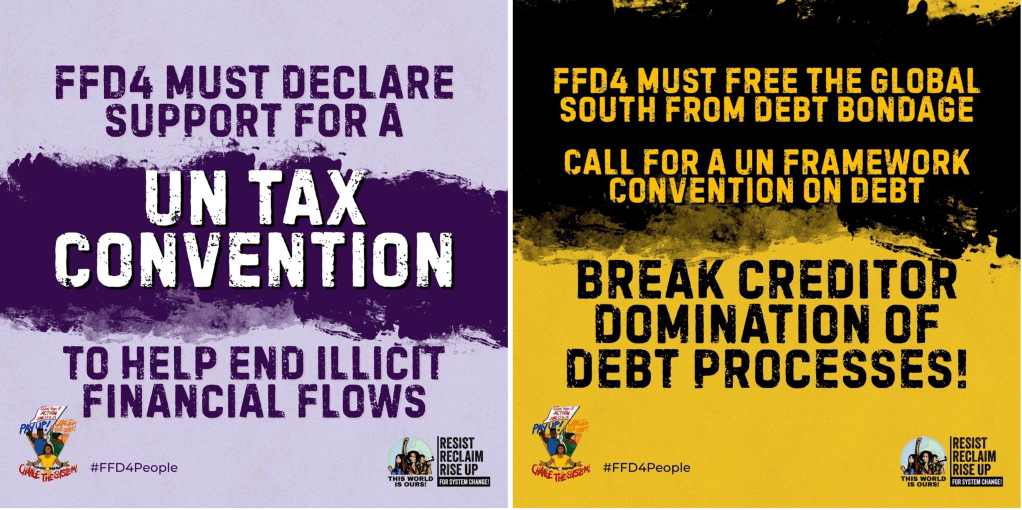
That APMDD statement that I referred to above presses hard on that global financial architecture, describing a “rigged system” that favours creditors. It criticizes the Financing for Development (FfD) process, which was created to ensure fair and just financing for development and climate action—especially for the Global South. “Instead, it has become another space for the Global North to rewrite the rules to protect their power, shirk their responsibilities, and advance false solutions. Their hypocrisy is most glaring when it comes to climate finance.”
At the end of June, world leaders will gather in Seville, Spain, for the fourth international conference on financing for development, dubbed FfD4. (I attended an ecumenical pre-event at the first FfD conference in Monterrey, Mexico, in 2002 and wrote about it here.) In recent months, negotiations on the outcome document have sparked intense civil society campaigning.
The Global Policy Forum said June 17 that the final draft retains an intergovernmental process for managing debt, but weakened its mandate to making “recommendations”. Critics argue that this could kill whatever hope remains for achieving Sustainable Development Goals (SDG) as “debt crises strangle fiscal space and derail the implementation of the Agenda 2030 for Sustainable Development.” Global Policy Forum describes some of what is gone from the outcome document (referred to now as the “Compromiso de Sevilla”):
The paragraph on phasing out fossil fuel subsidies (27i) has been deleted entirely, as well as the specification of asset types to be covered by national and global asset registries (28g). The language around the UN Framework Convention on International Tax Convention was also softened just two months before the first round of negotiations starts: “We support” was downgraded to “we encourage support” (28b). A similar change occurred in the paragraph on investor-state dispute settlement, where the “we undertake reform” was replaced by “we support efforts to reform” (43l).
Meanwhile, the rich countries led by the United States are cutting international aid and increasing their military spending.
The G7 meeting near Calgary issued a series of statements (CBC, left) but one searches in vain for anything about debt cancellation or development assistance. The statement on “migrant smuggling” fails to address the question of why people leave their homes or how development aid and peace-making strategies can ease the problem.
The APMDD statement concludes:
“We are here to expose the Global North—not just for failing to deliver climate finance, but for actively sabotaging it in bad faith. This is no accident. It is a calculated strategy to protect their profits and deny justice to those they have exploited for centuries…. We see through every lie. We reject every excuse.”
“I am infuriated to come home to the aftermath of six typhoons that have struck the Philippines in the space of just four weeks with basically zero gains from COP29,” said Patricia Mungcal, a young climate advocate who serves as humanitarian manager with the National Council of Churches in the Philippines.
“I will be telling thousands of Filipino families who were devastated by these strong typhoons that world leaders have left us to suffer the heaviest impacts of the climate crisis and disregarded our demands for finance and reparations. This failure to address loss and damage is a grave disregard of our human dignity and rights. We charge this failure of COP29 to the moral bankruptcy of the rich, polluting nations.”
News from Philippines and (right) Patricia Mungcal (screenshot from WCC video)
At the recent climate conference in Baku, Azerbaijan, world leaders failed miserably in their response to the climate crisis and its consequences. Of the $1.3 trillion of climate finance that independent experts estimate will be required annually by 2030, the UN climate conference agreed to provide just $300bn every year – by 2035 (Progressive International newsletter, Dec. 3).
Meanwhile, governments around the globe (including Canada) are still ploughing billions of dollars into fossil fuel subsidies to shelter citizens from higher energy costs, but that comes with a fiscal burden and impedes the goal of reducing overall use.
And Philippines had six typhoons. In the Canadian Rockies, Jasper townsite burned—just days after I had written about climate disasters in British Columbia.
What is to be done?
More often now, we are seeing the connection between the climate crisis and the growing indebtedness of the so-called “highly indebted poor countries” (HIPC). And proposals for a new international financial architecture are once again getting attention.
In June, Pope Francis pressed leading economists and world finance ministers to support new mechanisms to ease foreign debt, lamenting that “poorly managed globalization” has deprived millions of people of a “dignified future.”
“Ecological debt and foreign debt are two sides of the same coin that mortgages the future,” the pope said. “For this reason, dear friends, the Holy Year of 2025, to which we are heading, calls us to open our minds and hearts to be able to untie the knots of the ties that strangle the present, without forgetting that we are only custodians and stewards, not masters.”
The focus of this Jubilee Year is gaining ecumenical and inter-faith support. In Canada, KAIROS will lead a Canadian Ecumenical Jubilee campaign, in step with global debt relief efforts. “These are inspired by the Jubilee tradition from the Book of Leviticus. Rooted in faith, Jubilee calls for the release of debts, liberation from servitude, and the return of seized lands—principles that resonate deeply in today’s world,” says KAIROS. This campaign aims to:
Cancel unjust debts.
Establish a UN-led mechanism for debt resolution.
Prevent future cycles of crippling debt.
The 2025 meeting of G7 (leaders of the richest countries) will be held June 15-17 in Kananaskis, Alberta (southwest of Calgary).
The global Progressive International network, meanwhile, is presenting a Program of Action on the Construction of a New International Economic Order. It speaks of a “polycrisis”—the combination of the “old crises of debt, dependency and under-development” combined now with “an accelerating crisis of climate to threaten not only the developmental prospects of the South—but also, in the case of many small island states, their very existence.”
The Program of Action offers nearly three dozen measures across five broad sections: to leverage the South’s natural wealth, labor power, and collective voice in order to extract concessions from Northern partners; to bolster the sovereign development agenda by building Southern alternatives to Northern institutions; and to pool Southern knowledge, resources, and ingenuity in service of a whole that is greater than the sum of its parts.
Keep an eye on KAIROS, of course, and on Development and Peace-Caritas Canada for ways to get involved in the new Jubilee campaigns.
I also want to share with you some suggestions from Katharine Hayhoe, a Canadian atmospheric scientist whose research focuses on understanding the impacts of climate change on people and the planet.
“For climate action to happen at scale, conversations have to move beyond international summits to what’s happening in our communities, our workplaces, and our organizations. And there, change isn’t something we wait for. It’s something we catalyze,” she wrote after COP29.
She suggests starting conversations “about climate solutions where you work or study. Ask what your organization is already doing, and what more it could do—and share that with people around you, particularly those who can make decisions.”
That will be especially important as Canadians vote in a federal election in 2025, and as one party opts for simplistic slogans over serious conversations about climate policy.




 Unwrapping Development