

A headline and a photo in the Buenos Aires newspaper Página 12 caught my eye today. Together with a photo of Saint Óscar Romero was this phrase: “Justice and snakes only bite bare feet.” *

The writer, Alejandro Slokar, is a judge in Argentina’s federal court for appeals of criminal cases (Cámara Federal de Casación Penal). Here, he is writing about the International Day for the Right to the Truth Concerning Gross Human Rights Violations and the Dignity of Victims—or more simply, the Right to Truth Day, marked now every March 24.
March 24 is not only the date when we recall the martyrdom of San Salvador’s archbishop, the human rights defender Óscar Romero in 1980. It’s also when Argentineans recall the 1976 military coup that ushered in a “dirty war” against the popular movements of the impoverished—those with bare feet—along with trade unionists, journalists, writers, artists and human rights defenders. As many as 30,000 people were killed or disappeared over the next five years.
In El Salvador, about 80,000 people were killed or disappeared between 1979 and the end of the civil war in 1992. In both countries, as elsewhere across Latin America, movements to find the “historical truth.”
In recent weeks, families of people who disappeared during Mexico’s long “war on drugs” have drawn attention to a half-hectare farm in Teuchitlán, about 60 km west of Guadalajara in the state of Jalisco. The farm had been used to recruit new traffickers, but also to execute those who refused the cartel’s orders. State and federal authorities had known about the site since last September but did nothing to secure it or to identify human remains and other items found on the land. Predictably, state and federal authorities point fingers of blame at each other.
About 120,000 people have gone missing in Mexico since 2006 when then-President Felipe Calderón launched a military-led offensive against the drug cartels in an attempt to curb their violent turf wars. Instead, the violence became worse. And Calderón’s security chief, Genaro García Luna, was convicted in October in a U.S. court for his deep ties to the Sinaloa cartel.
Among the disappeared (still) are 43 students from a training school for rural teachers in Ayotzinapa, Guerrero state, taken in 2014.
The “right to truth” cannot only be about historical cases. It must be the demand now in the case of the young men taken by the Trump regime and dumped into El Salvador’s infamous Terrorism Confinement Centre (CECOT). Certainly, some of the 238 Venezuelans may be criminals who were members of the “Tren de Aragua” gang but, as stories leak out, it’s clear that some of those deported were never accused, much less tried or convicted, of any crime.
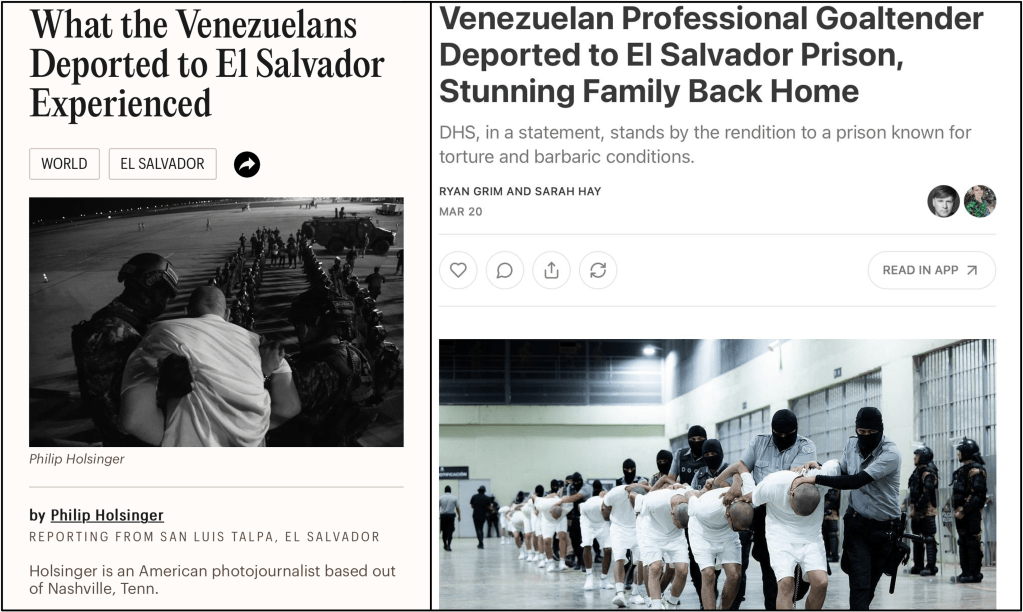
Drop Site News reported that another deportee was a Venezuelan professional soccer player and youth soccer coach with no criminal record. “The family only discovered that their loved one, Jerce Reyes Barrios, had been sent to El Salvador when they saw him in viral videos posted by the Trump administration, in which it celebrated what it said was the mass deportation of violent members of the Venezuelan gang Tren de Aragua.”
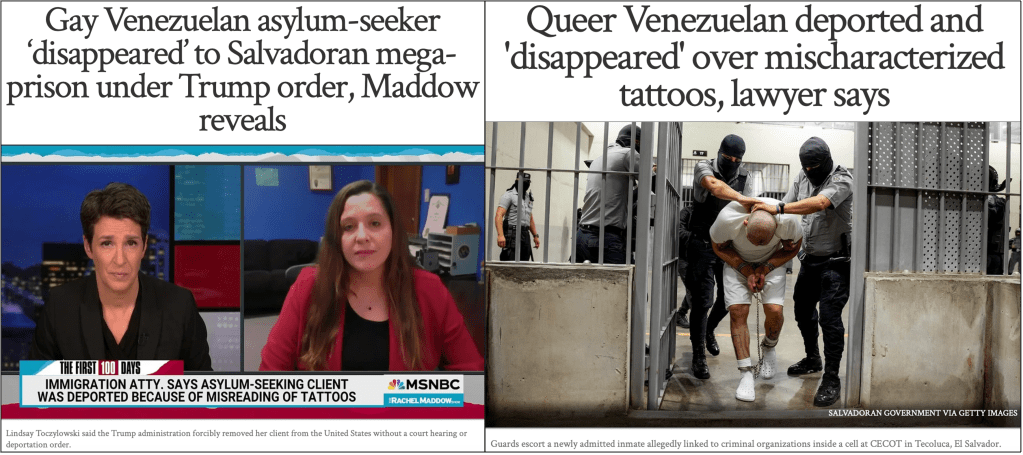
Those stories, combined with reports of detentions of visa holders and other visitors, and harassment of legal residents and citizens, suggest that what happened in Argentina and El Salvador has begun in the United States. Can paramilitary death squads be far behind?
Writing of historical events and of the present-day right-wing populist regimes of Nayib Bukele in El Salvador and Javier Milei in Argentina, Slokar’s article argued that such abuses derive from the “neocolonial models”—European feudalism—applied in throughout the Americas. “While those responsible die in their beds without sanction, the consequences are almost infinite, farce and tragedy at the same time, and expressed in the inhumane neoliberal experiment that laughs at the Constitution, bitcoin, extractivism and punitive demagoguery that converge in the present.”
* The quote is variously attributed to both Óscar Romero and to the Uruguayan journalist Eduardo Galeano. It may be that Galeano was quoting Romero, but I cannot find the original source: just partial citations.


 Unwrapping Development