Vatican’s Jubilee commission urges systemic change as it launches new debt relief report

A Vatican-backed report authored by more than 30 prominent economists calls for urgent action and systemic reforms to address the global debt and development crises of our times.

The group, convened by the late Pope Francis for this Jubilee year, provides recommendations on debt relief and economic policy.

What follows is (mostly) from a news releases today by Jubilee USA and the Initiative for Policy Dialogue at Columbia University:
“This report is a blueprint to solve the current global debt crisis, prevent future economic crises and create an economy that radically reduces poverty,” said Eric LeCompte, executive director of the Jubilee USA Network and a Vatican advisor who is at the Pontifical Academy of Social Sciences (PASS) for the report launch. 

“While debt relief and a just economy are at the center of Catholic teaching, this is the first report convened by a Pope that focuses on technical recommendations to achieve an economy that serves everyone,” he added.
Nobel Prize-winning economist Joseph Stiglitz and former Argentine Minister of the Economy, Martín Guzmán, led the work of the expert group.

The report “seeks to contribute to a comprehensive rethinking of the global rules governing finance, taxation, trade, and the sharing of knowledge,” said PASS. “At its heart lies a clear and urgent goal: to help build a global economy that serves people, especially the most vulnerable, and truly leaves no one behind.”
Pope Francis reiterated the interfaith calls of Pope Benedict and Pope John Paul II on debt relief and economics, making these issues the focus of the Christian holy year of Jubilee 2025. Pope Leo XIV continues the efforts of his predecessors. 

Twenty-five years ago in Jubilee 2000, over $100 billion in international debt was cancelled, but a lack of structural reform, combined with recent world events, resulted in systemic vulnerabilities that are now undermining hard-won gains. 
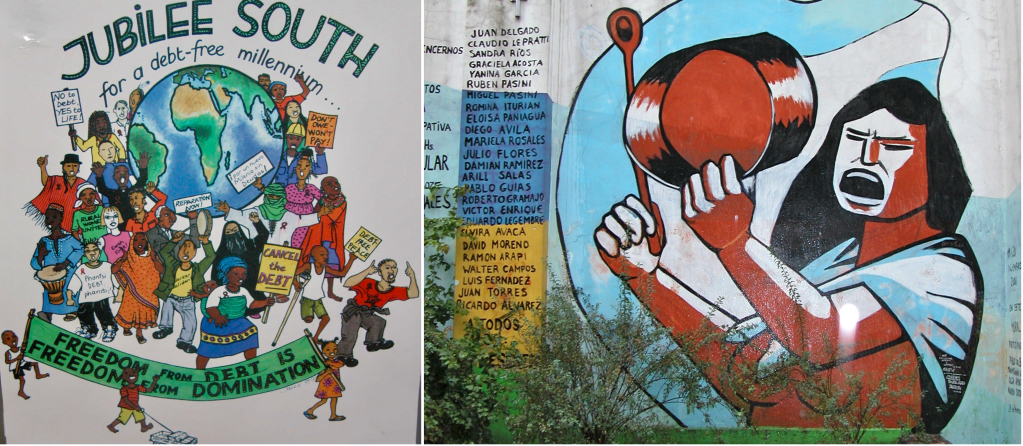
The time for new Jubilee action is now.

Recommendations include:

  • Improve debt restructuring: Change multilateral institution policies and legislation in key jurisdictions so that creditors and debtor governments are newly incentivized to agree to more timely and sustainable debt restructurings.
  • End bailouts to private creditors: Multilateral institutions including the International Monetary Fund should change their policies and practices to support sustainable recoveries, not de facto bailouts of private creditors or crippling austerity.
  • Strengthen domestic policies: Developing countries should more extensively use capital account regulations to discourage destabilizing flows and create a more stable environment for long-term investments and should invest in structural transformation.
  • Enhance transparency: All should support financial policies that are transparent and have broad societal support.
  • Reimagine global finance: All should support a comprehensive change in global financing models to drive financing for sustainable development, including lending that supports long-term growth.

The report’s findings will be discussed at the 4th International Conference on Financing for Development in Seville, Spain, June 30-July 3 and other global gatherings where the global debt and development crises will be high on the agenda.
“Developing countries spent a record $1.4 trillion paying debt in 2023 and too many countries spend more on paying debt than they do on the urgent needs of their people,” said LeCompte who also serves on United Nations debt expert groups. “In African and low-income countries, debt payments are two-thirds higher than their combined spending on health, education and social services.”
According to the World Bank, more than 800 million people live in extreme poverty, over 100 million more than previously believed. The report calls for a range of reforms as a debt and poverty crisis that has been growing in the face of the pandemic, wars, cost-of-living and interest rate hikes rose to prominence in the agenda of global leaders in multiple forums. Proposals include greater transparency, reforms to the International Monetary Fund, changes to laws in New York and the United Kingdom which govern private sector debt, improving debt contracts and an international bankruptcy system akin to the national bankruptcy courts that exist in most countries.
“This report can move the G7, G20, IMF and United Nations to make short-term decisions to address the current crisis and lay a foundation to prevent future crises,” stated LeCompte.
“The experts who wrote this report are a critical part of the global Jubilee movement, which includes advocates in pews, development groups, conservatives, liberals and people of every faith,” shared LeCompte. 

Read or download the report here or here.

Read Pope Francis’ Jubilee 2025 debt focus speech here.

Time to end the hypocrisy on global debt

by Jim Hodgson

“From collapsing ecosystems to collapsing economies, our communities have been battered by a storm of climate chaos, debt distress, deepening inequality, and systemic exploitation. These crises are the direct result of a global economic system built to extract from our lands, our people, our futures—so the rich and powerful can thrive off our suffering.”

That was the message May 29 of the Asian Peoples’ Movement on Debt and Development (APMDD), a Manila-based network that calls for change in debt, climate, economic and development systems.

In June 2024, Pope Francis and other church leaders around the world launched a new Jubilee campaign for debt cancellation. In Canada, the call is taken up by KAIROS, the Canadian Council of Churches and by Development and Peace (D&P) — among others. KAIROS launched a “Turn Debt into Hope” Jubilee 2025 petition that by June 13 had been signed by more than 36,400 Canadians.

Promoters of the campaign gathered for a People’s Forum in Calgary this past weekend ahead of the G7 summit and joined Sunday’s protests in the heart of the city. The Catholic Register reported on the event:

Salome Owuonda, executive director at the Africa Centre for Sustainable and Inclusive Development (Africa CSID), spoke about the consequences of crushing debt in Kenya…. She told participants that in her East African country “50 per cent of revenue generated is directed toward paying debt” and that puts health care, education, climate action and food security at risk. “And things are not getting better,” said Owuonda. “The government is calling for more taxes as they have to try and pay the debt.”

Dean Dettloff, a research and advocacy officer at D&P, shared that over “3.3. billion people in the world live in countries that spend more paying the interest of their debt than health care and education.” He added that many nation states also direct more funds to these expenditures than safeguarding the environment.

Tarek Al-Zoughbi, a Palestinian Christian who serves as the project and youth coordinator at Wi’am: The Palestinian Conflict Transformation Centre in the West Bank, spoke about the suffering in Gaza and many countries around the world.

Al-Zoughbi said that during this Jubilee year, we “must begin to recognize this image of God that is in each of us and that is in the spirit of creation.” He called for an end to environmentally exploitative practices that contribute to ecological debt. 

Some readers will recall the the Millennium Jubilee of 2000, which mobilized millions globally to demand debt cancellation for nations in the Global South. KAIROS reminds us:

In Canada, this movement took shape as The Canadian Ecumenical Jubilee Initiative, the country’s most successful faith-based advocacy campaign. This powerful campaign, led by church-based justice organizations, KAIROS’ predecessor coalitions, and the Canadian Council of Churches, played a crucial role in achieving over $100 billion in global debt relief.  

Yet, 25 years later, a worsening global debt crisis continues to affect vulnerable populations, exacerbated by rising interest rates, climate change, and economic inequality. An unacknowledged “ecological debt” owed by the North to the South and Indigenous Peoples further exacerbates the crisis.

Global “Financing for Development” system is part of the problem

When Pope Francis launched the new Jubilee debt campaign a year ago, he called for a “new international financial architecture” that breaks the financial-debt cycle that has contributed to a current global debt now estimated at $313 trillion. 

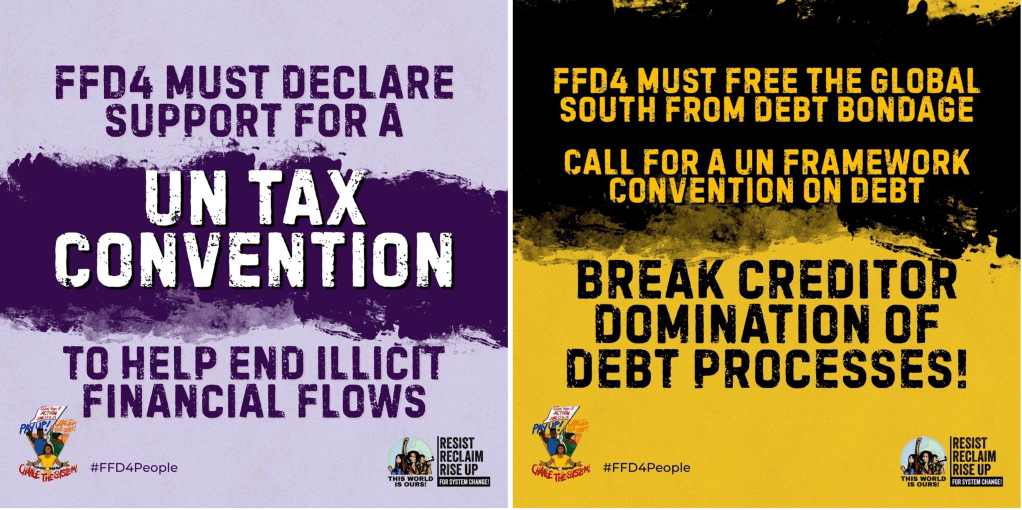
That APMDD statement that I referred to above presses hard on that global financial architecture, describing a “rigged system” that favours creditors. It criticizes the Financing for Development (FfD) process, which was created to ensure fair and just financing for development and climate action—especially for the Global South. “Instead, it has become another space for the Global North to rewrite the rules to protect their power, shirk their responsibilities, and advance false solutions. Their hypocrisy is most glaring when it comes to climate finance.”

At the end of June, world leaders will gather in Seville, Spain, for the fourth international conference on financing for development, dubbed FfD4. (I attended an ecumenical pre-event at the first FfD conference in Monterrey, Mexico, in 2002 and wrote about it here.) In recent months, negotiations on the outcome document have sparked intense civil society campaigning

The Global Policy Forum said June 17 that the final draft retains an intergovernmental process for managing debt, but weakened its mandate to making “recommendations”. Critics argue that this could kill whatever hope remains for achieving Sustainable Development Goals (SDG) as “debt crises strangle fiscal space and derail the implementation of the Agenda 2030 for Sustainable Development.” Global Policy Forum describes some of what is gone from the outcome document (referred to now as the “Compromiso de Sevilla”):

The paragraph on phasing out fossil fuel subsidies (27i) has been deleted entirely, as well as the specification of asset types to be covered by national and global asset registries (28g). The language around the UN Framework Convention on International Tax Convention was also softened just two months before the first round of negotiations starts: “We support” was downgraded to “we encourage support” (28b).  A similar change occurred in the paragraph on investor-state dispute settlement, where the “we undertake reform” was replaced by “we support efforts to reform” (43l).

Meanwhile, the rich countries led by the United States are cutting international aid and increasing their military spending.

The G7 meeting near Calgary issued a series of statements (CBC, left) but one searches in vain for anything about debt cancellation or development assistance. The statement on “migrant smuggling” fails to address the question of why people leave their homes or how development aid and peace-making strategies can ease the problem.

The APMDD statement concludes:

“We are here to expose the Global North—not just for failing to deliver climate finance, but for actively sabotaging it in bad faith. This is no accident. It is a calculated strategy to protect their profits and deny justice to those they have exploited for centuries…. We see through every lie. We reject every excuse.”