Human rights and land rights defenders are still under attack in Guatemala

by Jim Hodgson

Despite the inauguration earlier this year of a more progressive government in Guatemala, community land defenders still face criminal violence and judicial threats.

The government of President Bernardo Arévalo condemned the murder June 5 of a 47-year-old lawyer who worked to protect Indigenous and small-farmer land rights.

José Alberto Domingo Montejo worked with the Comité de Unidad Campesina (CUC, Committee for Farmworkers Unity) and had been part of CUC’s legal team since 2019. 

Left: A poster from Prensa Comunitaria denouncing the murder of José Domingo. Right: a statement from the Office of the UN High Commissioner for Human Rights upholding the right of small farmers’ organizations to work freely and safely, and calling for a fast and impartial investigation.

Domingo was shot during an ambush on a gravel road in Palin, Escuintla department, southwest of the Guatemalan capital. Two other CUC members, Gustavo Yoxon and Marcelo Yoxon, were wounded in the same attack.

They were doing what CUC and another organization with which I am more familiar, the Comité Campesino del Altiplano (CCDA, Highlands Committee of Small Farmers) do all the time: working to advance the interests of small farmers and Indigenous peoples by helping to legalize a community land title. The CCDA condemned the attack and expressed its solidarity with families of the victims.

“This attack is added to the wave of violent judicial and extrajudicial evictions, captures and arrest warrants,” said CCDA in a statement on social media. 

The Pact of the Corrupt

Guatemala may have that more progressive government but Arévalo and his cabinet do not control all the levers of power. 

A key obstacle is Consuelo Porras, the attorney general appointed in 2018; her term was renewed in 2022 and extends to 2026; she can only be removed if convicted of a crime. 

Left: A CCDA news conference [text in English] on June 3 warned the “Pact of the Corrupt” tries to provoke confrontations between government and small farmers and Indigenous communities.

The U.S. Department of State added Porras to a list of “undemocratic and corrupt” officials in 2021. And last year, the Organization of American States (OAS) called her efforts to annul Arévalo’s election “an attempted coup d’état.”

“Porras has served as the spearhead of the Pact of the Corrupt,” wrote former Guatemalan foreign minister Edgar Gutiérrez in December while she was still trying to quash the election result. He described the Pact of the Corrupt as “a loose coalition of politicians, bureaucratic and business elites, plus powerful drug trafficking groups, which has pushed back civil and political liberties, unleashing fierce persecution against dissent, particularly against independent justice operators, who now number half a hundred in exile.”

For people in a community that is struggling to establish a land claim, even with good legal advisors from CCDA or CUT, it is often a challenge to identify opponents. One example is the Xinca Indigenous community of Nueva Jerusalén, located further south in the same Escuintla department where José Domingo was killed. By March 2023, the community had exhausted legal avenues within Guatemala (despite having shown the land in question belongs to the government and having proven irregularities in the claim of a supposed owner. After I had joined a meeting with community leaders and CCDA advisors, I wrote about the community’s appeal to the Inter-American Court of Human Rights (IACHR).

But a few months later, on August 9, police and private security forces burned the community to the ground and forced the 53 resident families to flee. 

In these scenarios—and there are scores of them—it can be difficult to distinguish between a legal, court-ordered eviction (even if fraudulently obtained) and a private army: in effect, a paramilitary death squad. 

And so you find a paragraph like this one in an Amnesty International report that (correctly, in my view) blends the crimes of state and non-state actors. From the victims’ point of view, it’s hard to see the difference.

“The Unit for the Protection of Human Rights Defenders in Guatemala (UDEFEGUA) reported 5,965 attacks against human rights defenders between January and November 2023, including threats, killings, harassment and arbitrary detentions. Criminalization increased, particularly against those involved in the fight against impunity and corruption.”

And this paragraph from a Maritimes-Guatemala Breaking The Silence (BTS) Network report on the Nueva Jerusalén eviction:

“[T]he state abets and perpetrates violence against the community. The police—the armed wing of the state—have…ransacked homes, destroyed possessions and sought to provoke community members to protect themselves. With this sleight of hand, they bring charges against community members, used to defame and criminalize the residents of Nueva Jerusalen.”

“Bringing charges.” “Criminalization.” 

Mélisande Séguin of BTS notes that land defenders continue to meet with government officials to stop future arrests. “Nonetheless, with Consuelo Porras at the helm of the Public Prosecutor’s office, criminalization remains a major threat for Indigenous and campesino movements.”

On Feb. 8, the new government signed an agreement with CCDA, CUT and other organizations of small farmers and Indigenous peoples. 

“For our administration, dialogue is not just a tool but a key pillar that promotes citizen participation in defining the agendas that effectively solve different needs,” said Arévalo during the signing ceremony. He said the agreement was the product of a dialogue process that began in the last quarter of 2023.

“All Guatemalans are equal in dignity and rights. The new government embraces the idea that everyone has something valuable to contribute and deserves to be heard,” he said.

Speaking at the ceremony, CCDA national coordinator Neydi Yasmín Juracán stated: “For us, it is a historic day because we have been meeting politically and technically for these agreements.” She said CCDA has worked for more than 28 years to prevent and end land evictions, but:

  • 12 community leaders were assassinated between 2018 and 2022.
  • Seven leaders are currently imprisoned.
  • 1,788 arrest warrants, 35 per cent targeting women.
  • Seven active temporary shelters to attend to agrarian conflicts.
  • 1,320 cases were accompanied by the CCDA.
Haitian claim for slavery reparations at the heart of a UN forum

by Jim Hodgson

A United Nations forum on the historic wrongs committed against people of African descent is building momentum in favour of an international tribunal on atrocities dating back to the transatlantic trade of enslaved people.

When the UN Permanent Forum on People of African Descent (PFPAD) held its third session in less than two years in Geneva in mid-April, African and Caribbean governments together with civil society organizations pressed forward with plans to create a tribunal that would be similar to that which oversaw the Nuremberg trials of Nazi war criminals after World War II.

Proponents say such a tribunal would help establish legal norms for international and historical reparations claims.

Supporters include many members of the Caribbean Community (CARICOM), made up of 15 member states, and the African Union (AU), which includes 55 states—and Antonio Guterres, the UN General Secretary. “We call for reparatory justice frameworks, to help overcome generations of exclusion and discrimination,” he said March 25.

Supporters argue that Western countries and institutions that continue to benefit from the wealth slavery generated should be held accountable, particularly given ongoing legacies of racial discrimination. Opponents say that contemporary states and institutions should not be held responsible for historical slavery.

The World Council of Churches was among faith-based and civil society organizations that came together at the PFPAD forum to examine what states and other actors may do to redress the historic exploitation and harms that Africans and people of African descent have suffered. (You can learn more here about global ecumenical efforts to overcome racism, discrimination and xenophobia.)

Righting the wrongs in Haiti

Given that Haiti’s claim for reparations is among the strongest, the voices of Haitian civil society groups and their diaspora counterparts were heard at the PFPAD forum. 

Those groups used the forum to put a spotlight on the crucial role that Haiti played in the struggle to end slavery. “To recognize the historic context is essential to understand the unique position of Haiti in the global struggle for justice and egality,” they said in a statement before the forum. Participating groups—including the Montana Accord network and of the Haitian-American Foundation for Democracy (HAFFD)—said they strongly approve calls for reparations to Haiti.

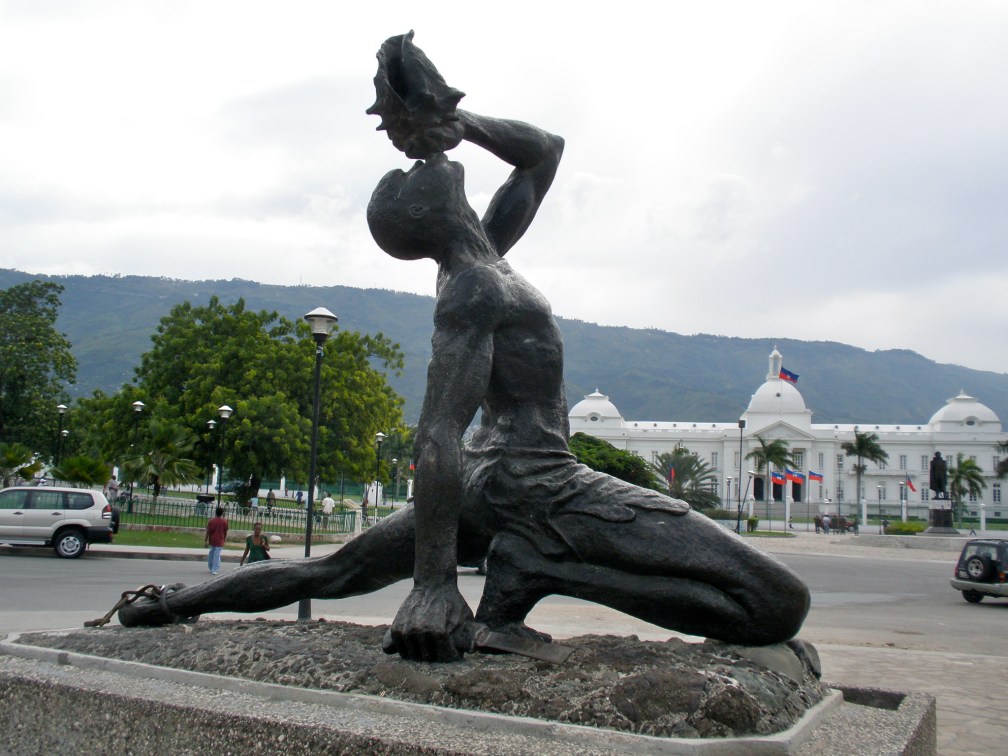
Le Marron Inconnu, and in the background, the National Palace before the 2010 earthquake.

Haiti was born as an independent nation in 1804 after the enslaved people revolted against their French colonial masters. The values of “liberté, égalité et fraternité,” expressed in the triumph of the French Revolution in 1789, resonated among slaves in Saint-Domingue, France’s richest colony. In 1804, the world’s first successful slave rebellion resulted in the birth of the Republic of Haiti. 

Beginning in 1825, France squeezed an “independence debt” from Haiti that adds up to at least $21 billion in today’s dollars. That estimate comes from The New York Times, but backers of the reparations claim say the amount is much higher.

“It’s $21 billion plus 200 years of interest that France has enjoyed so we’re talking more like $150 billion, $200 billion or more,” Jemima Pierre, professor of Global Race at the University of British Columbia, told Reuters.

Despite the obvious injustice of that debt, France continues to resist pressure to join in reparations. In August 2010, about 100 prominent academics, authors, and human rights activists signed on to an open letter to then-President Nicolas Sarkozy, arguing that the case for repayment was “morally, economically, and legally unassailable.” France dismissed the petition, pointing to its record of delivering other aid to Haiti and not addressing the legitimacy of the debt.

“What’s important is that it’s time that France recognises this and we move forward,” Haitian civil society activist Monique Clesca told Reuters. France, whose development agency has given hundreds of millions of dollars in aid to Haiti, has previously referred to a “moral debt” owed to Haiti.

Trans women in Mexico say: “They’re killing us”

by Jim Hodgson

In Mexico, the new year began with a series of highly-publicized murders and beatings of Trans women. The violence, sadly, is not rare: Mexico follows only Brazil with the highest numbers of murders of LGBTQIA+ people each year. The fact that they’re being talked about at all is what’s unusual.

Two of the women who were killed were active in party politics. A woman beaten by her fiancé is a well-known social media “influencer,” Paola Suárez. The incidents are reminders of the breach between much-improved legal protection for LGBTQIA+ people in most of Latin America, and the harsh realities of day-to-day life where many men still hold to old ways. More on that below.

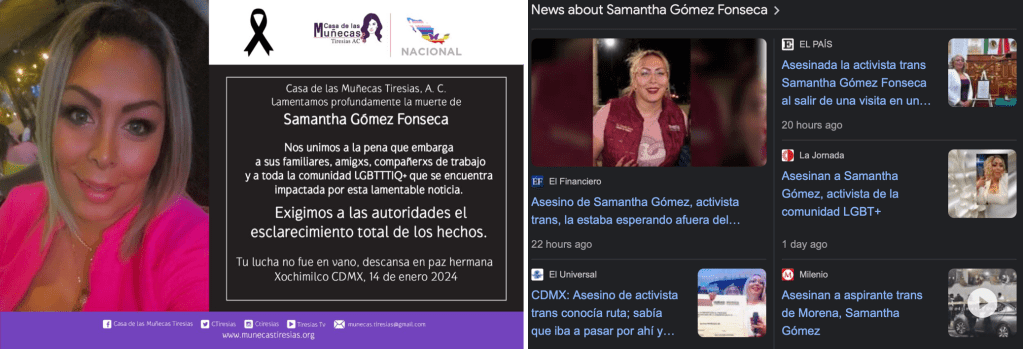
The assassination of Samantha Gómez Fonseca came the day before a planned march by Trans women in Mexico City.

Samantha Gómez Fonseca, 37, had launched a campaign for a seat in the national Senate as a member of the ruling MORENA (Movement for National Regeneration) party. She was shot and killed on Jan. 14 in the street after a prison visit in the Xochimilco area in the south end of Mexico City. 

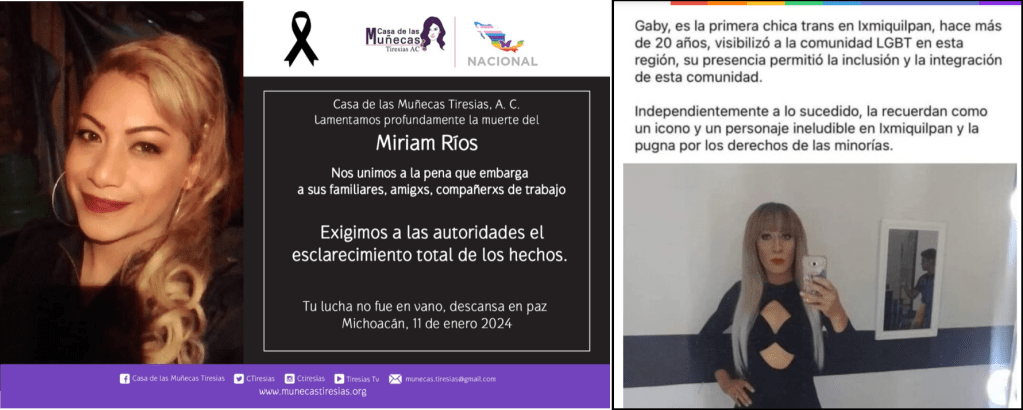
Miriam Noemí Ríos, part of the Citizens’ Movement party (MC) in Michoacan state, was shot and killed Jan. 11 in Zamora, Michoacan. She was a candidate for the municipal council in nearby Jacona. 

Miriam Ríos (left) is remembered in Michoacán state. In Hidalgo, Gaby is remembered as the first Trans woman to come out in Ixmilquilpan more than 20 years ago.

“What is going on in Mexico?” demanded Salma Luévano Luna, a Trans woman who is a member of the national Chamber of Deputies for the MORENA. 

“Why do we have four violent deaths of Trans women already this year? They’re killing us.

“This is what I am talking about when I say that hate speech is the entry point for hate crimes. For this, I demand justice for Samantha and all of my sisters. Enough. Not one more.” 

Luévano had been in the news just days early after President Andrés Manuel López Obrador had referred to her as “a man in a dress.” He apologized a day later, and she accepted the apology, but the incident still rankles among Trans activists. 

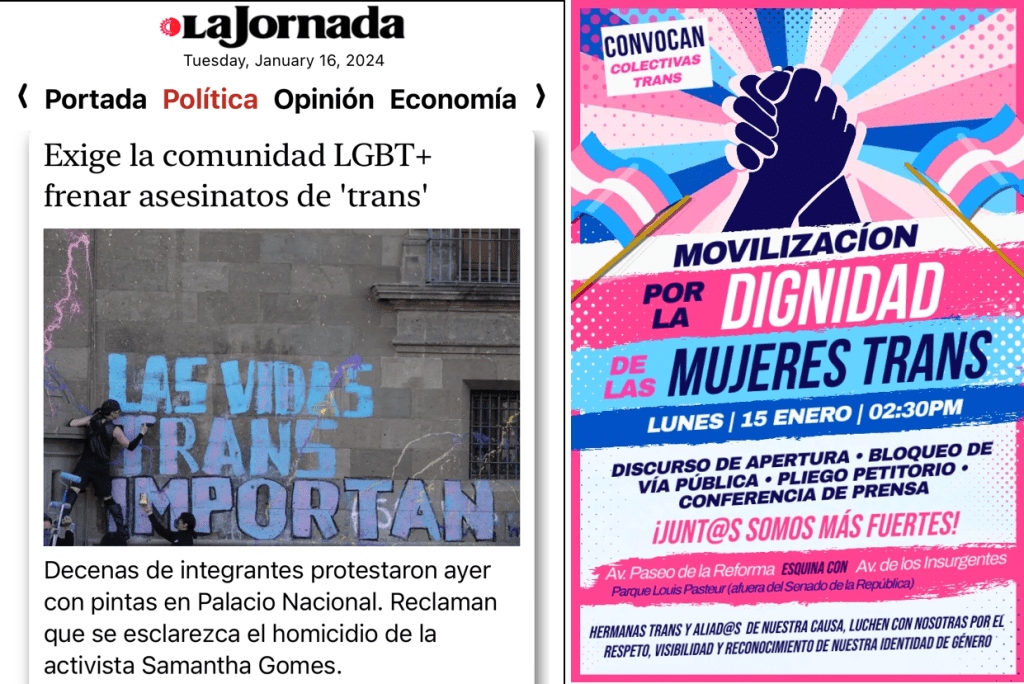
The words of the prophets are written on the walls of the National Palace: “Trans Lives Matter.” The graffiti was created during the Jan. 15 Trans mobilization.

Others killed in the first two weeks of the year included Gaby Ortiz, whose body was found beside a rural highway near Ixmiquilpan, Hidalgo. In Coatzalcoalcos, Veracruz, the bodies of Vanessa, a Trans woman and her partner (whose name is not given) were found in their home. The Arcoiris organization points to two more: a Trans woman whose name is not known found shot in the back and dead Jan. 13 in Tlaquepaque, Jalisco, and a person identified as 35-year-old Fabián Kenneth Trejo, who died Jan. 14 in the Álvaro Obregón area of Mexico City. 

“All of the victims, known and unknown, deserve justice,” said the Human Rights Commission of Mexico City in a statement Jan. 15. The commission called on authorities to investigate in ways that take seriously their gender identity and political activities “so that truth be known, leading to sanctions that are necessary for the transformation of the structural conditions that will allow LGBTTTIQA+ populations to live free from violence.”

From 2007 through 2022, a total of 590 Trans people were murdered in Mexico. That’s an average of 53 each year. 

Unfortunately, few violent crimes in Mexico result in criminal charges, especially if the victim is from a marginalised group. In July last year, Ulises Nava, the head of a sexual diversity unit at the University of Guerrero in Chilpancingo was shot and killed while attending a LGBTQIA+ conference in Aguascalientes. In November, Mexico’s first openly non-binary magistrate and prominent activist Ociel Baena was killed; the body of their partner, Dorian Herrera, was found at their side. Police have treated the crime as one of passion. But activists, including Salma Luévano, the member of the Chamber of Deputies cited above, are sceptical. 

“To be Trans is to transgress the social order,” say the authors of fascinating essay, International Borders and Gender Borders, about the experiences of Central American Trans people among the migrants who are passing northward through Mexico. Trans people, they write, “challenge the heteronormativity of social and religious ways of thinking and being,” with all of their patriarchal norms and values. That system imposes a “binary, heteronormative” set of rules that try to restrict “each person within parameters that dictate gender roles, sexual orientation, and the spaces and tasks that are designated for each biological sex.”

That essay brought to mind two writers whose work is available in English. Neither is Trans, but both helped to shape my own thinking about gender, borders and identities.

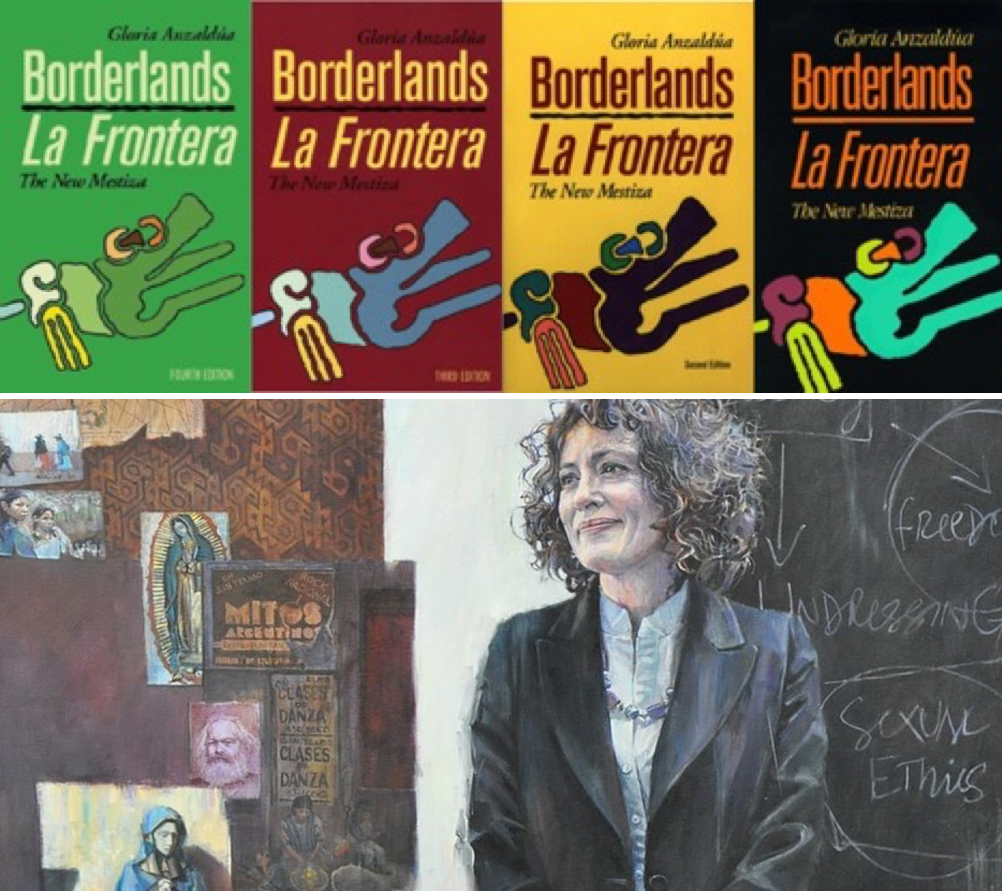
Borderlands (above); a portrait of Marcella Althaus-Reid by Scottish artist David Martin hangs in a classroom at New College School of Divinity at the University of Edinburgh.

When I was living in Cuernavaca in the late 1990s, friends recommended the work of the Chicana lesbian writer Gloria E. Anzaldúa (1942-2004), particularly Borderlands/La Frontera: The New Mestiza (1987). Born in Texas, she lived her life across the U.S. southwest. Some of her gems, retrieved from the internet (as my copy of the book is in Canada and I am in Mexico):

“Culture is made by those in power- men. Males make the rules and laws; women transmit them.”

And:

“This land was Mexican once,

was Indian always, 

and is. 

And will be again.”

I would also suggest reading work by or about Marcella Althaus-Reid (1952-2009), who challenged the foundations of patriarchal Christian theology with her “indecent theology.” A hint: “All theology is sexual theology.” Here’s a good introduction from Kittredge Cherry.