In Colombia, “mass mobilization” needed to counter Trump’s candidate

by Jim Hodgson

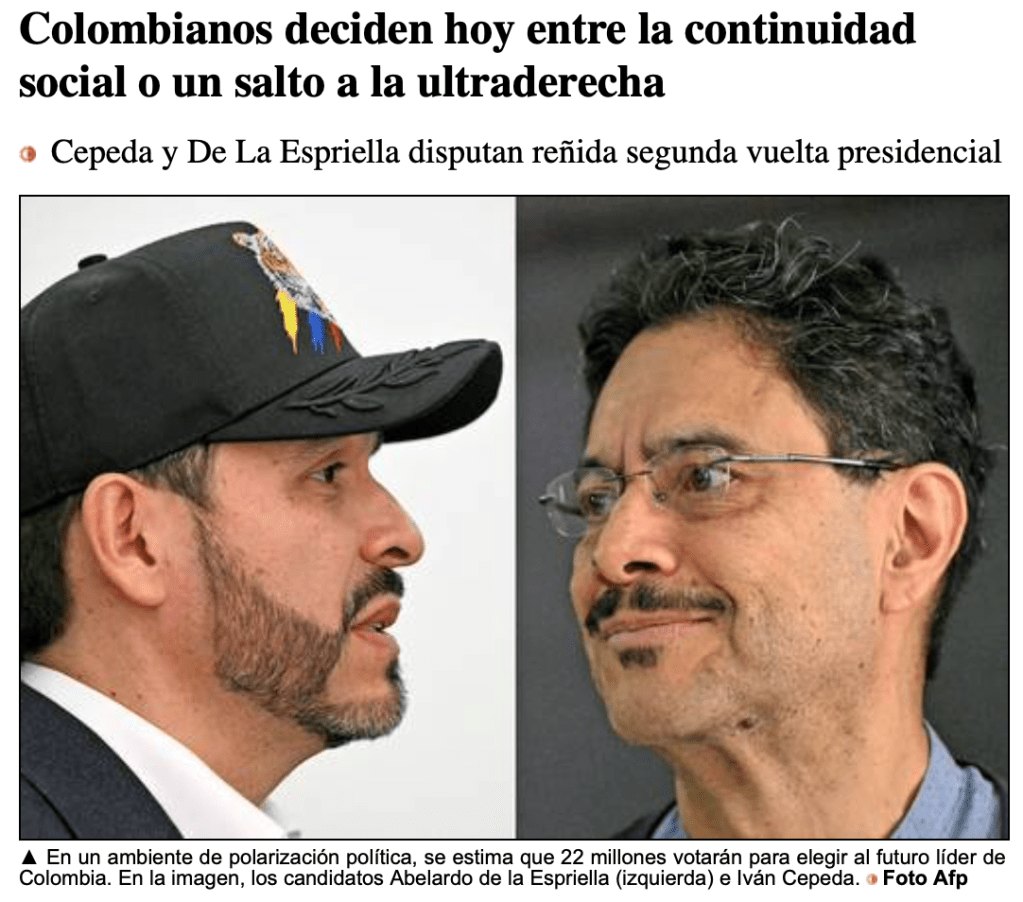
U.S. President Donald Trump has again interfered in a Latin American election, this time endorsing far-right candidate Abelardo de la Espriella in Colombia’s June 21 presidential runoff. Trump called him a “smart, strong, and tough leader” and described his opponent, Senator Iván Cepeda, as a “radical left Marxist.”

I beg to differ. Cepeda is a long-time human rights defender. My first awareness of his work dates from 2008 when he was with the National Movement of Victims of State Crimes (MOVICE). The first time that I can remember meeting him was in November 2015 at a breakfast meeting in Bogotá. By then he was a senator and had joined about 60 people from church and other civil society groups to hear reports from the peace negotiations that sputtered along in Havana ahead of the 2016 agreement.

Cepeda and de la Espriella will face each other in a second round of presidential voting on June 21. They were the top two candidates after a first round of voting May 31. De la Espriella won 44 per cent of votes, while Cepeda obtained 41 per cent. 

Petro urges mass mobilization

Colombia’s incumbent president, Gustavo Petro, swiftly condemned Trump’s backing of de la Espriella as a threat to Colombian sovereignty.

“When a country interferes in the decisions of another country, freedom dies,” Petro wrote. “I invite all of Colombia to vote in full freedom and not become either slaves or a colony of anyone.” Petro invoked Simón Bolívar and Antonio Nariño, the founding fathers of Colombian independence from Spain in the early 19th century, to draw a parallel between historical colonial subjugation and what he characterized as modern American meddling. “If the heart of the world loses its freedom and sovereignty, the hope of the world and of Colombia fades away.”

Petro had earlier cast the presidential runoff as a historic struggle between democracy and what he called “mafia fascism,” accusing de la Espriella of ties to paramilitary death squads and alleging widespread vote-buying during the first round. Petro argued that fascist movements have produced catastrophic human suffering wherever they have ruled and said Colombians have a moral obligation to defeat them at the ballot box.

For his part, Cepeda challenged his opponent to a public debate and called for an investigation into what he described as 885,000 electoral irregularities in the first-round vote, also alleging foreign interference in the election.

Every single ant is out moving mountains”

Among international observers, Rev. Emilie Teresa Smith of the Anglican diocese of New Westminster (B.C.) said in a Facebook post June 3 that “the forces of manipulation and corruption are deep and powerful.”

She looked at the context: that Trump and Secretary of State Marco Rubio had already re-configured the 19th-century Monroe Doctrine and declared Abya Yala (Latin America and the Caribbean) “their territory to control, exploit and destroy.” 

Smith also pointed to the April audio leaks of Honduran leaders, including convicted drug-trafficker and former president Juan Orlando Hernández. Together these comprise “Hondurasgate,” an international conspiracy to influence the last election in Honduras and to “extend the same operation across the region, targeting the progressive governments of Latin America.”

She also wrote of preparations for the next round of voting: “Every single ant is out moving mountains.”

In its observation report, the San Francisco-based human rights group Global Exchange said that for the first time in Colombian history, the U.S. embassy sent 86 observers to the polls. Among them was Ohio Republican Senator Bernie Moreno, born in Bogotá and now a close Trump ally. Weeks earlier, he warned that Washington might refuse to recognize results if evidence of coercion emerged and conditioned future U.S. assistance explicitly on the election’s outcome. A Florida member of the House of Representatives, María Elvira Salazar, went further. She publicly endorsed de la Espriella and urged Colombians to vote for him. After the vote, Moreno reported that the elections were “completely free and well run.”

The first-round result was unexpectedly close. The vote for a third candidate, Paloma Valencia, seemed to collapse, despite backing from former hard-right president Álvaro Uribe. 

The election also had a higher voter turnout – almost 58 per cent – than any first-round vote since the new constitution came into force in 1991. To win, Cepeda will need to add to Petro’s coalition. 

“What happens in Colombia on June 21 will not stay in Colombia,” concluded the Global Exchange report. “It will send a signal to every progressive movement in the hemisphere about whether it is possible to govern — and to be succeeded — under the weight of the Donroe Doctrine.”

Ecuador bans opposition party, criminalizes ecological defenders, joins U.S. military attacks

by Jim Hodgson

In a just world, news that Ecuador has banned its largest opposition party would be enough to scuttle Canada’s plans for a free trade agreement with the country – and even end U.S. military collaboration. But that is not the world we live in.

The news came as 77 organizations from Ecuador, Canada and around the world sent a letter to Canada’s ambassador in Ecuador urging the embassy to adopt Canada’s 2019 Voices at Risk: Canada’s Guidelines on Supporting Human Rights Defenders in response to the criminalization of Indigenous and environmental defenders. Among the signatories are MiningWatch Canada, Common Frontiers, and KAIROS Canada.

The letter to Ambassador Craig Kowalik was sent in response to the criminalization of Indigenous and environmental defenders from the Federation of Indigenous and Campesino Organizations of Azuay (FOA, Federación de Organizaciones lndigenas y Campesinas del Azuay). 

FOA members are facing criminal proceedings for their environmental defense work to safeguard the Kimsakocha páramo from the Loma Larga gold mining project, owned by Canadian mining company DPM Metals Inc.

The letter to the embassy expresses concern over criminal charges initiated by DPM Metals against six FOA members — Lauro Sigcha, Lizardo Zhaqui, Marco Tapia, Ruth Pugo, Carmita Pérez, and Yaku Pérez — following a peaceful clean-up action to remove mining waste left by the company near the headwaters of the Irquis and Tarqui rivers in the Kimsakocha páramo. The Kimsakocha páramo is a fragile ecosystem that regulates the regional hydrological cycle and provides fresh water to tens of thousands of people. For more than 30 years, Indigenous and peasant communities have defended this ecosystem against large-scale mining projects.

Ecuador bans opposition party

Acting on the request of the government-aligned Prosecutor General, an electoral judge in Ecuador on Friday (March 6) ordered the nine-month suspension of the country’s largest opposition party, the Citizens’ Revolution (RC ). 

The Center for Economic and Policy Research (CEPR) denounced the ban as the latest escalation in a broader pattern of authoritarian regression, including lawfare against opponents, repeated states of emergency, and deepening military ties with the Trump administration.

“The government of President Daniel Noboa, who is strongly backed by President Trump, is trying to accelerate the destruction of what is left of democracy in Ecuador,” said CEPR Co-Director Mark Weisbrot. The move bars RC –led by former President Rafael Correa – from local elections to be held in 2027.

U.S.-Ecuador military strikes

On the same day as the ban on the RC party, the Ecuadorian and U.S. militaries conducted joint airstrikes near the Colombian border targeting a site allegedly tied to dissidents from the former FARC guerrillas from Colombia. 

These “lethal kinetic operations,” as the U.S. military calls them, are another of Noboa’s efforts since his 2023 election to deepen ties with Washington — including a failed attempt to re-establish a U.S. military base in the country.

Days earlier, on Tuesday (March 3), the United States and Ecuador launched joint attacks against “designated terrorist organizations” – Trumpspeak for drug-traffickers.

Since September last year, the United States has attacked small boats in the Caribbean and eastern Pacific, but these attacks in Ecuador are the first known land operations by U.S. forces against drug cartels. At least 150 people have been killed in 44 known strikes. The United States has never shown proof that any of the dead were in fact moving illegal drugs.

While neither government will say precisely where the attacks are happening, Noboa ordered curfews in four provinces west and southwest of Quito, extending to the city of Guayaquil and beyond. Noboa said his country was “entering a new phase in the internal war.”

* An update (March 25 from Drop Site News:

New York Times investigation raises serious questions about a March 6 airstrike that Defense Secretary Pete Hegseth publicized on social media as proof the U.S. military was “now bombing Narco Terrorists on land.”

According to the Times, the target appears to have been a 350-acre cattle and dairy farm owned by a 32-year-old carpenter named Miguel, not a drug trafficking compound. Farm workers told the Times that Ecuadorean soldiers arrived three days earlier, beat and detained four Colombian workers, subjected them to waterboarding and electric shocks, doused structures with gasoline and set them alight—then returned on March 6 to film themselves bombing the smoldering ruins, producing footage Ecuador and the U.S. jointly promoted as the destruction of a traffickers’ training camp.

The Pentagon said the strike was conducted “jointly” with Ecuador, though Times sources said U.S. troops had no direct involvement in the bombing itself. Ecuador claimed to have recovered weapons and evidence of illicit activity but released no photographs, as it typically does following drug seizures. “It’s a lie that 50 people trained here,” Miguel said, standing amid his dead chickens. “There’s no logic.” (NYT)

As Haiti’s transitional government comes to an end, the U.S. flexes its muscles

by Jim Hodgson

In April 2024, I welcomed the formation of Haiti’s transitional council (known as the CPT). It was the product of negotiations among a broad spectrum of Haitian political parties and civil society organizations, including the business sector.

Within a month, fractures that would block steps toward a new election became apparent. And efforts to create conditions for an election were undermined by a rapid and ongoing increase in neighbourhood-based gang violence – despite the presence of UN-backed soldiers and police.

The mandate of the CPT expired on Saturday, Feb. 7, which also happened to be the 40th anniversary of the fall of the Duvalier family dictatorship. 

The transition ceremony Feb. 7: Haitians are “anti-constitutionally governed” (AlterPresse)

A U.S. warship and two Coast Guard ships sit in the Port-au-Prince harbour and a military plane was on the ground at the international airport. As many as 1.4 million people are displaced by gang violence. The political in-fighting rages.

In moments like this, I try to look at a variety of media sources to understand what is going on. The one I trust most is AlterPresse, a civil society initiative that emerges from among the groups that have worked for decades for a better future for people afflicted by poverty and violence. Haitian elites and their neoliberal allies abroad, meanwhile, seem determined again to impose a new totalitarian state, which is a predator state (like that of Duvalier) safe only for the rich and their cronies.

In the absence of any elections, Prime Minister Alix Didier Fils-Aimé (a businessman named to the post by the CPT in November 2024) will hold on to power beyond the CPT’s expiry. He will rule like former de facto Prime Minister Ariel Henry did from July 2021 through February 2024: a head-of-government without a head-of-state or Parliament. 

Accountability? Only to the foreign governments that have backed him: the United States, France and Canada.

Left: Statement by Foreign Affairs Minister Anita Anand. Right: Prime Minister Alix Didier Fils Aimé and Canadian ambassador to Haiti André François Giroux (Le Nouvelliste).

In several recent public statements, U.S. authorities affirmed their support for Fils-Aimé. He is presented as the key figure capable of ensuring institutional continuity. They particularly emphasize his role in building a Haiti that is “strong, prosperous, and free.”

But it is those ships in the Port-au-Prince harbour that remind Haitians that pleasant statements barely mask the history of U.S. hard power in Haiti. 

AlterPresse: strong signals from the United States and uncertainty about the transition in Haiti.

“The naval presence appears to provide the latest proof of Washington’s willingness to use the threat of force to shape politics in the Western Hemisphere,” Diego Da Rin, an analyst with the International Crisis Group, told AP News. Arrival of the ships comes during a months-long build-up of U.S. military force in the Caribbean – already used against Venezuela on Jan. 3. 

An essential historical overview

Gotson Pierre, editor at AlterPresse, wrote Feb. 5 (text is translated and lightly-edited for clarity and length):

For many observers, these developments cannot be understood without a historical overview of relations between Haiti and the United States. This history is marked by repeated interventions, both military and political.

From the occupation of 1915 to 1934, with its devastating human, economic, and institutional consequences, to the [interventions in 1994 and 2004], and including the massive deployment of troops in 2010 following the earthquake, the United States has played a central role in major Haitian crises. Added to this are non-military political interventions, notably during the 2010-2011 elections, and more recently, the case of former Prime Minister Ariel Henry.

Many analysts also believe that regional bodies such as the Caribbean Community (CARICOM) and the Organization of American States (OAS) operate within a framework heavily influenced by Washington. 

Haiti maintains a complex relationship with the United States, characterized by geographical proximity, strategic interdependence, and asymmetrical power dynamics. This proximity … continues to influence the country’s political trajectory.

On the eve of February 7, 2026, amid institutional uncertainties, increased international pressure, and a reinforced military presence, the equation remains unresolved. The coming days will reveal whether these signs signal a simple continuation within established frameworks or a new phase of political realignment under strong external influence.