After successful negotiations with the United States and El Salvador, Venezuela welcomed home 252 men held for five months in the infamous CECOT prison.
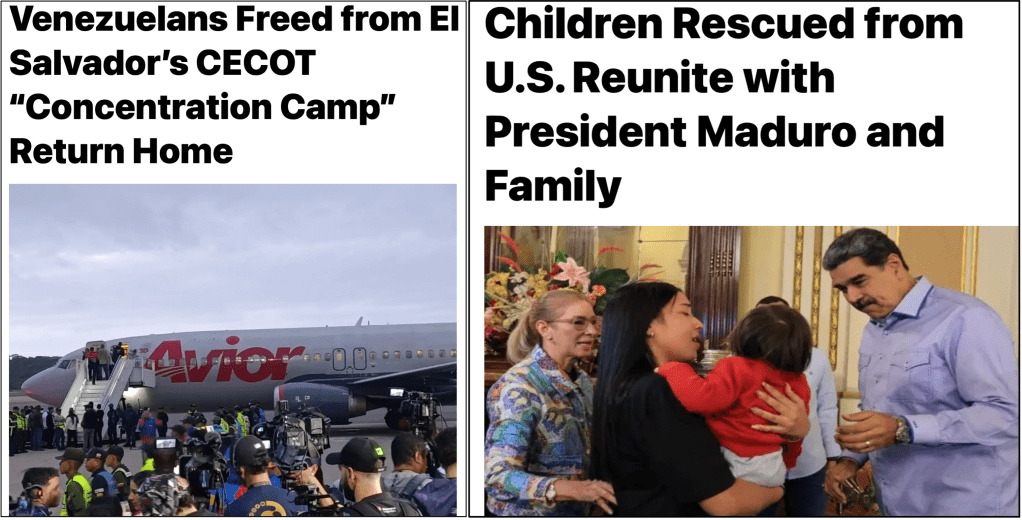
Headlines and photos from TeleSUR.
They arrived Friday, July 18, in two flights at Maiquetía International Airport north of Caracas, marking what TeleSUR called “a remarkable diplomatic victory for Venezuela’s ongoing campaign to defend its citizens abroad.” Earlier in the day, seven children separated by the U.S. government from their parents also arrived back in Venezuela after a flight from Texas.
In return, Venezuela freed ten U.S. citizens and permanent residents accused of political crimes. “Terrorists for innocents,” said President Nicolás Maduro. “We went to look for them from the concentration camps and we brought them back safe and sound.”
He explained that the prisoner exchange involved the release of confessed “foreign terrorists” and “agents of U.S. intelligence” accused of planning violent attacks in Venezuela, underscoring Venezuela’s commitment to protect its sovereignty and people.
U.S. Rep. Robert Garcia (a Democrat from California) confirmed that Andry Hernández Romero, the 31-year-old gay hair stylist, was among the men returned to Venezuela.
The Trump administration’s choice to send scores of young men to a high-security prison in El Salvador was based on a lie: that they were part of a Venezuelan gang called Tren de Aragua. But investigations by journalists and civil society groups like thedisappeared.org showed that most (if not all) of the men had no ties to organised crime, no criminal records and had been admitted legally to have their asylum claims heard.
Aside from outright cruelty and the lack of even the pretence of due process, these extraordinary renditions (to borrow a phrase from the George W. Bush years) have damaged Trump’s credibility on immigration issues. In her Substack column July 14, U.S. historian Heather Cox Richardson pointed to recent polls that show his actions are not going over well with the U.S. public.
Seventy-nine per cent of adults say immigration is good for the country. Eighty-five per cent of adults want laws to allow “immigrants, who were brought to the U.S. illegally as children, the chance to become U.S. citizens if they meet certain requirements over a period of time.” Seventy-eight per cent of adults want the law to allow “immigrants living in the U.S. illegally the chance to become U.S. citizens if they meet certain requirements over a period of time.” Only 38 per cent want the government to deport “all immigrants who are living in the United States illegally back to their home country.”
A two-day meeting this week in the Colombian capital ended with renewed commitment to pursue accountability for Israeli abuses in Gaza, including by preventing the transfer of weapons to Israel.
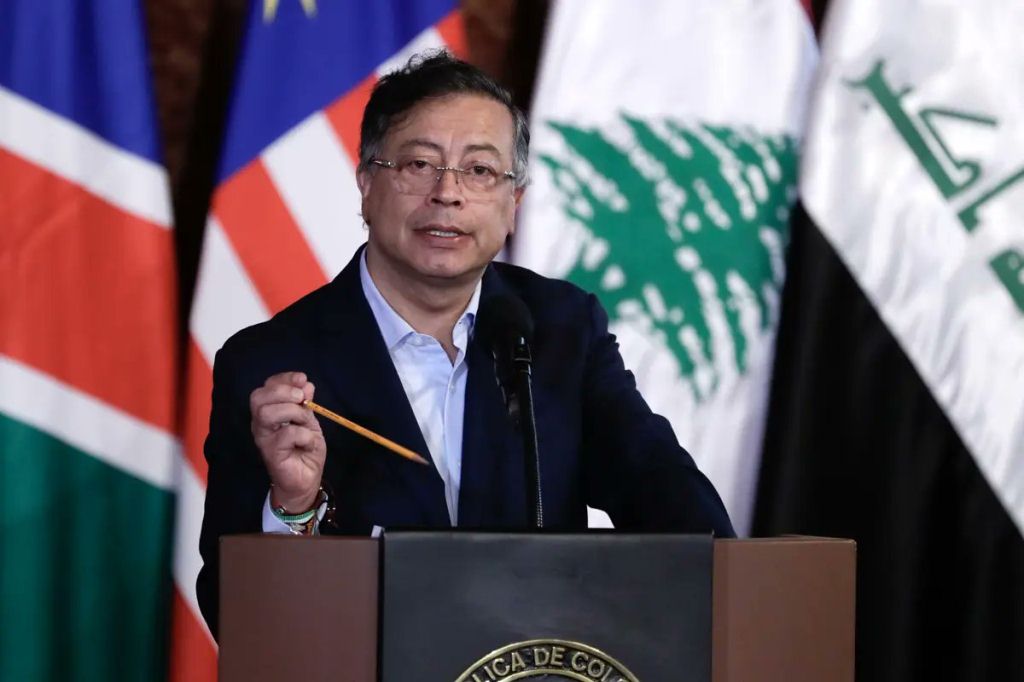
As the event drew to a close Wednesday (July 16), Colombian PresidentGustavo Petro (above) told participants, “Gaza is simply an experiment by the ultra-rich to show the impoverished people of the world how they will respond to humanity’s rebellion.”
Petro also distanced himself further from the North Atlantic Treaty Organization (NATO), which in 2022 had designated Colombia as a “non-member strategic ally.”
“What are we doing in NATO, if its principal leaders are with the genocide?” he asked. “We must leave.”
A coalition known as The Hague Group organised the summit. It was born in January last year through the help of Progressive International (PI), an organization founded in 2020 to unite, organize, and mobilize progressive forces around the world. PI called the Bogotá meeting the “most ambitious multilateral action since the start of Gaza genocide 21 months ago.”
Jointly convened by the governments of Colombia and South Africa as co-chairs, the Hague Group also includes Bolivia, Cuba, Indonesia, Iraq, Libya, Malaysia, Namibia, Nicaragua, Oman and Saint Vincent and the Grenadines. At least 18 other countries, plus the United Nations and the World Council of Churches, sent representatives. Qatar and Egypt, which are overseeing negotiations between Hamas and the Israeli government, attended.
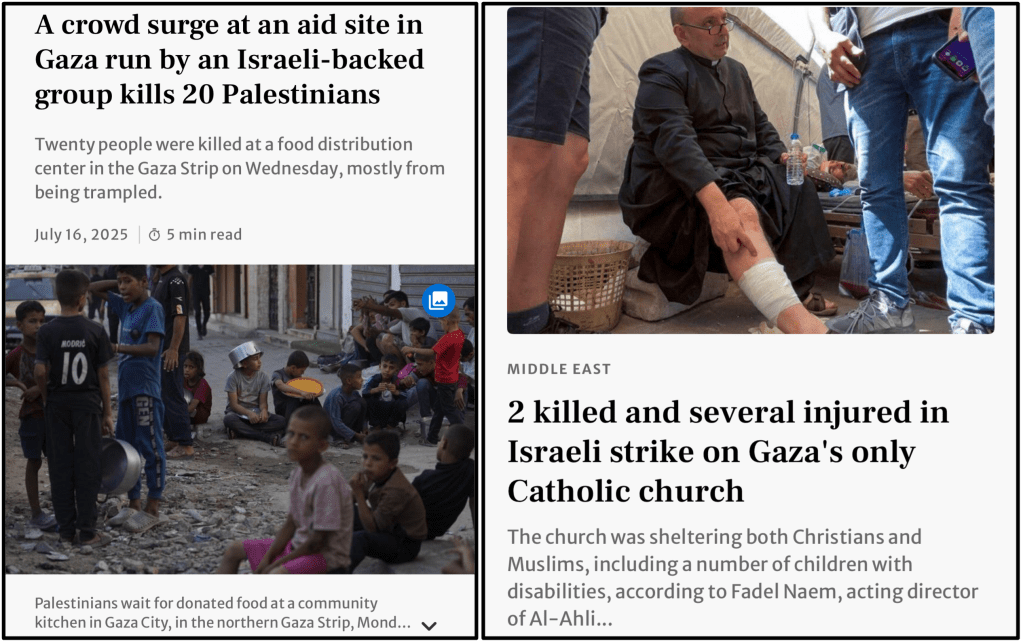
Israel’s offensive in Gaza has killed more than 58,000 Palestinians, according to Gaza’s Health Ministry, which has said women and children make up more than half of the dead. At least 90 were killed on Thursday (July 16), including those who were crushed at an Israeli-controlled food distribution site. Holy Family Church also came under attack, sparking criticism and new calls for peace from Pope Leo XIV and from the World Council of Churches.
During Tuesday morning’s opening event, various officials spoke, calling for an end to Israel’s attacks on Gaza. Colombia’s foreign minister, Rosa Yolanda Villavicencio, said during her morning address that Israel’s attacks constitute an unequivocal “genocide.”
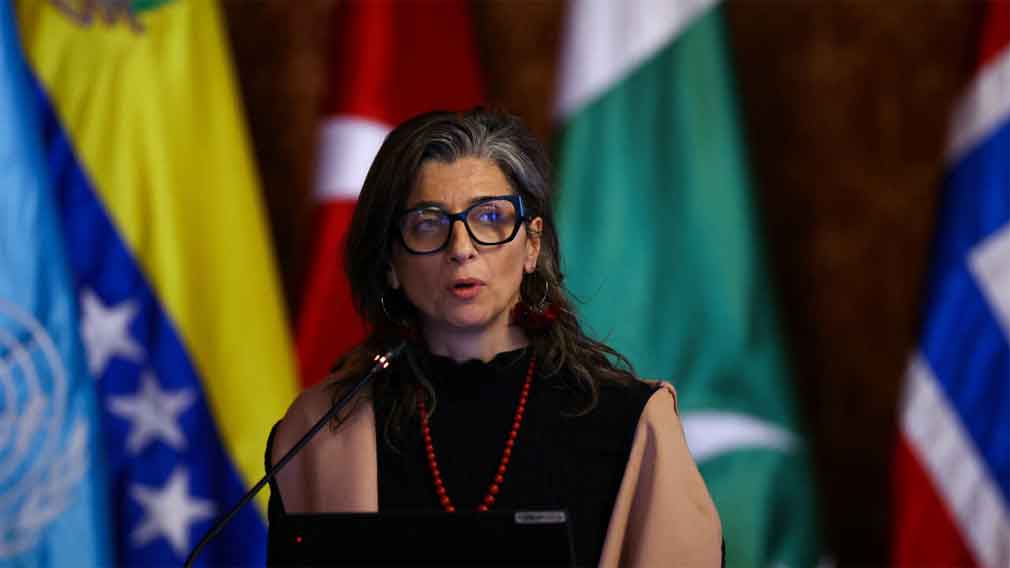
Another key participant was Francesca Albanese (above), the U.N. special rapporteur for the Palestinian Territories. She denounced the inaction of the international community. She accused the West of justifying Israeli actions as the “right to defense” and said the vetos in the U.N. Security Council “protect war crimes” carried out in the sight of all.
“Palestine has changed global consciousness, drawing a clear line between those who oppose genocide and those who accept it or are part of it,” she said. Albanese was recently sanctioned by the US for her outspoken criticism of Israel’s actions.
“We believe in protagonism, not supplication,” said Varsha Gandikota-Nellutla, the executive secretary of The Hague Group. “Today marks an end to the era of the impunity and the beginning of collective state action by governments of conscience.”
The group members committed to implementing six measures immediately through their domestic legal and administrative systems to break the ties of complicity with Israel’s campaign of devastation in Palestine. They set September 20 as a date for other states to join them, coinciding with the 80th U.N. General Assembly. Consultations with capitals across the world are now ongoing.
“We hereby announce the following measures,” the Joint Statement on the Conclusion of the Emergency Ministerial Conference on Palestine reads, “to be adopted based on states’ domestic legal and legislative frameworks:”
Prevent the provision or transfer of arms, munitions, military fuel, related military equipment, and dual-use items to Israel…
Prevent the transit, docking, and servicing of vessels at any port…. in all cases where there is a clear risk of the vessel being used to carry arms, munitions, military fuel, related military equipment, and dual-use items to Israel
Prevent the carriage of arms, munitions, military fuel, related military equipment, and dual-use items to Israel on vessels bearing our flag… and ensure full accountability, including de-flagging, for non-compliance with this prohibition.
Commence an urgent review of all public contracts, to prevent public institutions and funds from supporting Israel’s illegal occupation of the Palestinian Territory and entrenching its unlawful presence.
Comply with obligations to ensure accountability for the most serious crimes under international law, through robust, impartial and independent investigations and prosecutions at national or international levels, to ensure justice for all victims and the prevention of future crimes.
Support universal jurisdiction mandates, as and where applicable in national legal frameworks and judiciaries, to ensure justice for victims of international crimes committed in the Occupied Palestinian Territory.
“These 12 states have taken a momentous step forward,” said Albanese about the joint statement. “The clock is now ticking for states—from Europe to the Arab world and beyond—to join them.”
El Salvador’s government has arrested Ruth Eleonora López, a prominent human rights lawyer, as it steps up attacks on rights defenders, environmentalists and journalists.
López leads anti-corruption work at Cristosal, one of the country’s leading human rights groups. It was created in 2000 with backing from the global Anglican communion in 2000. “To this day, our work is inspired by the Anglican communion’s commitment to justice and the dignity of every human being and demonstrated through the role of the church during El Salvador’s civil war,” its website states.
Cristosal helps document evidence of state crimes under El Salvador’s ongoing three-year state of emergency.The measure is used to arrest people believed to be associated with gang violence, but other people have been swept up as well. It restricts the right to gather, to be informed of rights and to have access to a lawyer. It extends to 15 days the time that someone can be held without charges. Associated Press says that some 85,000 people have been arrested under the state of emergency.
Al Jazeera reported that Cristosal has also tried to assist more than 250 Venezuelans who were sent by the United States to a jail in El Salvador.
On Sunday night (May 18), two weeks before Nayib Bukele reaches his sixth anniversary in power in El Salvador, the Attorney General’s Office announced the arrest of López via X (formerly Twitter). As of late afternoon Monday, her whereabouts were still unknown and her family joined Cristosal in demanding the government provide more information.
The English-language service of El Faro newspaper—itself under attack by the Bukele regime— said the arrest derives from accusations of embezzlement, but the case file is declared secret. Prosecutors claimed to have gathered information during raids carried out against Eugenio Chicas, a former president of the Supreme Electoral Tribunal arrested in February, and who remains in custody.
“The only reason for this detention is that I am a human rights defender and work for an NGO uncomfortable for the government,” López said upon her arrest. She told the officers: “Have some decency; one day this will all end. You must not play into this.”
El Faro said May 5 that a reliable source had told its reporters that the Bukele-controlled Attorney General’s Office is preparing at least seven arrest warrants for members of El Faro. The source reached out following the publication of interviews with former leaders of the Revolucionario faction of the 18th Street Gang (Barrio 18) about Bukele’s years-long relationship to gangs.
If carried out, such arrests would be the first time in decades that prosecutors seek to press charges against individual journalists for their journalistic efforts.
One of the gang leaders said that he had been secretly released from custody at the height of the country’s ongoing state of exception as part of his gang’s continued negotiations with Bukele’s government. The interview focus attention on the extent to which Bukele’s rise to power was tied to secret negotiations with the country’s gangs.
The NACLA Updatesummarizes the interviews this way:
El Faro’s reporting shows that the links between the Barrio 18 gang and Bukele began all the way back in 2014, when Bukele was a council member of small-town Nuevo Cuscatlán looking to run for mayor of San Salvador. During his campaign for mayor, a close Bukele ally warned gang members of impending police raids and delivered community development projects to the gang’s turf; in exchange, gang leaders cracked down on opposition activists and forced community members to vote for Bukele.
Ties between Bukele and the country’s gangs, including MS-13, have long been documented by El Faro and other outlets and have caused tensions with the United States. Nevertheless, news that a gang leader convicted of murder was released at the height of the crackdown brings unwanted scrutiny on the Salvadoran government at a time when Bukele has enthusiastically sought favor with the Trump administration.




 Unwrapping Development