Haitian claim for slavery reparations at the heart of a UN forum

by Jim Hodgson

A United Nations forum on the historic wrongs committed against people of African descent is building momentum in favour of an international tribunal on atrocities dating back to the transatlantic trade of enslaved people.

When the UN Permanent Forum on People of African Descent (PFPAD) held its third session in less than two years in Geneva in mid-April, African and Caribbean governments together with civil society organizations pressed forward with plans to create a tribunal that would be similar to that which oversaw the Nuremberg trials of Nazi war criminals after World War II.

Proponents say such a tribunal would help establish legal norms for international and historical reparations claims.

Supporters include many members of the Caribbean Community (CARICOM), made up of 15 member states, and the African Union (AU), which includes 55 states—and Antonio Guterres, the UN General Secretary. “We call for reparatory justice frameworks, to help overcome generations of exclusion and discrimination,” he said March 25.

Supporters argue that Western countries and institutions that continue to benefit from the wealth slavery generated should be held accountable, particularly given ongoing legacies of racial discrimination. Opponents say that contemporary states and institutions should not be held responsible for historical slavery.

The World Council of Churches was among faith-based and civil society organizations that came together at the PFPAD forum to examine what states and other actors may do to redress the historic exploitation and harms that Africans and people of African descent have suffered. (You can learn more here about global ecumenical efforts to overcome racism, discrimination and xenophobia.)

Righting the wrongs in Haiti

Given that Haiti’s claim for reparations is among the strongest, the voices of Haitian civil society groups and their diaspora counterparts were heard at the PFPAD forum. 

Those groups used the forum to put a spotlight on the crucial role that Haiti played in the struggle to end slavery. “To recognize the historic context is essential to understand the unique position of Haiti in the global struggle for justice and egality,” they said in a statement before the forum. Participating groups—including the Montana Accord network and of the Haitian-American Foundation for Democracy (HAFFD)—said they strongly approve calls for reparations to Haiti.

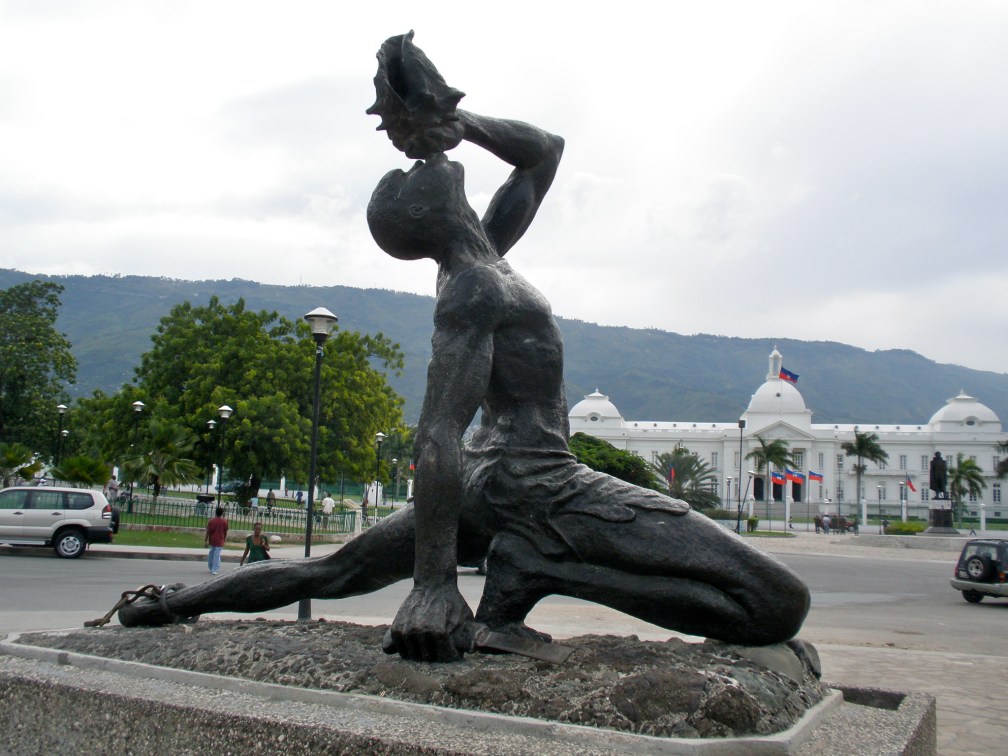
Le Marron Inconnu, and in the background, the National Palace before the 2010 earthquake.

Haiti was born as an independent nation in 1804 after the enslaved people revolted against their French colonial masters. The values of “liberté, égalité et fraternité,” expressed in the triumph of the French Revolution in 1789, resonated among slaves in Saint-Domingue, France’s richest colony. In 1804, the world’s first successful slave rebellion resulted in the birth of the Republic of Haiti. 

Beginning in 1825, France squeezed an “independence debt” from Haiti that adds up to at least $21 billion in today’s dollars. That estimate comes from The New York Times, but backers of the reparations claim say the amount is much higher.

“It’s $21 billion plus 200 years of interest that France has enjoyed so we’re talking more like $150 billion, $200 billion or more,” Jemima Pierre, professor of Global Race at the University of British Columbia, told Reuters.

Despite the obvious injustice of that debt, France continues to resist pressure to join in reparations. In August 2010, about 100 prominent academics, authors, and human rights activists signed on to an open letter to then-President Nicolas Sarkozy, arguing that the case for repayment was “morally, economically, and legally unassailable.” France dismissed the petition, pointing to its record of delivering other aid to Haiti and not addressing the legitimacy of the debt.

“What’s important is that it’s time that France recognises this and we move forward,” Haitian civil society activist Monique Clesca told Reuters. France, whose development agency has given hundreds of millions of dollars in aid to Haiti, has previously referred to a “moral debt” owed to Haiti.
Transformation in Mexico: a work in progress

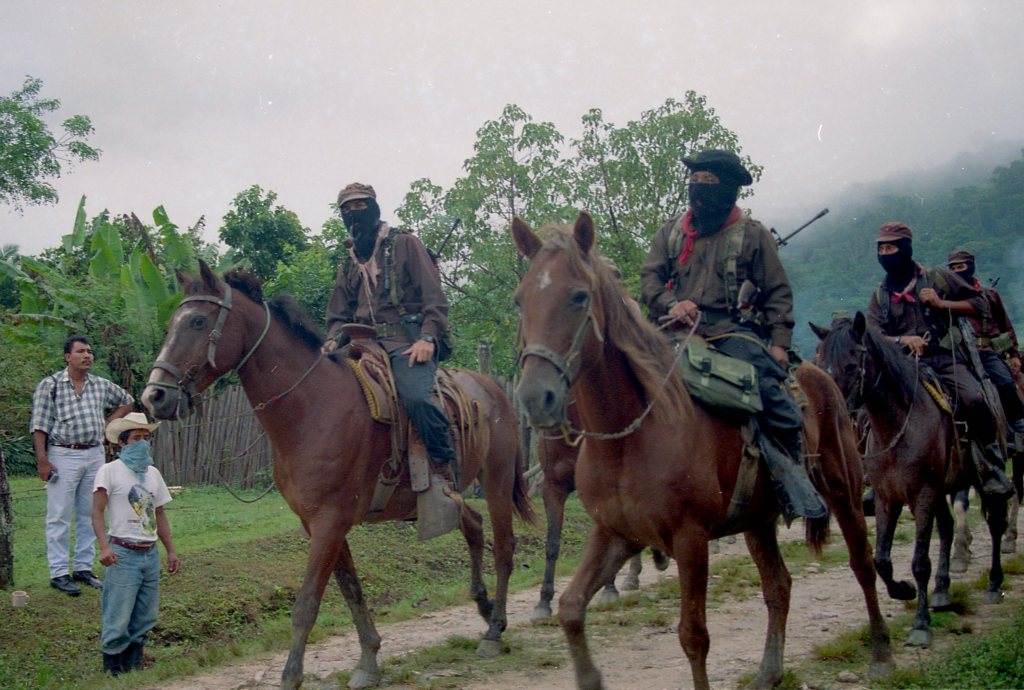
Zapatista leaders: Marcos and Moises in La Realidad, Chiapas, November 1996. Photo: Jim Hodgson

by Jim Hodgson

On Jan. 1, 1994, the same day that the North American Free Trade Agreement (NAFTA) came into effect, the Zapatista Army of National Liberation (EZLN) seized control of several cities in the highlands of Chiapas, Mexico’s southern-most state.

Within a few days, it was clear that the group was Indigenous-led and that it had a charismatic spokesperson in Subcomandante Marcos. The movement also had expectations of social transformation that extended beyond the immediate goal of improving the lot of the Maya people of the Chiapas highlands.

From mountains of southeast Mexico, the Zapatistas put forward a vision of a world where there is respect for diverse ways of being human and of organizing political life, where there might be diverse expressions of truth in the face of supposedly universal truths like the one offered by business elites about the all-powerful “invisible hand” of the free market. They invited us to imagine a world with room for all – “un mundo donde quepan muchos mundos.”

Headlines on Jan. 1, 1994: “Uprising in Chiapas,” “EZLN takes 4 cities in Chiapas”

The Zapatistas pressed for new ways of thinking about power – that leaders should obey their communities – and rejected the hegemony of political parties. The vision had a big impact on those who created the World Social Forum series of encounters that in turn have helped to transform politics in Latin America over the past quarter-century.

Zapatista communities established autonomy from other levels of government, and set about ruling themselves. In the words of a chronicler of social movements in Latin America, Raúl Zibechi, these processes “modify” how people relate to each other as they manage health, education, production, justice, celebrations, sports and art: more mutual, less expert-client, relationships.

Competing posters: Bishop Samuel Ruiz was a man “wanted” for “treason;” EZLN says, “The world that we want is one with room for many worlds.”

“Disorganized crime” and “remilitarization”

Thirty years on, the communities say they have to re-organize themselves in the face of violence between rival drug cartels – “disorganized crime,” the EZLN called them in a recent statement – that now afflicts Indigenous territories near the border with Guatemala and indeed across most of Chiapas. 

Forced displacement, said the Fray Bartolomé de Las Casas Human Rights Centre (known as Frayba), is among the most serious human rights violations in Chiapas today. In a new report launched in July, the San Cristóbal-based group said 16,755 people had been forced from their homes between 2010 and 2022. Frayba attributed the violence to actions by paramilitary groups that have afflicted the state for decades and to the newer criminal gangs, adding that the violence affects the Zapatista communities. At the same time, Frayba describes a “remilitarization” –more soldiers, more bases – in the area. 

Mexico’s Fourth Transformation

In 2018, Mexicans chose their new president, Andrés Manuel López Obrador (AMLO) on the same day as the people of Chiapas elected their new governor, Rutilio Escandón. Their party, the National Regeneration Movement (Morena), promotes a program of change they call the “Fourth Transformation” (4T), the previous three being the war of independence, the mid-19th-century liberal reforms of Benito Juárez, and the Mexican Revolution (1910 to 1917 – or through 1940, if you include the massive land reform led by Lázaro Cárdenas in the mid and late 1930s).  The 4T includes a security component: “abrazos, no balazos” (hugs, not shootings), the idea being to ensure that people have viable economic possibilities so that they do not turn to lives of crime.

More than five years into their respective administrations (and six months before the next elections), reviews are mixed. The old conservative parties loathe AMLO – “socialist!” “Chavista!” A more responsible critique comes from Indigenous people and sectors of the left that reject “neo-developmentalist” approaches that emphasize resource extraction and mega-projects for the sake of job creation – but again mostly benefit the traditional elites. Those criticisms were also levelled at all of the so-called “pink tide” governments that produced some changes over the past 25 years, but did not transform the systems of dependence on the export of natural resources. (This problem afflicts Canada too and in the face of climate change, requires urgent action.)

Despite promises, Mexico’s 4T government has not tried to implement the San Andrés Sakamch’en Agreement that was achieved in negotiations among Indigenous peoples and the government in 1996. Those talks, sparked by the EZLN-led rebellion and moderated by Bishop Samuel Ruiz, marked the first (and only) time that the government has negotiated face-to-face with Indigenous peoples. It was not a comprehensive peace deal, but rather the first step in a planned process to address Indigenous rights in Chiapas and beyond.

On June 2, 2024, voters will elect a new president and a new governor for Chiapas. These will be the sixth since the EZLN uprising. Over the years, the Zapatistas have used a variety of strategies to have an impact on Mexico’s political culture. They won’t be silent in the coming months.