Catholic bishops from Latin America, Africa and Asia demand climate justice

by Jim Hodgson

In a new document, Catholic church leaders from across the Global South blasted the “openly denialist and apathetic stance” of “so-called elites of power” in the industrialized world who pressure their governments to back away from much-needed mitigation and adaptation measures.

Preparing for the next United Nations climate change gathering, COP30, which will take place in November in Brazil, conferences of bishops from Asia, Africa and Latin America (FADM, SECAM and CELAM respectively) published a joint document entitled A call for climate justice and the common home: ecological conversion, transformation and resistance to false solutions. (You can download the document here.)
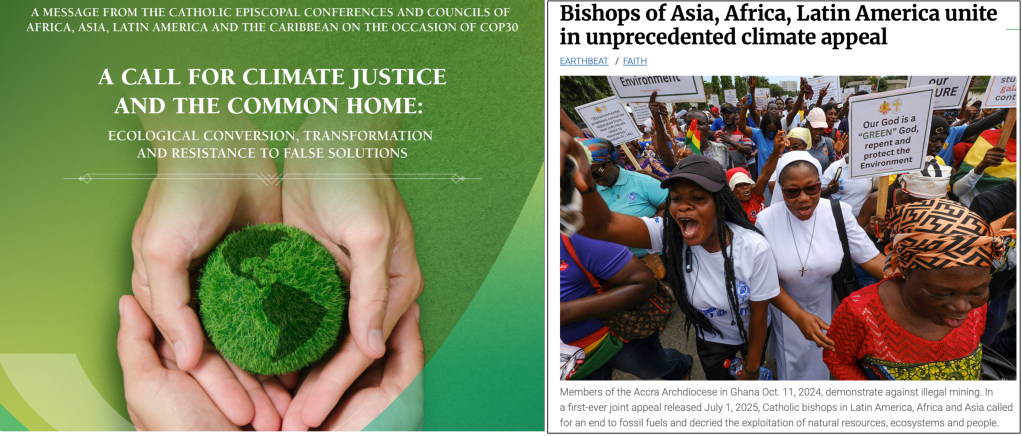
It’s the first time the three regional bodies have created a joint statement. The document offers an expansive vision for the U.N. climate conference. “At COP30, we demand that States take transformative action based on human dignity, the common good, solidarity and social justice, prioritising the most vulnerable, including our sister Mother Earth,” the bishops said.

They described the U.N. climate gathering as a moment for the church “to reaffirm its prophetic stance.”

Part of the 32-page document states:

Our demand

The climate crisis is an urgent reality, with global warming reaching 1.55°C in 2024. It is not just a technical problem: it is an existential issue of justice, dignity and care for our common home.

The science is clear: we must limit global warming to 1.5°C to avoid catastrophic effects. We must never abandon this goal. It is the Global South and future generations who are already suffering the consequences.

We reject false solutions such as ‘green’ capitalism, technocracy, the commodification of nature, and extractivism, which perpetuate exploitation and injustice.

Instead, we demand:

Equity: Rich nations must pay their ecological debt with fair climate finance without further indebting the Global South, to recover losses and damages in Africa, Asia, Latin America and the Caribbean, and Oceania.

Justice: Promote economic degrowth and phase out fossil fuels, ending all new infrastructure and properly taxing those who have profited from them, ushering in a new era of governance that includes and prioritises the communities most affected by the climate and nature crises.

“I am raising a voice that is not mine alone, but that of the Amazonian peoples, of the martyrs of the land—we could say of the climate—and of the riverside, Indigenous, Afro-descendant, peasant and urban communities,” said Cardinal Jaime Spengler, archbishop of Porto Alegre in southern Brazil and president of CELAM. He was speaking at a news conference July 1 at the Vatican.

Vatican News reported that Canadian Cardinal Michael Czerny, prefect of the Vatican’s human development office, spoke spontaneously in the news conference to point to the document’s connection to the legacy of Pope Francis. “Ten years ago, I wonder if there is anyone who could have imagined this press conference as a fulfilment and implementation of Laudato si’. This is an extraordinary expression of what Pope Francis has called for and what Pope Leo is continuing to underline and call. I am grateful,” he said.

WCC begins Ecumenical Decade of Climate Justice Action

In Johannesburg ten days earlier, the World Council of Churches launched its Ecumenical Decade of Climate Justice Action.

During a plenary session June 21 of the WCC central committee, church leaders from six continents shared reflections and urged action for climate justice.

The plenary emphasized the biblical concept of jubilee as a framework for systemic transformation—a key foundation of the Ecumenical Decade. Speakers called for churches to move beyond charitable responses toward addressing root causes of climate injustice, particularly the disproportionate impact on vulnerable communities.

“Our lifestyle consumes 1.8 times what Earth can renew. Economic transformation must begin in the heart; theology must shape discipleship and discipleship must shape the world,” said Rev. Dr. Charissa Suli, president of the Uniting Church in Australia, during a theological reflection on “Jubilee for People and Earth.”

[When I shared Dr. Suli’s comment on Facebook several days ago, my colleague and friend Mark Hathaway pointed out: “In the Global North, it is more like 4.5 times what the Earth can renew—and even higher in the U.S. and Canada (I think about 6 times). The richest 10-20 per cent of humanity is responsible for most consumption and most GHGs [greenhouse gases] and a mere 100 large corporations are responsible for 70 per cent of GHGs.”

WCC has held previous ecumenical decades in the past, including The Ecumenical Decade of the Churches in Solidarity with Women (1988-1998) and The Ecumenical Decade to Overcome Violence (2001-2010).
From bishop of Chiclayo to Pope Leo XIV

by Jim Hodgson

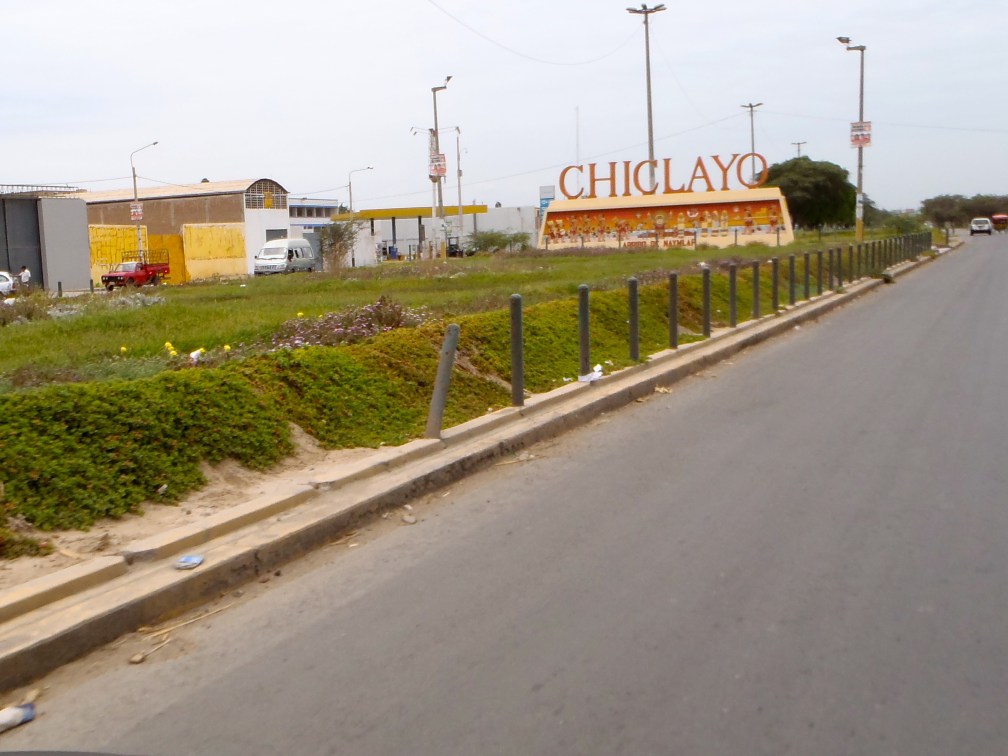
Like many who have worked in Latin America, I rejoiced when I saw that cardinal-electors chose Robert Francis Prevost, the former bishop of Chiclayo (Peru) to serve as Pope, the bishop of Rome. 

And as one who believes Catholic social teaching is not studied sufficiently, I was over the moon when I understood that Prevost had chosen to be called Leo XIV. The last Leo was Pope Leo XIII, who served from 1878 to 1903. He is respected as a pioneer of modern Catholic social teaching. In his famous 1891 encyclical Rerum novarum, Pope Leo outlined the rights of workers to a fair wage, safe working conditions, and the formation of trade unions.

Yes, there are controversies over the selection of Prevost. 

Prevost talked negatively in 2012 about sexual and gender diversity. But in that same year, Archbishop Jorge Bergoglio (a year later Pope Francis) was still in Buenos Aires and fighting legal reforms promoted by the Kirchner-Fernández governments in favour of same-sex marriage. Jesuit Father James Martin, long an ally of LGBTQIA+ people, spoke positively about Prevost after being part of a table group with him during the Vatican’s Synod on Synodality.

There are allegations that Prevost did not pay sufficient attention to victims of clerical sexual harassment while bishop in Chiclayo. Tragically, it is hard to find any bishop, living or dead, who has adequately served survivors of clerical abuse. The real issue is making rules that are effective in making dioceses submit to civil authorities in cases of crime, and to take victims’ allegations seriously in all cases of harassment or abuse. Perhaps his proximity to scandal will help him and others take further steps toward justice for all victims of clerical abuse. 

Much has changed; more needs to change; and Leo XIV may be a step in the right direction. Let’s work toward full inclusion of—and leadership by—women and 2SLGBTQIA+ people.

The church in Chiclayo

Today, I found myself going back through decades of notes. Here is something I wrote during a visit to Chiclayo in 2017:

“Chiclayo has a new bishop who is more in the line of Pope Francis—a positive sign after many years of traditionalist Opus Dei bishops. The new bishop, my friends said, still needs some education around gender justice, but he’s pretty good on economic justice and on developing lay leadership. Social movements here have bloomed outside of the church, including the LGBTIQ and People Living with HIV and AIDS (PLWHA) movements.”

That conversation unfolded with members of Centro Esperanza, a United Church partner from 2006 to 2018. Their work had roots in progressive Christian base communities. It began with a focus on women, particularly those who were involved in community kitchens organized and run by women in impoverished neighbourhoods. Over time, activities expanded to include programs to prevent domestic violence, stimulate learning in early childhood, and gender justice education among high school students.

Several of my Canadian friends have worked in Chiclayo over the decades, beginning with members of the Scarboro Foreign Missionary Society. Their leadership is part of what shaped Chiclayo’s influence on its new bishop.

Catholic Social Teaching

And I went back through my notes on Catholic social teaching. One of the most complete—and still quite short—summaries is a presentation by Bill Ryan, a Canadian Jesuit and social activist. He was a general secretary of the Canadian Conference of Catholic Bishops (CCCB) during part of the time I worked with the Canadian Council of Churches.

In 2000, he spoke to the Coady International Institute at St. Francis Xavier University in Antigonish, Nova Scotia, on the development of Catholic social teaching. Some key points:

What is Catholic Social Teaching? It is a formula or a set of principles for reflection to evaluate the framework of society and to provide criteria for prudential judgment and direction for current policy and action.

  • The inherent human dignity of every person that makes them “sacred”—created in God’s image. This is the ultimate grounding for human rights.
  • The principle of human solidarity. Every person is radically social by nature and by nurture, destined to build up and share human community. The basic element of all creation is interconnectivity, interdependence, and relationships between and among all creatures. Without community we are not human.
  • The principle of subsidiarity. This principle balances the power between the individual and community. It calls for a pluralistic structuring of power in society. That is, human society is more than government; it is the thousands of voluntary and corporate associations that make up civil society. Decisions in society should be taken at the lowest competent level of society.
  • The neediest among us have a special claim on our care and compassion.
  • The common good: the social conditions that allow people to reach their full human potential and to realize their human dignity.
  • And remember that fidelity in relationships extends also to our caring for our “mother” earth.

All of this, it seems to me, is “teaching”—asserting principles, not doctrine.

Ryan said it was untidy, and it is. Church leaders, he said, attempt “to balance the maintenance needs of the church with those of its prophetic mission. What priority should they place on safeguarding unity in the church while preaching the prophetic preferential option for the poor?”

The process, he added, may become even more untidy as more conferences of bishops learn with their people how better to “read the signs of the times” and to “engage Christian communities in believing, preaching and acting on a preferential option for the poor.”

Pope Francis opened a process—“synodality”—for bishops to talk with their people. From his opening remarks, Pope Leo XIV seems determined to keep that door open.

The next morning, the new pope said Christians must offer witness in a world that prefers power, pleasure, and success to faith. Where Christians are “mocked, opposed, despised or at best tolerated and pitied” is where the Catholic Church’s “missionary outreach is most desperately needed,” he said in his first homily as leader of the world’s 1.4 billion Catholics.