From Palenque, Chiapas, Latin American leaders call for migration solutions

In recent weeks, my partner and I took a long drive from British Columbia through the western United States and then almost the length of Mexico to arrive in Chiapas.

While people who migrate northwards either for seasonal work or for more permanent refuge from poverty, violence and impacts of climate change were on our minds and in the news, at least some of the people we met alongside us in gas stations and cafés were seasonal workers heading home for the winter. 

Migration, my friends, is normal. In southern Texas and northern Mexico, we encountered thousands of monarch butterflies as they headed for Michoacán. And here in Chiapas, the migratory birds are arriving daily.

At around the time of our trip, leaders of ten nations of Latin America and the Caribbean – frustrated by slow progress with the United States (and other northern countries) in advancing meaningful human development and managing the flow of people – gathered in the historic Maya city of Palenque, Chiapas, and proposed some ways forward.

Photo from the Office of the President of Mexico

Led by Mexico, the governments of Belize, Colombia, Costa Rica, Cuba, El Salvador, Haiti, Honduras, Panama and Venezuela signed the Palenque Declaration on Oct. 22 and called for solutions. (A representative of the newly-elected government in Guatemala also joined the talks.)

In the declaration, presented by the Mexican Foreign Minister, Alicia Bárcena, the leaders described several structural causes of migration: internally political, economic, social factors and the effects of climate change. But they also pointed to “external factors such as unilateral coercive measures of an indiscriminate nature – dictated from the United States – that negatively affect entire populations and, to a greater extent, the most vulnerable people and communities.”

They urged the United States to lift the sanctions imposed on Cuba and Venezuela that help drive the exodus. Such sanctions are against international law and, as the migration flow shows, they have impacts beyond the countries to which they are applied.

The document also proposed undertaking efforts to modify the financial architecture of debt; to close social gaps to as to reduce the impulse to migrate; push for measures aimed at increasing agricultural activity to promote food self-sufficiency in the region; and to promote intraregional trade and investment for socioeconomic development.

The signatory nations stressed that measures must be taken to confront transnational organized crime, human trafficking and corruption, as well as promote joint cooperation in security matters.

They called for destination countries to “adopt immigration policies and practices in line with the current reality of our region and abandon those that are inconsistent and selective, to avoid arbitrarily producing both ‘call effects’ and ‘deterrent effects’ – advantages given to certain countries for political reasons while nationals of other countries are blocked.

They encouraged destination countries to widen their regular migration pathways, with emphasis on labour mobility and promotion of re-integration and safe return of temporary workers to their homes.

The declaration makes special mention of Haiti, and called on nations to support efforts by the United Nations and others to re-establish conditions for human security so that the political, economic and social situation may be normalized, and to focus on sustainable development. (The presence of the Haitian president at the gathering angered some of the Haitian migrants camped out in the centre of Palenque, reported La Jornada.)
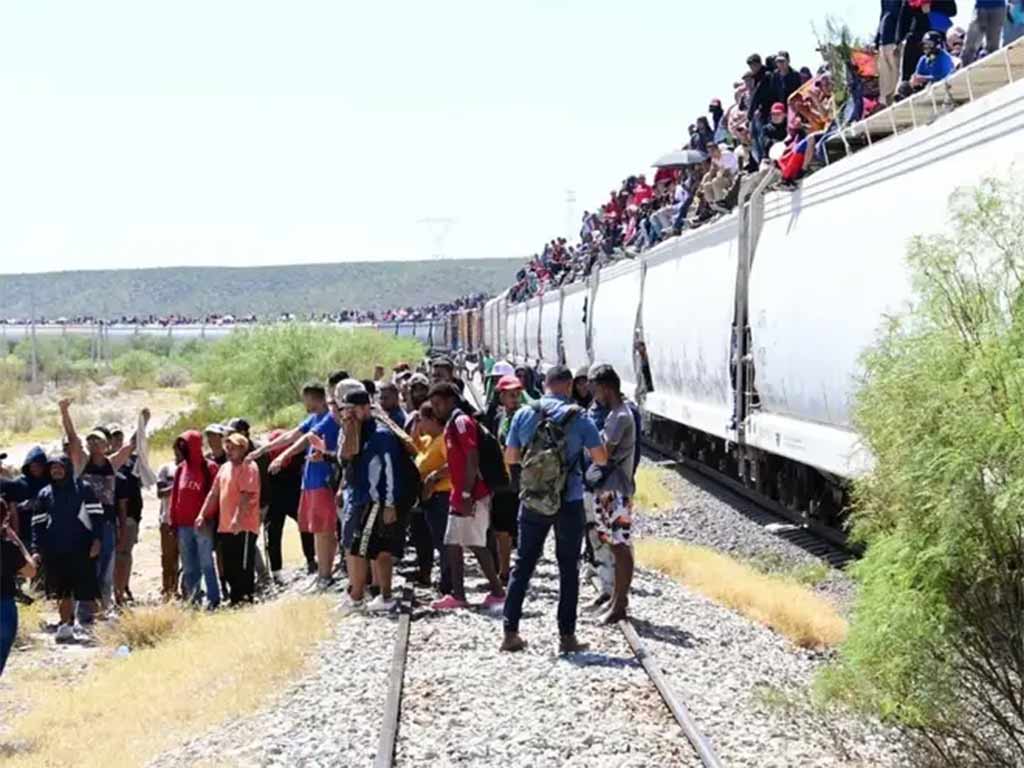
Undated photo from Prensa Latina.

The declaration’s emphasis on economic drivers of migration did not satisfy everyone. Eunice Rendón of the Mexican advocacy group Agenda Migrante told Courthouse News Service that while insecurity was mentioned as a factor driving migration, “it’s not one of the causes, it’s the principal cause,” Rendón said.

“People go because the gang members threaten to kill them, because they try to forcibly recruit them,” she said. (Some might argue that the lack of education and employment opportunities are drivers as well in recruitment for organized crime.)

Meanwhile, migration dramas continue. On Nov. 9, authorities reported that they found found 123 Central and South American migrants trapped in a trailer in Matehuala, San Luís Potosí (less than a week after we passed through there). And than 400,000 migrants have crossed the Darien Gap from Colombia into Panama in 2023, according to the Panamanian government, up from 250,000 in 2022.

World Council of Churches: for peace, against sanctions, and sexuality talks continue

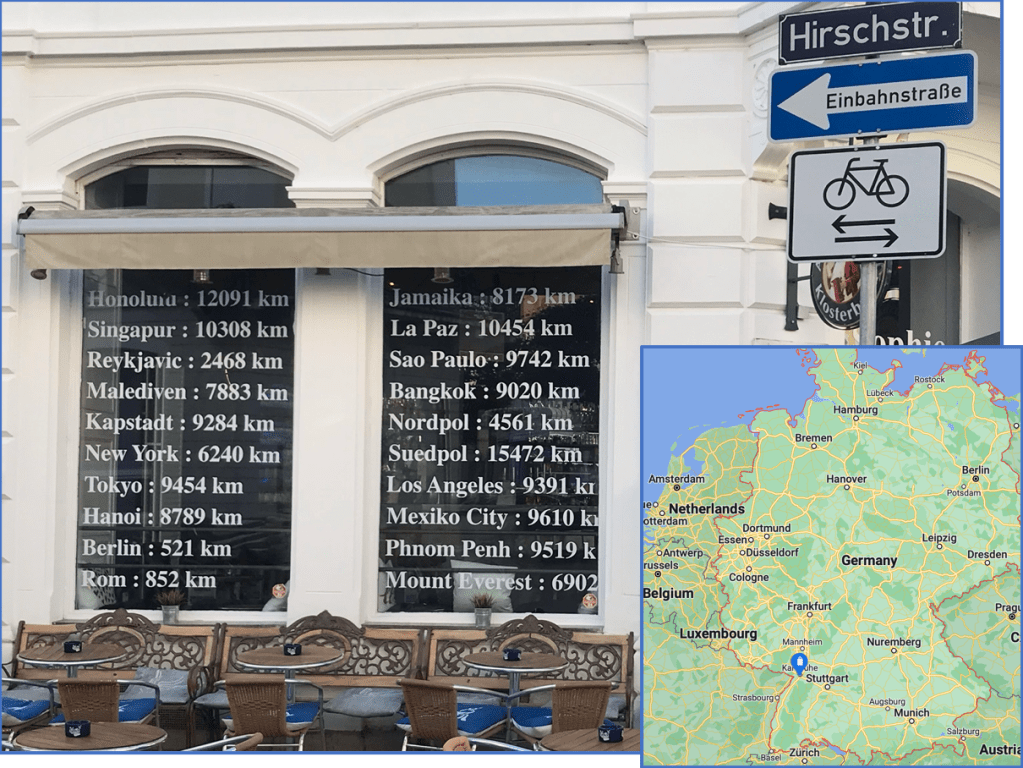
From this small city in southwest Germany, impacts of the WCC Assembly may be felt from Cape Town (9,284 km) to to Phnom Penh (9,519 km).

KARLSRUHE – As sometimes happens in large gatherings, I found myself on a single track in this Assembly of the World Council of Churches. For several years, I have participated in Rainbow Pilgrims of Faith, a global coalition that has accompanied the WCC work on sexuality (specifically) and gender justice (generally). 

Here in Karlsruhe, I led the group’s media work: blog posts, news releases and a few interviews. My colleagues managed more direct forms of engagement with delegates and other participants through an information booth and in various panels and workshops. 

At the same time, 660 delegates and more than 2,000 other participants from all parts of the world worked to shape ecumenical priorities for the next eight years or so.

Signs are positive that WCC will continue work on sexuality (sexual orientation, gender identity and expression), but that was just one thread in a tapestry of concerns addressed here.

There are many documents and scores of news releases to pour over, but two stand out for me. 

One, the more theological or spiritual of the two, is A Call to Act Together. For inspiration, it drew from the last book of the Bible, Revelation, and its themes of human suffering at work in the world: war, death, disease, and famine. “We were conscious of their manifestations in the world today. In their wake come injustice and discrimination, where those who have power often use it to oppress others rather than to build inclusion, justice, and peace.”

The message continues: “As the climate emergency accelerates, so does the suffering experienced by impoverished and marginalized people.”*

A sign of peace in Toronto’s distillery district.

The second document, The Things That Make For Peace, is also worthy of attention. It is longer and more focused on policy options.

“We understand that making peace involves addressing racism, xenophobia, antisemitism, hate speech and other forms of hatred of the other (all of which have increased and intensified during these years, in large part encouraged by populist nationalist movements); crisis and competition for essential resources for life; economic injustice and inequality in the marketplace; interstate conflicts and re-emergence of war; and the raising of the spectre of nuclear war.”

It is specific about Russia’s invasion of Ukraine and other armed conflicts – from Colombia to Eritrea and Ethiopia – calling for a global ceasefire “as an urgent moral imperative.”

Particularly close to my heart are sections that call for “support for the churches and peoples of Syria, Cuba, Venezuela and Zimbabwe in the midst of oppression due to international sanctions that affect these populations’ human rights and dignity.” 

Syria is an important case in point, the document says. “International and unilateral sanctions are contributing to worsening the humanitarian situation, harming a civilian population already made vulnerable by war. Moreover, sanctions are damaging the historical multicultural and multi-religious fabric of the Syrian society, forcing Christians and other indigenous groups to flee the country.”

The document calls for the removal of Cuba from the U.S. list of countries that sponsor terrorism and to “accompany the churches as prophetic voices of peace, hope, cooperation and mutual respect.”

* There is a third, equally-impressive document that I found later: The Living Planet: Seeking a Just and Sustainable Global Community. The document calls governments to “practical actions… to meet the pressing need to avert ecological disaster.”

Finding hope in Canada’s election, the UN General Assembly and CELAC

The concurrence this week of a federal election in Canada with the spurt of diplomatic action around the United Nations General Assembly reminds me that I value political debate, and that the world needs urgent action on multiple, related issues.

What we have in Canada is what Marta Harnecker and others have called “polyarchy”—the alternation of power among elites, or the choice from among the elites of whom we wish to govern us for the next few years. And no: we should not be satisfied with that, but rather build toward a system that ensures that everyone can have a meaningful sense of participation in the social, economic and political decisions that most affect their lives. That means having societies and governments that are strong enough to control the worst excesses of capitalism and flexible enough to embrace diversity.

Monday night, Sept. 20 – Liberal minority government projected.

But, in Canada for the moment, we have what we have. Perhaps the most optimistic view is that some sort of new coalition among Liberals, the NDP and the Greens will be strong enough to achieve solid measures to limit climate change, advance justice for Indigenous peoples, promote a global recovery from the pandemic, and quick action on housing and child care.

Meanwhile, at the United Nations, world leaders appeared at the General Assembly podium or via video link. Some emphasized the UN Charter, with its affirmations of national sovereignty and self-determination, and (rightly) criticized the sanctions applied by powerful states against the more vulnerable. Others promised new action to try to enforce their version of a rules-based international order (that is: the corporate-led, neo-liberal one).

Again, amidst the contradictions, one has to look for signs of hope. U.S. President Joe Biden, beset by divisions in his own party and fallout from his border patrol’s gross mistreatment of Haitian asylum-seekers, promised “relentless diplomacy” (an improvement, I hope, from “endless war”).

Biden held two online summits: one to try to advance action on climate goals, and the other to advance action on Covid vaccines—including the urgent need for a waiver that would allow more widespread manufacture of vaccines. Biden promised a new contribution of 500 million doses to the global effort, raising the U.S. commitment to 1.1 billion doses. Canadian Prime Minister Justin Trudeau, who joined Biden’s pandemic summit, promised in the Liberal election platform that Canada will donate “at least” 200 million doses of vaccine through COVAX, the UN vaccine-sharing program, by the end of next year. Critics say the contributions are insufficient.

Participants in the CELAC summit, Palacio Nacional, Mexico City, Sept. 18.

Monroísmo vs Bolivarianismo

A few days earlier, Mexican President Andrés Manuel López Obrador convened leaders of the Community of Latin American and Caribbean States (CELAC) for a summit in Mexico City, in part, at least to strengthen the forum as a counter-weight to the U.S.-dominated Organization of American States (OAS).

Venezuela’s Nicolás Maduro proposed replacing the “Monroe Doctrine” (promoted by the early 19th century U.S. President James Monroe—”America for the Americans,” meaning the United States and reflected today in the actions of the OAS) with a “Bolivarian Doctrine” that would uphold both the unity and the autonomy of the peoples of Latin American and the Caribbean, with CELAC as a space for common action.

Brazil and Colombia (led by the region’s two most conservative presidents) stayed away, but others either came or sent representatives. There were flare-ups over different approaches to human rights protection and economic policy, but in the end, the leaders issued a common declaration and called for an end to the U.S. embargo against Cuba.

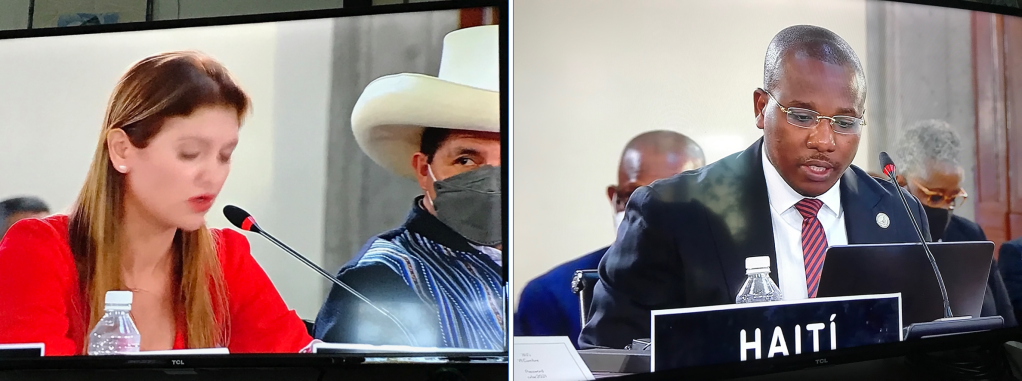
Érika Mouynes (left), Panamá’s foreign minister, noted that she was just one of three women at the CELAC table. Claude Joseph (right), Haiti’s foreign minister, met outside the meeting with Mexico’s immigration service to express concern for Haitian migrants in Mexico.