Even as Cuba’s foreign minister rose to speak Saturday in the United Nations General Assembly, CBS News reported that the U.S. Army Reserve is considering how it can support the military’s Southern Command in coming months.
James LaPorta of CBS News reported that the reserve is looking at providing support units, including police forces and medical personnel, to the Southern Command, which covers Latin America south of Mexico, the waters around Central and South America, and the Caribbean, including Cuba.
The memo reviewed by CBS doesn’t say for what operation the troops would be needed “in 90 to 120 days,” but LaPorta reported that “multiple U.S. officials” said the planning is for a potential operation aimed at Cuba.
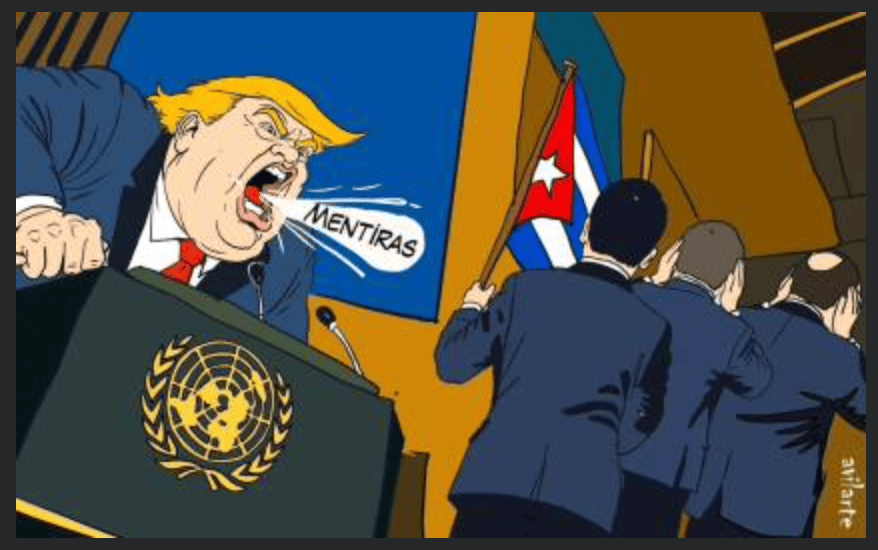
“Lies!” Image: Trump speaks at UN as Cuban delegation walks out. By Avilarte in Juventud Rebelde, Sept. 27, 2026.
Days earlier, U.S. President Donald Trump told the General Assembly that Cuba was a “failed state” and that he was seeking a “fundamental change” on the island, declaring that “freedom will be coming to Cuba.”
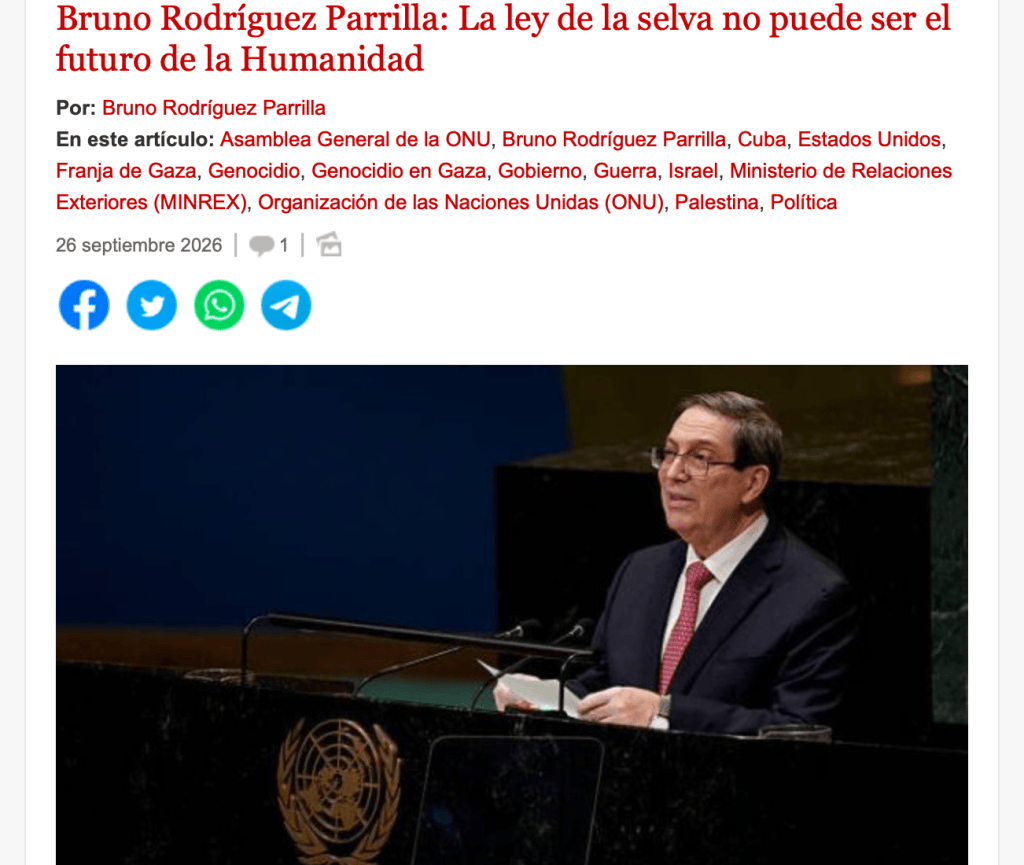
The speech Saturday by Cuban Foreign Minister Bruno Rodríguez Parrilla was partly a rebuke to Trump, but he also called for the United Nations to be preserved and strengthened while becoming “more democratic and effective” and closer to the peoples it serves.
“We are convinced that the current course of international relations, of disrespect for international law, contempt of the United Nations, and the imposition of the unilateral will of the most powerful on other countries, through intimidation and coercion, is dangerous and unsustainable. The law of the jungle cannot be the future of humanity,” he said.
Rodríguez repeated that Cuba remains willing to engage in dialogue with the United States to seek resolution of bilateral differences, but without “interference or pre-conditions.
Actions you can take:
Before October 11: if you are in Canada and have not done so already, please sign this House of Commons petition. It will be presented in the House by opposition Members of Parliament on October 12.
Common Frontiers and its allies have revamped their Take Action so that you can press the Canadian government to support Cuba in a UN General Assembly vote on October 27 or 28 to end the U.S. embargo against Cuba. Canada must also increase humanitarian aid to Cuba.
If you are in any other country, please write to your representatives and/or foreign minister to press for support to the Cuba resolution in the UN General Assembly and to increase aid to Cuba.
U.S. military lays groundwork for potential action around Cuba[Section adapted from the CBS report cited above.]
Earlier this year, U.S. forces conducted reconnaissance operations on the seafloor and maritime approaches that surround Cuba, multiple U.S. military personnel told CBS News. Separately, U.S. airpower components were placed on heightened readiness and directed to pre-stage personnel for potential deployment. Those plans, however, did not come to fruition.
CBS News reported in May that U.S. intelligence officials were assessing how Cuba would respond to possible U.S. military action.
In July, CBS News reported that U.S. military planners had examined a range of options for possible action against Cuba, including an Army-led air assault involving thousands of U.S. soldiers to be carried out by the 101st Airborne Division, the only unit trained for such a task.
U.S. officials who spoke to CBS News in July stressed that the briefings were not an indication that the president or the Pentagon had decided to go forward with an operation.
“Siege warfare:” unilateral coercive measures
Meanwhile, the Trump regime has continuously upgraded its sanctions on Cuban government entities and officials.
For an excellent description of how the Trump administration is using “starvation and misery” to achieve regime change in Cuba, please read Joy Gordon’s long analysis in Lawfare. She concludes: “what the U.S. is doing to Cuba is illegal, it is indefensible, and it is indecent.”
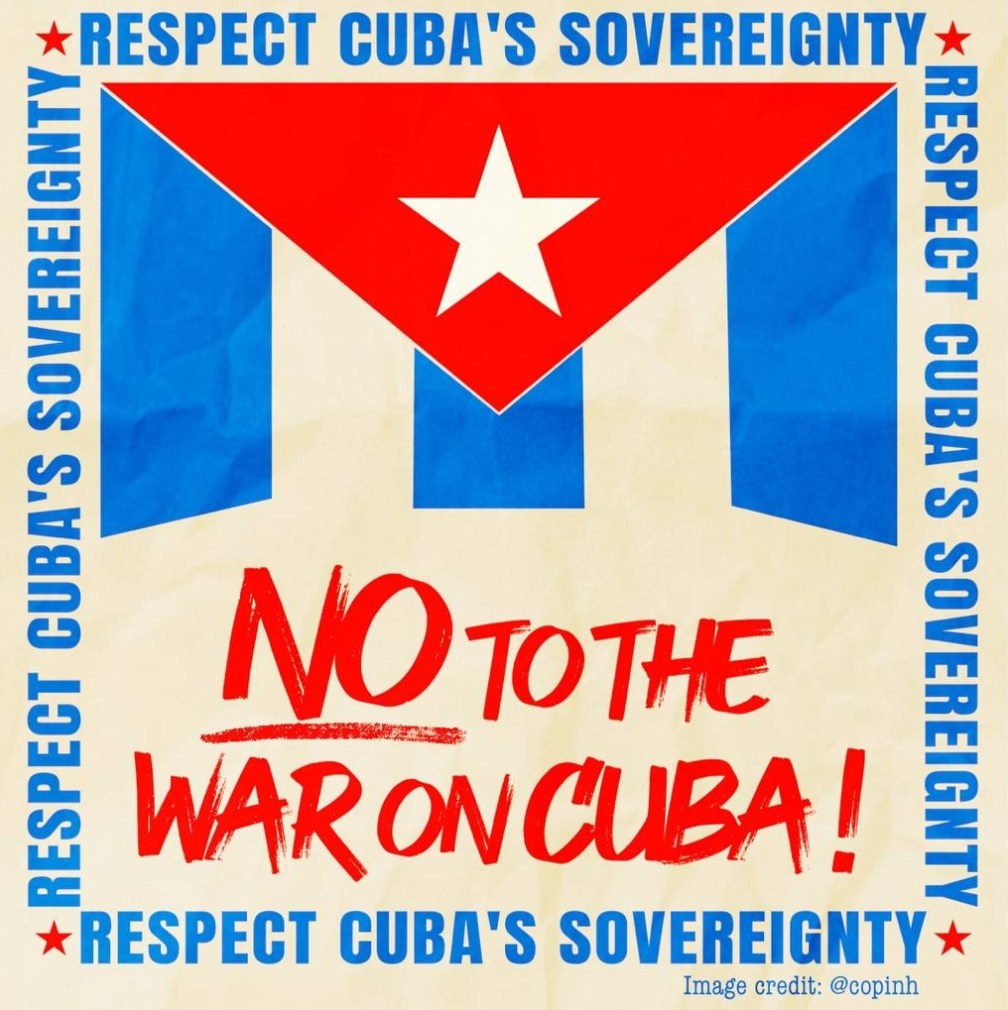
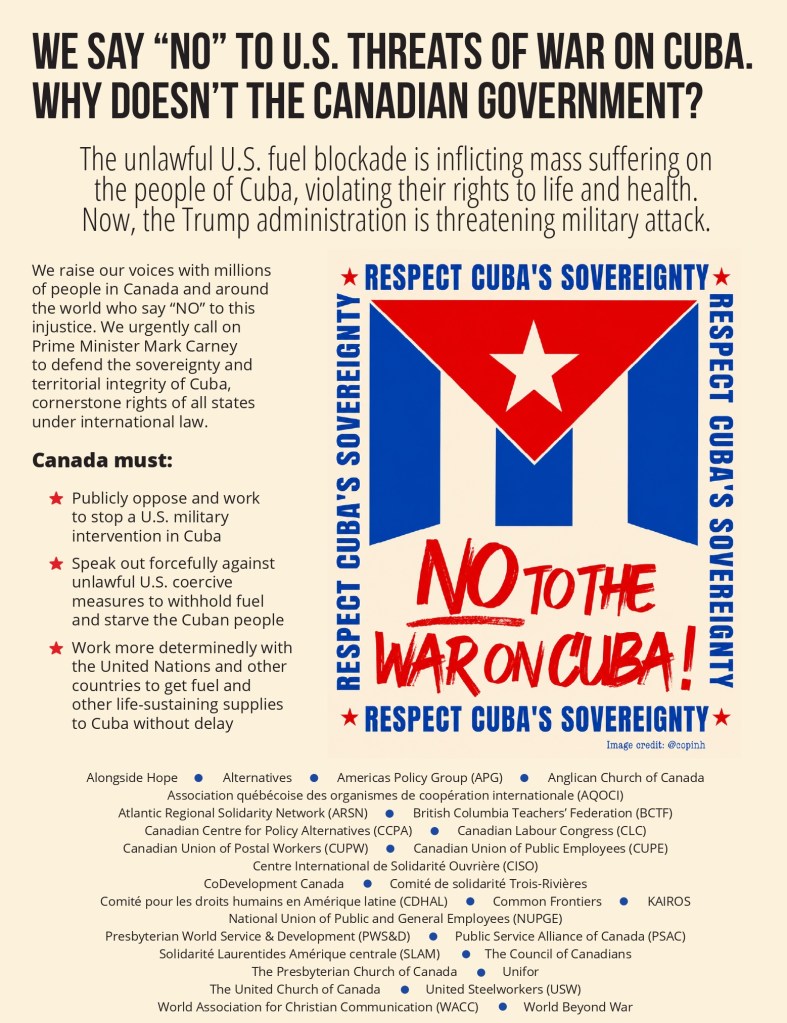
Today, Canadian churches, labour unions, development agencies and solidarity groups are calling on our government to defend the sovereignty and territorial integrity of Cuba – cornerstone rights of all states guaranteed in the United Nations Charter.
The statement (reproduced below) appears as an ad in the Hill Times, a newspaper in Ottawa whose audience is made up of politicians, public servants and those of us who try to influence them. Look at them: 28 organizations, representing millions of Canadians.
For more than three years, I have worked as a volunteer among a loose network of civil society groups to press the government of Canada for action. We began with a letter April 17, 2023, sent to the ministers of foreign affairs and international development.
We followed up with other letters and statements, and I wrote or co-wrote several opinion pieces: Hill Times in 2023, Canadian Dimension in 2024 and at rabble.ca a few weeks ago. Sometimes, I wrote these together with John Kirk, retired from teaching at Dalhousie University but still, like me, pressing our government for the sake of our many friends and co-workers in Cuba – and in favour of a different way to live together on our planet.
Several times, our inter-agency group called on Canadians to send letters to our politicians. (We’re still doing so, here.) Some of us met with members of Parliament and with staff at Global Affairs Canada and at the Embassy in Havana.
Earlier this year, we were joined by an ad hoc group of trade unionists who used a series of labour conventions and other gatherings to lift the campaign to a whole new level, with hundreds of postcards sent to the prime minister.
The government’s response, to put it mildly, has been feeble. A few million dollars here and there for humanitarian relief delivered through UN bodies or Canadian NGOs, but no calls to end the vicious U.S. sanctions, no shiploads of supplies (like those sent by Mexico, Colombia and other countries, and no fuel. Not even support for a humanitarian corridor so that fuel can be supplied to those agencies that are providing aid. No protest to the United States over its extraterritorial measures that harm Canadians who have worked alongside Cuban state enterprises in mining and tourism.
This afternoon, Canada’s parliamentary Subcommittee on International Human Rights (SDIR) is holding a Briefing on Human Rights in the Caribbean Region with a focus on Cuba. But, like the Feb. 26 Standing Committee on Foreign Affairs and International Development hearing before it, the witness list is tilted in favour of right-wing exile groups, raising concerns about the balance of views brought forward to the committee. This time, fortunately, the Canadian Network on Cuba is being allowed to share a more progressive perspective.
It’s pretty clear now that the Carney government will not speak up for Cuba so long as its talks to renew Canada’s free trade deal with the United States and Mexico continue.
At risk here is not just Cuba’s sovereignty, but Canada’s too. What many of us warned about in the free trade debates of 1998 and 1993 was the loss of Canada’s sovereignty. The long U.S. history of invasions, coups, electoral interference and sanctions has been made more acute in this second Trump administration.
The Canadian government must be bold and defend Cuban sovereignty, international law and the lives of Cubans.
Please write (again) to the prime minister and to your member of parliament. If you are in a country other than Canada, please write to or call your representatives to ask for their solidarity with the people of Cuba.
“The U.S. government is going crazy with its shameful war on Cuba,” writes Medea Benjamin of CodePink. “Every week, there’s a new sanction, a new restriction, a new way to punish the Cuban people.” She goes on to describe measures directed against U.S. travellers and solidarity groups.
Here, I want to focus on the measures that are forcing foreign investors to abandon holdings in hotels, mines and other joint ventures – and forcing cancellations by still more airlines and abandonment of Cuba by the credit card duopoly of Visa and Mastercard. All of these actions hurt the Cuban people, directly or indirectly.
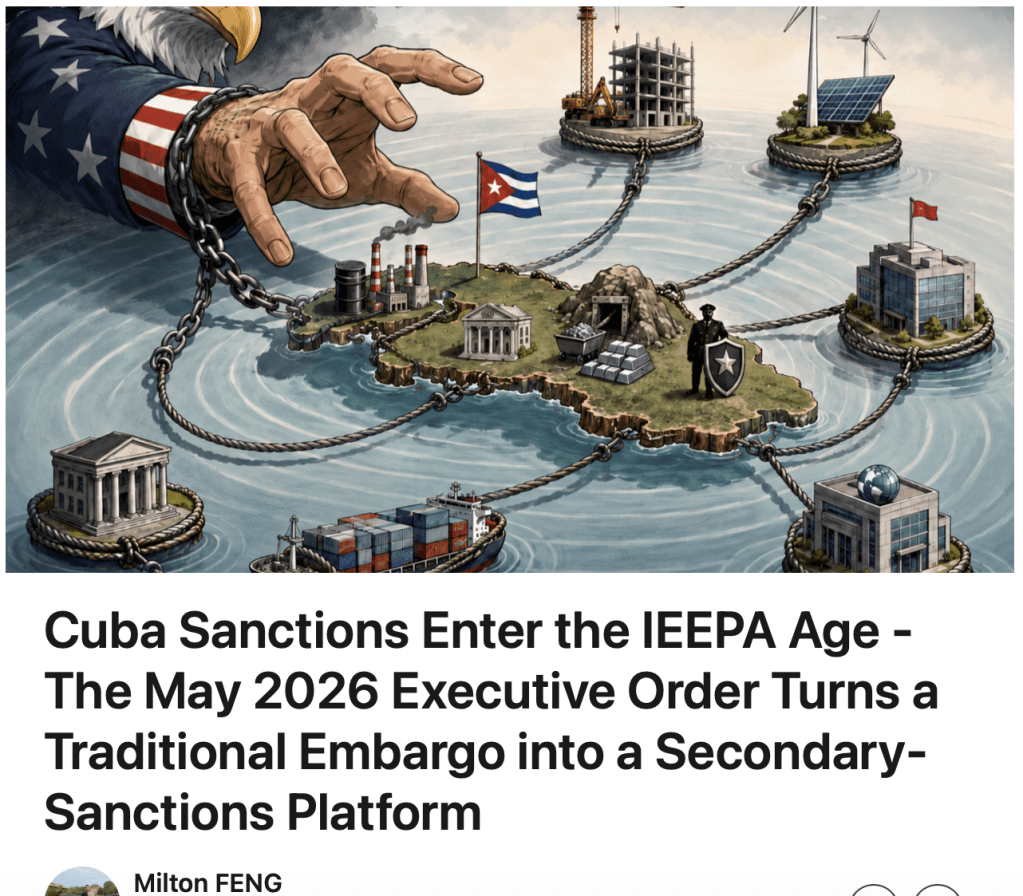
Unilateral sanctions applied by the United States are reaching new levels of cruelty in Cuba. The latest wave is rooted in the U.S. International Emergency Economic Powers Act (IEEPA), a 1977 law that allows a president to regulate international trade after declaring a national emergency in response to some extraordinary threat. It’s the law Trump used to apply his tariffs in early 2025, a move the U.S. Supreme Court struck down in February. Now he’s using the same law to punish Cuba. Milton Feng outlines Trump’s use of IEEPA to back his newest sanctions on Cuba in an essay here.
On May 1, U.S. President Donald Trump signed an executive order, effective June 5, that freezes U.S. assets of foreign companies and people that conduct business with the Cuban government.
A week later, U.S. Secretary of State Marco Rubio announced more details: the U.S. would impose additional sanctions on Cuban state-owned businesses that manage joint operations with foreign companies across tourism, retail, mining and distribution. The move had an immediate impact on Canadian investment in Cuba, notably nickel-miner Sherritt’s surrender to Gillon Capital LLC, the family office linked to Ray Washburne, a former adviser and appointee of Trump himself.
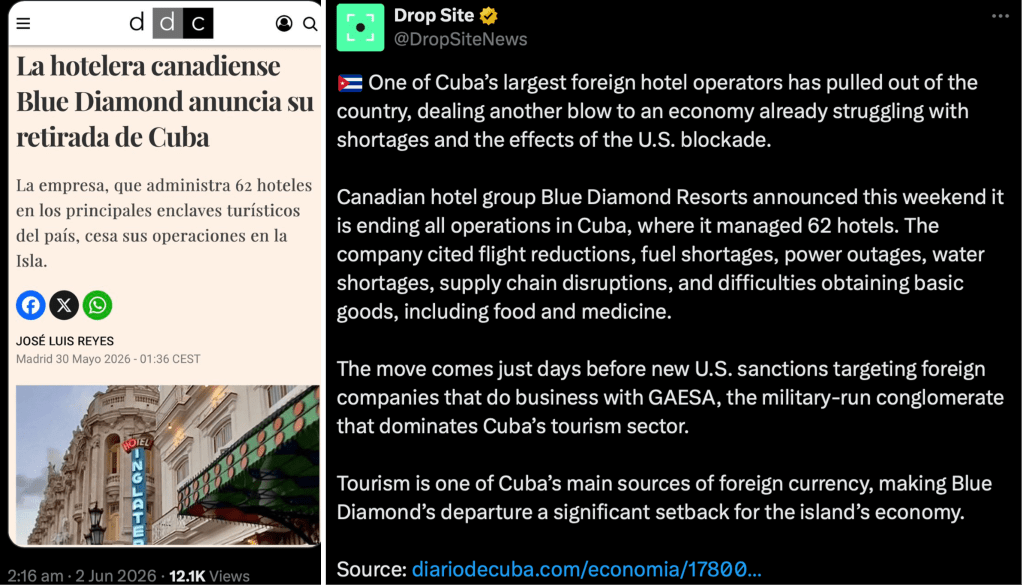
Montreal-based Royalton Hotels (which includes Blue Diamond, above) and Spanish hotel companies Melia and Iberostar ended their management and licensing operations in Cuba. Air Canada, WestJet and Air Transat have indefinitely suspended flights and vacation packages in Cuba. They had previously planned to resume service to Cuba this fall.
Many of the U.S. measures were aimed at partnerships with GAESA, a company linked to Cuba’s military. On June 2, the Cuban government defended GAESA, saying its joint ventures had funded housing, schools, clinics, and infrastructure.
The Spanish foreign minister said the moves against the hotel companies would aggravate the “humanitarian hardship” faced by the Cuban people in the wake of other U.S. sanctions and the fuel blockade underway since early this year. Church leaders from Canada and other parts of the world saw first-hand the impact of the U.S. blockade on ordinary people when they visited earlier this year.
But Canada has said nothing.
Like the European Union, Canada has law to protect its companies from the kind of extraterritorial reach demonstrated by Trump’s executive order. Amendments in the 1990s to its Foreign Extraterritorial Measures Act (FEMA) explicitly prohibit Canadian corporations from complying with US extraterritorial measures that affect trade and commerce with Cuba.
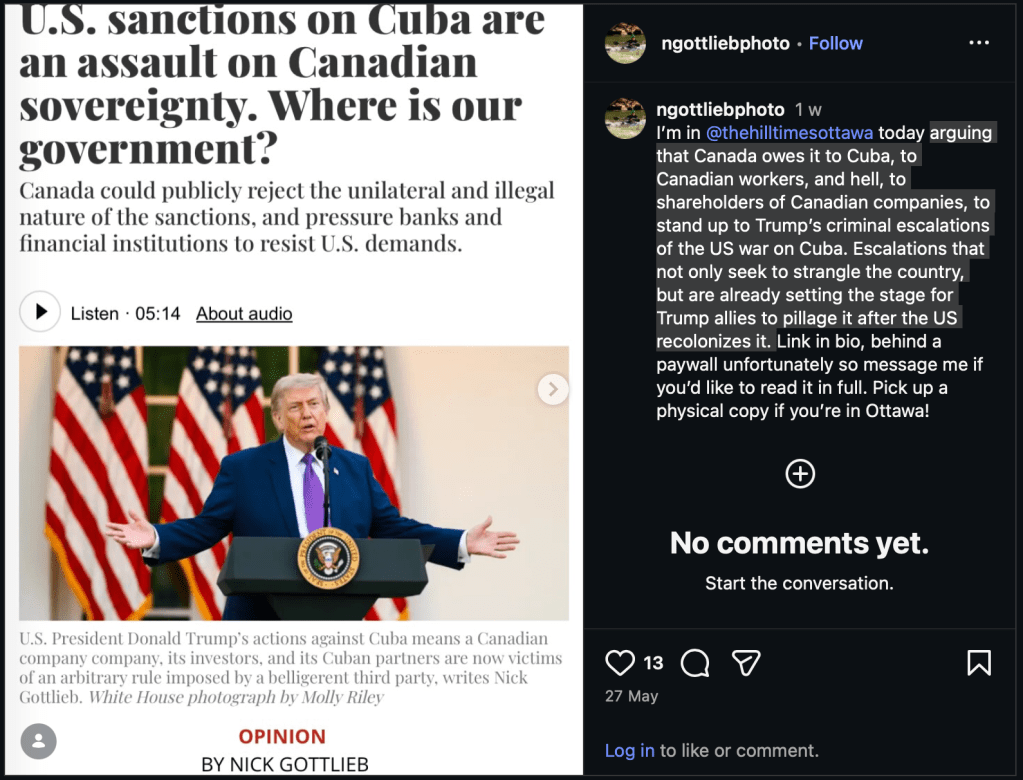
Nick Gottlieb’s op-ed comment in The Hill Times, Ottawa.
“If the Canadian government refuses to invoke FEMA at the precise moment it was designed for, then the legislation becomes little more than symbolic theatre,” wrote Dalhousie University’s Isaac Sainey in a Facebook post May 20. “Worse still, Canada effectively concedes that Washington possesses the right to determine Canadian economic policy and punish Canadian firms at will. This is not sovereignty. It is subordination.”
But CUSMA. Under Mark Carney’s leadership (not that he has said so yet), it seems Canada will not support Cuba as long as its free trade relationship with the United States is facing re-negotiation. In 2019, when Justin Trudeau was prime minister and Chrystia Freeland his foreign minister, Canada strongly defended the interests of Canadians doing business in Cuba.
When Trump threatened Canada last year, most of us joined with Carney in saying “#ElbowsUp.” That defiance needs to extend in solidarity with people in Cuba and in other parts of this hemisphere threatened by resurgent U.S. imperialism.
Please write (again) to the prime minister and to your member of parliament. If you are in a country other than Canada, please write to or call your representatives to ask for their solidarity with the people of Cuba.