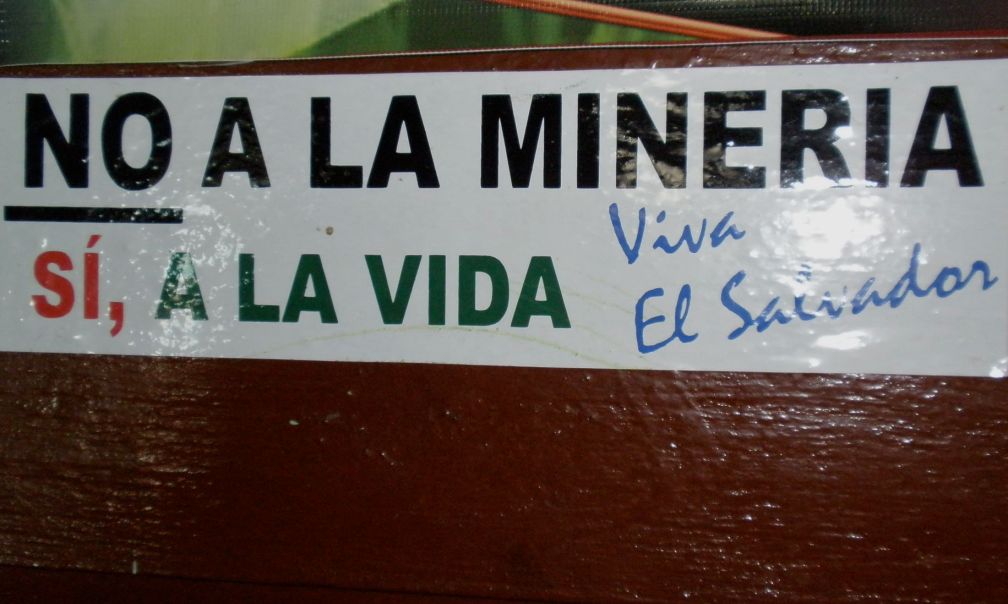
No to mining, Yes to life

Family members of the ‘Santa Marta 5’ file legal complaint over delay in final ruling

by Jim Hodgson

After four postponements in delivering the final written ruling to confirm the acquittal of the defendants, family members of five anti-mining leaders in El Salvador have filed an official complaint against the judges who provided only a verbal not-guilty verdict after trial five months ago.

The defendants are people that I have known for nearly 25 years through their involvement in the Santa Marta Association for Economic and Social Development (ADES).
The text that follows is a based on a text published this week by the Committee in Solidarity with the People of El Salvador (CISPES), supplemented by other media reports.

The complaint against the judges was filed with the Judicial Investigation Directorate of the Supreme Court of Justice (CSJ) Jan. 20, 2026, and adds to a series of public actions undertaken by the families, organizations, and human rights groups to demand the definitive closure of the judicial process against the water defenders. They had previously been part of a successful struggle to stop a gold mine from re-opening in the northern part of Cabañas department.

The Santa Marta 5 were arrested Jan. 11, 2023, and charged in connection with the alleged disappearance of a woman during El Salvador’s civil war. The charges were widely denounced as political persecution: the community leaders had been sounding the alarm over indications that the Nayib Bukele government was seeking to overturn El Salvador’s 2017 ban on metal mining, the first and only in the world. 

They were imprisoned for eight months while awaiting trial and subsequently placed under house arrest, a measure that was granted only after pressure from national and international human rights organizations and elected officials.

In December of 2025, El Salvador’s legislature, dominated by Bukele’s New Ideas party, did in fact overturn the law prohibiting mining in the country.

The defendants were acquitted of all charges in October 2024. The Attorney General appealed the decision, and in November 2024, the Cojutepeque Criminal Chamber overturned the dismissal of the charges and allowed a retrial in a new jurisdiction.

When the second trial concluded in September 2025, the San Vicente Sentencing Court reached the same conclusion in its oral ruling, acquitting the defendants of criminal charges. But the court has since delayed delivering its final written ruling four times, unjustifiably prolonging the judicial process and leaving the case without definitive closure.

On Jan. 9, the judges once again postponed the delivery of the written ruling until Jan. 30, a decision that the families believe could constitute a delay of justice in violation to the principle of “prompt and fair justice” and keeps a process indefinitely open that already has two acquittal rulings.

In the document they submitted to the CSJ, the families of the defendants requested an investigation into the delays as they have prevented the sentence from becoming final. Without a written ruling, the procedural deadlines for either a possible appeal or the definitive closure of the case cannot commence.
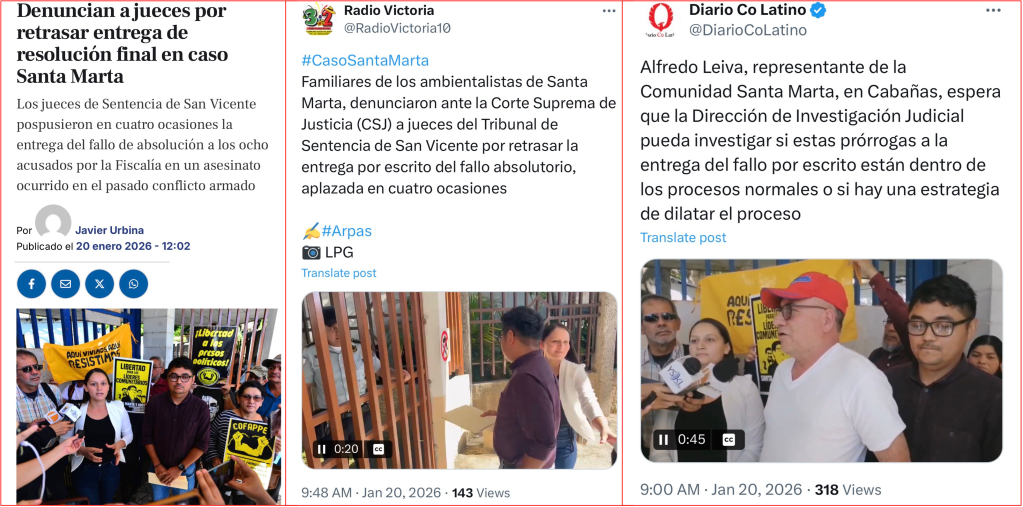
Media and social media coverage of the new legal complaint.

Milton Rivas, son of Pedro Antonio Rivas, one of the defendants, explained to the media that the judges “have been delaying the final ruling” and that the complaint filed seeks to demand justice for his family members. “We are not asking for anything, nor have we come to beg for anything; we have come to demand justice, because it is unacceptable that it takes them about five months to submit a document that they could have delivered the same day the hearing ended,” he declared.

Social movements, human rights groups, community representatives, and family members of the defendants denounced the court’s stall tactic during a press conference on Jan. 13. Rivas, joined by community leader Alfredo Leiva, stated that the failure to deliver the written ruling has both prolonged the legal uncertainty and kept the defendants, their families, and the community in a constant state of anxiety.  “This delay keeps our family members in a situation of constant anguish and constitutes a denial of justice,” they declared.

A representative of the University Movement for Critical Thought also warned of a broader context of increasing persecution and criminalization in the country. Currently, at least 38 human rights, environmental, labour, and political activists remain imprisoned, while human rights defenders and community journalists continue to report receiving threats, police harassment, and intimidation campaigns against them.

“We demand an immediate end to [this] persecution and respect for the right to defend the environment, to inform, and to organize,” the organizations stated, issuing an urgent call to Salvadoran society and the international community to remain vigilant given the risk of additional arbitrary arrests targeting critical voices and community organizing efforts.

Finally, they reported that a permanent vigil is being held in front of the Metropolitan Cathedral in San Salvador every day at six in the evening as a peaceful act of protest and a demand for justice, freedom, and respect for human rights.

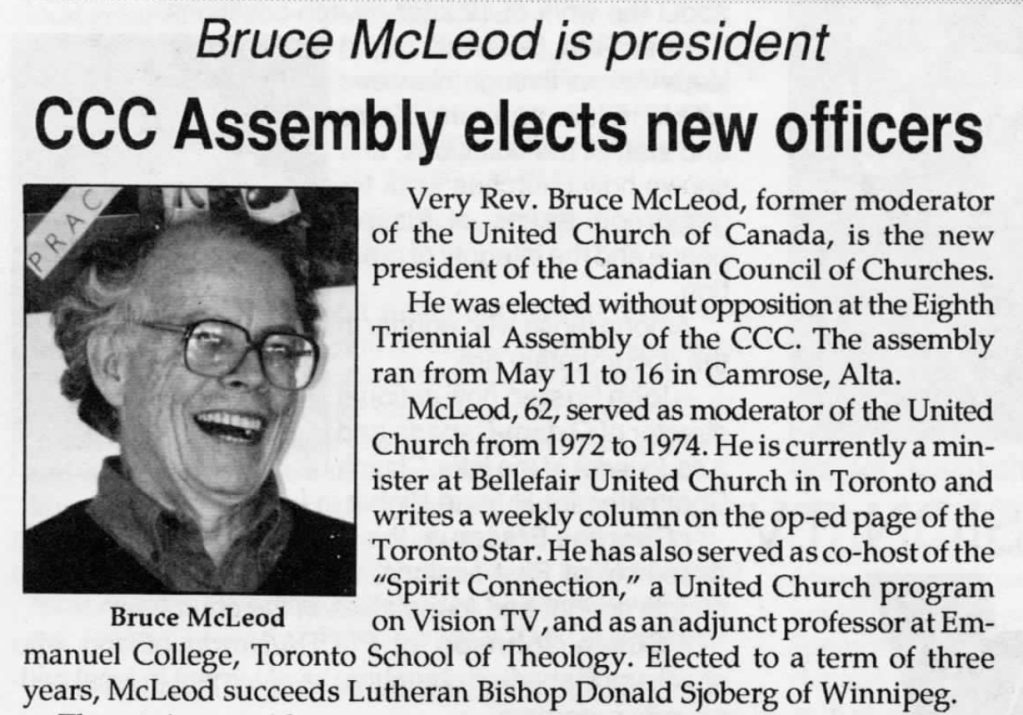
Bruce McLeod: an inspiring ecumenical educator and communicator

by Jim Hodgson

Here today, I want to share some of the words and teaching of the Very Rev. Dr. Bruce McLeod, former moderator of The United Church of Canada (1972-74) and former president of the Canadian Council of Churches (1991-94). He passed away this week at age 96.

It was in that latter role that I knew him best. (The United Church’s memorial is here, and there is more information too on the site of the United Church’s archives.) He was interviewed by Broadview magazine less than a year ago.

I can’t be sure, but I think I first met him in the mid-80s when he co-hosted the United Church’s weekly television program Spirit Connection. (Bruce was also an early ally to 2SLGBTQIA+ people who sought full inclusion and ministry in the United Church and beyond.)

In 1989, I had joined the CCC staff to serve as its secretary for ecumenical education and communication. Bruce was an inspiration for me in my new role (and long since). Some reflections from those years follow.

Entre-nous (the CCC newsletter), July 1991, p.3

Soon after his election as CCC president, he spoke to the CCC’s executive (June 21, 1991):

It’s especially important, in this kairos time of economic retrenchment in which God speaks to us for the Council to address the churches from which we come.

  • To remind them again of the Lund Principle which commits churches to doing separately in God’s world only those things which cannot be done together;
  • To summon our member churches from those ingrown, competing and duplicated enterprises which often preoccupy us;
  • To challenge separated structures (and our own denominational hearts) to think and act together – nationally, regionally and locally – in the name of Jesus who prays that we might be one.

Not for our sakes; but that the world might know that it’s bathed in the love of God, whose Spirit uses us, with others, to make the breaking world a home.

Refugee rights: “We saw their faces”

Back in the late 1980s, the government of Brian Mulroney brought in new rules to restrict the numbers of people who could claim refugee protection in Canada. Bruce was part of the CCC’s board when it launched a court challenge to a new refugee determination system in January 1989.

The churches’ concern then was much as it is today: rules were too tight and would endanger the lives of some refugee claimants by sending them back to persecution, imprisonment or possible death. The specific alarm was over the process for determining whether individuals were eligible to make a claim, and if rejected, whether they would be able to make a meaningful appeal. (We didn’t win the suit then and the fight for protection continues in the face of ever-harsher anti-refugee rhetoric and stricter measures in many parts of the world.)

In a sermon at the council’s assembly in Charlottetown in 1994, he said the churches challenged the new rules “because they knew refugees not as numbers or statistics; they saw their faces, knew their stories and wiped their tears. They heard God calling them to come; they did together what they couldn’t have done separately. It was as though something more than the initiative of the churches was at work here — as though a presence or purpose was waiting in the issues themselves, plucking at the churches to respond.”

Bruce McLeod with his successor as president of the CCC, Dr. Alexandra Johnston (1994).

To cherish and preserve this small world

I heard Bruce tell the story of his encounter in 1992 with astronomer Carl Sagan more than once. They met at a “religion and science” gathering in Washington, and he included the story in a report to the CCC executive that I reproduced in Entre-nous, the CCC newsletter, in July 1992:

“Sagan said that when the Voyager spacecraft spun past Neptune and Pluto edging beyond the solar system to wander forever across the Milky Way, its cameras focused backward for one last glimpse of home.

“’Planet earth from there is not the same as looking at it from the moon where you see the outlines of the continents. Planet earth from there is just a pale blue point of light. That’s where we live,’ he said, his brooding face alight. ‘Where every human being who ever lived, lived – every couple in love – every political leader,’ every church with its earnest positions. Voyager’s photographs he said, ‘conveyed a sense of vulnerability. At least to me it cries out the need to cherish and preserve this small world.’”

Bruce continued: “Here where it is night, we remember the words of Rubem Alves: ‘Hope is the melody of hearing God’s future, faith is dancing it now.’ Together in Jesus name, taking each other’s hands around this table and beyond our different churches, we dance as well we can.”

“God’s single love in the world”

In 1994, at the end of his term as CCC president, Bruce challenged the churches over funding cuts to ecumenical bodies. “Over-lapping mandates” was among the reasons cited for cuts to the council and the inter-church justice coalitions.

Bruce refused to accept those excuses. In a sermon delivered in Charlottetown in 1994 at the CCC’s triennial assembly, he said: “For all the shared ministries at the unpublicized edge, there’s no dearth of ecclesiastical leaders ready to explain why there have to be ten different churches, all struggling to repair their roofs, in one Ontario town with 2,200 people. For all the examples of coalition cooperation, there remain competing church publishing houses (each with separate, crushingly expensive, hymn book projects) and duplicated church head offices, each with floors devoted to world outreach and justice issues, all claiming their share of sacrificial weekly gifts dedicated, to the accompaniment of doxologies across the land, for the work of God’s single love in the world.”

Take action for Cuba this Christmas

by Jim Hodgson

As Beth Baskin, my friend and former colleague at the United Church of Canada, wrote in an email Wednesday to several Canadian churches, unions and solidarity groups:

“Unfortunately, the people of Cuba will be experiencing a Christmas without sufficient power and having spent 70 per cent of their income on food to feed their family this month. They may be missing family members at the table as they suffer from increased disease or have left the country seeking a better life. All of these realities existed before Hurricane Melissa struck earlier this fall affecting 3.5 million people and damaging homes, schools, and healthcare centres.” 

You might have been doing this (or something like it) over the past few years – or for more than 65 years since the triumph of the Cuban Revolution on January 1, 1959, sparked the ire of the United States. Maybe you have written letters like the one we suggest here and below. Or maybe you have contributed funds to one of the organizations that support workers, churches, women and farmers in Cuba. Or perhaps you contributed goods to send in a container to Cuba, or took an extra suitcase with medicine or milk powder to leave with friends when you last travelled there.

Thank you!

The government of Canada has contributed at least $6.5 million to several agencies carrying out relief actions in response to Hurricane Melissa. But there are longer term requests that we have of our government. 

Canada should take these actions:

  • Continue to scale up efforts to provide immediate food, medicines and medical supplies and ongoing development assistance to Cuba;
  • Strengthen Canada’s commitment to an independent foreign policy with Cuba based on dialogue, constructive engagement and respect for self-determination rather than punitive measures such as sanctions that only hurt the Cuban people;
  • Work with other countries, including from Latin America, the Caribbean and others, to prevent U.S. measures that isolate and harm the Cuban people from interfering with the delivery of humanitarian assistance by other countries, including Canada.

You are invited to raise your concerns with our Canadian government through this Take Action link.

And thanks for sharing this request as you are able. 

From the text of our Take Action request:

What’s Happening in Cuba
Cuban partner organizations and recent visitors say conditions in Cuba today are much more difficult than in the early 1990s when the implosion of the Soviet Union led to a massive deterioration in living standards. The pandemic shuttered the tourism industry, a main source of revenue used to acquire food, medicines and fuel from abroad. Cuba has also suffered a series of hurricanes, droughts and floods, leading to lost crops and food shortages. Energy shortages limit public transit and even the collection of garbage. Punitive U.S. measures under both Biden and Trump have also reversed the many gains delivered by the easing of such measures by the Obama administration.

The return of Trump in 2025, and appointment of Marco Rubio, a vocal proponent of increased sanctions on Cuba, as U.S. Secretary of State, has meant additional pressure. U.S. measures not only restrict U.S. citizens and businesses from providing support to the Cuban people, they also interfere with the delivery of humanitarian aid by other countries because banks limit transactions; suppliers face risks of U.S. retaliation; shipping of freight becomes more complicated and costly.

Again, here’s a way to write to Canadian government ministers and your Member of Parliament: https://petition.web.net/CanadaActNowOnCuba

Thanks! ¡Feliz Navidad!