
by Jim Hodgson
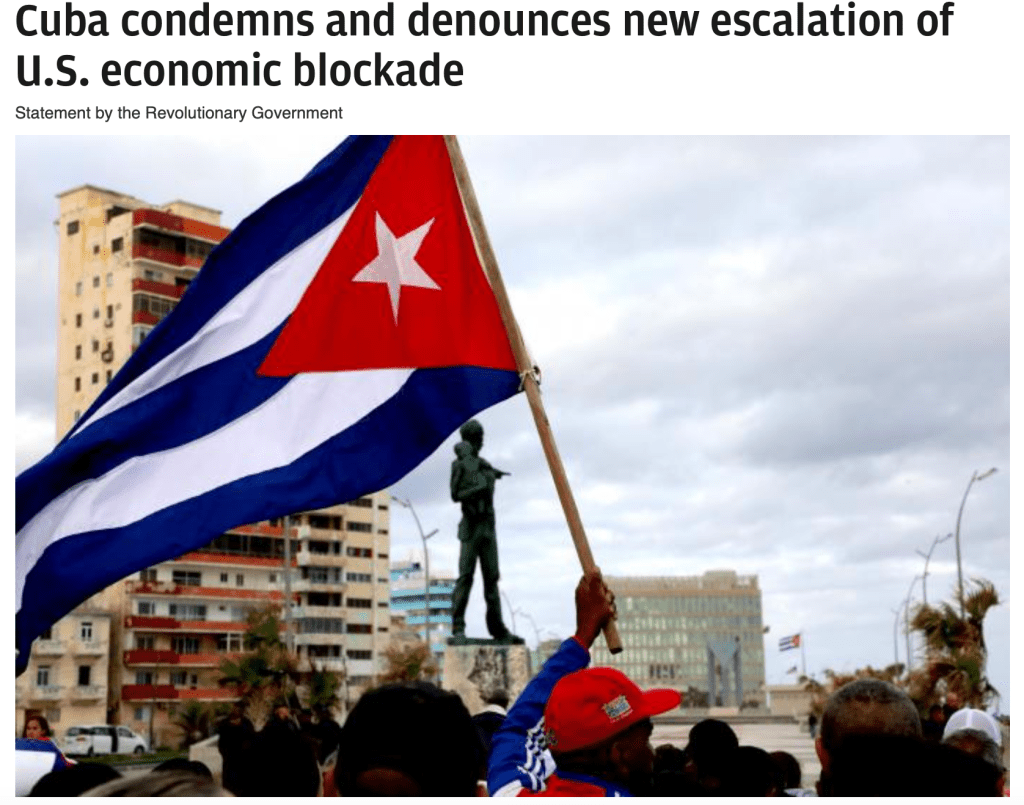
Canada must condemn the ongoing U.S. embargo against Cuba, say two coalitions of Canadian non-governmental organizations (including churches, trade unions, aid groups and human rights defenders).
The Americas Policy Group (APG) and Common Frontiers wrote Feb. 20 to Prime Minister Mark Carney,Foreign Minister Anita Anand, and Secretary of State (International Development) Randeep Sarai. Their letter condemned the new “coercive measures” – threats of higher tariffs – announced by the Trump administration that make it harder to get food, medicine and fuel.
Before I go too far into this, here’s an action you can take. (And thank you if you already did so!) The Canadian Network on Cuba has worked with MP Alexandre Boulerice to promote an important on-line petition to the members of Parliament. (Once you have signed, be sure to respond to an email asking you to confirm your signature.)
Text of the letter is available in English, French and Spanish.
The English version follows below:
February 20, 2026
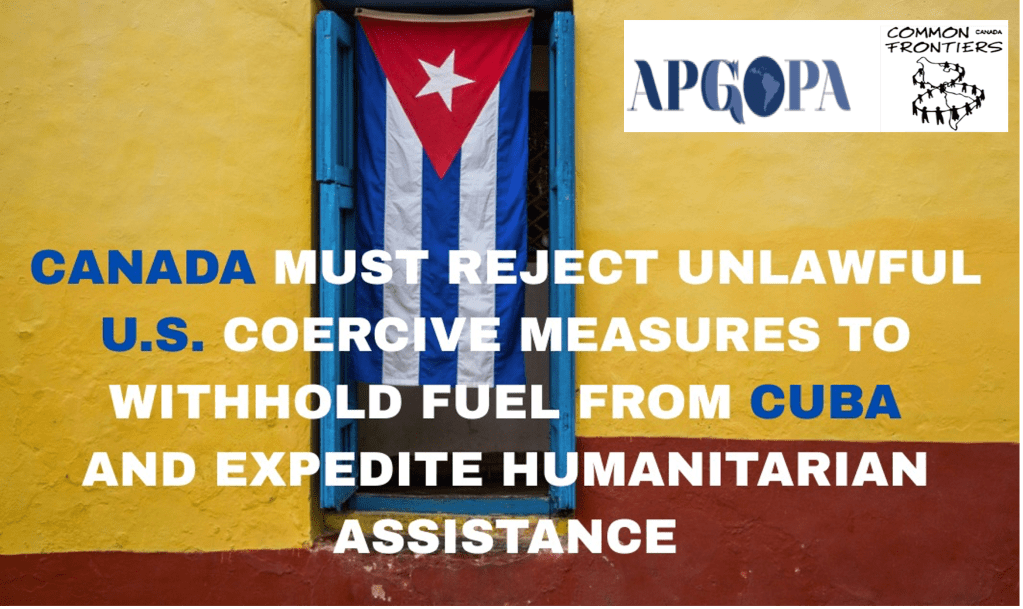
Re: CANADA MUST REJECT UNLAWFUL U.S. COERCIVE MEASURES TO WITHHOLD FUEL FROM CUBA AND EXPEDITE HUMANITARIAN ASSISTANCE
Dear Prime Minister Mark Carney, Foreign Affairs Minister Anita Anand and Secretary of State (International Development) Randeep Sarai:
The Americas Policy Group (APG) and Common Frontiers, coalitions formed by dozens of respected Canadian civil society organizations, are deeply concerned about the human rights impacts of a U.S. executive order imposing a fuel blockade on Cuba. We call on Canada to immediately reject this dangerous, coercive action which is incompatible with principles of sovereignty, non-intervention and self-determination, essential for a democratic, equitable and peaceful international order.
A month ago, our coalitions called on the Government of Canada to unequivocally condemn U.S. attacks and threats of intervention in Venezuela, Colombia, Mexico, and Cuba as violations of the United Nations Charter and longstanding international norms. We warned about the implications of U.S. security policy that promises to “reassert and enforce the Monroe Doctrine,” a doctrine used in the past to justify brutal interventions in Latin America and the Caribbean.
In October 2025, United Nations member states at the General Assembly voted for the 33rd consecutive time for an end to a decades-long U.S. embargo against Cuba, which has caused enormous hardship and scarcity for the Cuban people. This is reaching crisis proportions as a result of an executive order signed by President Trump on January 29 authorizing the imposition of trade tariffs on any country that directly or indirectly provides oil to Cuba.
UN human rights experts have stated “there is no right under international law to impose economic penalties on third States for engaging in lawful trade with another sovereign country.” The UN experts conclude that the imposition of a fuel blockade on Cuba is “a serious violation of international law and a grave threat to a democratic and equitable international order.”
Member organizations of the Americas Policy Group and Common Frontiers have a long history of cooperation with Cuban civil society organizations and are hearing from them about the impacts of blocking oil supplies to their country. Cuba is highly dependent on imported fuel for essential services, including electricity generation, hospitals, health services, water and sanitation, public transportation, food production and distribution. Moreover, Cuba has been experiencing a deepening socio-economic crisis due to a 60-year financial and trade blockade by the United States, as well as the impacts of increasing extreme weather events. U.S. unilateral measures of economic and political coercion deliberately seek to deepen the suffering of the Cuban people to force regime change. We condemn these measures in the strongest possible terms and are horrified by the collective punishment of the civilian population that we are witnessing.
As an illustration of the dire situation on the ground, the Secretary General of the Provincial Union of Public Administration Workers of Havana shared this message with us: “Our members are experiencing firsthand the effects of the measures taken to prevent fuel from entering the country. For example, our municipal services have been affected; services that are vital to the population like solid waste collection. Without fuel we have no way to collect the garbage. The population, along with municipal workers, are doing everything we can to prevent consequences such as an epidemic or the spread of diseases. We will not give up.”
The UN High Commissioner for Human Rights Volker Türk has sounded the alarm about other consequences and reiterated his call “to lift unilateral sectoral measures, given their broad and indiscriminate impact on the population.” As the High Commissioner has reported, intensive care units, emergency rooms, and ambulance services are compromised, as are the production, delivery, and storage of vaccines, blood products, and other temperature-sensitive medications. Power cuts are undermining access to safe water, sanitation, and hygiene. The fuel shortage has also disrupted the rationing system, the regulated basic food basket, and social protection networks, including school meals, maternity homes, and nursing homes. Vulnerable groups are disproportionately affected. The right to life and the ability to enjoy many other rights are in jeopardy.
Our coalitions are heartened by Canada’s long, highly respected history of independent foreign policy towards Cuba and uninterrupted diplomatic relations with the country since 1945. This includes the Foreign Extraterritorial Measures Act (FEMA), Canadian legislation that protects Canadian sovereignty and commercial interests from U.S. laws and policies that try to impose their jurisdiction inside Canada. We also welcome Canada’s past support for multilateral efforts to end the unjust U.S. economic embargo, such as repeated votes in the United Nations General Assembly condemning the blockade. We call for this principled stance to be upheld and strengthened.
Without delay, we urge the Government of Canada to:
- Publicly and unequivocally condemn the ongoing U.S. trade embargo against Cuba, including coercive measures announced by the Trump administration that threaten access to the necessities of life: including food, medicine and fuel.
- Reaffirm Canada’s commitment to the UN Charter, international law, and the human rights obligations Canada has willingly undertaken, including respect for sovereignty, self-determination and the rights to food, health, and wellbeing.
- Deepen bilateral humanitarian cooperation with Cuba, including direct Canadian assistance to alleviate suffering among the civilian population.
- Work with regional allies – including at the UN and in other spaces for multilateral action – to end the oil blockade and other punitive economic measures against Cuba, as well as to expand access to humanitarian supplies.
- Reject all threats of intervention or coercion against countries in the Americas and promote peace, diplomacy, dialogue and regional stability, in accordance with Canada’s stated values and international obligations.
We welcome the opportunity to discuss our recommendations with you and stress that while humanitarian relief is urgently needed, access to fuel and respect for sovereignty are indispensable.
Sincerely,
Americas Policy Group Steering Committee
Common Frontiers Steering Committee
The Americas Policy Group (APG) is a national network of Canadian civil society organizations working for human rights and social and environmental justice in Latin America and the Caribbean. It brings together international development and humanitarian NGOs, human rights organizations, labour unions, faith-based and solidarity groups, and research institutions.
Common Frontiers is a national coalition composed of labour, environmental, faith based and social justice organizations focused on the Americas. We amplify the struggles of organizations and communities with which our members hold long-term relationships throughout the region, and who work to defend democracy, human rights, labour rights, strong public services and the environment.

 Unwrapping Development