Transformation in Mexico: a work in progress

Zapatista leaders: Marcos and Moises in La Realidad, Chiapas, November 1996. Photo: Jim Hodgson

by Jim Hodgson

On Jan. 1, 1994, the same day that the North American Free Trade Agreement (NAFTA) came into effect, the Zapatista Army of National Liberation (EZLN) seized control of several cities in the highlands of Chiapas, Mexico’s southern-most state.

Within a few days, it was clear that the group was Indigenous-led and that it had a charismatic spokesperson in Subcomandante Marcos. The movement also had expectations of social transformation that extended beyond the immediate goal of improving the lot of the Maya people of the Chiapas highlands.

From mountains of southeast Mexico, the Zapatistas put forward a vision of a world where there is respect for diverse ways of being human and of organizing political life, where there might be diverse expressions of truth in the face of supposedly universal truths like the one offered by business elites about the all-powerful “invisible hand” of the free market. They invited us to imagine a world with room for all – “un mundo donde quepan muchos mundos.”

Headlines on Jan. 1, 1994: “Uprising in Chiapas,” “EZLN takes 4 cities in Chiapas”

The Zapatistas pressed for new ways of thinking about power – that leaders should obey their communities – and rejected the hegemony of political parties. The vision had a big impact on those who created the World Social Forum series of encounters that in turn have helped to transform politics in Latin America over the past quarter-century.

Zapatista communities established autonomy from other levels of government, and set about ruling themselves. In the words of a chronicler of social movements in Latin America, Raúl Zibechi, these processes “modify” how people relate to each other as they manage health, education, production, justice, celebrations, sports and art: more mutual, less expert-client, relationships.

Competing posters: Bishop Samuel Ruiz was a man “wanted” for “treason;” EZLN says, “The world that we want is one with room for many worlds.”

“Disorganized crime” and “remilitarization”

Thirty years on, the communities say they have to re-organize themselves in the face of violence between rival drug cartels – “disorganized crime,” the EZLN called them in a recent statement – that now afflicts Indigenous territories near the border with Guatemala and indeed across most of Chiapas. 

Forced displacement, said the Fray Bartolomé de Las Casas Human Rights Centre (known as Frayba), is among the most serious human rights violations in Chiapas today. In a new report launched in July, the San Cristóbal-based group said 16,755 people had been forced from their homes between 2010 and 2022. Frayba attributed the violence to actions by paramilitary groups that have afflicted the state for decades and to the newer criminal gangs, adding that the violence affects the Zapatista communities. At the same time, Frayba describes a “remilitarization” –more soldiers, more bases – in the area. 

Mexico’s Fourth Transformation

In 2018, Mexicans chose their new president, Andrés Manuel López Obrador (AMLO) on the same day as the people of Chiapas elected their new governor, Rutilio Escandón. Their party, the National Regeneration Movement (Morena), promotes a program of change they call the “Fourth Transformation” (4T), the previous three being the war of independence, the mid-19th-century liberal reforms of Benito Juárez, and the Mexican Revolution (1910 to 1917 – or through 1940, if you include the massive land reform led by Lázaro Cárdenas in the mid and late 1930s).  The 4T includes a security component: “abrazos, no balazos” (hugs, not shootings), the idea being to ensure that people have viable economic possibilities so that they do not turn to lives of crime.

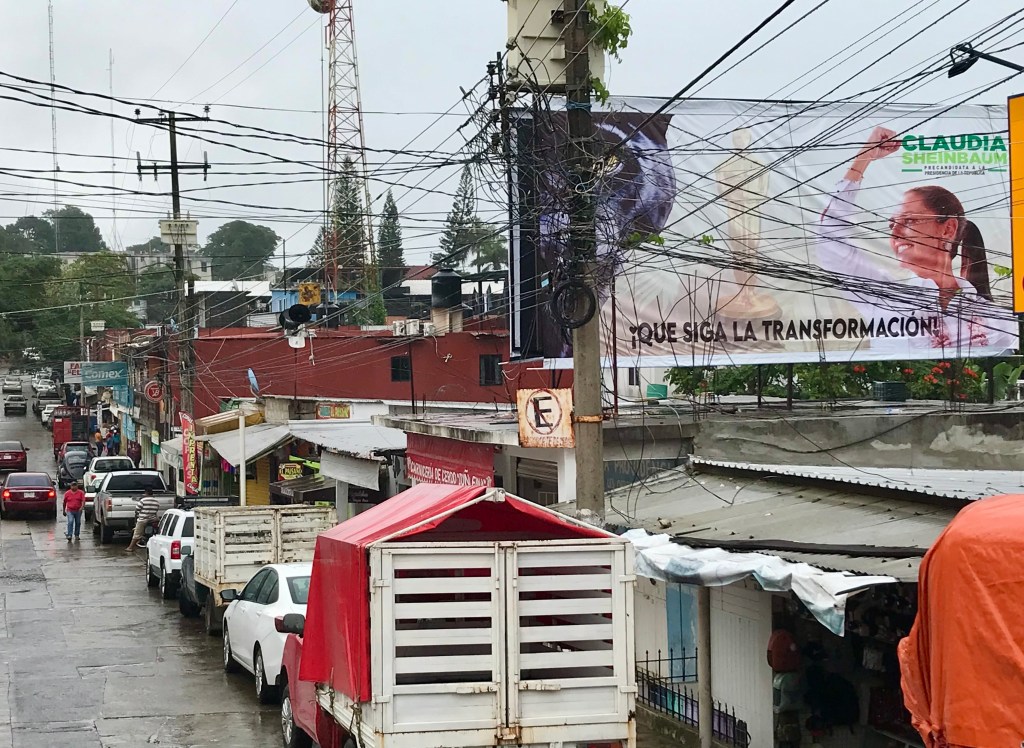
More than five years into their respective administrations (and six months before the next elections), reviews are mixed. The old conservative parties loathe AMLO – “socialist!” “Chavista!” A more responsible critique comes from Indigenous people and sectors of the left that reject “neo-developmentalist” approaches that emphasize resource extraction and mega-projects for the sake of job creation – but again mostly benefit the traditional elites. Those criticisms were also levelled at all of the so-called “pink tide” governments that produced some changes over the past 25 years, but did not transform the systems of dependence on the export of natural resources. (This problem afflicts Canada too and in the face of climate change, requires urgent action.)

Despite promises, Mexico’s 4T government has not tried to implement the San Andrés Sakamch’en Agreement that was achieved in negotiations among Indigenous peoples and the government in 1996. Those talks, sparked by the EZLN-led rebellion and moderated by Bishop Samuel Ruiz, marked the first (and only) time that the government has negotiated face-to-face with Indigenous peoples. It was not a comprehensive peace deal, but rather the first step in a planned process to address Indigenous rights in Chiapas and beyond.

On June 2, 2024, voters will elect a new president and a new governor for Chiapas. These will be the sixth since the EZLN uprising. Over the years, the Zapatistas have used a variety of strategies to have an impact on Mexico’s political culture. They won’t be silent in the coming months.

Liberation theologians see relationships as key to overcoming Israel-Palestine conflict

A demonstration in Toronto during the July 2014 Gaza War.

by Jim Hodgson

For people like me whose faith found new grounding in the waves of liberation theology that have emerged over the past 55 years or so, a global conversation about solidarity with Palestine offered a chance to reflect with people who are living with the effects not just of the present war, but of generations of conflict that preceded it.

The zoom conversation – “Transnational Solidarity Amongst Liberation Theologies: Palestine & Beyond” – organized by the Sabeel Ecumenical Liberation Theology Centre (a United Church of Canada global partner) in Jerusalem, was held Nov. 10 and drew together about 100 people from around the world.

Sabeel’s director, Rev. Dr. Naim Ateek (an Anglican priest) spoke of both the immediacy of the “crushed children of Gaza” and of the urgent need to “understand the other, respect the other, accept the other. Without those, there is not a healthy or productive exchange.”

“These are absolutely crucial when we think about rebuilding relationships (not just homes), and building solidarity for the future of all the people of Palestine and inside Israel,” he said, adding: “Have in mind the tragedy and the suffering; that is the departure point for us.”

Ateek encouraged those who would be in solidarity with Palestinians to be “pro-peace, pro-understanding, pro-liberation, and pro-reconciliation. We need to be looking for justice in accordance with international law.”

Sabeel is a space where community reflection continues to drives new action for justice and peace, and to build relationships far beyond Jerusalem. You can also follow Canadian Friends of Sabeel (CFOS) on Facebook.

Dr. Farid Esack of the University of Johannesburg (and a member of the United Church of Canada’s first partners council a decade ago) spoke of the reflection-action process in liberation theology that drives praxis beyond theorizing. “We must always reflect on our praxis, and make that affect our praxis,” he said. “Colonialism, imperialism and capitalism always view the Earth as territory to be captured.” For Palestinians, he added, the task is to elaborate a vision of what a “post-Zionist society would look like, and for the rest of us, to follow that.”

Esack, a Muslim scholar of liberation theology in South Africa, emphasized the need to “not demonize all Jews and to always fight anti-Semitism, but I will not fall into the white trap, not privilege that above other forms of racism.”

In response to a question about the role of inter-religious dialogue in seeking justice and peace, he warned against platitudes and “a butterfly dance of escapism and digression.”

“The occupation is not a result of Jews not understanding Muslims or Christians not understanding Jews. In liberation theology, the priority now is inter-religious solidarity against occupation, the armaments industry, the military, and not to remove attention from the occupation.”

This is to put it mildly, but global South views of current conflicts tend to be different from the positions taken by leaders in countries like Canada. A Brazilian Methodist feminist theologian, Rev. Dr. Nancy Cardoso, hoped to press that point as one of the speakers invited to be part of the Sabeel conference. Working now in Angola, she was unable to join the zoom call because of internet problems. I have known her for many years, and contacted her later because I was curious about what she would have said.

“Doing liberation theology implies a distrust of the tradition of bourgeois knowledge, a guerrilla war relationship with the church, university and their bunkers and dictators, a difficult relationship with publishers and their audiences, because it is always marked by class struggle,” says the text she shared with me. 

She drew attention to the actions of “Christian Zionists” – Christian fundamentalists who think Israel needed to be re-founded so as to bring about the return of Jesus Christ – whose “apocalyptic and hypocritical visions… dream with the past.”  

“Reconstruction of hope,” Cardoso insisted, “to be real and not illusion, should spring from the poor and excluded.”

The methods of liberation theology demand re-reading of religious texts including the Bible from the perspective of the poor, she said, and “returning the text methodologically to poor communities, not as a book of power and authority but as a possibility of dialogue with other narratives of faith present in cultures.”

In the days after the Oct. 7 Hamas attack on an Israeli music festival and kibbutz, and then the overwhelming Israeli military response, images like these proliferated in social media – a sign of the hope, perhaps, that the rest of the world holds for peace between Palestinians and Israelis and among religions.
You can find some good content analysis of Canadian reporting on Palestine and Israel at The Breach.

Guadalupe, Tonantzin and roses in December

by Jim Hodgson (from a text published on Dec. 11, 2011 in a previous version of this blog site)

One of the people that I used to visit in Cuernavaca was Doña Guadalupe, an elderly woman who lived with her many beautiful cats in the Patios de la Estación neighbourhood, near the former train station and Casino de la Selva hotel.

To make a living, she made tortilla cloths (including the one shown here) and other embroideries that she sold to visitors who came from the Cuernavaca Centre for Intercultural Dialogue on Development (CCIDD) where I worked in the mid and late 90s. This image shows the Virgin of Guadalupe, for whom our friend was named. (She died in July 2000, just before I returned to Canada.)

Tonight, six million people will fill the streets around Mexico City’s Guadalupe basilica (shown below). Many will have travelled on foot, by bicycle and in trucks and buses, to get there. Most sleep in the street. All expect to get in to the basilica to greet La Virgen on her feast day.

Inside, there will be a succession of Masses and celebrity stars in a televised variety show. What you don’t see on television is the flood of people whose focus is not on centre stage. And those who can’t get to Mexico City are celebrating across Mexico and increasingly, throughout the Americas and beyond.

It’s the confluence of different spiritualities around The Feast of Our Lady of Guadalupe. And there are different ways of telling the story. But let me give you a basic outline.

The Virgin Mary is believed to have appeared to an Indigenous man, Juan Diego, on three occasions in December 1531, 10 years after Spain’s conquest of the Aztec empire. She encountered him on a hill known as Tepeyac, on the north edge of Mexico City—formerly Tenochtitlan, the Mexica (or Aztec) capital). The hillside was associated with the worship of Tonantzin, a mother of gods in the Mexica faith.

Mary spoke to Juan Diego in Nahuatl, the language of the Aztecs that is still spoken by about three million people in central Mexico. She addressed him with an honorific title and asked him to tell the bishop that she wanted a church built on the site. When the bishop later asked Juan Diego for proof that she had made this request, Juan Diego returned to Tepeyac. Mary told him to gather roses in his cloak and to take them to the bishop.

When Juan Diego unrolled his cloak to reveal the roses to the bishop, the cloak itself was emblazoned with the image of Mary, dressed as a dark-skinned Aztec princess, standing in front of the sun and on top of a crescent moon.

In the apparitions, Mary called herself Tecuatlaxopeuh, a Nahuatl word which means “one who drives away those who eat us.” The Spanish called her Guadalupe, after a popular devotion to Mary in Estremadura, Spain.

“Flowers of life in the crude winter”

The message was understood to be an affirmation of the Indigenous people in the midst of their defeat and oppression. It’s another one of those stories (like that of Jesus born in a stable in Bethlehem under Roman occupation) that tell of God’s action at the margins, among the poor, away from power.

The hillside where Mary appeared, Tepeyac, is the focal point of popular religiosity in Mexico and all of the Americas, wrote Fr. Miguel Concha of the Dominican religious order in Mexico. (Fr. Miguel passed away in January 2023.)

“There is no greater moral and religious strength that unites so many people precisely because of what she represents,” he wrote in La Jornada newspaper Jan. 23, 1999.

“She is a Marian symbol, it’s true, but she has connotations that go beyond what the institutional church holds forth in its doctrines. Guadalupe is the product of the synthesis that the poor developed from what Christianity offers, bringing that together with the essence of the oldest indigenous religious traditions,” wrote Concha.

“To come today to Tepeyac to proclaim from here the commitment of the church in the face of the third millenium is to assume the trajectory of those who, like Juan Diego, are the bearers of the few flowers of life which still survive in this crude winter which is imposed on humanity.”

Images on the church in Santa Marta, Cabañas department, El Salvador: Guadalupe and Saint Oscar Romero.

Development and the faith of the people

Why is a blog about development dealing with Latin American celebrations of the Virgin Mary? Aside from being in the midst of the Advent and Christmas season, when Mary’s central role in the Jesus story is celebrated, it seems to me that a lot of development activities are carried out as (apparently) benevolent foreign interventions. People come from some place else to build a school. Experts lead an agricultural project. Funds are shared from North to South in support of some cause or other.

At their best, these activities represent cross-cultural cooperation. Southern partners make the key decisions; Northern partners are but a supporting cast; solidarity grows.

At their worst, zealous to promote a better pig or construction technique, foreign development workers (like bad missionaries) feel no need to understand local cultures or practices.

One time, we accompanied Doña Guadalupe on a visit to her huesera, a healer of bones and their aches. In small barrels, the huesera had a spectacular collection of different varieties of beans, in all their many colours—seed varieties disparaged by the agro-industrialists with their monocrops.

A bit of time spent in friendship and solidarity with Guadalupe showed me vividly how Indigenous people and small farmers are the keepers of seeds and of the wisdom and knowledge that we will need to survive the warm decades to come.