Canada-Ecuador free trade deal sparks concern in both countries

by Jim Hodgson

As ministers signed a new free trade agreement today in Ottawa, civil society organizations in Canada and Ecuador repeated their concerns about the deal.

The 26-chapter document was signed in Ottawa today by Canada’s international trade minister, Maninder Sidhu and Ecuador’s minister of production, foreign trade and investment, Luis Alberto Jaramillo.
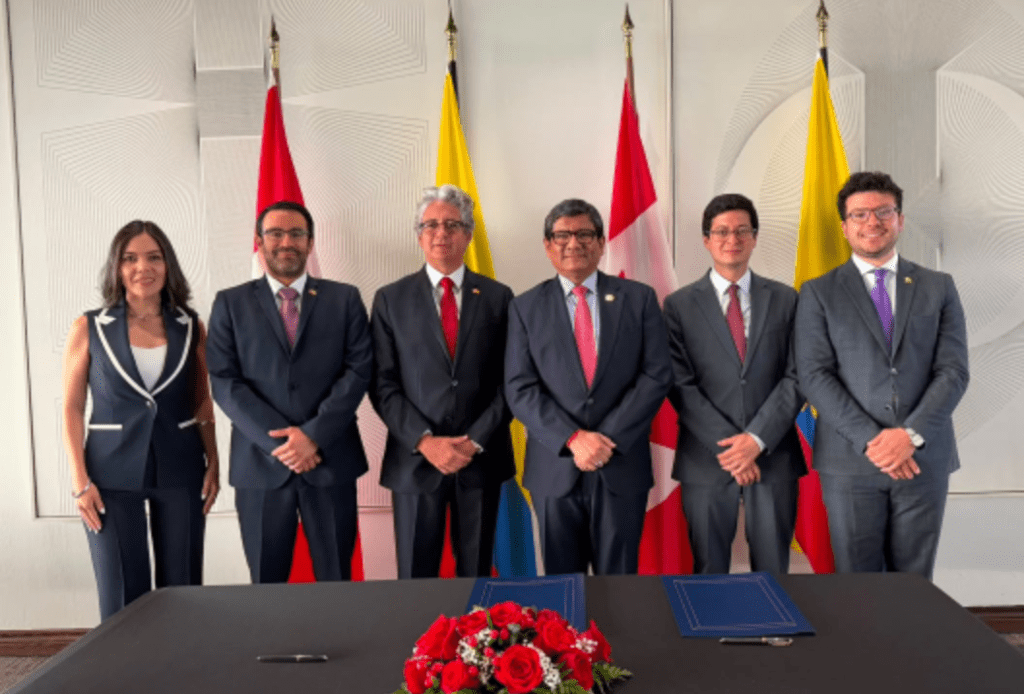
Ministers meet. Photo: Primicias, Ecuador.

In Canada, Common Frontiers and MiningWatch Canada said the agreement was “deeply dangerous.” From what is known about the deal, it’s clear that it “grants sweeping and undemocratic protections to Canadian investors while deepening Ecuador’s human rights crisis.”

(I have worked with both organizations and their members for the better part of three decades – since our struggles over the North American FTA, opposition to the proposed Free Trade Area of the Americas – a fight we won in 2005 – and the impacts of Canadian mining companies in Guatemala and beyond. Challenging as the current situation in Ecuador is, I am pleased to see Common Frontiers and MiningWatch fighting the good fight against these FTAs that only benefit the rich.)

Groups in both countries had previously criticized Ecuador’s ban on its largest opposition party, ongoing criminalization of ecological defenders, failure to consult with Indigenous peoples, and collaboration with the United States in military attacks on supposed drug-traffickers.

Common Frontiers and MiningWatch prepared a four-page explainer on why the deal is bad. And here is a statement on the new FTA from colleagues at Latin America is Better without Free Trade.

Most of what follows is text from the Common Frontiers-MiningWatch news release:

Minister Sidhu said the agreement will “open new opportunities for Canadian companies in a growing market, strengthen supply chains, and provide more predictable access to goods, services, and investment.” But Canada’s own assessment of the agreement projected insignificant growth in trade. Its main purpose is to attract and protect Canadian investment in Ecuador’s mining sector. 

The agreement is massively opposed by a large share of Ecuadorian civil society and Indigenous groups.

Paramount among the concerns:

  • A worsening human rights crisis in Ecuador. Ecuadorian and international human rights organizations have documented widespread, systematic human rights violations, including increasing militarization, repression of dissent, the criminalization of environmental defenders, and the imposition of executive decrees that undermine the rule of law. Much of this is exacerbated by – or in support of – existing Canadian mining investment in the country.
  • No consultation, consent, or transparency. The agreement was negotiated and signed without the free, prior, and informed consent of affected Indigenous Peoples, violating the UN Declaration on the Rights of Indigenous Peoples and Ecuador’s obligations under the Escazú Agreement.
  • Investor protections that violate Ecuador’s constitution. The agreement contains an Investor-State Dispute Settlement (ISDS) mechanism that is prohibited by Ecuador’s constitution and was rejected in two recent plebiscites. According to former UN Rapporteur David Boyd, ISDS poses “catastrophic” consequences for climate action, environmental protection, and the realization of human rights.
  • No corporate accountability mechanism in Canada. The recent closure of the Canadian Ombudsperson for Responsible Enterprise (CORE) and the lack of due diligence legislation underscore a major accountability gap in Canada. Communities harmed by the operations of Canadian companies in Ecuador will have no standing in investor-state disputes and nowhere to turn for justice and remedy.

The agreement now heads to Parliament to be ratified. In response to repeated concerns raised by Ecuadorian civil society and Indigenous communities and echoed by prominent civil society voices in Canada, the organizations are urging Members of Parliament to reject the agreement.

In Ecuador, the Primicias news site said the trade agreement with Canada will allow almost all of the products that Ecuador exports to that market to enter with zero tariff, once it comes into force. According to the Government, the benefit covers 99.6% of items for Ecuador.

Among the products that will enter without paying tariffs are: textiles, vegetables, roses, sardines, confetti, chocolate and ceramics.

Likewise, some of the products imported from Canada that will reach Ecuador without paying tariffs, including: wheat, cell phones, cleaning products, laptops, drones, fertilizers, medicines and sporting goods.
Ecuador bans opposition party, criminalizes ecological defenders, joins U.S. military attacks

by Jim Hodgson

In a just world, news that Ecuador has banned its largest opposition party would be enough to scuttle Canada’s plans for a free trade agreement with the country – and even end U.S. military collaboration. But that is not the world we live in.

The news came as 77 organizations from Ecuador, Canada and around the world sent a letter to Canada’s ambassador in Ecuador urging the embassy to adopt Canada’s 2019 Voices at Risk: Canada’s Guidelines on Supporting Human Rights Defenders in response to the criminalization of Indigenous and environmental defenders. Among the signatories are MiningWatch Canada, Common Frontiers, and KAIROS Canada.

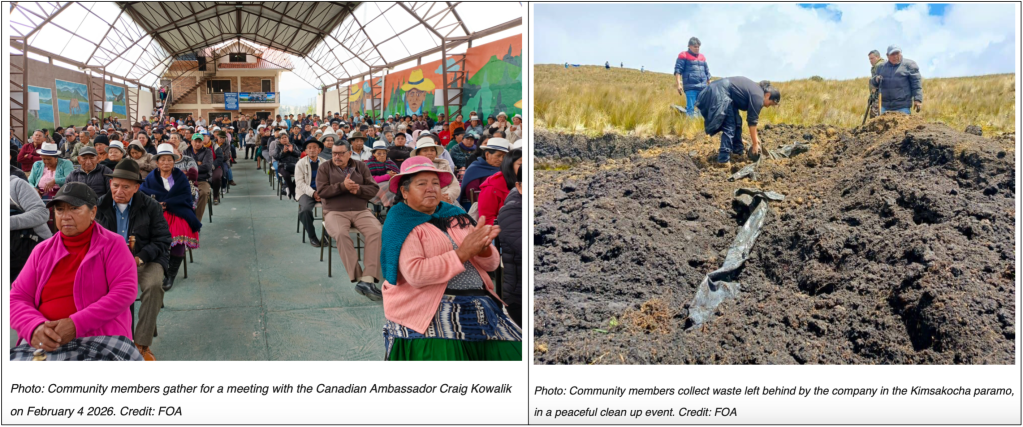
The letter to Ambassador Craig Kowalik was sent in response to the criminalization of Indigenous and environmental defenders from the Federation of Indigenous and Campesino Organizations of Azuay (FOA, Federación de Organizaciones lndigenas y Campesinas del Azuay). 

FOA members are facing criminal proceedings for their environmental defense work to safeguard the Kimsakocha páramo from the Loma Larga gold mining project, owned by Canadian mining company DPM Metals Inc.

The letter to the embassy expresses concern over criminal charges initiated by DPM Metals against six FOA members — Lauro Sigcha, Lizardo Zhaqui, Marco Tapia, Ruth Pugo, Carmita Pérez, and Yaku Pérez — following a peaceful clean-up action to remove mining waste left by the company near the headwaters of the Irquis and Tarqui rivers in the Kimsakocha páramo. The Kimsakocha páramo is a fragile ecosystem that regulates the regional hydrological cycle and provides fresh water to tens of thousands of people. For more than 30 years, Indigenous and peasant communities have defended this ecosystem against large-scale mining projects.

Ecuador bans opposition party

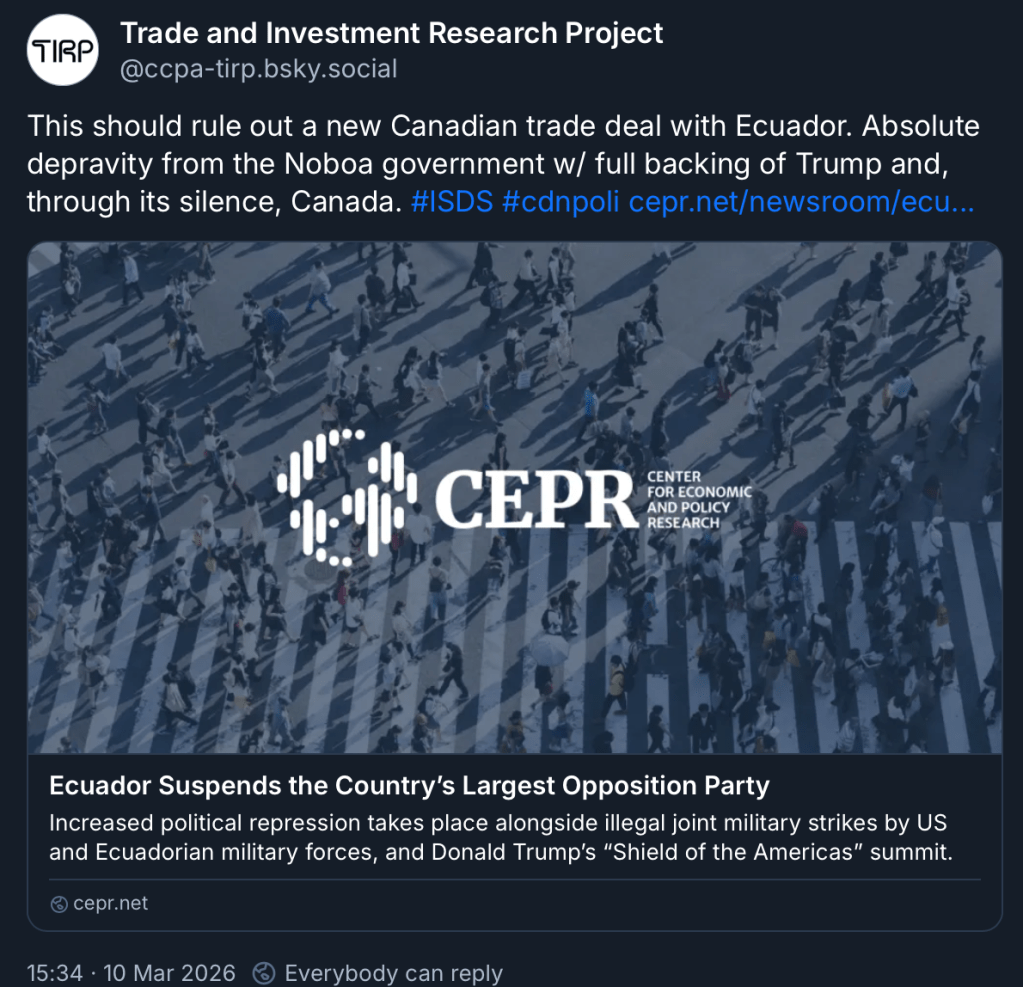
Acting on the request of the government-aligned Prosecutor General, an electoral judge in Ecuador on Friday (March 6) ordered the nine-month suspension of the country’s largest opposition party, the Citizens’ Revolution (RC ). 

The Center for Economic and Policy Research (CEPR) denounced the ban as the latest escalation in a broader pattern of authoritarian regression, including lawfare against opponents, repeated states of emergency, and deepening military ties with the Trump administration.

“The government of President Daniel Noboa, who is strongly backed by President Trump, is trying to accelerate the destruction of what is left of democracy in Ecuador,” said CEPR Co-Director Mark Weisbrot. The move bars RC –led by former President Rafael Correa – from local elections to be held in 2027.

U.S.-Ecuador military strikes

On the same day as the ban on the RC party, the Ecuadorian and U.S. militaries conducted joint airstrikes near the Colombian border targeting a site allegedly tied to dissidents from the former FARC guerrillas from Colombia. 

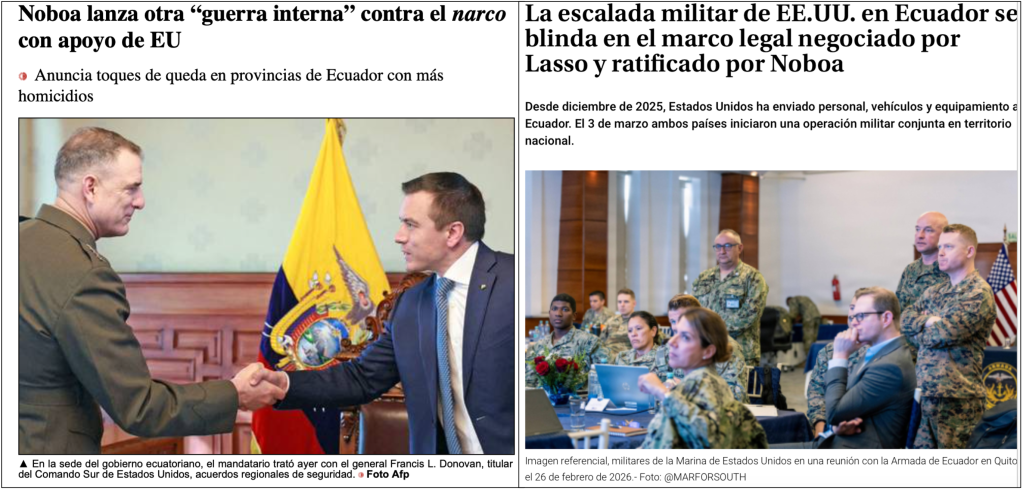
These “lethal kinetic operations,” as the U.S. military calls them, are another of Noboa’s efforts since his 2023 election to deepen ties with Washington — including a failed attempt to re-establish a U.S. military base in the country.

Days earlier, on Tuesday (March 3), the United States and Ecuador launched joint attacks against “designated terrorist organizations” – Trumpspeak for drug-traffickers.

Since September last year, the United States has attacked small boats in the Caribbean and eastern Pacific, but these attacks in Ecuador are the first known land operations by U.S. forces against drug cartels. At least 150 people have been killed in 44 known strikes. The United States has never shown proof that any of the dead were in fact moving illegal drugs.

While neither government will say precisely where the attacks are happening, Noboa ordered curfews in four provinces west and southwest of Quito, extending to the city of Guayaquil and beyond. Noboa said his country was “entering a new phase in the internal war.”

* An update (March 25 from Drop Site News:

New York Times investigation raises serious questions about a March 6 airstrike that Defense Secretary Pete Hegseth publicized on social media as proof the U.S. military was “now bombing Narco Terrorists on land.”

According to the Times, the target appears to have been a 350-acre cattle and dairy farm owned by a 32-year-old carpenter named Miguel, not a drug trafficking compound. Farm workers told the Times that Ecuadorean soldiers arrived three days earlier, beat and detained four Colombian workers, subjected them to waterboarding and electric shocks, doused structures with gasoline and set them alight—then returned on March 6 to film themselves bombing the smoldering ruins, producing footage Ecuador and the U.S. jointly promoted as the destruction of a traffickers’ training camp.

The Pentagon said the strike was conducted “jointly” with Ecuador, though Times sources said U.S. troops had no direct involvement in the bombing itself. Ecuador claimed to have recovered weapons and evidence of illicit activity but released no photographs, as it typically does following drug seizures. “It’s a lie that 50 people trained here,” Miguel said, standing amid his dead chickens. “There’s no logic.” (NYT)

Human rights, ecology, in the spotlight as Canada-Ecuador trade talks move forward

Behind all the bad-news headlines from Ecuador these days (political murdersgang violence, a government crackdown, a police raid on the Mexican embassy), Indigenous people and environmental groups continue to organize in opposition to resource extraction industries.

On April 21, they claimed victory when voters rejected two government proposals that would have fortified investments by transnational corporations and provided “flexibility” in their ways of contracting workers. Those victories, however, are overshadowed by approval of a range of security measures that, in turn, provoke greater concern about human rights under President Daniel Noboa.

Headlines in English about the April 21 referendum focused on President Noboa’s security agenda. La Jornada (Mexico) and TeleSUR (Venezuela) examined Noboa’s failure to advance his market-oriented economic agenda.

The proposals to expand public security that were approved include: involvement of the armed forces in fighting crime, increased penalties for serious crimes, the possibility of extradition of citizens to face charges in other countries, seizure of illicitly-obtained good, and restrictions on private ownership of weapons.

In contrast, the package of measures sought by corporations were rejected: international arbitration of investment and trade disputes, and a measure that would establish time-limited contracts and hourly-work—the “flexibility” to replace permanent, full-time jobs. 

Meanwhile, in the face of human rights and security concerns, Canada is pressing ahead with plans for a free trade agreement with the South American nation.

Canada’s objectives for negotiating this FTA look nice: “a modern, ambitious and inclusive trade agreement, reflecting the latest approaches, including in areas such as digital trade, trade and gender, environment and labour.” Mention is made of women, Indigenous peoples and labour rights.

But it is the experience of Indigenous people in Ecuador with Canadian mining companies and with the Chevron Texaco oil giant that drives opposition to free trade and one of its hallmarks: protection of foreign investors.

Canadians have seen the harmful effects of investor-state dispute settlement (ISDS) processes, both with corporate lawsuits against Canada and others involving Canadian companies overseas. (One of the latter with which I became very involved was that launched by mining companies against the government of El Salvador after it rejected an application to re-open a gold mine in Cabañas department. Salvadoran water defenders and their international allies won that fight, but such victories are rare—and our victory has provoked a cruel response by the present government.)

Stuart Trew of the Canadian Centre for Policy Alternatives (CCPA) points to a “litany of expensive and controversial ISDS awards against Ecuador involving natural resources” that led the former government of Rafael Correa to withdraw his country from ISDS processes. Constitutional reforms in 2008 include a ban on such arbitrations, and it was this article of the constitution that the Noboa government sought to amend in the referendum. 

Throughout the lead-up to the vote, the Union of People Affected by Texaco/Chevron Operations (UDAPT), the Indigenous and peasant movement led by the Confederation of Indigenous Nationalities of Ecuador (CONAIE), and others like Acción Ecológica campaigned to ensure the “no” vote.

On its website, Acción Ecológica maintains ongoing actions on mining, petroleum, protection of nature defenders, and free trade.

Christian Pino, a lawyer who specializes in investment law, welcomed the result, saying that approval of international arbitration of investment disputes would have benefited the transnationals and those Ecuadorans who hold their investments in offshore “fiscal paradises.”

I like to say that I have been fighting free trade since 1848, when Karl Marx and Friedrich Engels described it in The Communist Manifesto as “that single, unconscionable freedom” that drowns all others. But no: more like 1988, when Canadians gave Brian Mulroney a mandate to sign the first FTA with the United States, abandoning more than a century of caution in Canada-U.S. trade relations, transforming modes of production, and provoking the loss of more than 300,000 jobs

So this is not our first free trade fight or struggle to defend human and ecological rights in the face of resource extraction companies. As these FTA negotiations proceed, bear two things in mind: 

  • In the Harper years, when Canada was negotiating free trade with Colombia, we called for a “human rights impact assessment” (HRIA) but ended up with a fake mechanism that has failed to protect rights. 
  • We also pressed for a ombudsperson who could press for accountability by Canadian companies operating overseas so as to protect individuals and organizations who complain about abuses. But we ended up with a toothless office, the Canadian Ombudsperson for Responsible Enterprise (CORE), that has no investigatory power.

CCPA, together with MiningWatch Canada and Amnesty International, have amplified the concerns of Ecuadoran organizations and shared them with Canadian parliamentarians.

While any Canada-Ecuador FTA cannot now include ISDS, the deal could still exacerbate the human rights situation in Ecuador.

“Amnesty International Canada’s Human Rights Agenda for Canada calls for guarantees that no free trade agreement will advance without meaningful consultation with affected Indigenous Peoples and their organizations and their free, prior and informed consent. The organization is also calling for credible, independent human rights and environment impact assessment of any proposed trade agreement,” states an April 30 news release from the three Canadian organizations.

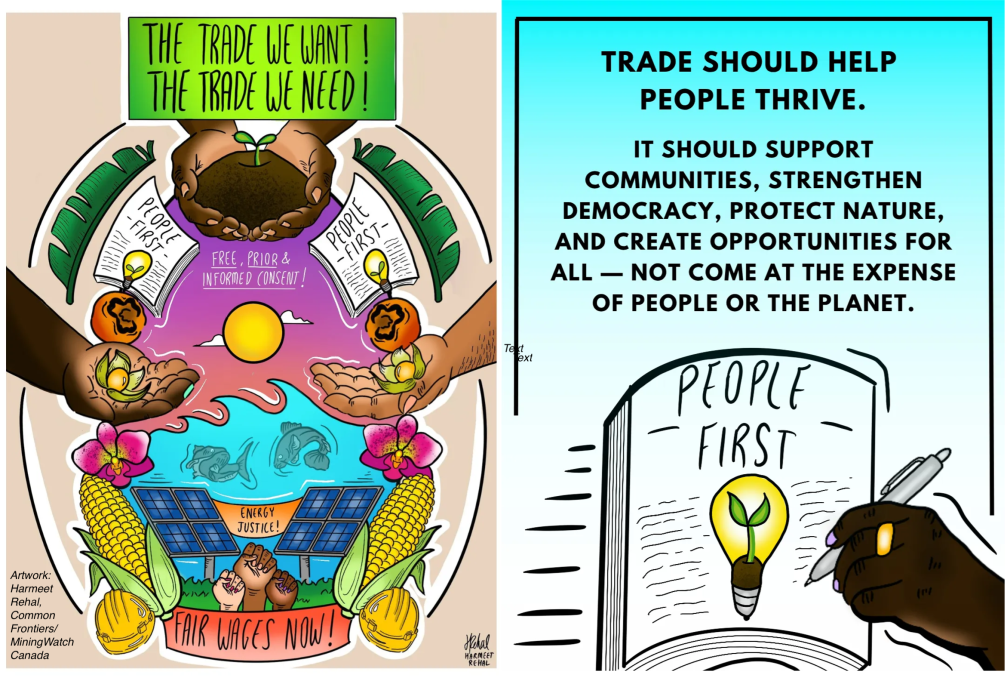
We can do better this time.

No Ecuador trade deal without human rights, consultation and consent

If you too wish to express your concern about Canada’s free trade plans for Ecuador, Amnesty International has set up a page from which you can send a message to Trade Minister Mary Ng telling Canada to put human rights and the environment first.