
by Jim Hodgson (with help from Common Frontiers, CCPA, Drop Site News, Decolonized Journalism, and others)
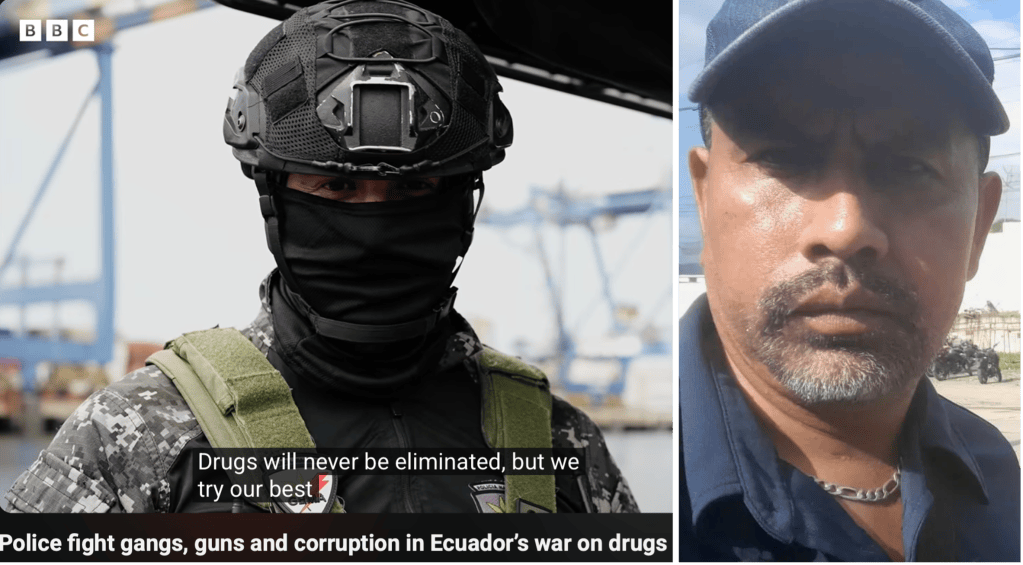
Under President Daniel Noboa, Ecuador is becoming one of the most dangerous countries in Latin America. There’s a state of emergency – just one in a long series – as drug-traffickers move cocaine from Peru and Colombia to markets in richer countries. The country’s murder rate is now among the world’s highest.
Let’s take a look at what is going on:
- Recent demonstrations have protested persistent violence, university budget cuts and worsening public services while also demanding the release of imprisoned opposition leader Luisa González. González, arrested Oct. 22 at her home and accused of money-laundering, challenged Noboa in the 2023 and 2025 elections on behalf of the Citizen Revolution Movement that is made up of followers of former president Rafael Correa, who led the country from the left between 2007 and 2017.
- Pete Hegseth, the U.S. defence secretary, stopped in Ecuador Thursday to shore up U.S. military collaboration. The visit came after AFP and Aljazeera reported on U.S. military use of Ecuador’s Taura Air Base near Guayaquil, prompting Noboa this week to deny that the base had become a U.S. base. Foreign military bases are prohibited by Ecuadorian law. A year ago, voters said no in a referendum on Noboa’s proposal to allow foreign bases, but the United States has used Ecuadorian bases for its attacks on civilian boats it alleges are used for drug-trafficking. (Noboa is alleged to have his own ties to drug-smuggling networks in Europe.)
- Ecuadorian fishermen who survived a U.S. drone strike on their vessel in March have filed a lawsuit In U.S. federal court against the Trump administration. Drop Site News contributor Camila Lourdes Galarza reported on the fishermen’s accounts of the attack and alleged abduction and torture, alongside testimony from survivors of another strike. A follow-up investigation reported that the prosecutor investigating the attacks was murdered and documented evidence of U.S. Coast Guard activity prior to the attack.
Canada’s trade deal: the investment chapter is “unconstitutional”
With all of that going on, forgive me for taking you into the less dramatic but still vital detail of the Canada-Ecuador free trade agreement that was signed in July but still awaits ratification in both countries.
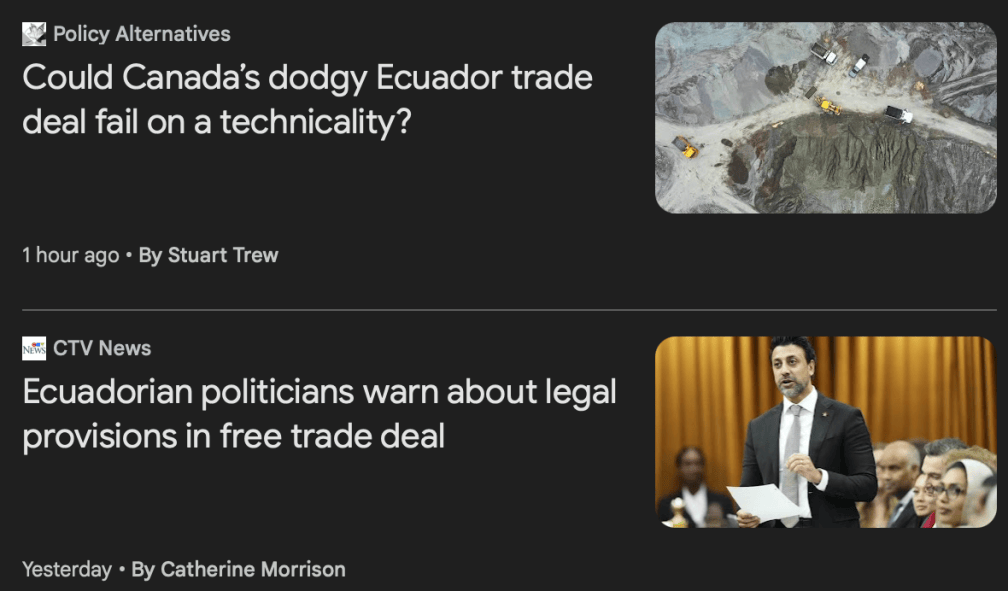
This week, 25 Ecuadorian politicians warned that one provision in the Canada-Ecuador free trade agreement violates Ecuador’s constitution by ceding jurisdiction over disputes with private companies to international arbitration.
In a letter sent to Canada’s International Trade Minister Maninder Sidhu, the former ministers and ex-presidents of the national assembly asked for removal of remove the investor–state dispute settlement (ISDS) sections of Chapter 15 (Investment) before tabling implementing legislation of the deal.
Stuart Trew, senior researcher at the Canadian Centre for Policy Alternatives, writes:
“ISDS is the controversial legal tool with which corporations and investors can challenge governments’ laws and regulations through international arbitration rather than domestic courts. Supporters of ISDS, like Canada, claim it creates legal certainty for overseas investors, but too often it is used as a weapon to deter, or seek punitive financial compensation for, the imposition of policies that directly or only inadvertently affect an investor’s returns (profits).”
Voters in Ecuador have twice (April 2024 and November 2025) upheld a constitutional ban on submitting conflicts with private companies to international arbitration.
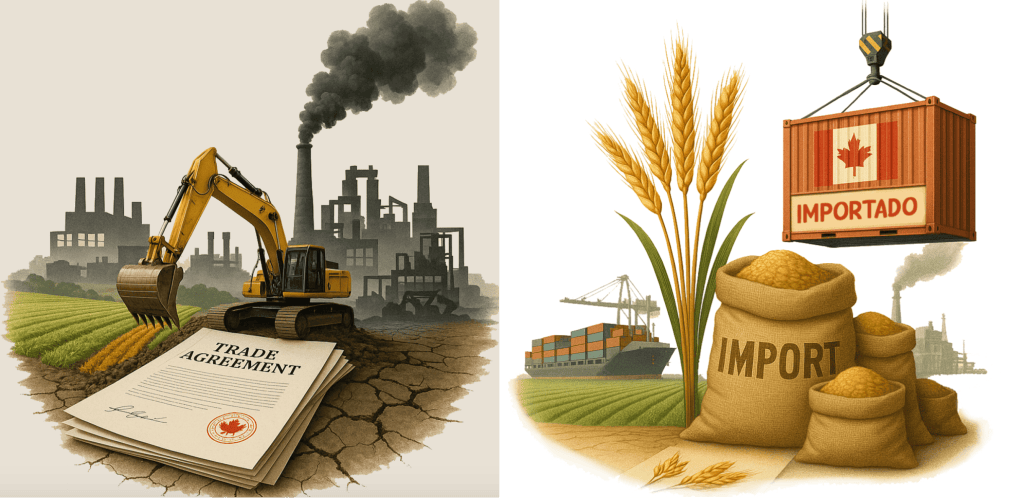
“The population is clearly against ISDS, yet Ecuador and Canada are stubbornly trying to wedge it back into Ecuadorian life, mainly to the benefit of Canadian mining companies,” adds Trew. He points to Canadian-based mining companies that want trade and investment agreements to include ISDS.
“An agreement built on sound legal and democratic foundations will serve the relationship between our countries considerably better than one that invites constitutional challenge from the day it enters into force,” says the Ecuadorian politicians’ letter.
Canadians might want to write to our own politicians.

