
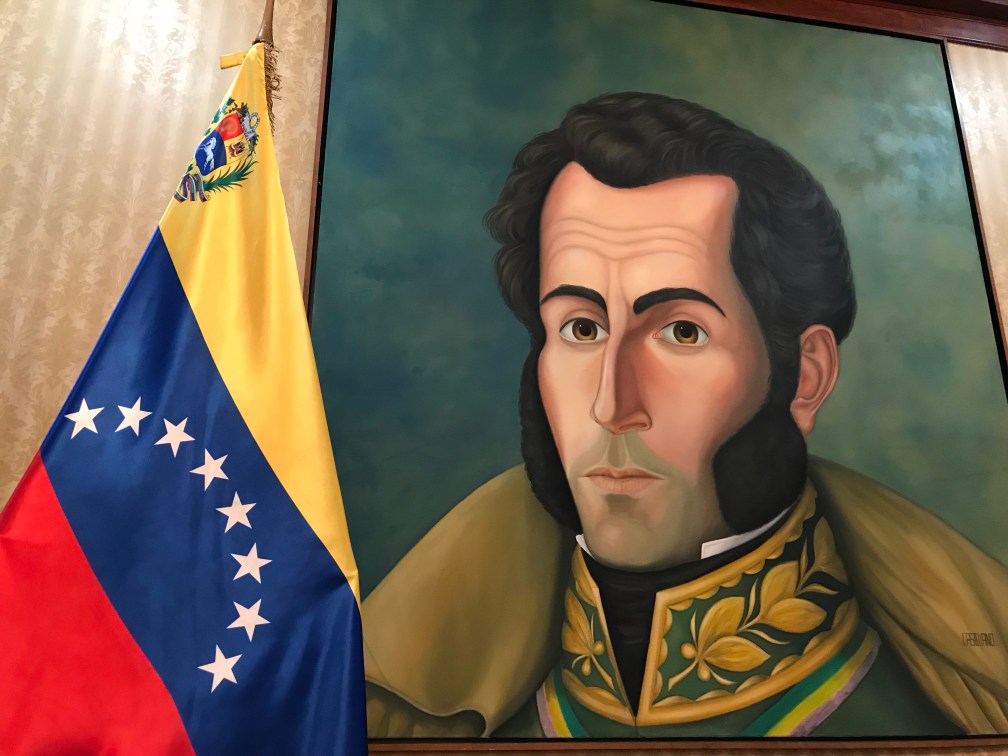
by Jim Hodgson
In this decade of Donald Trump at centre-stage, it has been hard to choose a moment or an issue about which to react. The former reality TV star is an expert in deflection and distraction.
Yet some things (Israel’s genocide in Gaza is one) matter more than others. So too Trump’s threats against Venezuela.

Trump’s statement below defending extrajudicial executions shows again how little he values human life. He was responding to a question from a journalist on Oct. 23 about why he didn’t ask Congress for a declaration of war against drug cartels he claims are at war with the United States:
“Well, I don’t think we’re gonna necessarily ask for a declaration of war, I think we’re just gonna kill people that are bringing drugs into our country. OK? We’re going to kill them. You know? They’re going to be, like dead. OK?”
Over the past two months, Trump’s assassins have killed at least 43 people and sunk ten small boats in the Caribbean and along the Pacific coast of Colombia. As Greg Grandin has documented, when the U.S. withdraws from the rest of the world, it doubles down in this hemisphere.
This time, the United States isn’t even bothering with its usual lies as it moves from a decade of sanctions (“unilateral coercive measures”) to threats of war as it presses for regime change in Venezuela. Sanctions have had devastating effects in Venezuela, according to a study conducted by the Center for Economic and Policy Research and published in August in The Lancet Global Health.
Trump’s ire is mostly directed against Venezuela, which since 1998 has refused imperial orders about oil, medical care, governance, and individualistic notions of human rights. But he has plenty left over for Colombia and Mexico.

The text below is translated and lightly adapted from an Oct. 25 editorial in the Mexico City daily La Jornada.
Washington seeks war
The Trump administration is sending increasingly alarming signals about its determination to attack Venezuela to impose regime change and install a puppet administration. Trump uses a “combination of threats of armed action and economic extortion” to support right-wing politicians in Argentina, Brazil, Ecuador, El Salvador and now Bolivia “to facilitate the rise or consolidation of the far right throughout the hemisphere.”
On Oct. 24, his “War Department” announced the deployment of an aircraft carrier, the USS Gerald R. Ford, and its strike group to the U.S. Southern Command—that is, the southern Caribbean and northern South America. This entails the presence of the aircraft carrier itself, the 75 aircraft it carries, and the full range of necessary operations: three destroyers, a replenishment ship, a dry cargo ship, and a Coast Guard cutter. The Gerald R. Ford alone carries 4,600 military personnel, in addition to the crews of auxiliary vessels.
The argument that all these vessels are being deployed with the goal of “dismantling Designated Terrorist Organizations (DTOs) and countering narco-terrorism in defence of the homeland” doesn’t stand up to scrutiny. First of all, they could be deployed off the US coast, thereby reducing the cost of maintaining long supply chains and avoiding diplomatic friction.
The thousands of soldiers already sent to the Caribbean could have provided a much greater service to their homeland by monitoring land and air points of entry, where narcotics actually enter the United States. Instead of spending billions of dollars operating its fleets abroad, Washington could gain vast resources by combating money laundering within its own financial system, where authorities estimate that organized crime launders $300 billion annually. If traffickers were unable to collect and move the profits from their activities, they would be immediately paralyzed. But it is clear that the White House is not interested in the health of its citizens or the legality of the money circulating through its banks.
The bellicose tone of this escalation is so evident that even Brazilian President Luiz Inácio da Silva (Lula—who is not friendly to Venezuelan President Nicolás Maduro) criticized the U.S. bombing of boats in the Caribbean, noting that “if it becomes fashionable, everyone will believe they can invade someone else’s territory and do whatever they want,” thus turning the region into a lawless land.
Lula’s special advisor and former Foreign Minister Celso Amorim warned that external intervention, whether armed or through intelligence services, is not the way to decide who will govern Venezuela, a problem that concerns only Venezuelans. He also warned of the danger of setting South America ablaze and leading to the radicalization of politics throughout the continent. At the same time, Washington is making clear its longing to empower the Colombian oligarchy in Bogotá, always ready to follow its directives and make the Andean-Caribbean territory available to its troops and spy agencies.
In this regard, Trump escalated his attacks against President Gustavo Petro and imposed sanctions for “allowing drug cartels to flourish and refusing to stop this activity.” No evidence was presented, which is what happens in his constant diatribes against Mexico, Venezuela, and other nations whose governments protect their independence and sovereignty.
In South America, there is no war that justifies besieging the subcontinent with a series of attacks. But it becomes increasingly clear that the White House is determined to start a conflagration, no matter how absurd its pretexts.
The international community, and particularly Latin American and Caribbean societies, must join forces in rejecting Trump’s attempt to plunge the region into barbarism in order to divert attention from his own ineptitude and hand over vast amounts of money to the military-industrial complex, the only sector whose prosperity apparently interests the U.S. president.
…
Here’s a way to keep up with Trump’s threats and responses from Caribbean and Latin American political and social movement leaders. The Center for Economic Policy and Research (CEPR) has been a good source of information on U.S. intervention in the region for decades.


 Unwrapping Development