Justice denied: U.S. sends Venezuelan asylum-seekers to Salvadoran prison

Even in the face of the Trump regime’s horrific arrests, extraordinary renditions, and forced disappearances of immigrants and asylum-seekers, there are shreds of hope.

Activists and journalists are gradually identifying and sharing the stories of victims, including the 238 Venezuelans and 23 Salvadorans shipped to a prison in El Salvador on March 15. And judges and some politicians are more vocal in support of “due process”—the U.S. constitutional guarantee of at least being heard before being deprived of liberty—for all migrants.

One group has built a website: thedisappeared.org. They make prominent use of the blue triangle, the symbol used by Nazis in their concentration camps to designate migrants. About the 238 Venezuelans, they say: “There is no evidence to support the allegations that they are hardened criminals.” The group also posts on Facebook.

Above on the left is Andry Hernández Romero, age 31. I learned of his case the way many others did. A photojournalist, Philip Holsinger, met the airplanes that brought the Venezuelans to El Salvador and then accompanied them to the prison. A man who caught Holsinger’s attention shouted “I’m innocent” and “I’m gay,” and was crying as his head was shaved. From Holsinger’s photo, friends and family members identified him as Andry. Details of his situation were covered first in LGBTQIA+ media (The Advocate and the Washington Blade) and later by NBCCBS and elsewhere. His lawyer has mobilized political support in California, including that of Gov. Gavin Newsom and U.S. Rep. Robert Garcia.

The disappeared.org site draws attention to many other cases, including that of two-year-old Maikelys Antonella Espinoza Bernal (below) whose father, Maiker Espinoza Escalona, was sent to the prison in El Salvador. She and her mother Yorely Bernal Inciarte, were supposed to be sent together on a deportation flight back to Venezuela—part of her homeland’s “Vuelta a la Patria” program for citizens willing to go home. But the United States refused to return the child to her mother before she left.
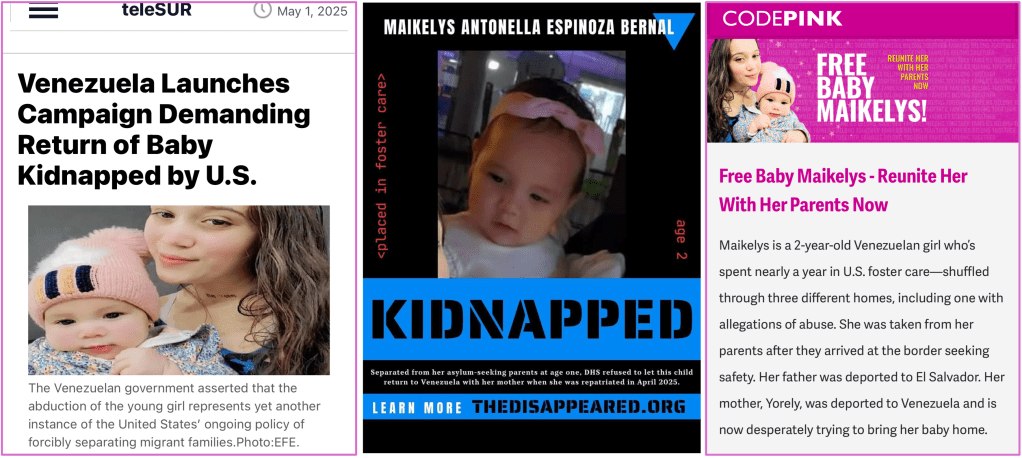
When Yorely arrived back home alone, Venezuelan media and the government took up the family’s cause (image on the left, above). So too did CodePink (right), a women’s peace network in the United States with which I have collaborated to draw attention to the negative impact on Venezuelans of U.S. economic sanctions

The Disappeared shared a piece from a group called United Strength for Action about the U.S. role in creating the disaster that Venezuelans face. I can’t concur with all the group said–many people in the United States just can’t see the historical context of U.S. imperialism–but I am relieved that they at least acknowledged the role of U.S. sanctions in creating a humanitarian crisis that drives the exodus of refugees. “This wasn’t foreign policy; it was collective punishment that pushed millions of Venezuelans past their breaking point.”

Since 1998, successive U.S. administrations have done all they could to be rid of Nicolás Maduro and his predecessor, Hugo Chávez: a coup attempt in 2002, a “revocatory” referendum in 2004, the effort to impose a “president” (Juan Guaidó) whom nobody had voted for, and through waves of sanctions. Given the failure of those efforts to induce regime change and seeing the flow of migrants out of Venezuela, President Joe Biden for a time tried a different approach, one of dialogue and engagement. The early weeks of Trump’s administration gave some hope this could continue, but the hard-liners seem to hold sway once again.

At a May Day march, President Maduro vowed to “rescue” Maikelys along with the Venezuelans now held by El Salvador. He also spoke directly to the hundreds of thousands of Venezuelans who have tried to reach the United States in recent years: 

“Stop going there. The true dream is that of our land to build with our hands. Stop being victims of xenophobia, of abuse… The only land that will welcome you and serve you like the prodigal son is called the Bolivarian Republic of Venezuela. We must take care of it, fertilize it, and build it. This homeland belongs to all!”

Maduro emphasized Venezuela’s right to build its own social model. “We have the right to true democracy, to our cultural identity. We are not gringos. We are proudly Bolivarian, Latin American, Caribbean. We are Venezuelans!”

Venezuela says it is willing to receive people deported from other countries. Between February and April 25 this year, 3,241 Venezuelans had returned on 16 government-funded flights. Yorely (the mother of Maikelys) came home on just such a flight.

Two more issues. Trump officials say that the people sent to jail in El Salvador were linked to the Tren de Aragua criminal gang, and that they used tattoos to identify the gang members.
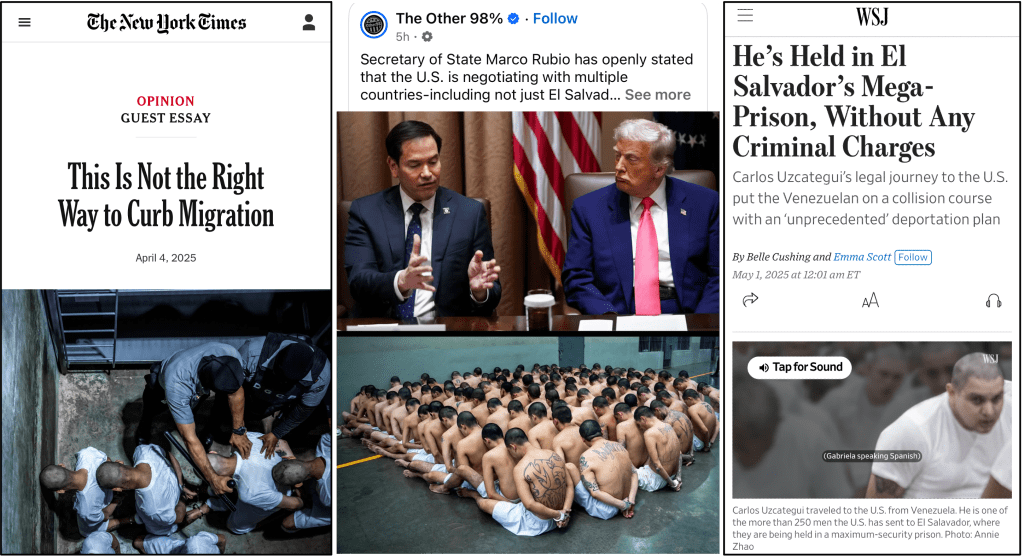
It’s good to see “mainstream” media like The New York Times (left) and Wall Street Journal (right) join the rest of us rabble-rousers in calling attention to the Trump regime’s actions.

Trump’s executive order decreeing the deportations said the gang is “conducting irregular warfare and undertaking hostile actions against the United States.”

But that is not true. In an article for The New York Times, a team of experts on violence in Venezuela said Tren de Aragua is not invading the United States. Nor is it a “terrorist organization,” and to call such “criminal groups terrorist is always a stretch since they usually do not aim at changing government policy.” The article goes on to show that Tren de Aragua is not centrally organized, though members were involved in migrant smuggling and the sexual exploitation of Venezuelan migrants in Colombia, Chile and Peru. 

The NYT piece adds that even U.S. intelligence officials do not believe the Maduro government is colluding with the gang, the key assertion in Trump’s justification for invoking the 1798 Alien Enemies Act to render Venezuelan migrants to El Salvador.

Immigration officials used tattoos to “determine” if someone was linked to Tren de Aragua, but the authors of the NYT piece say Venezuelan gangs (unlike Salvador groups like the MS-13) do not use tattoos that way. “Many young Venezuelans, like young people everywhere, borrow from the global culture of iconic symbols and get tattoos. That doesn’t mean they’re in a gang,” they wrote.

Moreover, the Tren de Aragua gang network in Venezuela is largely dismantled.

“The Tren de Aragua is cosmic dust in Venezuela; it no longer exists, we defeated it,” President Maduro said March 19. He was quoted by the English-language Orinoco Tribune in a longer article about the gang’s history in Venezuela.

Interior Minister Diosdado Cabello questioned whether all deportees were Tren de Aragua members, and demanded the US extradite captured suspects. “The US is acting in a confusing manner. They promised to send us Tren de Aragua members, but they have not. Someone there is lying.”

* Update, May 14 * Two-year-old Maikelys has been re-united with her mother in Venezuela. Her father remains in the Trump-Bukele prison in El Salvador. See the statement from CodePink.

In El Salvador, the struggle continues as AG appeals not-guilty verdict in case of Santa Marta 5

The office of El Salvador’s Attorney General has decided to appeal the acquittal Oct. 18 of five community leaders, a move quickly rejected by their community and by Salvadoran and global organizations that have worked in solidarity for more than two decades to reject a proposed gold mine that threatened water resources.

Images: ACAFREMIN (the Central American Alliance Against Mining) and CISPES (Committee in Solidarity with the People of El Salvador)

The office of El Salvador’s Attorney General has decided to appeal the acquittal Oct. 18 of five community leaders, a move quickly rejected by their community and by Salvadoran and global organizations that have worked in solidarity for more than two decades to reject a proposed gold mine that threatened water resources.

Leonel Herrera, a journalist covering the case for Diario Co Latinocalls the decision to appeal “reprehensible.” Authorities should use their time and resources “to investigate true war crimes, beginning with the massacres committed against Santa Marta which took the lives of hundreds of civilians—mostly women, the elderly and children.” 

This was never a true criminal case, Herrera added, but rather “a spurious accusation invented to persecute a group of former guerrilla fighters not for war crimes, but rather for what they do now: care for the water, protect the ecosystem and attain the continuity of lives gravely threatened by the possible re-activation of mining projects.”

Santa Marta Rejects Appeal of Acquittal of Water Defenders

Translation by CISPES (Spanish original is  here)

We reject the appeal of the Attorney General’s Office and demand that the acquittal of our environmental leaders be upheld

The Attorney General’s Office (FGR) remains determined to prevent legality and justice from prevailing for the community leaders of Santa Marta and ADES, who were definitively acquitted last October 18 by the Sentencing Court of Sensuntepeque, Cabañas. For this reason, an appeal has been filed before the Criminal Chamber of Cojutepeque.
Despite multiple calls to respect the acquittal of the environmental activists of Cabañas, the Prosecutor’s Office seeks to reverse Sentencing Court’s ruling, which is in accordance with the law and congruent with the principles of due process. The appeal is characterized by a lack of valid legal argumentation and by the disrespectful way in which the representatives of the Prosecutor’s Office refer to the honorable sentencing judges.
In this sense, we ask the magistrates of the Criminal Chamber of Cojutepeque not to admit the appeal and to ratify the decision of the Sentencing Court of Sensuntepeque, which has acted independently, in accordance with the law and without being pressured by extrajudicial factors that conspire to condemn the defenders of water, the environment and life threatened by the possible reactivation of mining.
In this regard, it is worth remembering that the ruling of the Sensuntepeque Sentencing Court responds to the mandate of the Cojutepeque Criminal Chamber, which on two occasions transferred the decision of whether or not the alleged acts constituted crimes against humanity or war crimes to the Sensuntepeque Sentencing Court.
In accordance with this mandate, the sentencing judges analyzed the case and unanimously determined that the alleged crimes presented by the prosecution did not meet the definition of a crime against humanity or a war crime, as established in the Rome Statute and the Geneva Conventions, respectively. Therefore, they ruled that the criminal action was inadmissible due to the statute of limitations of the alleged crimes and decreed a definitive dismissal for the defendants.
We alert the country and the world of this attempt by the Salvadoran Attorney General’s Office to continue using the judicial system to persecute environmental activism and manipulate restorative and transitional justice to criminalize environmental defenders who warn about the serious dangers of mining extractivism.

Definitive freedom for the community leaders of Santa Marta and ADES!
Yes to Life, No to Mining!

Cabañas, El Salvador, October 30, 2024

Libertad! Not guilty verdicts in El Salvador show trial.

by Jim Hodgson

It’s a chaotic scene this noon hour outside the courthouse in Sensuntepeque after the not-guilty verdict today in the case of the “Santa Marta 5.” There will be time for analysis in days and weeks ahead but for the moment, I hope you can share my joy and that of countless good friends–compañerxs de lucha over many years–at news of this verdict.

Thank you to ALL who have accompanied the people of Cabañas in their defense of the water, against the mining project and for the freedom of five compañeros unjustly arrested and made to suffer. International allies will remain attentive.

More information….

International Allies Applaud the Acquittal of the Five Unjustly Jailed Water Defenders in El Salvador

Friday, October 18, 2024, 4 pm ET

“No Crime to Pursue”: International Organizations Applaud Salvadoran Tribunal Ruling that the Five Salvadoran Water Defenders Are Innocent of the False Charges against Them

The five prominent Water Defenders who faced politically-motivated charges are heroes of El Salvador — and they should never have been arrested. 

San Salvador and Washington, D.C. – On October 18, the presiding tribunal in the Salvadoran trial of five leading Salvadoran Water Defenders ruled that all five are completely innocent of the two sham charges of murder and illicit association that were laid against them.

“We call on the Attorney General’s office not to appeal this decision in order to ensure the definite freedom of our compañeros as soon as possible,” the Economic and Social Development Association of Santa Marta (ADES), whose leading members were among those on trial, stated. “Rather than insisting on prolonging this process any further, the Attorney General’s office should apologize to the five and to the community, and should dedicate themselves to investigating the real war crimes, starting with the massacres that were committed against Santa Marta and other communities.” ADES held a press conference outside the courthouse and will release a more detailed statement later today.

In response to the verdict, an international coalition of 14 groups (listed at bottom) led by International Allies against Mining in El Salvador released the following statement: 

The five prominent community leaders known as the “Santa Marta 5,” Miguel Ángel Gámez, Alejandro Laínez García, Pedro Antonio Rivas Laínez, Antonio Pacheco, and Saúl Agustín Rivas Ortega, were all instrumental in the successful campaign to save El Salvador’s rivers from the threat of gold mining. With a unanimous vote in El Salvador’s National Assembly in March 2017, El Salvador became the first nation on earth to ban all metallic mining.

Since the arrest of the five water defenders in January 2023 on politically-motivated charges, prominent organizations and individuals have led a national and international campaign spanning 31 countries demanding that the bogus charges be dropped and denouncing the political motivations behind their detention given the lack of evidence presented by the Salvadoran Attorney General’s office.

Beyond the lack of evidence, the Salvadoran Attorney General’s pursuit of this case has dealt a serious blow to the Salvadoran government’s credibility, belying its claim that it remains a democracy and that it holds no political prisoners. The unceasing and courageous pressure from grassroots organizations in El Salvador – in concert with international solidarity – may have worked in favor of the Water Defenders today, but hundreds of political opponents, labor leaders and human rights defenders remain imprisoned. The community-led movement of water defenders still stands strong in the face of future attempts to undermine land and water protections for communities in El Salvador.

Our organizations support the call by Salvadoran civil society groups that the Salvadoran Attorney General should apologize to the five defendants, whose health has suffered greatly over the past 21 months that they have stood accused of and imprisoned on false charges, and to the Santa Marta community, which suffered from genuine military atrocities during the Salvadoran Civil War in 1980-1992. 

As highlighted in a crucial fact-finding January 2024 report, the national and international campaigns have also condemned the criminalization of environmental defenders, the lack of legal rights and due process under the current “state of exception” imposed by the Salvadoran government, and have warned about the intention of the Salvadoran government to reverse the historic 2017 nationwide ban on metals mining. 

The five Water Defenders should never have been charged, and the Salvadoran government’s willingness to pursue these accusations despite their clear innocence signals a worrying willingness to persecute the movement that these five water defenders represent. We call on the Salvadoran government to forgo future sham prosecutions and uphold the democratic rule of law in future pursuit of true justice.

An international observer delegation made up of academics and lawyers from Canada, the United States, and Mexico observed the trial and noted several transgressions by the Salvadoran Attorney General’s lawyers during the proceedings.  Not only did they violate the tribunal’s gag order, by recklessly exposing the identities of witnesses and observers, they exhibited “overly aggressive behavior” toward witnesses.

The international solidarity movement supports the call by Salvadoran civil society and human rights organizations to end the ongoing “state of exception” in El Salvador, to release thousands of people who have been unjustly imprisoned, and to ensure that the historic 2017 nationwide ban on metallic mining remains in place. 

“We applaud this verdict as a signal that justice must prevail in El Salvador. The five prominent Water Defenders who faced politically-motivated charges are heroes of El Salvador — and they never should have been arrested in the first place,” said John Cavanagh, Senior Advisor at the Institute for Policy Studies. “These charges were clearly politically motivated, and through them, the Salvadoran attorney general displayed a stunning lack of respect for human rights and the environment in El Salvador. But the fight is not over – we have to ensure that the persecution of these community and environmental movement leaders does not continue and that they and others will be able to continue their important work safely. Pursuing this trial from the start still signals a willingness by the Salvadoran government to reverse the protections guaranteed by the historic 2017 mining ban.”

“We are grateful to the hundreds of national and international civil society organizations who worked tirelessly for more than 20 months to denounce this injustice. A guilty ruling would have been a death sentence for our compañeros, as the inhumane conditions of Salvadoran jails have become a death trap for people of advanced age who suffer from chronic health conditions,”  said Vidalina Morales, president of The Economic and Social Development Association of Santa Marta (ADES). “We urge the Attorney General not to appeal this decision to the higher courts, but we are ready to go to the international human rights system if necessary to defend their innocence and their life.” 

“As we have said, the absolution of our environmental defenders was the only legal and just outcome. This ruling also upholds the interests and well-being of the country,” Morales continued. “We recognize the professionalism, the independence and the courage of the judges of the Sentencing Tribunal of Sensuntepeque, who correctly applied the law and have not yielded to the extrajudicial pressures and interests that conspired to invent this case.”

“We applaud the verdict. It is an important victory for environmental justice and human rights,” said Viviana Herrera, Latin America Program Coordinator at MiningWatch Canada. “We join Salvadoran civil society, particularly environmental organizations such as ADES, who have worked hard on the case, and hope it will set a precedent for any future case of water defenders facing politically motivated prosecution in El Salvador”.

“Through unity, conviction, and courage – and with overwhelming international support – the Salvadoran popular movement halted a grave injustice today,” said Alexis Stoumbelis, organizational director at the Committee in Solidarity with the People of El Salvador (CISPES). “It should not have taken twenty months of a massive national and international campaign to free these community leaders when there was no evidence that a crime had ever occurred – and everyone knew it. That is why international organizations and governments must also join the call for freedom and justice for the dozens of union leaders, land defenders, and community leaders who denounced attacks on their rights and democracy who are now in jail, facing trumped up charges, or in exile, and for the tens of thousands who have been arbitrarily detained under the state of exception. Their lives are in jeopardy every day they remain in prison.”

This statement is endorsed by the following 14 organizations: International Allies against Mining in El Salvador, Americas Policy Group/Groupe d’orientation politique pour les Amériques (APG-GOPA), the Central American Alliance on Mining (ACAFREMIN), Committee in Solidarity with the People of El Salvador (CISPES), Common Frontiers, CoDevelopment Canada, the Institute for Policy Studies Trade and Mining Project, InterPares, MiningWatch Canada, Pax Christi International, the SHARE Foundation, Sisters of Mercy of the Americas – Justice Team, The United Church of Canada, and the Washington Ethical Society.

Press contacts:

John Cavanagh, Institute for Policy Studies: johnc@ips-dc.org, +1 (202) 297-4823

Pedro Cabezas, Central American Alliance against Mining (ACAFREMIN) and International Allies Against Mining in El Salvador: stopesmining@gmail.com, + (503) 7498-4423

Alexis Stoumbelis, Committee in Solidarity with the People of El Salvador (CISPES), alexis@cispes.org +1 (202) 521-2510 ext. 205

Olivia Alperstein, Institute for Policy Studies: olivia@ips-dc.org, +1 (202) 704-9011

Viviana Herrera, MiningWatch Canada: viviana@miningwatch.ca, +1 (438) 993-1264

Christie Neufeldt, United Church of Canada: cneufeldt@united-church.ca, +1 (416) 231 7680 ext. 4078 

Professor Jorge Cuéllar, Member of International Delegation Observing Trial, jorge.cuellar@dartmouth.edu

Professor Bernie Hammond, Member of International Delegation Observing Trial, berniehammond@gmail.com