Labour, development NGOs demand Canada condemn U.S. boat attacks in Caribbean

By Jim Hodgson 

Canadians need to call on their government to speak out against illegal U.S. airstrikes on boats in the Caribbean and eastern Pacific, say two coalitions in which I have participated for nearly three decades. 

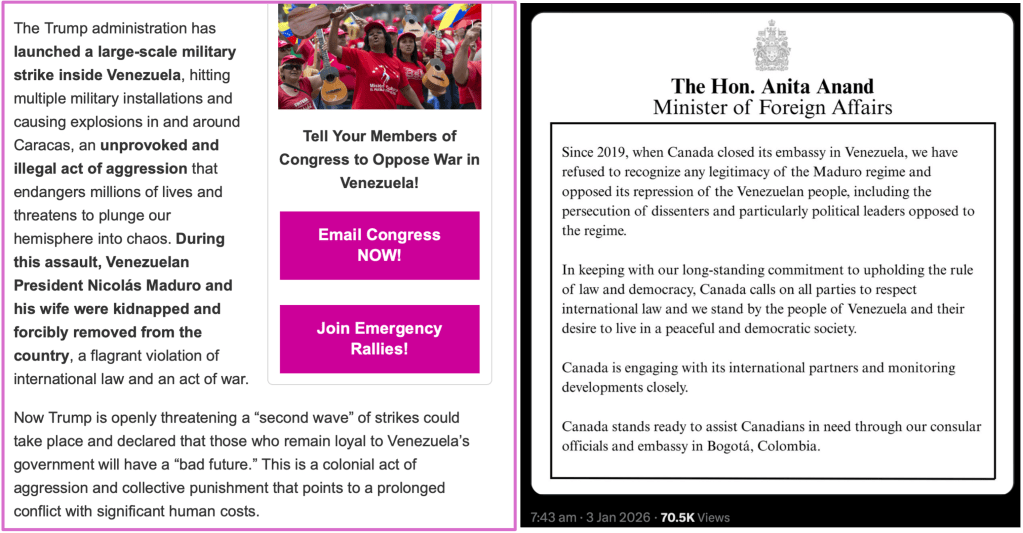
Left: Calling on Canadians to act (Artwork by Harmeet Rehal); Right: AP news story on the 20th boat strike carried out by the United States since September. Another attack was reported a day later.

Common Frontiers and the Americas Policy Group sent a letter Nov. 13 to Foreign Minister Anita Anand, Trade Minister Maninder Sidhu, and Defence Minister David McGinty urging Canada to: 

  • Speak out publicly and condemn the unlawful attacks and extrajudicial killings of civilians in the Caribbean and Pacific by the U.S. military;

  • Contribute to the promotion of peace and security in the region and join efforts to press the Trump administration to respect national sovereignty and uphold the rule of law;

  • Suspend participation in Operation CARIBBE to avoid the risk of Canadian complicity; and

  • Adhere to Canada’s obligations under the Arms Trade Treaty by removing regulatory exemptions that allow loopholes for the export of arms to the U.S. without oversight or human rights risk assessment.

Just a day earlier, Anand had told reporters that it was not her job to determine if the United States has breached international law when striking alleged drug boats in the Caribbean Sea. 

“As Canada’s foreign minister, I hold responsibility for Canada’s compliance with international law—we are always seeking to comply with international law,” Anand said. “Regarding the question that you asked, I would say it is within the purview of U.S. authorities to make that determination.”

Her comment was soundly criticized by international law experts, including Ketty Nivyabandi, secretary-general of Amnesty International Canada’s English section. She told Hill Times that international law only works if it is upheld by all states. 

“It is a collective responsibility to uphold international law. It is not up to a country to focus on itself and decide whether or not it is applying international law—in that case, nobody would,” she said. “What the United States is doing is truly making a mockery of international law. It is normalizing what are, in effect, extrajudicial killings.”

The attacks take place amidst months of arrests and deportations of Venezuelans in the United States; false allegations of Venezuelan state collusion with a criminal gang called Tren de Aragua; massive U.S. movement of troops and warships into the Caribbean; and conjecture about what the Trump regime intends to do. On Nov. 13, Defense Secretary Pete Hegseth posted on social media: “President Trump ordered action—and the Department of War is delivering. Today, I’m announcing Operation SOUTHERN SPEAR.”

Former CBC News correspondent Dan Rather cited the Washington Post in calling it the biggest military presence in the Caribbean in decades. And he added: 

… a curious build-up if the stated goal is simply drug interdiction. Another explanation would be Trump wagging the dog, creating a diversion by manufacturing a crisis that he can then fix and allowing him to flex and crow about taking down the leader of a small country. Or it could be just about commandeering Venezuela’s oil.

Here below, from the Venezuela Solidarity Network, are some reasons to help stop a potential U.S. war against Venezuela:

Please write to your own Member of Parliament to express your views.

Join actions across Canada for the No War on Venezuela Days of Action, November 15-23:

📍VANCOUVER, BC
Rally & Info Tabling
Friday, November 21, 5:00pm
Vancouver Art Gallery – Robson Street Side
Organized by Fire This Time Movement for Social Justice 

📍OTTAWA, ON
Saturday, November 22, 3:30pm
U.S. Embassy – York and Sussex
Organized by Alba Movimientos Ottawa

📍WINNIPEG, MB
Sunday, November 23, 1:00pm
River and Osborne
Sponsored by Peace Alliance Winnipeg, Manitoba-Cuba Solidarity Committee, United in Action, Communist Party of Canada – Manitoba & Araucaria

The Canada-Wide Peace and Justice Network (CWPJN) encourages members and all antiwar and peace organizations to register their actions at https://unac.notowar.net/no-war-on-venezuela-action-registration and with the CWPJN at canadapeaceandjustice@gmail.com
For updates visit: tinyurl.com/Hands-Off-Venezuela

Gunboats follow sanctions in U.S. strategy for regime change in Venezuela

by Jim Hodgson

U.S. claims to have bombed a supposed “drug vessel” in the southern Caribbean were met with considerable scepticism and calls for action to stop an invasion.

Action suggestion from the Alliance for Global Justice (AFGJ): Please send an email to UN Secretary General António Guterres asking him to intervene to stop a possible U.S. invasion of Venezuela.

“Earlier this morning [Tuesday], on my Orders, U.S. Military Forces conducted a kinetic strike against positively identified Tren de Aragua Narcoterrorists in the SOUTHCOM area of responsibility,” President Donald Trump said in a Truth Social post. “The strike occurred while the terrorists were at sea in International waters transporting illegal narcotics, heading to the United States. The strike resulted in 11 terrorists killed in action.”

He added that TdA is a “foreign terrorist organization” that operates under the control of Nicolás Maduro, Venezuela’s president.

Mexico’s La Jornada shared Images of the U.S. boat attack

Neither Trump nor the video showed any proof that the boat was carrying drugs, nor that it came from Venezuela, nor that it had anything to do with TdA, much less that its destination was the United States. There is no indication of who the crew was. Why would 11 people be on a small boat that is supposedly carrying a large amount of drugs? Could they have been migrants? Human traffickers? It’s more common that such craft are stopped and searched. If anything is found, arrests follow. Not summary executions.

On social media, Venezuelan news outlet Venezuelanalysis speculated on how U.S. SOUTHCOM knew the small boat was carrying drugs without carrying out an inspection. On Monday, President Maduro said his country was at “maximum preparedness” and denounced the expanded U.S. military presence in the Caribbean as, “an extravagant, unjustifiable, immoral and absolutely criminal and bloody threat.”

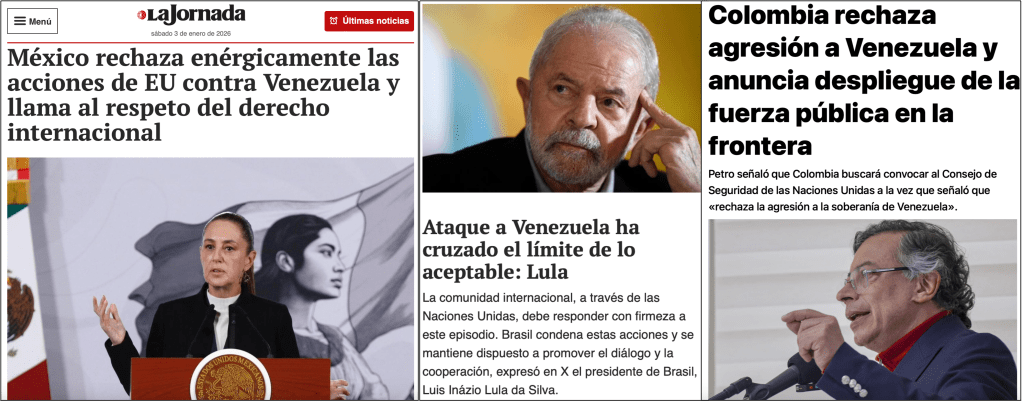
In Colombia, President Gustavo Petro said he doubted the veracity of the U.S. claim. “We have spent decades capturing civilians who transport drugs without killing them.”

In Mexico, where Trump’s secretary of state Marco Rubio arrived Monday night, news of the attack was felt to be a warning to President Claudia Sheinbaum about methods the United States might use in its effort to dismantle Mexican cartels.

In previous weeks, the United States had deployed as many as eight warships, a nuclear-powered submarine and 4,500 troops as part of Trump’s anti-drug cartel operation, projecting military force into the Caribbean Sea. Among useful news analyses: The Cradle (left, a publication usually focused on events in West Asia). Newsweek (right), unusual among mainstream U.S. media is sharing multiple articles about a new “Trump Doctrine.” It’s similar in effect to the Monroe Doctrine, ostensibly about curbing European influence in the Americas, but used to justify U.S. interference in Latin America and the Caribbean since 1823.

In March, Trump used the Tren de Aragua myth as a justification to justify the extraordinary rendition of young Venezuelan men to El Salvador. A New York Times article in April showed that Tren de Aragua is not invading the United States. Nor is it a “terrorist organization,” and to call such “criminal groups terrorist is always a stretch since they usually do not aim at changing government policy.” The article goes on to show that Tren de Aragua is not centrally organized, much less that it colludes with the Maduro government. 

Maduro said in March that TdA “no longer exists; we defeated it.” The Venezuelans held in El Salvador were finally returned home in July.

Left: Chevron is once again moving Venezuelan oil to the United States. Right: President Nicolás Maduro speaks with foreign reporters.

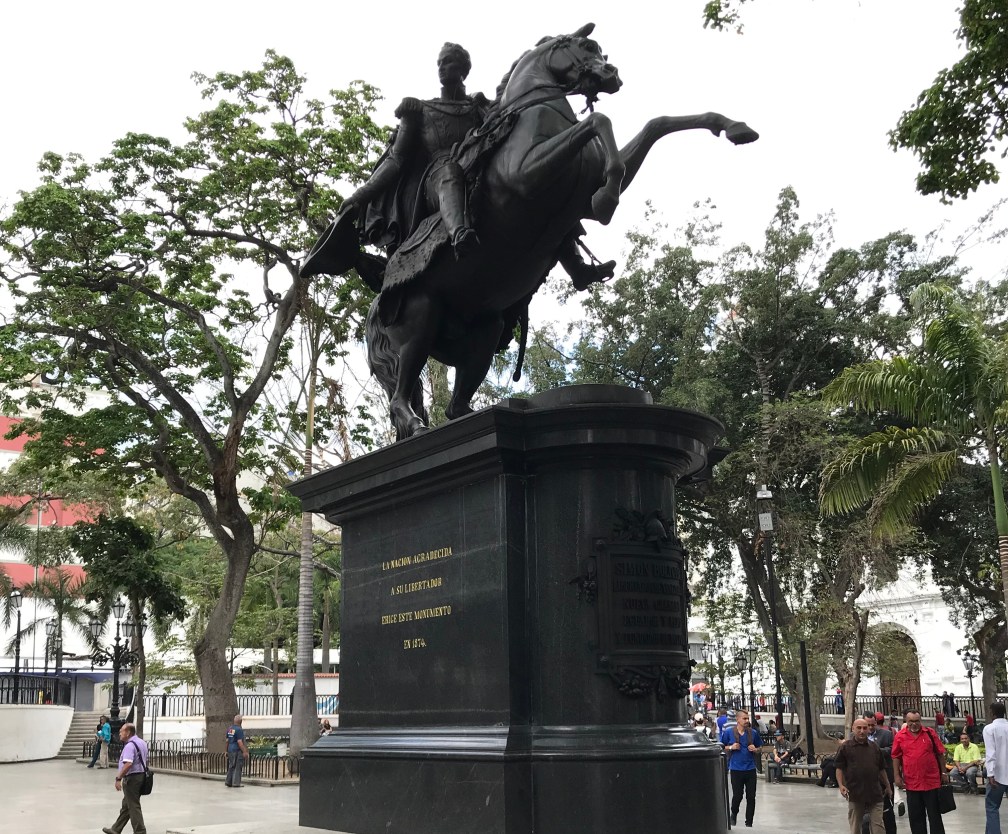
This new chapter in Venezuela’s drama plays out in the context of historic U.S. refusal to accept the development in this hemisphere of a political and economic model other than the capitalist one. Since 1998, Venezuela has embarked upon a “Bolivarian Revolution” (named for Simon Bolivar, the hero of the 19thcentury independence struggle) and intended to break capitalist hegemony over every aspect of the lives of the people.

Since 2005, U.S. administrations have made the annual determination that Venezuela has “failed demonstrably to adhere to its obligations under international narcotics agreements.” A year later, the United States began applying sanctions (“unilateral coercive measures,” the UN calls them). These and other measures have been strengthened since 2015, eventually driving a severe economic crisis and exodus of millions of people who sought better opportunities elsewhere.

In this second Trump administration, some see incoherence. On the one hand, ongoing verbal threats and this military build-up. On the other, easing of sanctions to allow Chevron to import Venezuelan oil to the United States. Conjecture persists about the relative influence of corporations like Chevron that want back in, the south Florida Venezuelans and Cubans who are Rubio’s constituency, and the isolationist sector of the Trump-MAGA base that wants out of all foreign wars.

Justice denied: U.S. sends Venezuelan asylum-seekers to Salvadoran prison

Even in the face of the Trump regime’s horrific arrests, extraordinary renditions, and forced disappearances of immigrants and asylum-seekers, there are shreds of hope.

Activists and journalists are gradually identifying and sharing the stories of victims, including the 238 Venezuelans and 23 Salvadorans shipped to a prison in El Salvador on March 15. And judges and some politicians are more vocal in support of “due process”—the U.S. constitutional guarantee of at least being heard before being deprived of liberty—for all migrants.

One group has built a website: thedisappeared.org. They make prominent use of the blue triangle, the symbol used by Nazis in their concentration camps to designate migrants. About the 238 Venezuelans, they say: “There is no evidence to support the allegations that they are hardened criminals.” The group also posts on Facebook.

Above on the left is Andry Hernández Romero, age 31. I learned of his case the way many others did. A photojournalist, Philip Holsinger, met the airplanes that brought the Venezuelans to El Salvador and then accompanied them to the prison. A man who caught Holsinger’s attention shouted “I’m innocent” and “I’m gay,” and was crying as his head was shaved. From Holsinger’s photo, friends and family members identified him as Andry. Details of his situation were covered first in LGBTQIA+ media (The Advocate and the Washington Blade) and later by NBCCBS and elsewhere. His lawyer has mobilized political support in California, including that of Gov. Gavin Newsom and U.S. Rep. Robert Garcia.

The disappeared.org site draws attention to many other cases, including that of two-year-old Maikelys Antonella Espinoza Bernal (below) whose father, Maiker Espinoza Escalona, was sent to the prison in El Salvador. She and her mother Yorely Bernal Inciarte, were supposed to be sent together on a deportation flight back to Venezuela—part of her homeland’s “Vuelta a la Patria” program for citizens willing to go home. But the United States refused to return the child to her mother before she left.

When Yorely arrived back home alone, Venezuelan media and the government took up the family’s cause (image on the left, above). So too did CodePink (right), a women’s peace network in the United States with which I have collaborated to draw attention to the negative impact on Venezuelans of U.S. economic sanctions

The Disappeared shared a piece from a group called United Strength for Action about the U.S. role in creating the disaster that Venezuelans face. I can’t concur with all the group said–many people in the United States just can’t see the historical context of U.S. imperialism–but I am relieved that they at least acknowledged the role of U.S. sanctions in creating a humanitarian crisis that drives the exodus of refugees. “This wasn’t foreign policy; it was collective punishment that pushed millions of Venezuelans past their breaking point.”

Since 1998, successive U.S. administrations have done all they could to be rid of Nicolás Maduro and his predecessor, Hugo Chávez: a coup attempt in 2002, a “revocatory” referendum in 2004, the effort to impose a “president” (Juan Guaidó) whom nobody had voted for, and through waves of sanctions. Given the failure of those efforts to induce regime change and seeing the flow of migrants out of Venezuela, President Joe Biden for a time tried a different approach, one of dialogue and engagement. The early weeks of Trump’s administration gave some hope this could continue, but the hard-liners seem to hold sway once again.

At a May Day march, President Maduro vowed to “rescue” Maikelys along with the Venezuelans now held by El Salvador. He also spoke directly to the hundreds of thousands of Venezuelans who have tried to reach the United States in recent years: 

“Stop going there. The true dream is that of our land to build with our hands. Stop being victims of xenophobia, of abuse… The only land that will welcome you and serve you like the prodigal son is called the Bolivarian Republic of Venezuela. We must take care of it, fertilize it, and build it. This homeland belongs to all!”

Maduro emphasized Venezuela’s right to build its own social model. “We have the right to true democracy, to our cultural identity. We are not gringos. We are proudly Bolivarian, Latin American, Caribbean. We are Venezuelans!”

Venezuela says it is willing to receive people deported from other countries. Between February and April 25 this year, 3,241 Venezuelans had returned on 16 government-funded flights. Yorely (the mother of Maikelys) came home on just such a flight.

Two more issues. Trump officials say that the people sent to jail in El Salvador were linked to the Tren de Aragua criminal gang, and that they used tattoos to identify the gang members.

It’s good to see “mainstream” media like The New York Times (left) and Wall Street Journal (right) join the rest of us rabble-rousers in calling attention to the Trump regime’s actions.

Trump’s executive order decreeing the deportations said the gang is “conducting irregular warfare and undertaking hostile actions against the United States.”

But that is not true. In an article for The New York Times, a team of experts on violence in Venezuela said Tren de Aragua is not invading the United States. Nor is it a “terrorist organization,” and to call such “criminal groups terrorist is always a stretch since they usually do not aim at changing government policy.” The article goes on to show that Tren de Aragua is not centrally organized, though members were involved in migrant smuggling and the sexual exploitation of Venezuelan migrants in Colombia, Chile and Peru. 

The NYT piece adds that even U.S. intelligence officials do not believe the Maduro government is colluding with the gang, the key assertion in Trump’s justification for invoking the 1798 Alien Enemies Act to render Venezuelan migrants to El Salvador.

Immigration officials used tattoos to “determine” if someone was linked to Tren de Aragua, but the authors of the NYT piece say Venezuelan gangs (unlike Salvador groups like the MS-13) do not use tattoos that way. “Many young Venezuelans, like young people everywhere, borrow from the global culture of iconic symbols and get tattoos. That doesn’t mean they’re in a gang,” they wrote.

Moreover, the Tren de Aragua gang network in Venezuela is largely dismantled.

“The Tren de Aragua is cosmic dust in Venezuela; it no longer exists, we defeated it,” President Maduro said March 19. He was quoted by the English-language Orinoco Tribune in a longer article about the gang’s history in Venezuela.

Interior Minister Diosdado Cabello questioned whether all deportees were Tren de Aragua members, and demanded the US extradite captured suspects. “The US is acting in a confusing manner. They promised to send us Tren de Aragua members, but they have not. Someone there is lying.”

* Update, May 14 * Two-year-old Maikelys has been re-united with her mother in Venezuela. Her father remains in the Trump-Bukele prison in El Salvador. See the statement from CodePink.