Gunboats follow sanctions in U.S. strategy for regime change in Venezuela

by Jim Hodgson

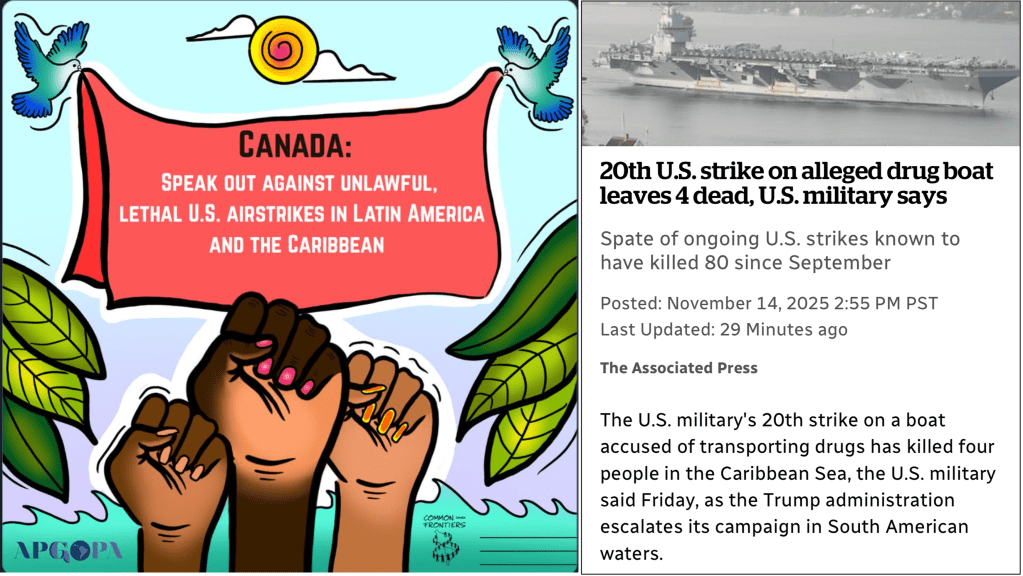
U.S. claims to have bombed a supposed “drug vessel” in the southern Caribbean were met with considerable scepticism and calls for action to stop an invasion.

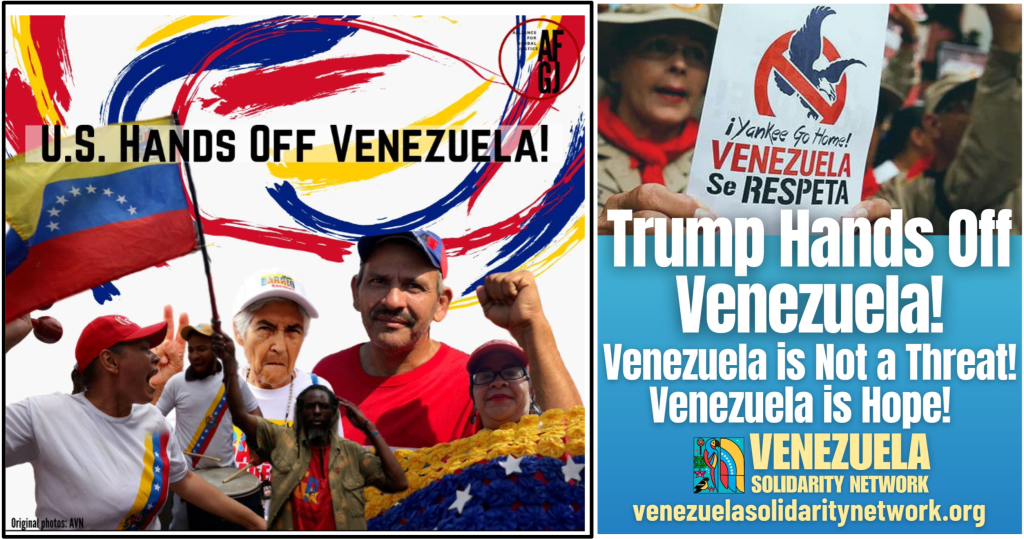
Action suggestion from the Alliance for Global Justice (AFGJ): Please send an email to UN Secretary General António Guterres asking him to intervene to stop a possible U.S. invasion of Venezuela.

“Earlier this morning [Tuesday], on my Orders, U.S. Military Forces conducted a kinetic strike against positively identified Tren de Aragua Narcoterrorists in the SOUTHCOM area of responsibility,” President Donald Trump said in a Truth Social post. “The strike occurred while the terrorists were at sea in International waters transporting illegal narcotics, heading to the United States. The strike resulted in 11 terrorists killed in action.”

He added that TdA is a “foreign terrorist organization” that operates under the control of Nicolás Maduro, Venezuela’s president.

Mexico’s La Jornada shared Images of the U.S. boat attack

Neither Trump nor the video showed any proof that the boat was carrying drugs, nor that it came from Venezuela, nor that it had anything to do with TdA, much less that its destination was the United States. There is no indication of who the crew was. Why would 11 people be on a small boat that is supposedly carrying a large amount of drugs? Could they have been migrants? Human traffickers? It’s more common that such craft are stopped and searched. If anything is found, arrests follow. Not summary executions.

On social media, Venezuelan news outlet Venezuelanalysis speculated on how U.S. SOUTHCOM knew the small boat was carrying drugs without carrying out an inspection. On Monday, President Maduro said his country was at “maximum preparedness” and denounced the expanded U.S. military presence in the Caribbean as, “an extravagant, unjustifiable, immoral and absolutely criminal and bloody threat.”

In Colombia, President Gustavo Petro said he doubted the veracity of the U.S. claim. “We have spent decades capturing civilians who transport drugs without killing them.”

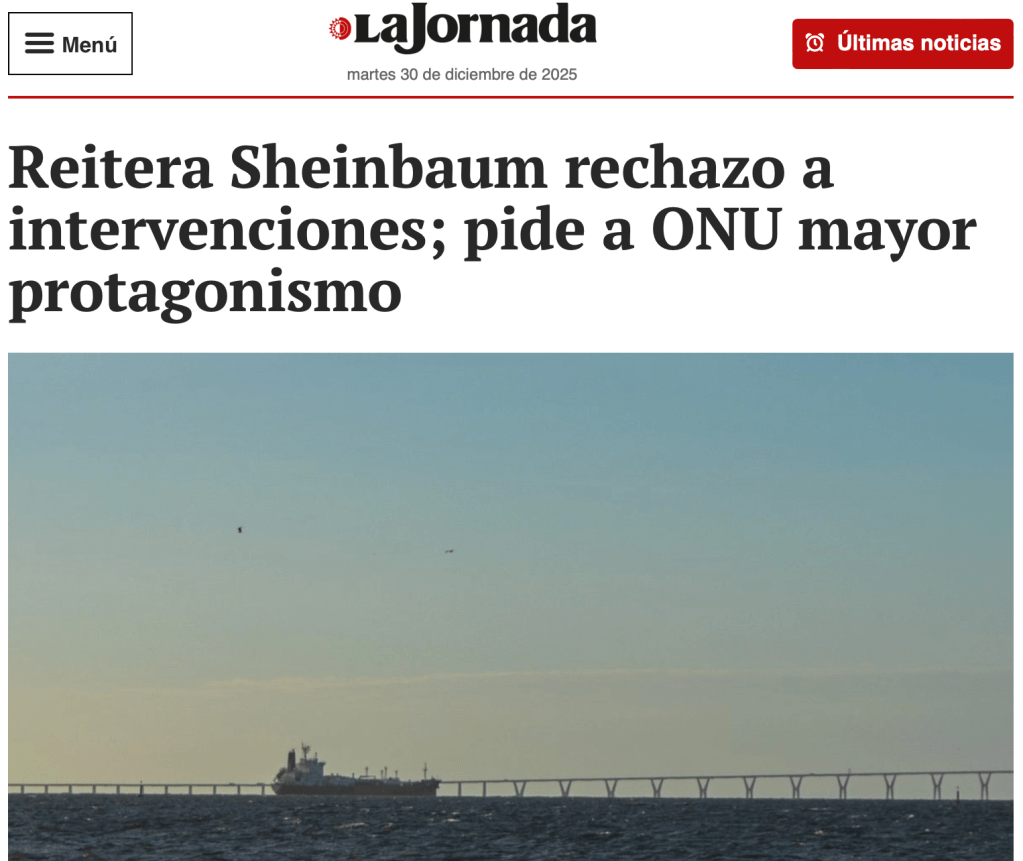
In Mexico, where Trump’s secretary of state Marco Rubio arrived Monday night, news of the attack was felt to be a warning to President Claudia Sheinbaum about methods the United States might use in its effort to dismantle Mexican cartels.

In previous weeks, the United States had deployed as many as eight warships, a nuclear-powered submarine and 4,500 troops as part of Trump’s anti-drug cartel operation, projecting military force into the Caribbean Sea. Among useful news analyses: The Cradle (left, a publication usually focused on events in West Asia). Newsweek (right), unusual among mainstream U.S. media is sharing multiple articles about a new “Trump Doctrine.” It’s similar in effect to the Monroe Doctrine, ostensibly about curbing European influence in the Americas, but used to justify U.S. interference in Latin America and the Caribbean since 1823.

In March, Trump used the Tren de Aragua myth as a justification to justify the extraordinary rendition of young Venezuelan men to El Salvador. A New York Times article in April showed that Tren de Aragua is not invading the United States. Nor is it a “terrorist organization,” and to call such “criminal groups terrorist is always a stretch since they usually do not aim at changing government policy.” The article goes on to show that Tren de Aragua is not centrally organized, much less that it colludes with the Maduro government. 

Maduro said in March that TdA “no longer exists; we defeated it.” The Venezuelans held in El Salvador were finally returned home in July.

Left: Chevron is once again moving Venezuelan oil to the United States. Right: President Nicolás Maduro speaks with foreign reporters.

This new chapter in Venezuela’s drama plays out in the context of historic U.S. refusal to accept the development in this hemisphere of a political and economic model other than the capitalist one. Since 1998, Venezuela has embarked upon a “Bolivarian Revolution” (named for Simon Bolivar, the hero of the 19thcentury independence struggle) and intended to break capitalist hegemony over every aspect of the lives of the people.

Since 2005, U.S. administrations have made the annual determination that Venezuela has “failed demonstrably to adhere to its obligations under international narcotics agreements.” A year later, the United States began applying sanctions (“unilateral coercive measures,” the UN calls them). These and other measures have been strengthened since 2015, eventually driving a severe economic crisis and exodus of millions of people who sought better opportunities elsewhere.

In this second Trump administration, some see incoherence. On the one hand, ongoing verbal threats and this military build-up. On the other, easing of sanctions to allow Chevron to import Venezuelan oil to the United States. Conjecture persists about the relative influence of corporations like Chevron that want back in, the south Florida Venezuelans and Cubans who are Rubio’s constituency, and the isolationist sector of the Trump-MAGA base that wants out of all foreign wars.

Justice denied: U.S. sends Venezuelan asylum-seekers to Salvadoran prison

Even in the face of the Trump regime’s horrific arrests, extraordinary renditions, and forced disappearances of immigrants and asylum-seekers, there are shreds of hope.

Activists and journalists are gradually identifying and sharing the stories of victims, including the 238 Venezuelans and 23 Salvadorans shipped to a prison in El Salvador on March 15. And judges and some politicians are more vocal in support of “due process”—the U.S. constitutional guarantee of at least being heard before being deprived of liberty—for all migrants.

One group has built a website: thedisappeared.org. They make prominent use of the blue triangle, the symbol used by Nazis in their concentration camps to designate migrants. About the 238 Venezuelans, they say: “There is no evidence to support the allegations that they are hardened criminals.” The group also posts on Facebook.

Above on the left is Andry Hernández Romero, age 31. I learned of his case the way many others did. A photojournalist, Philip Holsinger, met the airplanes that brought the Venezuelans to El Salvador and then accompanied them to the prison. A man who caught Holsinger’s attention shouted “I’m innocent” and “I’m gay,” and was crying as his head was shaved. From Holsinger’s photo, friends and family members identified him as Andry. Details of his situation were covered first in LGBTQIA+ media (The Advocate and the Washington Blade) and later by NBCCBS and elsewhere. His lawyer has mobilized political support in California, including that of Gov. Gavin Newsom and U.S. Rep. Robert Garcia.

The disappeared.org site draws attention to many other cases, including that of two-year-old Maikelys Antonella Espinoza Bernal (below) whose father, Maiker Espinoza Escalona, was sent to the prison in El Salvador. She and her mother Yorely Bernal Inciarte, were supposed to be sent together on a deportation flight back to Venezuela—part of her homeland’s “Vuelta a la Patria” program for citizens willing to go home. But the United States refused to return the child to her mother before she left.

When Yorely arrived back home alone, Venezuelan media and the government took up the family’s cause (image on the left, above). So too did CodePink (right), a women’s peace network in the United States with which I have collaborated to draw attention to the negative impact on Venezuelans of U.S. economic sanctions

The Disappeared shared a piece from a group called United Strength for Action about the U.S. role in creating the disaster that Venezuelans face. I can’t concur with all the group said–many people in the United States just can’t see the historical context of U.S. imperialism–but I am relieved that they at least acknowledged the role of U.S. sanctions in creating a humanitarian crisis that drives the exodus of refugees. “This wasn’t foreign policy; it was collective punishment that pushed millions of Venezuelans past their breaking point.”

Since 1998, successive U.S. administrations have done all they could to be rid of Nicolás Maduro and his predecessor, Hugo Chávez: a coup attempt in 2002, a “revocatory” referendum in 2004, the effort to impose a “president” (Juan Guaidó) whom nobody had voted for, and through waves of sanctions. Given the failure of those efforts to induce regime change and seeing the flow of migrants out of Venezuela, President Joe Biden for a time tried a different approach, one of dialogue and engagement. The early weeks of Trump’s administration gave some hope this could continue, but the hard-liners seem to hold sway once again.

At a May Day march, President Maduro vowed to “rescue” Maikelys along with the Venezuelans now held by El Salvador. He also spoke directly to the hundreds of thousands of Venezuelans who have tried to reach the United States in recent years: 

“Stop going there. The true dream is that of our land to build with our hands. Stop being victims of xenophobia, of abuse… The only land that will welcome you and serve you like the prodigal son is called the Bolivarian Republic of Venezuela. We must take care of it, fertilize it, and build it. This homeland belongs to all!”

Maduro emphasized Venezuela’s right to build its own social model. “We have the right to true democracy, to our cultural identity. We are not gringos. We are proudly Bolivarian, Latin American, Caribbean. We are Venezuelans!”

Venezuela says it is willing to receive people deported from other countries. Between February and April 25 this year, 3,241 Venezuelans had returned on 16 government-funded flights. Yorely (the mother of Maikelys) came home on just such a flight.

Two more issues. Trump officials say that the people sent to jail in El Salvador were linked to the Tren de Aragua criminal gang, and that they used tattoos to identify the gang members.

It’s good to see “mainstream” media like The New York Times (left) and Wall Street Journal (right) join the rest of us rabble-rousers in calling attention to the Trump regime’s actions.

Trump’s executive order decreeing the deportations said the gang is “conducting irregular warfare and undertaking hostile actions against the United States.”

But that is not true. In an article for The New York Times, a team of experts on violence in Venezuela said Tren de Aragua is not invading the United States. Nor is it a “terrorist organization,” and to call such “criminal groups terrorist is always a stretch since they usually do not aim at changing government policy.” The article goes on to show that Tren de Aragua is not centrally organized, though members were involved in migrant smuggling and the sexual exploitation of Venezuelan migrants in Colombia, Chile and Peru. 

The NYT piece adds that even U.S. intelligence officials do not believe the Maduro government is colluding with the gang, the key assertion in Trump’s justification for invoking the 1798 Alien Enemies Act to render Venezuelan migrants to El Salvador.

Immigration officials used tattoos to “determine” if someone was linked to Tren de Aragua, but the authors of the NYT piece say Venezuelan gangs (unlike Salvador groups like the MS-13) do not use tattoos that way. “Many young Venezuelans, like young people everywhere, borrow from the global culture of iconic symbols and get tattoos. That doesn’t mean they’re in a gang,” they wrote.

Moreover, the Tren de Aragua gang network in Venezuela is largely dismantled.

“The Tren de Aragua is cosmic dust in Venezuela; it no longer exists, we defeated it,” President Maduro said March 19. He was quoted by the English-language Orinoco Tribune in a longer article about the gang’s history in Venezuela.

Interior Minister Diosdado Cabello questioned whether all deportees were Tren de Aragua members, and demanded the US extradite captured suspects. “The US is acting in a confusing manner. They promised to send us Tren de Aragua members, but they have not. Someone there is lying.”

* Update, May 14 * Two-year-old Maikelys has been re-united with her mother in Venezuela. Her father remains in the Trump-Bukele prison in El Salvador. See the statement from CodePink.

Sanctions on countries like North Korea and Venezuela hurt more than they help

At the end of 2020, a United Church of Canada magazine, Mandate, published an article that I wrote about the impact of sanctions in Venezuela and North Korea. The text follows after the photo below. Read or download a PDF copy here.

Since then, more voices have joined the call on governments and the United Nations to ease up on use of sanctions because of humanitarian consequences for ordinary people in sanctioned countries. 

  • Pope Francis appealed to governments to relax sanctions on various countries. “In various cases, humanitarian crises are aggravated by economic sanctions, which, more often than not, affect mainly the more vulnerable segments of the population rather than political leaders,” he told the Vatican’s diplomatic corps on Feb. 8. “While understanding the reasons for imposing sanctions, the Holy See does not view them as effective, and hopes that they will be relaxed, not least to improve the flow of humanitarian aid, especially medicines and healthcare equipment, so very necessary in this time of pandemic.”
  • On Feb. 12, at the end of a two-week visit to Venezuela, a United Nations human rights expert urged an end to unilateral sanctions against Venezuela. Alena Douhan, the UN Special Rapporteur on unilateral coercive measures and human rights, said the sanctions have exacerbated pre-existing calamities. “Humanitarian exemptions are lengthy, costly, ineffective and inefficient,” she said as she shared her preliminary report. Douhan’s final report will be presented to the UN Human Rights Council in September.
  • In February, the U.S. Government Accountability Office (GAO) reported that U.S. sanctions likely exacerbated Venezuela’s economic decline and that that more can be done to remove obstacles to the delivery of humanitarian assistance.
A clerk in a subsidized bakery in Caracas (May 2019).

Sanctioned Ignorance: International sanctions in countries like North Korea and Venezuela hurt more than help

When I became involved in movements for global justice in the 1980s, economic and political sanctions were viewed as tools of liberation. They were a potential means to end colonial rule and, in the South African context, apartheid.

Today, sanctions are most often used by rich and powerful countries to pressure smaller states. Food and medicine are supposed to be exempt from sanctions, but banks block payments and transport companies won’t carry the goods out of fear of contravening the rules. Thus, Venezuela can’t buy wheat from Canada, fertilizers from Colombia, or insulin from Germany. North Korea can’t buy X-ray machines or finish building a hospital because it is prohibited from buying metals abroad. 

Since 2018, the United Church of Canada and a handful of other organizations have pressed the Government of Canada and the United Nations to ease up on use of sanctions because of unintended humanitarian consequences for ordinary people in sanctioned countries. For the United Church, these calls are rooted in the United Church’s practice of partnership, and often in its mission history—in the case of North Korea—or in wider ecumenical action—as with Venezuela. 

In 1998, two years before I joined the United Church staff as its Latin America-Caribbean partnership coordinator, Venezuelans chose Hugo Chávez to be their new president. Chávez began turning the country’s oil revenue to serve of the country’s impoverished majority by focusing on housing, health care, and education. In 2000, the people of the United States chose George Bush to be their new president, who in 2002, would refer to North Korea, together with Iraq and Iran, as part of the “Axis of Evil.” The stage was set for confrontations that reverberate today. 

Sanctions harm the vulnerable in North Korea

For Patti Talbot, the United Church’s north–east Asia partnership coordinator, the connection between The United Church of Canada and its partners in Korea—North and South—is deeply felt. It dates back to 1898 when Canadian Presbyterians established a mission in the northern port city of Wonsan, in what is now the Democratic People’s Republic of Korea (DPRK), also known as North Korea.

“The Canadian mission action combined a concern with the well-being of the person and the soul, the physical and the spiritual,” says Talbot. “Attention focused on people who were left out of traditional structures: education for women and girls, for example.” Church planting, she adds, went on in ways that developed Korean leadership and capacity building. Missionaries demonstrated respect for the Korean language and culture, particularly during the Japanese colonial period when the Korean people were brutally suppressed.

But “liberation” from the Japanese, with the end of World War Two in 1945, saw the division of the Korean peninsula between Soviet-led forces in the north and U.S.-led forces in south. The subsequent Korean War in the early 1950s was one of many proxy wars carried out between the Soviet Union and the United States and their allies as well as a civil war that pitted Koreans against each other. Many Christians fled to the south. Today, Koreans on both sides of the border yearn for reconciliation, but hope ebbs and flows depending on forces not at all within their control.

The late 1980s and the 1990s saw gradual opening as Cold War tensions eased. The Korean Christian Federation, a body representing North Korean Protestant Christians, was able to connect with the World Council of Churches, the United Church, and others. The Canadian Foodgrains Bank (CFGB) implemented a food aid program during and after a serious famine. Canada established diplomatic relations in 2001.

When more conservative governments came to power in Washington and Seoul in the early 2000s, official collaboration and dialogue with the DPRK dwindled. In 2006, North Korea tested a nuclear weapon. While this may have been a sort of bargaining chip to renew talks about demilitarization of the whole Korean peninsula, the United Nations Security Council responded by imposing sanctions. These were strengthened several times later over further nuclear tests and ballistic missile activities. Canada imposed its own set of sanctions in 2011.

Severe environmental and climate change–related challenges have led, in recent years, to prolonged dry, hot spells in some areas and major flooding in others.  With international sanctions blocking access to agricultural inputs and tools, and the near complete lockdown response to the COVID-19 pandemic, food insecurity has steadily increased throughout the DPRK.  In early 2020, UN agencies feared widespread undernutrition would threaten an entire generation of children in North Korea, with the growth of one in five children stunted due to chronic undernutrition.

Today, the United Church supports a modest maternal-child nutrition effort led by First Steps Canada, a Vancouver-based organization committed to preventing child malnutrition in the DPRK. Every day, First Steps provides more than 100,000 children with soymilk and 20,000 mothers and their babies with sachets of micro-nutrients in powder form that are added to food. First Steps does the arduous work of seeking exemptions from the sanctions so as to provide the aid. 

And the United Church hopes to work again with CFGB and with Finland’s Lutheran relief organization, Finn Church Aid, to provide food assistance, but the effort is delayed because of the COVID-19 pandemic. 

The United Church is part of a global effort to press for easing of sanctions against the DPRK, as it becomes increasingly clear sanctions are not achieving the intended goal of denuclearizing North Korea.

“What we bring to this sanctions conversation with other civil society organizations is this history of relationship as well as a moral and ethical objection to the use of sanctions,” says Talbot. “Sanctions do the most harm to those who are already vulnerable. We know that women and children suffer.”

Food distribution from a truck in Caracas (May 2018).

Sanctions are “warfare” in Venezuela

If some good came of all the threats made against Venezuela in recent years—including an attempted coup in April 2019, and a failed invasion by mercenaries in May 2020—it is that the threats seemed to provide new impetus for dialogue and for humanitarian aid.

Until the 2008 global economic crisis, Venezuela was providing more international assistance in Latin America than the United States. Oil was provided at reduced prices or with long-term, low-interest loans to Cuba, Haiti, Nicaragua and other countries. 

Oil prices collapsed in 2009, rose again between 2012 and 2014, and collapsed in 2015 with no recovery in sight. The United States had shifted to fracking to produce oil domestically, and found it no longer needed Venezuela’s oil. And while it is tempting to blame the arrival of Donald Trump in power at the beginning of 2017 for current problems, relations with the United States worsened in 2015 when the Obama administration declared that Venezuela represented a “security threat” to the United States, and began a series of political and economic measures against Venezuela. Faced with economic hardship derived both from the collapse of the oil industry and the impact of sanctions, several million Venezuelans left for Colombia and other countries.

Inside Venezuela, the government expanded its food distribution program to reach about 60 percent of the population. Gradually, United Nations agencies and the Pan American Health Organization became more involved, along with non-governmental organizations and a network supported by the global ACT Alliance of faith-based relief organizations.

“Sanctions are warfare tied to U.S. policy to provoke regime change,” said Teri Mattson of the U.S. women’s solidarity network Codepink during a visit to Ottawa in November 2019. The strategy doesn’t work, she said, and only seems to result in pushing countries like Russia, China, Venezuela, Iran, Cuba, North Korea and Syria closer together.

Mattson was part of a panel on the unintended humanitarian consequences of sanctions at a forum organized by the Canadian Council for International Cooperation (CCIC, now called Cooperation Canada). A response to calls for sanctions should always consider who is making the call and who will be most affected by their implementation, she insisted. 

On the same panel, the person responsible for emergency operations of the Canadian Red Cross, Chiran Livera, said there may be good reasons for sanctions, but they should always exempt humanitarian activities. Even when disasters occur, such as the earthquake in Iran in November 2017, transfers of funds for emergency assistance were blocked.

Another speaker, Kee Park, lecturer on global health and social medicine at Harvard Medical School, works frequently with doctors in North Korea. “Surgeons are using old scalpels because new ones cannot be obtained,” he said. “I am outraged as a humanitarian aid worker.”  

Park noted the issues of international power—that the U.S. government “has unchecked power, coercive power, and there is no accountability.” Policies can be divergent, he added, and Canada’s relationship with Cuba is an example of what can happen a country chooses a different tack.

Consequences of sanctions panel: Kee Park, Teri Mattson, Chiran Livera and Rachel Vincent, moderator. (Ottawa, November 2019).

Calls for new approaches

For more than 60 years, Canada has defied U.S. sanctions against Cuba. Canada calls its approach to Cuba “constructive engagement,” a model that could be encouraged with other countries. Norway, Mexico and Uruguay are among countries that have persevered in promotion of dialogue as a means to resolve conflict in Venezuela. 

Canada should similarly re-engage with North Korea right now, argued the United Church’s former Moderator, Very Rev. Lois Wilson, in an opinion piece published in the Ottawa Citizen. “If we want peace, we need to help make it happen,” she wrote. “Of course, Canada should maintain its commitments to human rights and to an international system based on rules, but at the same time Canada should re-establish direct communications and re-build official relationships with North Korea.”

Calls for new approaches sharpened as the COVID-19 pandemic spread. “Sanctions that were imposed in the name of delivering human rights are in fact killing people and depriving them of fundamental rights, including the rights to health, to food and to life itself,” said an August statement by five United Nations experts. Water, soap, electricity, fuel, and food, are all in short supply because of sanctions—a situation made more acute because of the global pandemic.

In May, the United Church joined with Mennonite Central Committee Canada and the Nobel Women’s Initiative in telling Canada’s then-foreign minister, François-Philippe Champagne, to ensure that aid is not blocked by sanctions during the crisis. “We join with others who share a vocation to be peacemakers and a commitment to work for the health and wholeness of the human and created world,” their letter said. “As civil society actors, we have active relationships with partner organizations and friends in Cuba, the Democratic People’s Republic of Korea, Gaza, Iran, South Sudan, Syria, Venezuela, and Zimbabwe working for a peaceful end to conflict, the creation of conditions for reconciliation and peace, and the provision of basic needs for everyone.”

Their words echoed calls for suspension of sanctions from UN Secretary General António Guterres and UN High Commissioner for Human Rights Michelle Bachelet, as well as statements from the ACT Alliance and the U.S. National Council of Churches, among others.

However we conceive of our motivation for justice—social gospel, right relations, preferential option for the poor—we should be suspicious of cures that are worse than the supposed diseases. We can argue over politics in Korea or Venezuela or Iran, and work for change, but sanctions these days hurt more than they help.

First published in Mandate, a magazine of The United Church of Canada, Fall 2020, p.19 ff. Used by permission © The United Church of Canada (2020). Read or download a PDF copy here.