
by Jim Hodgson
I write to share the statement Wednesday, Sept. 24, celebrating a second not guilty verdict in the political persecution of five environmental protectors in El Salvador. They should never have been arrested. See below for an action request. The statement comes from allies around the world who came together more than 15 years ago to accompany communities in El Salvador in their defence of water resources against a Canadian mining company….
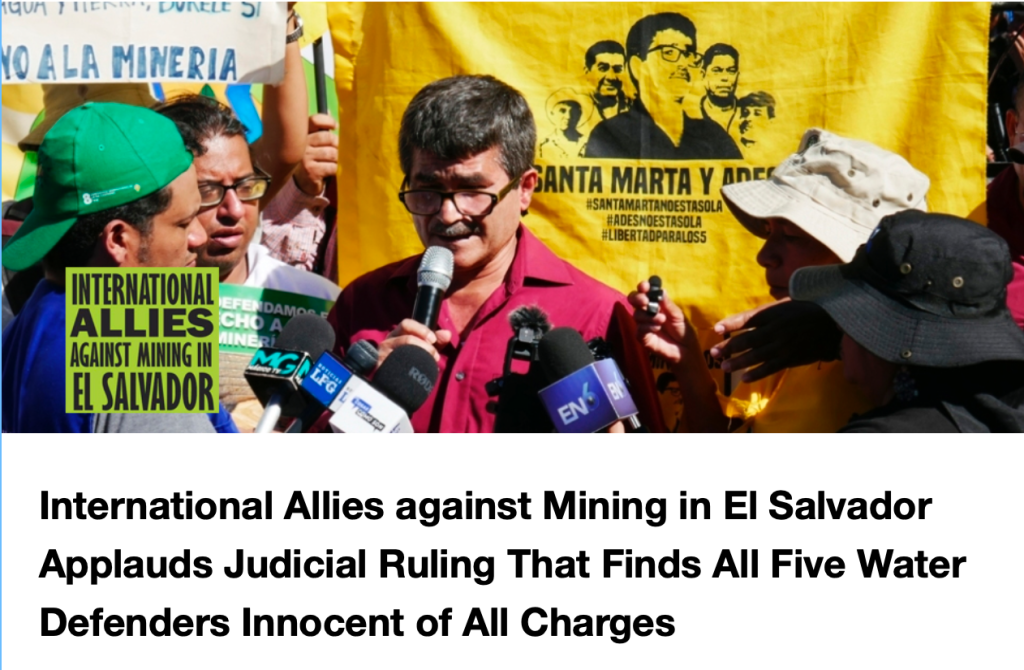
San Salvador – On September 24, the presiding tribunal in San Vicente, El Salvador, found five prominent water defenders from Santa Marta, Miguel Ángel Gámez, Alejandro Laínez García, Pedro Antonio Rivas Laínez, Antonio Pacheco, and Saúl Agustín Rivas Ortega, innocent of charges of murder, kidnapping, and illicit association.
Once again, the five prominent Water Defenders who faced politically-motivated charges have been declared innocent — and they should never have been arrested. International Allies against Mining in El Salvador calls upon the Salvadoran Attorney General to abstain from further legal action and demands that all civil liabilities are dropped.
Representatives from the governments of Canada, France, and Germany appeared at the court today to observe the ruling, a reminder that governments and international civil society are watching this case closely.
“We call on the Attorney General’s office to respect the decision of the tribunal, to abstain from appealing this decision and stop wasting government resources to keep up the farce,” stated Alfredo Leiva from the community of Santa Marta, whose leading members were among those on trial. “Rather than insisting on prolonging this process any further, the Attorney General’s office should apologize to the five and to the community, and should dedicate themselves to investigating the real war crimes, starting with the massacres that were committed against Santa Marta and other communities.”
“The five Water Defenders should never have been charged, and the Salvadoran government’s willingness to pursue these accusations despite their clear innocence signals a worrying willingness to persecute the movement that these five water defenders represent. We call on the Salvadoran government to forgo future sham prosecutions and uphold the democratic rule of law in future pursuit of true justice,” said John Cavanagh, Senior Advisor at the Institute for Policy Studies.
“We celebrate that the Water Defenders have on two occasions now been found innocent of all the charges laid against them. However, we are deeply concerned that the judicial system may continue to be used as a tool to persecute the leaders for their role in protecting the country’s scarce water resources. We ask that the findings of the two courts be respected. We look forward to the day when the Defenders can return to their community and families in full liberty, free from the threat of further persecution,” said Christie Neufeldt, Global Partnerships Coordinator for Latin America, The United Church of Canada.
“Despite the positive results, the international community should be aware that the struggle is far from over. The Attorney General still has the possibility of appealing the case and taking it all the way to the Supreme Court level, and it may take years before the Santa Marta Five are declared fully innocent,” said Pedro Cabezas, coordinator of the Central American Alliance on Mining.
“As was the case in their trial in Sensuntepeque in October 2024, the five water defenders of Santa Marta who were subjected to another trial have today again been found innocent of the charges of murder, kidnapping, and illicit association,” said Prof. Bernie Hammond, an international observer at the trial. “It is to be hoped that the Attorney General will have the good sense to let go of this case against the five. It has become clear to the legal community and to the general public that these charges were politically motivated and are a clear example of “lawfare” in which anti-mining advocacy on the part of the five were criminalized in order to change the 2017 law prohibiting mining in El Salvador.”
In January 2023, police arrested the five prominent water defenders from the rural community of Santa Marta and the Association for Social and Economic Development of El Salvador (ADES) on charges allegedly dating back to the country’s civil war and held them incommunicado for over eight months and then placed them on house arrest until their trial date. The five had played an instrumental role in the country’s heroic and successful struggle to pass a historic 2017 law prohibiting toxic metals mining in El Salvador, and were the first ones to denounce President Nayib Bukele’s intentions to overturn it.
When the five were finally tried in October 2024, after a long legal defense campaign that denounced a series of irregularities with the proceedings, the tribunal dismissed all charges against them due to lack of evidence, ruled that all five were completely innocent of the two sham charges of murder and illicit association that were laid against them. However, in aruling that has been widely condemned as a travesty of justice, an appeals court annulled the innocent verdict, allowing the Attorney General’s Office to try them again on the same charges.
Beyond the lack of evidence, the Salvadoran Attorney General’s pursuit of this case even after the original determination of innocence in October 2024 has dealt a serious blow to the Salvadoran government’s credibility, belying its claim that it remains a democracy and that it holds no political prisoners. The unceasing and courageous pressure from grassroots organizations in El Salvador – in concert with international solidarity – may have worked in favour of the Water Defenders today, but hundreds of political opponents, labour leaders and human rights defenders remain imprisoned. The community-led movement of water defenders still stands strong in the face of future attempts to undermine land and water protections for communities in El Salvador.
Our organizations support the call by Salvadoran civil society groups that the Salvadoran Attorney General should apologize to the five defendants, whose health has suffered greatly over the past two years that they have stood accused of false charges, and to the Santa Marta community, which suffered from genuine military atrocities during the Salvadoran Civil War in 1980-1992.
Media contacts:
- John Cavanagh, Institute for Policy Studies: johnc@ips-dc.org
- Pedro Cabezas, Central American Alliance against Mining(ACAFREMIN) and International Allies Against Mining in El Salvador: stopesmining@gmail.com
- Olivia Alperstein, Institute for Policy Studies: olivia@ips-dc.org
- Christie Neufeldt, The United Church of Canada: cneufeldt@united-church.ca
- Prof. Bernie Hammond, Member of International Delegation Observing Trial: berniehammond@gmail.com
Action Request:
Can you join us in uplifting the calls of the community that the Attorney General [ @FGR_SV ] respect the tribunal’s ruling? The International Allies Against Mining in El Salvador is calling on our network to:
1) Share the International Allies against Mining in El Salvador’s statement with your networks (here in Spanish). You can also share posts from the Committee in Solidarity with the People of El Salvador on X and on Facebook.
2) Call on the Attorney General not to appeal the ruling and, in the words of the Santa Marta community, “end this judicial farce.”
Sample tweets:
- I applaud this week’s ruling that found no basis for the charges brought against the #SantaMarta5 water defenders of El Salvador & call on the @FGR_SV to cease their unjust persecution. #NoALaMineria #EyesOnSantaMarta http://bit.ly/46Udt53
- Aplaudo la decisión del tribunal que dejo absueltos de todas las acusaciones en contra de los defensores de agua de #SantaMarta y hago un llamado a la @FGR_SV que deje su persecución injusta en contra de ellos. #NoALaMineria #SantaMartaNoEstaSola http://bit.ly/4nlIZyD



 Unwrapping Development