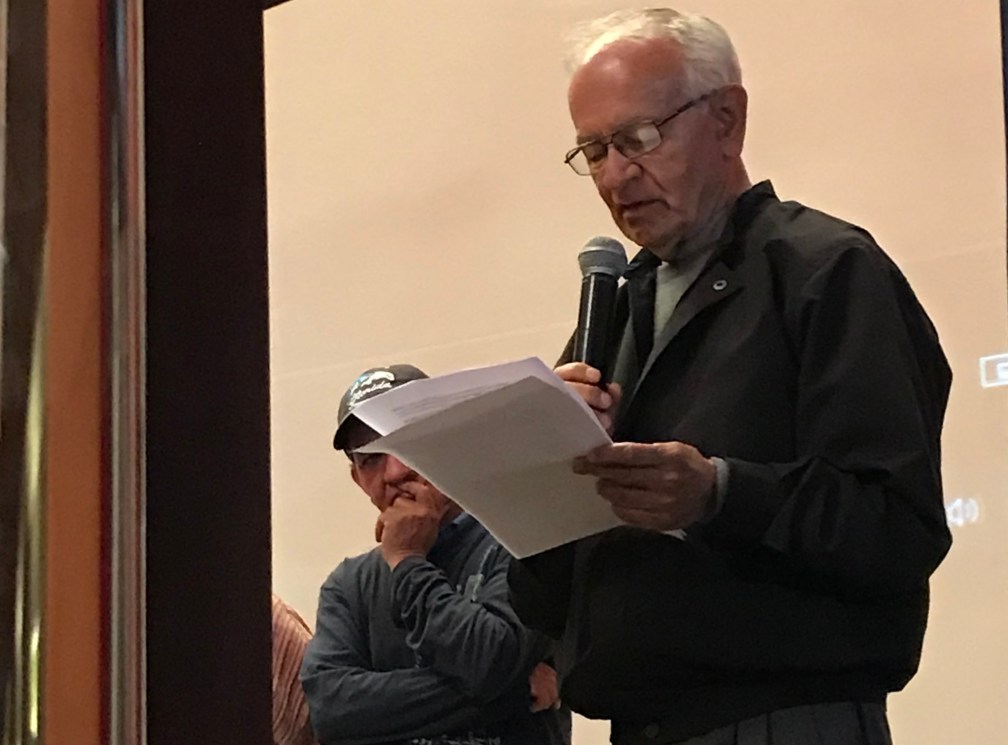
Javier Giraldo and “community ways of thinking”

“The killers did not seek to kill individuals, but rather to destroy community ways of thinking.”

Javier Giraldo, a Jesuit priest, was speaking of the paramilitary death squads and their allies in the official armed forces who did most of the killing during Colombia’s decades-long civil war. “This was their project since the sixties.” The paramilitaries were created by forces of greed – the large land-holders and industrialists – who demanded the land and fealty of impoverished people who had learned over centuries to support each other in community.

We had gathered on a Sunday evening in November 2019 to witness the presentation of a report to the chair of Colombia’s Truth Commission, Francisco de Roux, also a Jesuit. We met in an auditorium of the seventeenth-century Colegio San Bartolomé. It sits on a corner of Bogotá’s Plaza Bolívar, roughly between the national congress building and the cathedral. This was three years after ratification of the peace agreement between the government and the largest guerrilla army. 

The event mourned the victims of war but also celebrated decades of work for peace with justice and the investigations then underway into past crimes. The report, “Blood of Martyrs, Seeds of Liberation,” was prepared by the Mesa Ecuménica por la Paz (MEP), an ecumenical peace movement supported by The United Church of Canada and the KAIROS Canada ecumenical coalition.
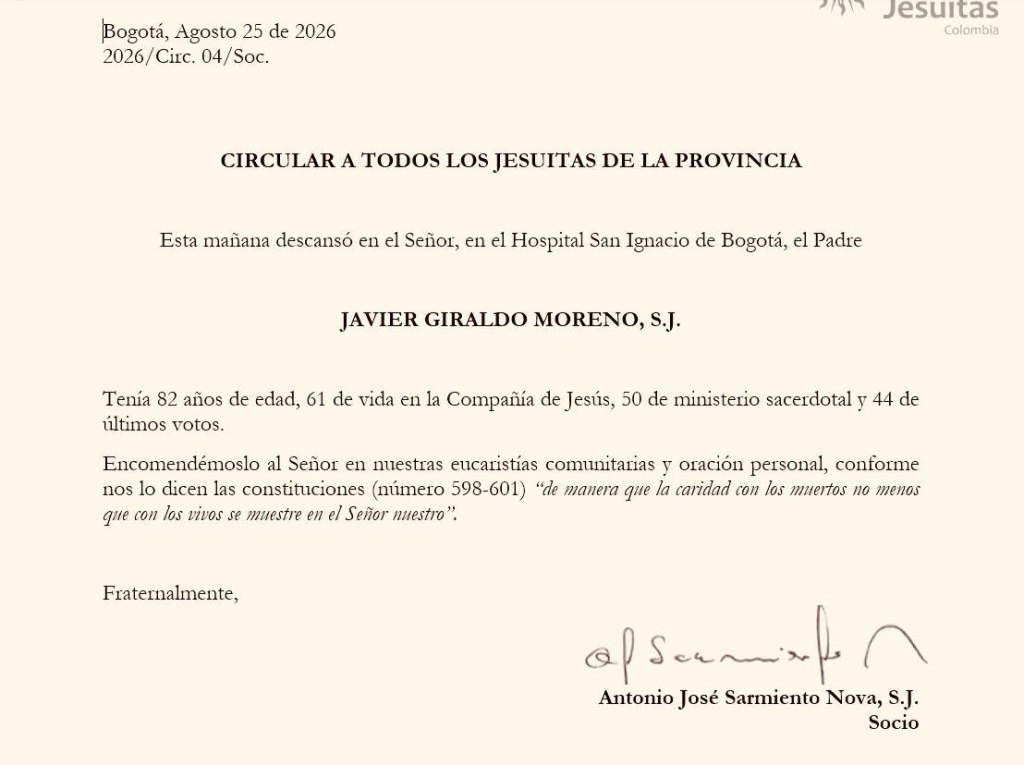
Padre Javier died Tuesday (Aug. 25): 82 years of age, 61 of them among the Jesuits, 50 years a priest. After surviving countless death threats, he died quietly in hospital.

“Arm yourselves, leave, or be killed”

Javier Giraldo was partly responsible for my first visit to Colombia in 1993. He led a group of Roman Catholic religious communities called the Inter-Congregational Commission for Justice and Peace (known as Justicia y Paz). Later, after tension with conservative bishops, the group became the Inter-Church Commission for Justice and Peace. 

Months before our 1993 visit, Justicia y Paz had presented a report on the growth of paramilitary activity in the mountains of Santander department. It compiled testimonies that showed how paramilitary groups – backed by the Colombian armed forces – were imposing control in the region. In the early 1990s, I was working with the Canadian Council of Churches as its ecumenical education and communication secretary. My colleagues at the Inter-Church Committee for Human Rights in Latin America (ICCHRLA) invited me to join a small delegation that would show solidarity with affected communities and amplify the findings of the Justicia y Paz report.

From people who had been displaced from their land, and from people who lived in fear of displacement, we learned of the paramilitary strategy. People were given three options: join the paramilitaries, leave or be killed. In 1993, the number of displaced in Colombia was around 200,000. 

Over time, the paramilitary strategy we witnessed in Santander was imposed on most of the country. My work with the United Church brought me back in 2001 and the number of displaced was two million. (During that visit, I met Fr. Javier again; because of threats, he was sheltered within a maze of connected churches and schools in central Bogotá.) By the time of my last visit in 2019, more than eight million people had been displaced.

In 1986, large land-owners had thirty-six per cent of the land; by 2011, they controlled 53.6 per cent of the land.

The violence

Media depictions of Colombians, with the drug lord Pablo Escobar as an archetype, have not served its people well. Yes, the violence is real. I think each of the Colombians I know has been touched within their immediate families by war and crime. A child watches a man be murdered in their father’s apartment. A teenager is witness to the killing of another teen and the whole family flees to Venezuela. A middle-class family surrenders its modest savings to extortion after a parent is kidnapped by one of the guerrilla armies. A local bank manager becomes aware that the security firm that delivers cash to the ATMs is pilfering money, and that senior management allows them to do so; he and his family leave for Canada. While I talk with a human rights defender in Bogotá, I am distracted by the bullet hole in her office window. 

But Colombia also produces countless stories of people who work for justice, peace and reconciliation within and among communities. Against all odds, they restore “community ways of thinking.” At all stages of my decades of travel in Colombia, there was time for friendship: a coffee, una cerveza, a conversation, dancing, or a hike in the hills above Bogotá. And now, after more than sixty years of war and despite a new crop of hard-right politicians, they’re still working toward “total peace.” 

Fr. Javier is mourned by many and will be missed, but there are thousands more inspired by his vision who will carry on the labour for peace with justice.

In reading many tributes yesterday and this morning, I am struck by his impact far beyond the Catholic religious communities. Here is what Bishop Luis Andres Caicedo of the Colombian Methodist Church wrote in a Facebook post:

“To follow the path of Father Javier Giraldo is to understand that peace is not built from silence in the face of injustice, but from truth, dignity and commitment with those who have suffered most. 

“May his path continue to engage us and our commitment to peace be also a commitment to justice and life.”

“The narco conquest of Indigenous land is like all the other conquests”

In September 1987, during my first visit to Mexico, I took a train through the Sierra Tarahumara from Chihuahua city to Creel and then along the rim of the spectacular Copper Canyon (left) to Los Mochis on the Pacific coast in Sinaloa state. (Now the same trip is a fancier tourist excursion, the Chepe Express.)

The murders last month in the Sierra Tarahumara of Mexico’s Chihuahua state of two Jesuit priests sparked grief and tension among Indigenous people, the Catholic church and various levels of Mexican government. The priests were Javier Campos Morales, 79, and Joaquín Mora Salazar, 81, known respectively as Gallo and Morita. A third person killed with them, Pedro Heliodoro Palma, was described as a tourist guide. Their bodies were taken by the killers, who were said by police to be linked to the Sinaloa cartel.

Mexican Jesuits recognized “with humility” that in a country with more than 100,000 disappeared people, they were fortunate to recover the bodies of their brothers within 72 hours of their disappearance. “A search that was coordinated among three levels of government reflects intense attention and action are likely not accessible to the immense majority of families whose cases do not gain public attention.”

In the last 30 years, 70 Catholic priests have been murdered in Mexico, including seven during the current presidency of Andrés Manuel López Obrador (known as AMLO). The motives, wrote sociologist Bernardo Barranco in La Jornada, are multiple: theft, kidnapping, extorsion, passion and politics. I would add incidental contact with drug-traffickers who, in this case, seem to have been chasing someone who sought refuge in the church in Cerocahui, municipality of Urique, where the Jesuits have carried out ministry among the Rarámuri Indigenous people in the Sierra Tarahumara. 

In 2006, then-President Felipe Calderón launched a military-led offensive against the drug cartels in an attempt to curb their violent turf wars. Instead, the violence became worse. 

In the town of Creel, in southwest Chihuahua, on Aug. 16, 2008, gunmen opened fire on a group of young people who were participating in a barefoot family race. One of them was carrying his baby in his arms. Some of the youth were related to the town’s mayor but had no link to organized crime. Thirteen people, including the baby, died. 

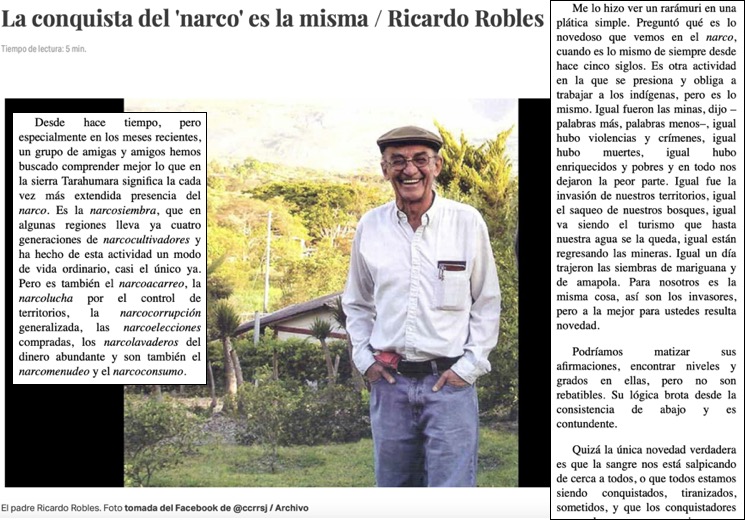
A few weeks later, Jesuit Fr. Ricardo Robles wrote

For a while now, but especially in recent months, a group of friends and I have been trying to better understand the significance of the evermore extended presence of the narco in the Sierra Tarahumara. It’s the narco-planting, that in some areas has seen four generations of narco-cultivators and has made this way of life become ordinary, indeed almost the only lifestyle now. But it is also the narco-transportation, the narco-struggle for control of territories, the generalized narco-corruption, including paid-for narco-elections, the abundant narco-money-launderers and the small narco-traffickers and narco-consumers

What is new in what we are seeing with the narco? A Rarámuri friend said it is the same thing they have seen for five centuries. “It’s another activity in which Indigenous people are pressured and obliged to work. It was the same with the mines,” he said. “There was the same violence and crime, the same deaths, the same enrichment and impoverishment and in everything we were left with the worst part. The same with the invasion of our territories, the same with the theft of our forests, the same with tourism that even takes our water, the same with the return of the mines. The same when one day they brought the planting of marijuana and poppies. For us it’s the same thing. This is how invasions are, but perhaps for you this seems new.”  

Perhaps all that is truly new is that now the blood is spattered on all of us, that we are all being conquered, tyrannized and forced to submit.

The Spanish conquistadores, hungry for gold and other precious minerals, arrived in the Rarámuri territory in 1589. The Jesuit religious order followed in 1608. They were expelled from the Spanish colony and 19th-century Mexico, but returned after 133 years in 1900 with the intention of educating the Indigenous people. La Jornada journalist Luis Hernández Navarro writes that after facing about 40 years of resistance, the Mexican Jesuits finally began to learn from the Rarámuri. By the 1960s, they had set aside their western notions and moved closer to the Rarámuri cosmovision. The Rarámuri converted the Jesuits “from being carriers of a doctrine into disciples, from being do-gooders into friends of the men and women of the Sierra Tarahumara, and companions in their secular resistance and defence of their freedom and autonomy.” Hernández adds that the two Jesuits killed in June had “accompanied the Rarámuri people who were subjects of their own history and not objects for colonization.”

In 2017, one of Hernández’s own La Jornada colleagues, Miroslava Breach, was murdered after documenting the expansion of organized crimes and its links with political institutions in Chihuahua. The image on the right is from the Committee to Protect Journalists. By the end of June, at least 10 journalists had been killed in Mexico this year.

At the funeral June 25 of the slain priests, Fr. Javier Ávila Aguirre, the Jesuit who serves at Creel, called on President López Obrador during his homily to look again at his approach to public security. “Our tone is peaceful but loud and clear. We call for actions from government that end impunity. Thousands of people in pain and without voice clamour for justice in our nation. Hugs are no longer enough to cover the bullets.”

In his daily news conference on June 30, the president responded: “Those expressions of ‘hugs are not enough.’ What would the priests have us do? That we resolve problems with violence? That we disappear everyone? That we bet on war?”

The point, however, made by human rights groups and some religious leaders, is that after nearly four years AMLO’s approach to the drug war has not produced a noticable reduction in violent attacks on civilians – or priests or journalists. While the president says he is working on the “causes of violence” – poverty, marginalization, exclusion – what people want is protection now. 

The issues raised by the Jesuits and human rights groups should not be seen as normal political attacks on an incumbent politician, but rather contributions in a search for real solutions. 

Bernardo Barranco, the sociologist-columnist cited above, told a La Jornada colleague in an interview that churches are present in places where the state is absent, and that they could have a mediating role. He pointed to the state of Guerrero where, for example, Bishop Salvador Rangel of Chilpancingo-Chilapa negotiated in 2018 with organized crime so as to end the assassination of local candidates and to permit the population to vote. 

Such conversations may not lead to solutions in every instance, but it’s clear that new ideas and less defensive dialogue are needed if Mexico is to find a way forward.

And North American narco-consumers need to say NO to illegal drugs, at least for the sake of solidarity with victims of narco-violence.